STUDY #05 · 2026 · IN OBSERVATION
Lorenz Attractor
A model-driven visual study of deterministic chaos.
WHAT IS THIS
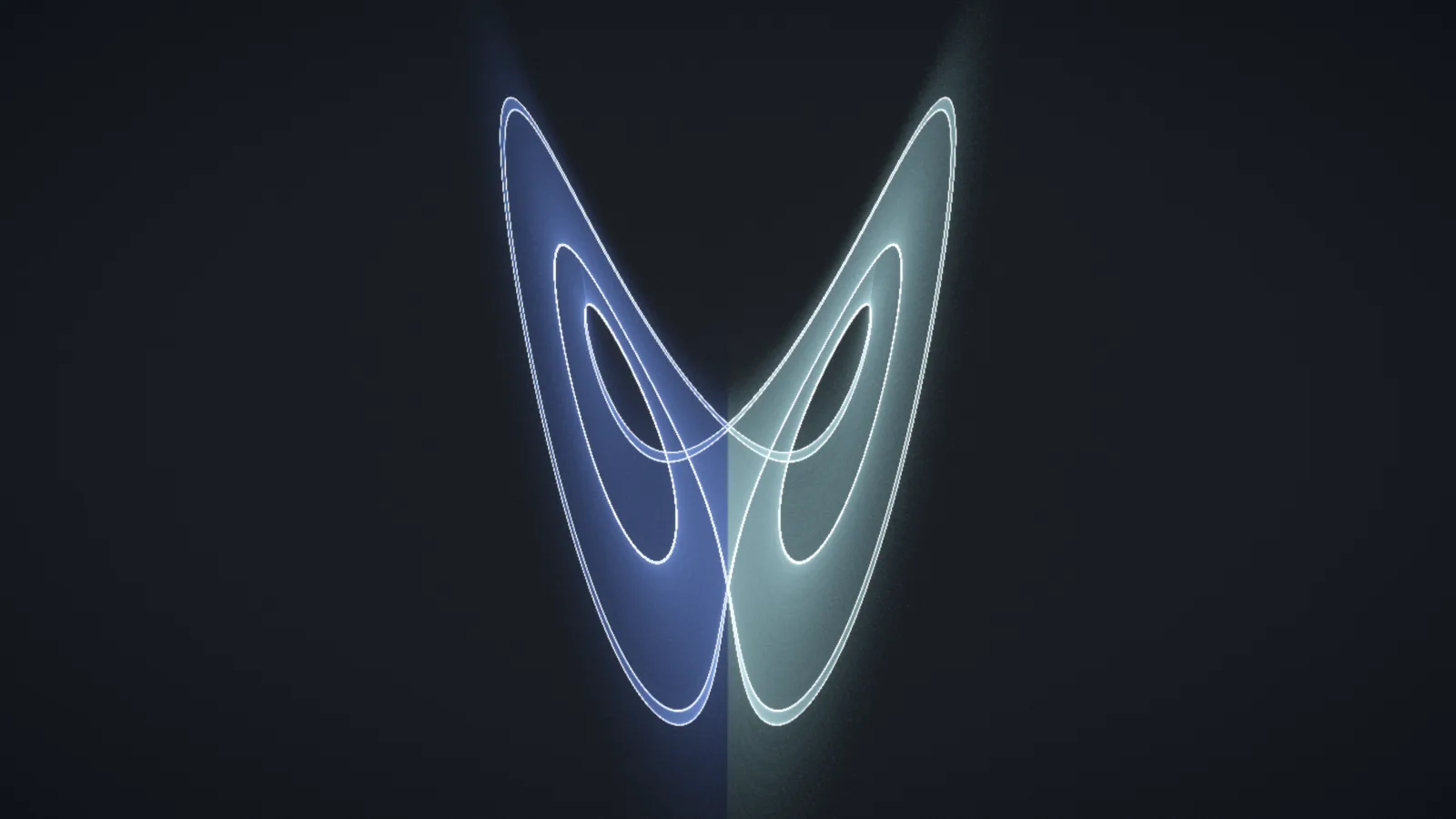
In 1963 the meteorologist Edward Lorenz reduced convection — a fluid layer heated from below — to three ordinary differential equations, and found that a fully deterministic system can be forever unpredictable: the butterfly effect. Every trajectory is unique, yet all of them weave the same two-winged figure, the Lorenz attractor.
This study renders the attractor as orbit density: tens of thousands of particles ride the equations in real time on the GPU, and their trails accumulate like a long photographic exposure. Brightness is literally the time the flow spends in each region — the attractor drawing its own portrait.
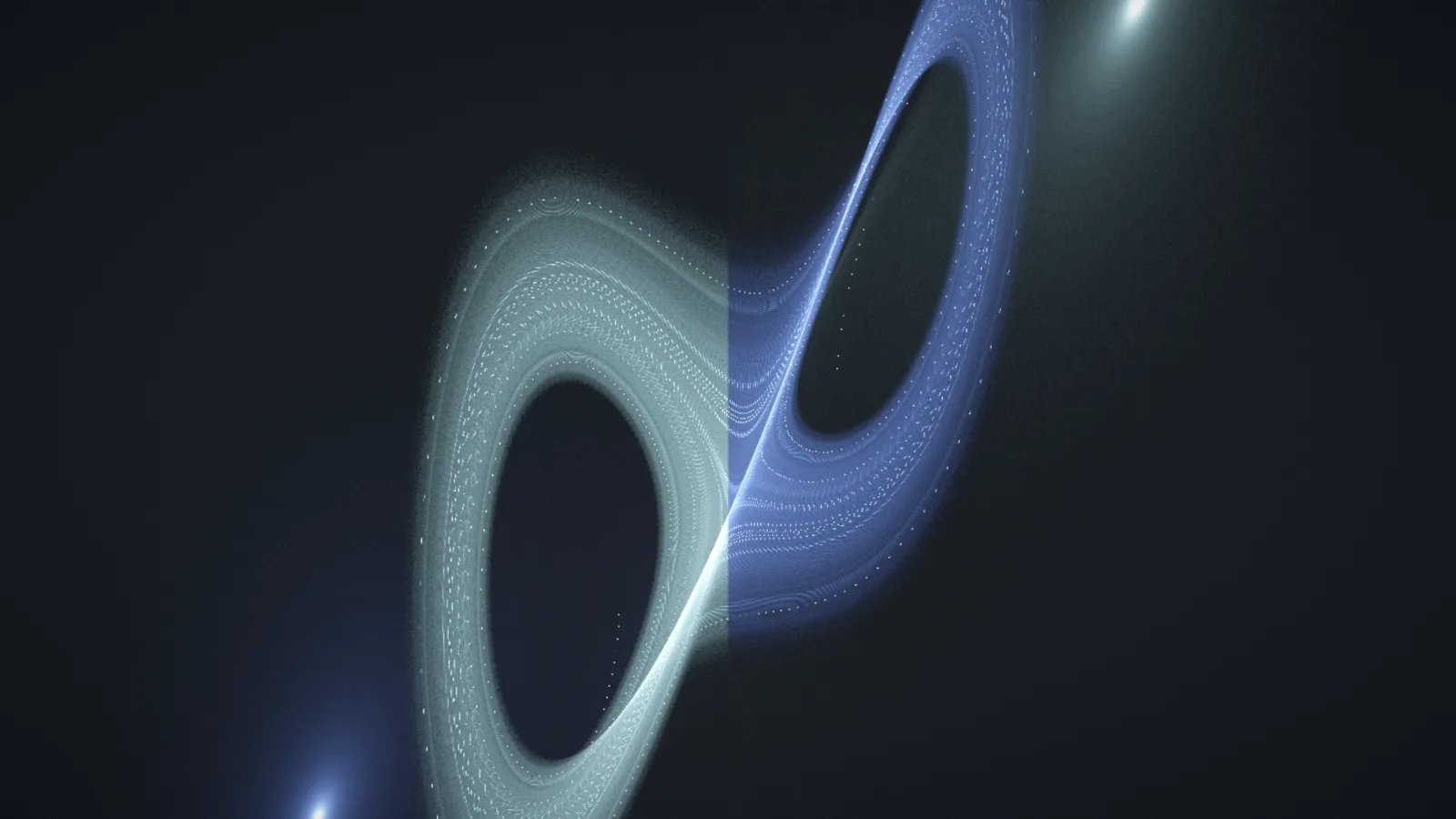
This is not a scientific simulation result, but a visual interpretation of the phenomenon.
A NEW CHAPTER
From fields that fill the frame to a single orbit that weaves it.
PARAMETERS EXPLORED
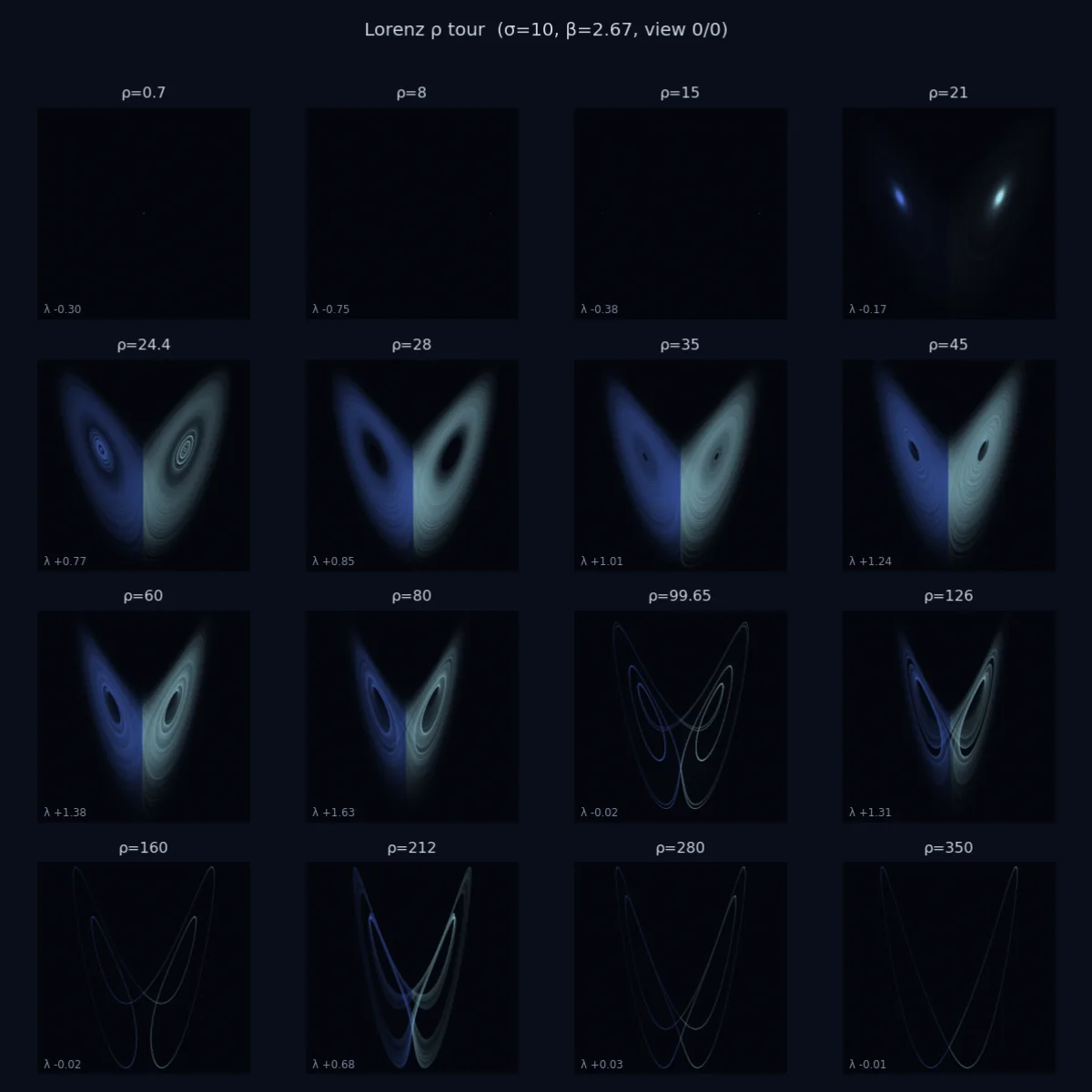
Each image below records its exact parameter set.
THE MATHEMATICS the model behind the images
Three coupled ordinary differential equations — Rayleigh–Bénard convection boiled down to a single roll. Fully deterministic, yet never repeating.
Inspired by the Lorenz system (σ = 10, β = 8/3). The two glowing eyes are its steady states C± = (±√(β(ρ−1)), ±√(β(ρ−1)), ρ−1). Not an exact fluid reproduction.
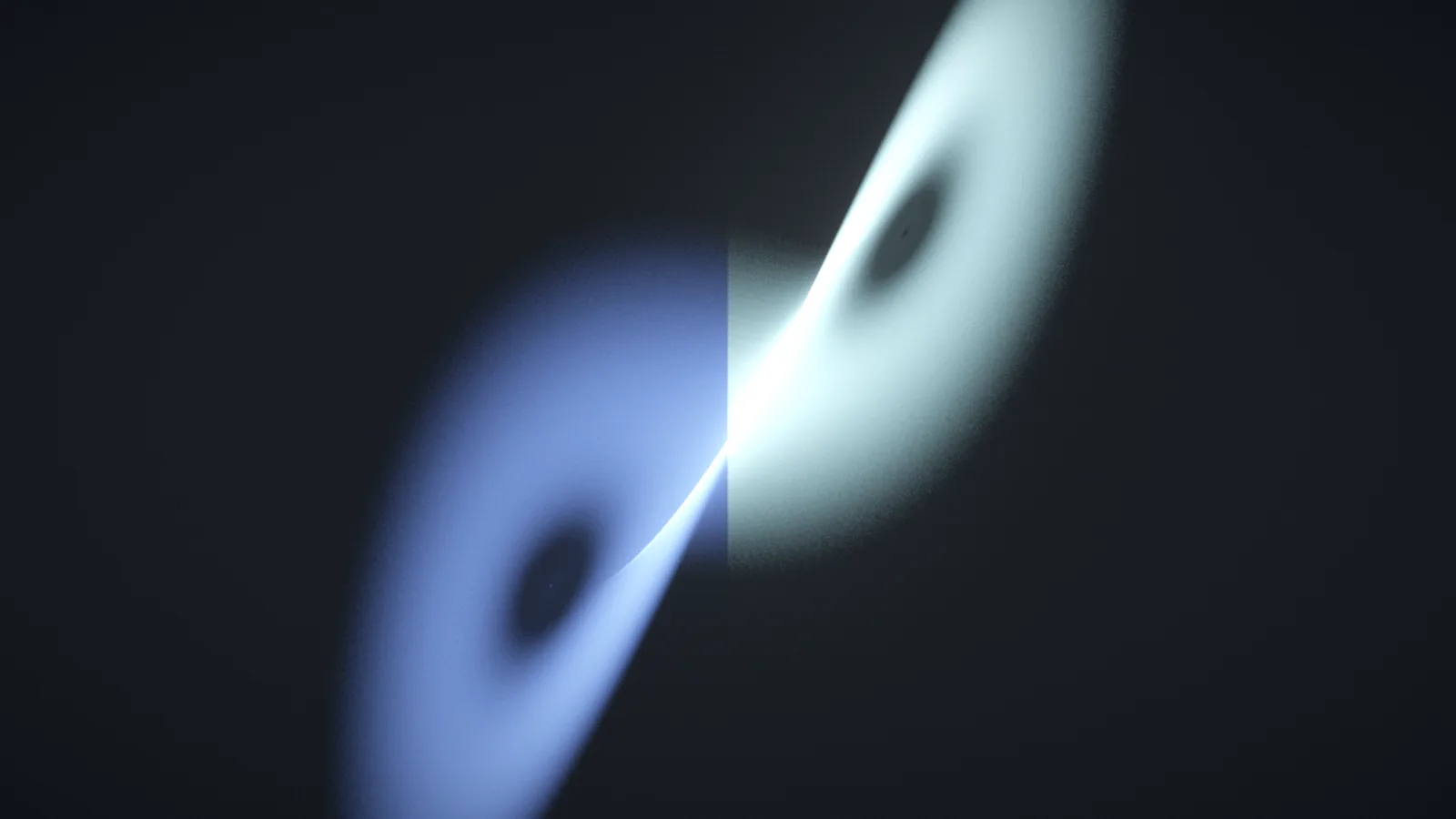
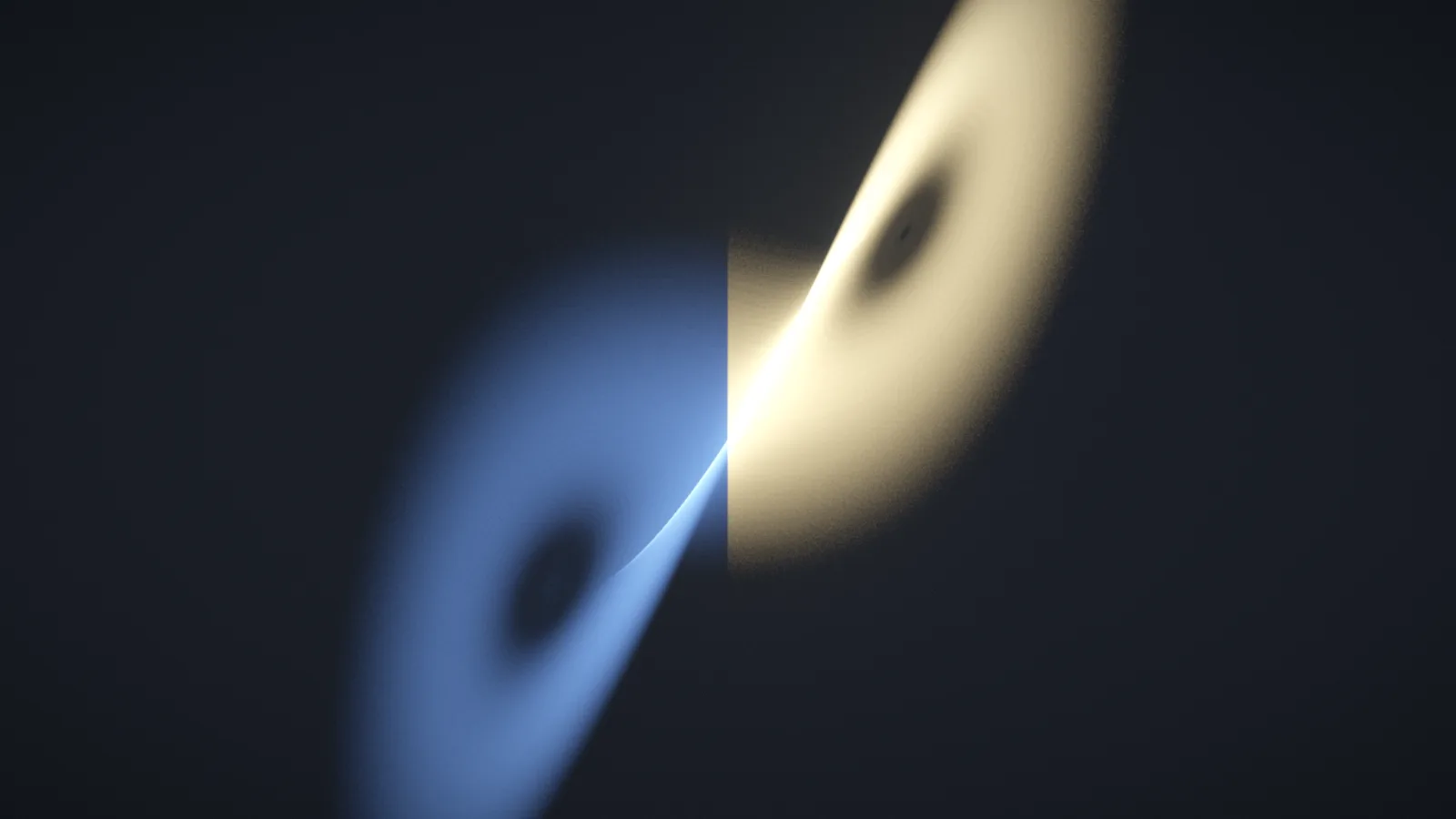
SELECTED STILLS — 5
PROCESS — PARAMETER SWEEPS
The whole regime map in one frame: as the drive ρ rises, a single point becomes two, then the butterfly opens, then narrows into high-ρ periodic windows.
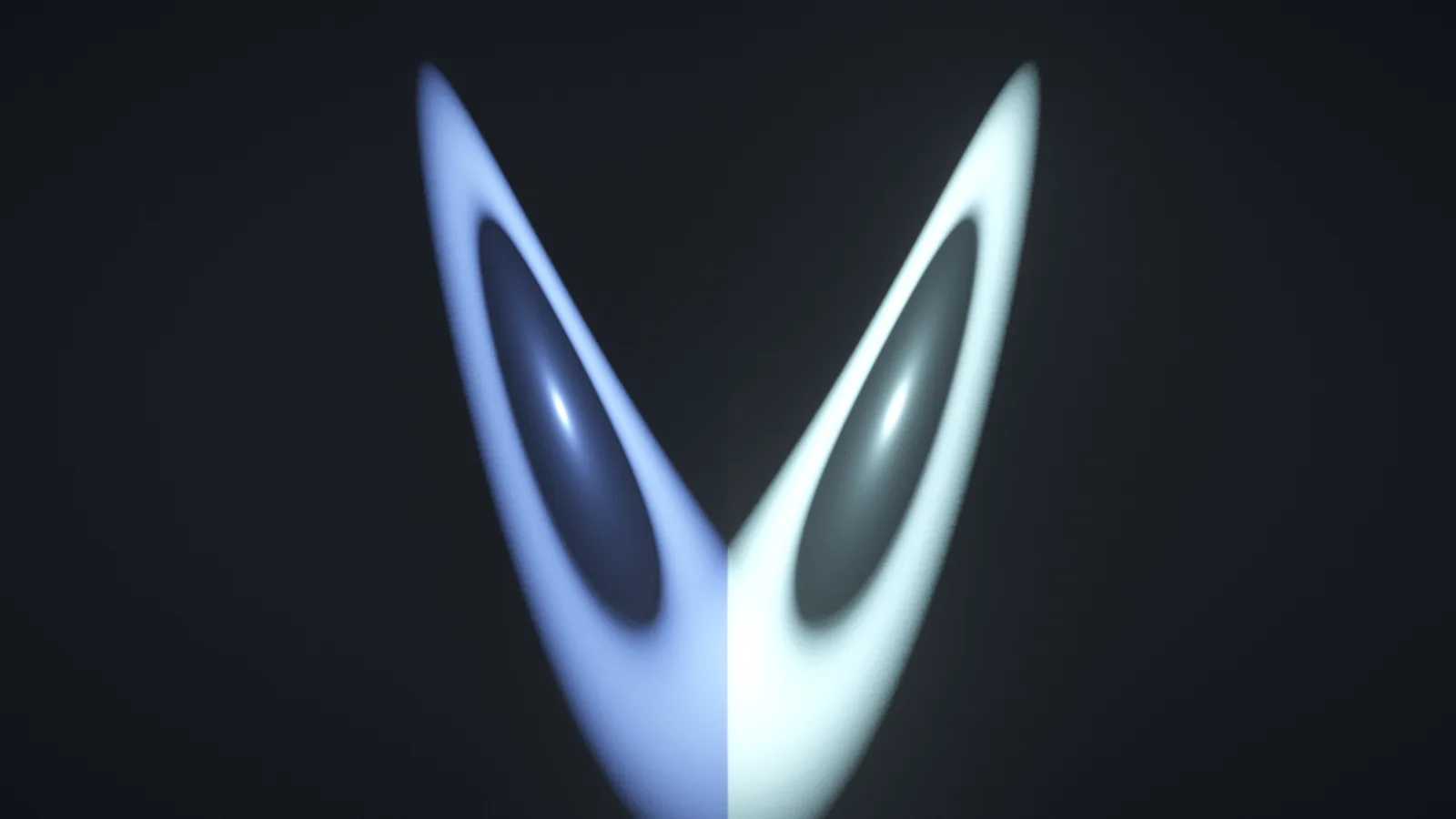
SIGNATURE — THE PUPIL BREATHES
One always-bright line, and two eyes that open and close.
As ρ rises and falls the dark centres dilate and close while the whole figure turns; the burning fold where both wings meet is the one line that never dims.
In the hero above this is the loop's slow breath; in the Interactive Study below it is the Drive knob — turn it and watch the pupils open.
COLOUR = ROLL DIRECTION
The two tints follow the sign of x in the model — physically, the two directions the convection roll can rotate. Each jump between wings is the roll reversing, so the colour boundary you see is a real dynamical divide, not a decorative one.
Brightness follows residence time, the attractor's own natural measure: the glowing "eyes" are where orbits spiral slowly around the unstable steady states, and the bright seam down the middle is where both wings fold together.
The colouring is an interpretive mapping based on the physical meaning of the model's variables — an artistic approximation, not a measurement.
Palette wing — hue = sign of x (roll direction) · luminance = residence time · the eyes and the folding seam glow brightest.
REFERENCES
- Edward N. Lorenz. "Deterministic Nonperiodic Flow." Journal of the Atmospheric Sciences, vol.20, 130-141 (1963).
INTERACTIVE STUDY
A small live model runs the same idea in your browser — the Lorenz system, integrated in real time, its orbits accumulating into density just like the works above. It is a deliberately simplified instrument, reduced in resolution and particle count, separate from the full GPU engine used to author the finished works. Turn the drive up and watch steady convection tip into chaos; lift the view from the butterfly to the twin galaxies.
This interactive study is not intended as a scientifically validated reproduction. It is a visual interpretation generated from an implemented model and curated parameter exploration — and it is a deliberately simplified instrument, separate from the full engine used to author the finished works.