STUDY #09 · 2026 · IN OBSERVATION
Diffusion-Limited Aggregation
A model-driven visual study of dendritic growth by diffusion.
WHAT IS THIS
Diffusion-limited aggregation (DLA) is how a branched, fractal cluster grows by chance. Particles arrive one at a time from far away, wander at random like pollen in water, and freeze in place the instant they touch the cluster. Growth is limited by diffusion: a wandering particle is far likelier to reach an exposed tip than to thread its way into a narrow gap, so tips screen the interior and the pattern amplifies its own branching into a self-similar dendrite (fractal dimension ≈ 1.71 in the plane).
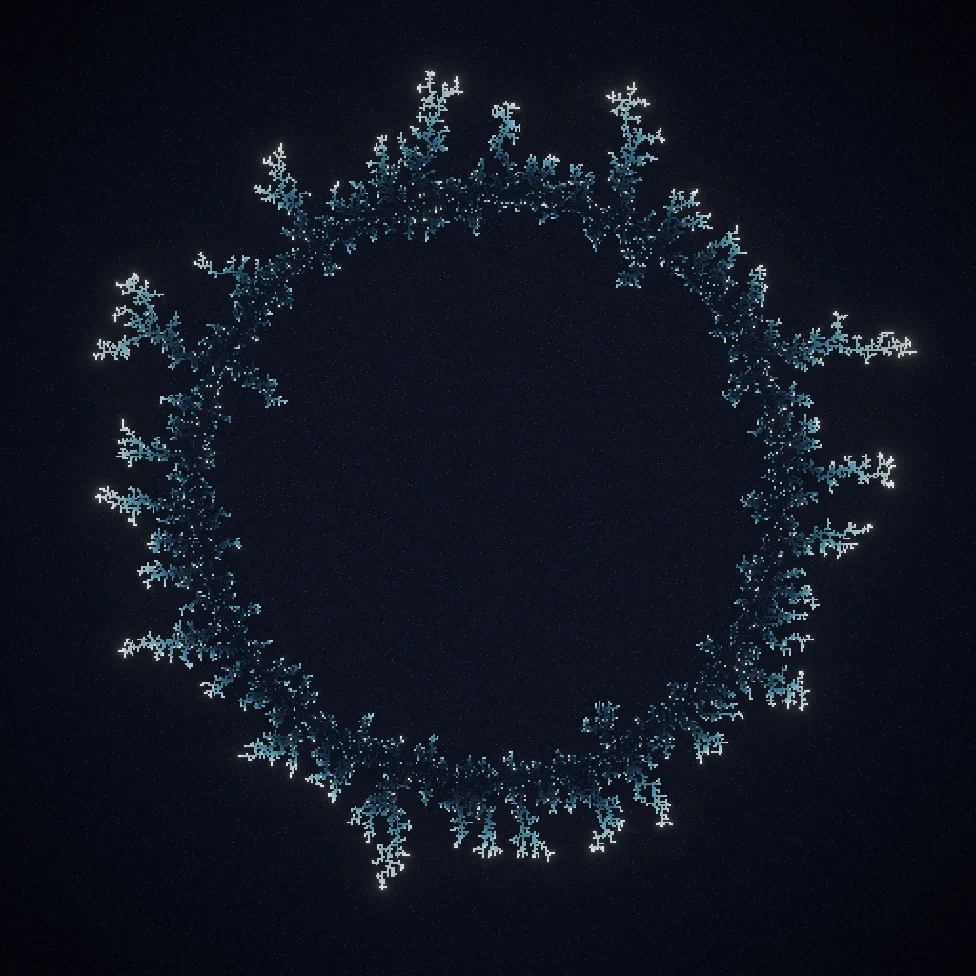
This study grows the model in real time on the GPU using its field cousin — the dielectric-breakdown / η-model — solving for a potential around the cluster and extending the tips with a probability set by the local field. A single exponent η tunes the whole morphology, from a compact mass to an open fern to sparse, lightning-like arms.
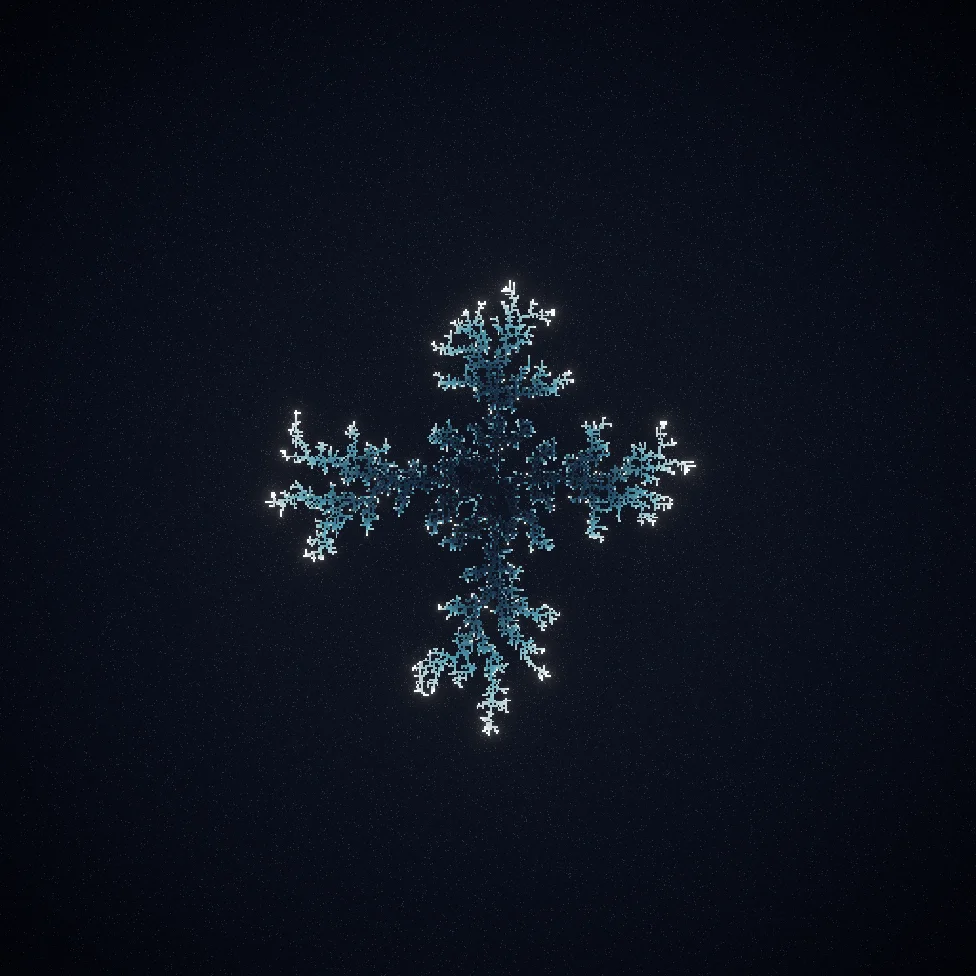
This is not a scientific simulation result, but a visual interpretation of the phenomenon.
A NEW CHAPTER
The one study you watch build, not settle.
PARAMETERS EXPLORED
Each image below records its exact parameter set.
THE MATHEMATICS the model behind the images
On a lattice, random walkers stick where they first touch the cluster. The engine runs its continuous-field cousin — the dielectric-breakdown model — solving for a potential and growing the tips by the local field.
Inspired by diffusion-limited aggregation and the dielectric-breakdown / η-model — a visual interpretation, not an exact reproduction. Fractal dimension D ≈ 1.71 in the plane.
SELECTED STILLS — 6
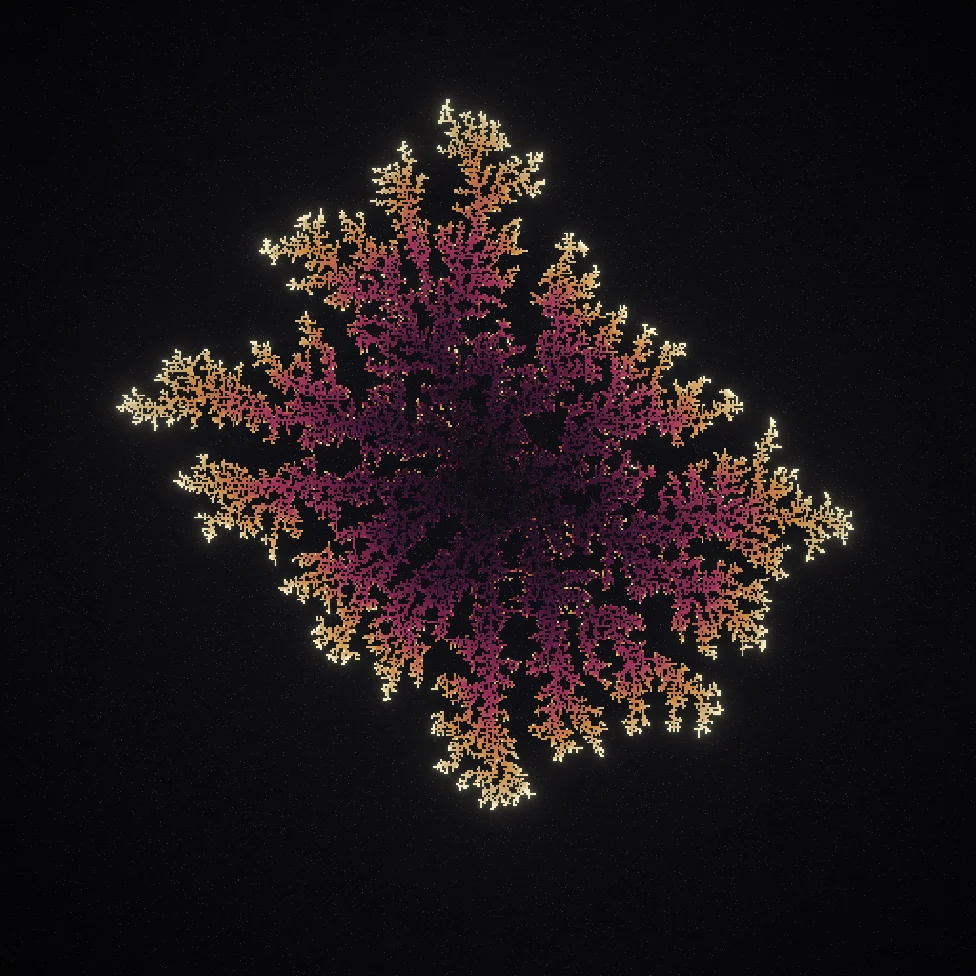
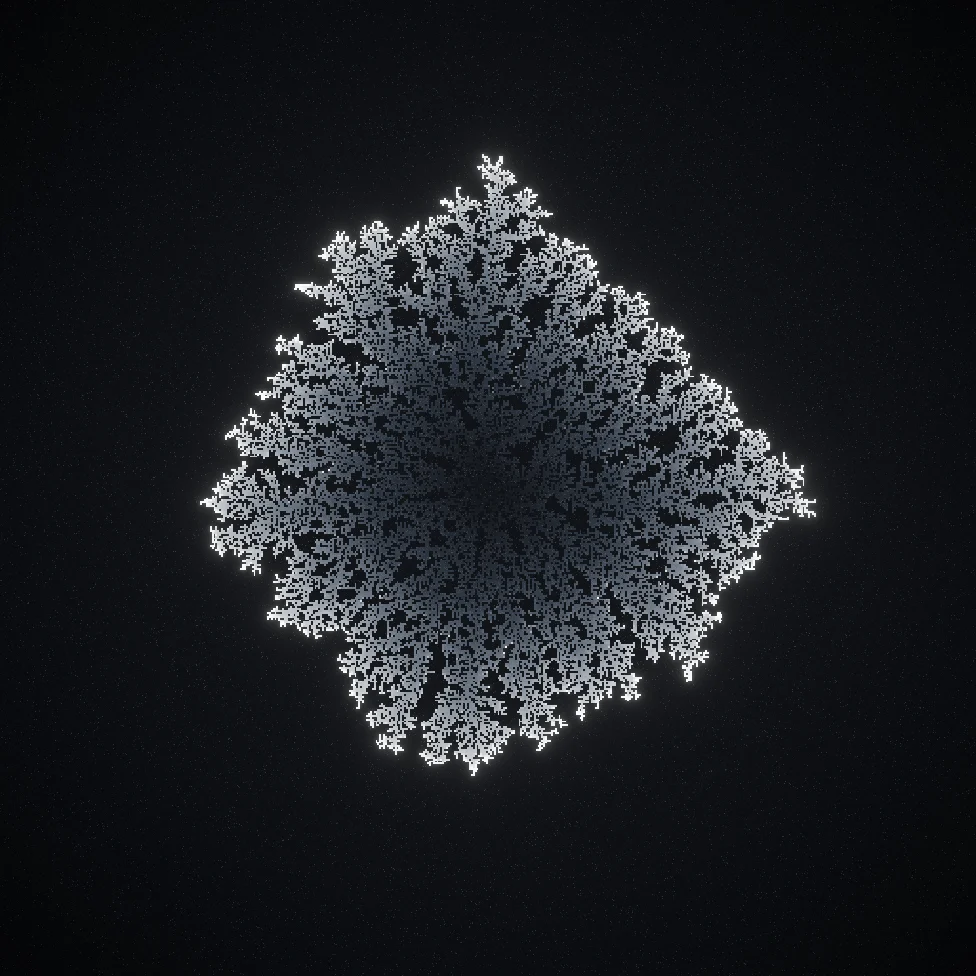
COLOUR = ARRIVAL TIME
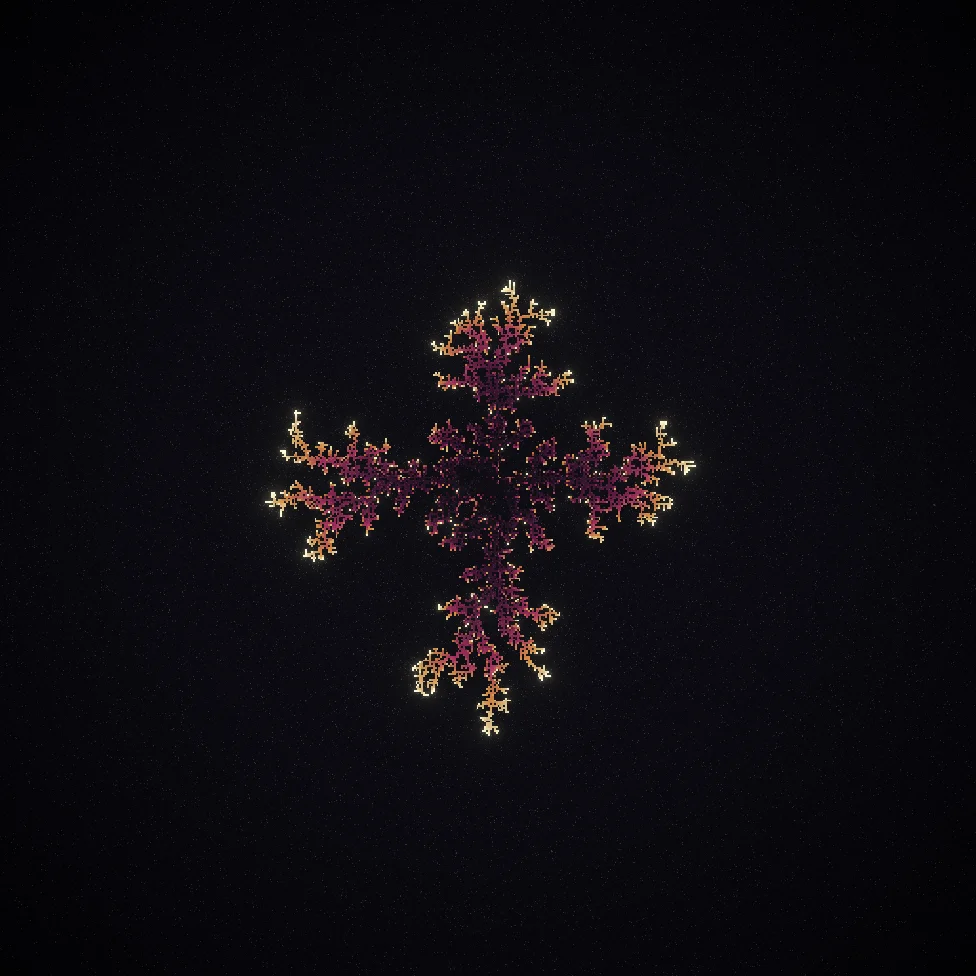
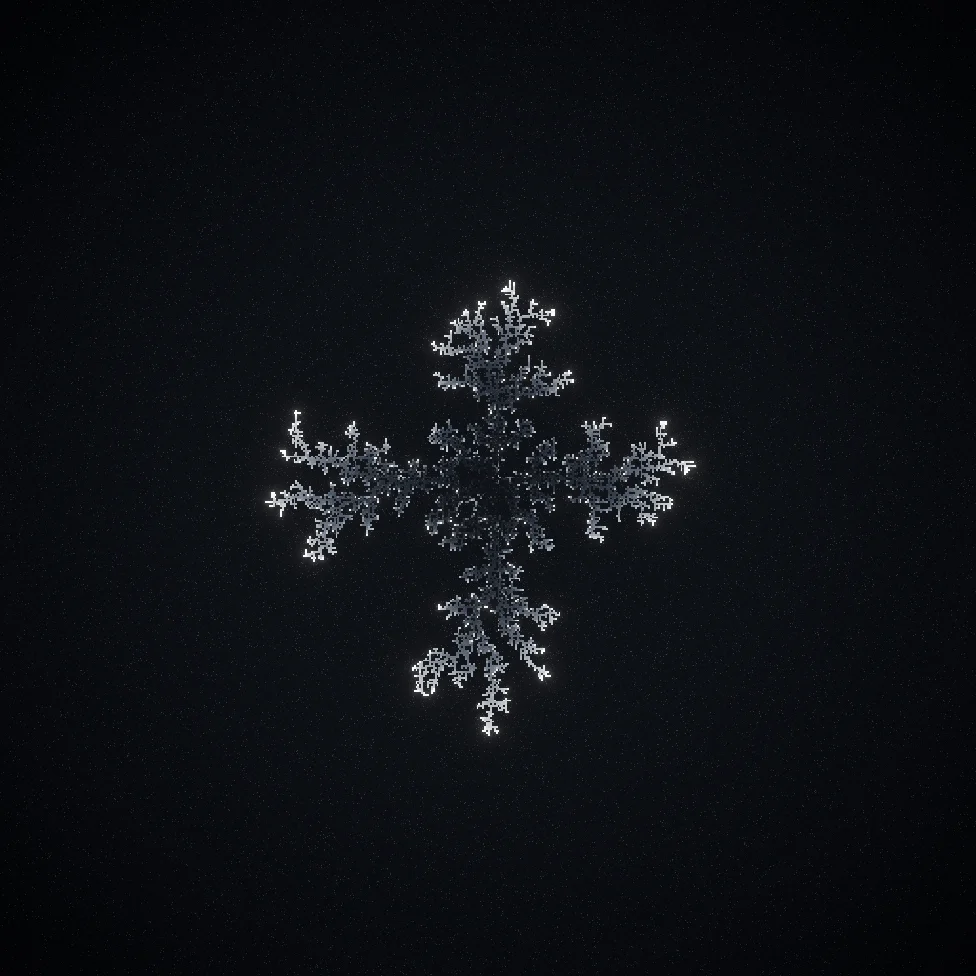
DLA is the shape shared by many real diffusion-limited growths, and each palette is grounded in one of them: frost — water vapour freezing on cold glass; ember — electrodeposition and the Lichtenberg tracks of an electric discharge; silver — the manganese-oxide "tree" dendrites in agate and native-metal crystals.
The colour within each is not arbitrary: it maps the arrival time, the order in which each point was added, so the dim core is the oldest material and the bright edge is where the crystal is still reaching — the growth's chronology made visible, like topological tree rings.
The colours are an artistic mapping of the model's own growth order, not measured quantities.
Palettes frost / ember / silver — hue = arrival time (growth order) · the glowing edge is the still-reaching front.
REFERENCES
- T. A. Witten, Jr., L. M. Sander. "Diffusion-Limited Aggregation, a Kinetic Critical Phenomenon." Physical Review Letters, vol.47, 1400-1403 (1981).
- L. Niemeyer, L. Pietronero, H. J. Wiesmann. "Fractal Dimension of Dielectric Breakdown." Physical Review Letters, vol.52, 1033-1036 (1984).
INTERACTIVE STUDY
Nothing here is ever undone — the cluster only grows, one wandering particle at a time, and every point keeps the moment it arrived: a dim old core out to a bright, still-reaching front. Sticking and drift are live — turn them mid-growth and the crystal's new rim changes habit around a core that remembers. It is a deliberately simplified instrument, capped in resolution with a few curated knobs and no export, separate from the full engine used to author the finished works.
This interactive study is not intended as a scientifically validated reproduction. It is a visual interpretation generated from an implemented model and curated parameter exploration — and it is a deliberately simplified instrument, separate from the full engine used to author the finished works.