STUDY #10 · 2026 · IN OBSERVATION
Ising Model
A model-driven visual study of a magnet's order-disorder phase transition.
WHAT IS THIS
A ferromagnet is made of countless atomic spins, each preferring to point the same way as its neighbours. Heat fights that alignment. At low temperature order wins and the material magnetises into large domains; at high temperature noise wins and the spins point every which way. The two are separated by a sharp critical temperature, Tc, where domains of every size coexist at once — scale-invariance, the lattice analogue of critical opalescence.
The Ising model is the minimal lattice version of this: spins s = ±1 that lower their energy by aligning, updated stochastically at a temperature by Metropolis Monte Carlo. This study runs the 2D model in real time on the GPU as a two-pass checkerboard update, and sweeps the single control — temperature — across the transition. Unlike the smooth reaction-diffusion studies before it, this one is stochastic: it flickers as it settles.
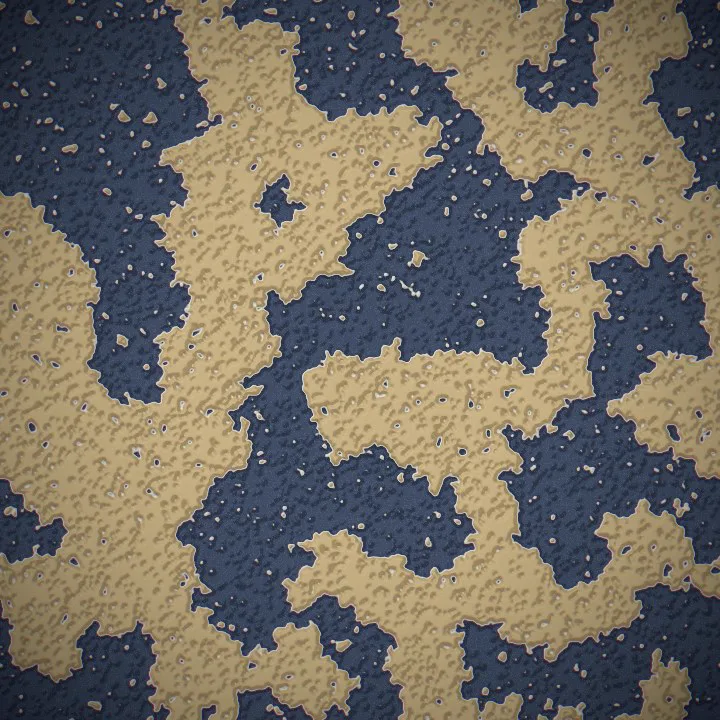
This is not a scientific simulation result, but a visual interpretation of the phenomenon.
DETERMINISTIC VS STOCHASTIC
Gray-Scott grows, Cahn-Hilliard sorts, Ising decides.
PARAMETERS EXPLORED
Each image below records its exact parameter set.
THE MATHEMATICS the model behind the images
A lattice of spins s = ±1. Alignment lowers the energy; temperature decides whether that preference wins.
Inspired by the Ising model — a visual interpretation, not an exact reproduction.
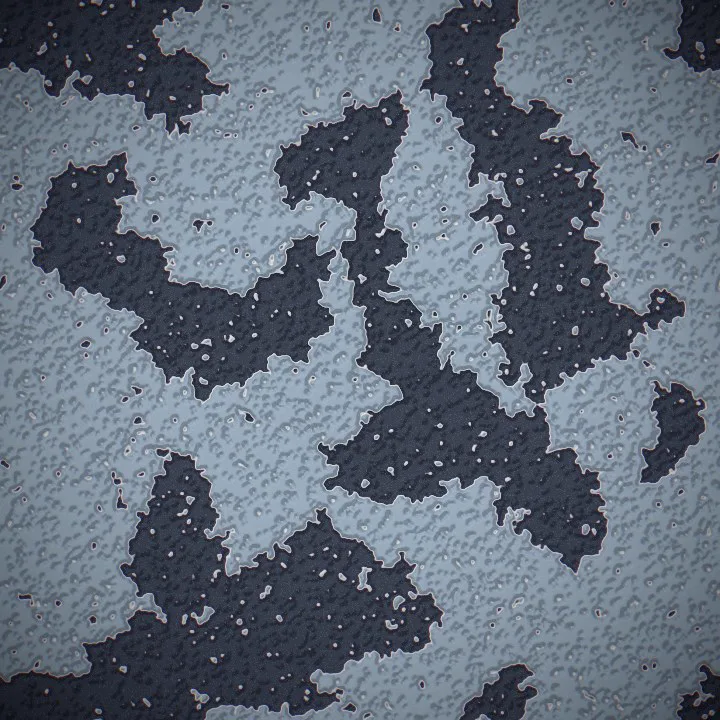
SELECTED STILLS — 3
PROCESS — PARAMETER SWEEPS
Same seed, same duration — only the temperature changes. Order → criticality → disorder in a single row.

VERIFIED AGAINST 1944
Checked against an exact solution — to three decimals.
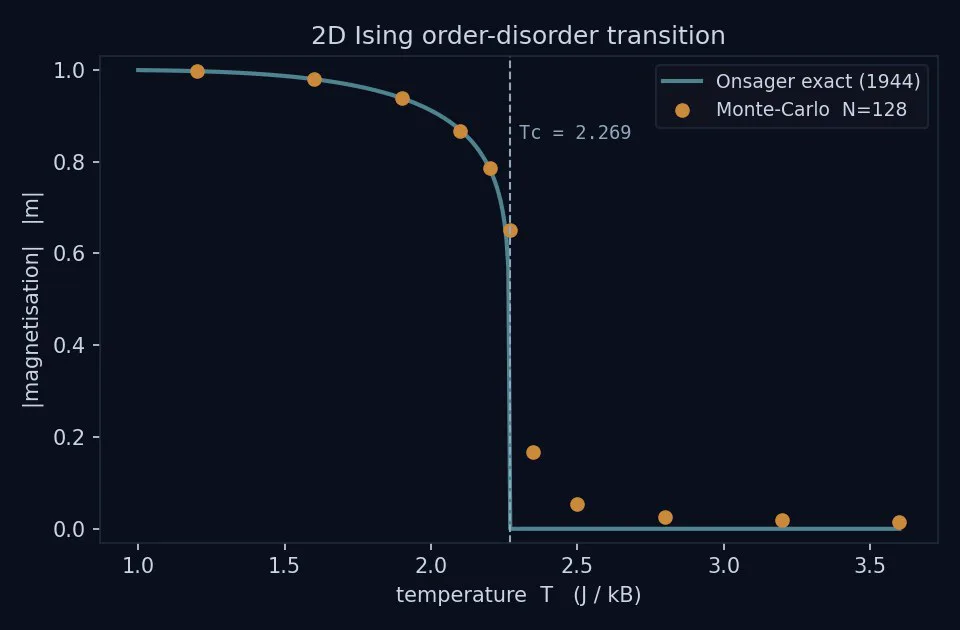
The 2D Ising model is one of the very few interacting systems ever solved exactly: Onsager's 1944 closed-form curve for the spontaneous magnetisation. Before any image was kept, this engine's order parameter |m|(T) was traced against that curve — maximum error 0.000 for T < Tc − 0.3; the rounding just above Tc is the expected finite-size effect.
That check is the series' method in miniature: the model has to be right before the picture is allowed to be beautiful.
COLOUR = MAGNETIC DOMAINS
The Ising model was born as a model of ferromagnetism, and real magnetic domains are imaged by the magneto-optical Kerr effect: the two magnetisation directions read as two tones split by a bright domain wall. This study keeps that mapping — the down phase is a cool navy steel, the up phase a warm gold (aligned with the field), and the domain wall, where the smoothed magnetisation crosses zero, glows.
Near Tc the milky, scale-spanning texture echoes critical opalescence. The colours are an artistic mapping of the spin field s and its domain walls, not spectral measurements.
Palette moke — hue = smoothed magnetisation m (navy ⇄ gold) · the bright cream seam = the domain wall where m crosses zero.
REFERENCES
- Ernst Ising. "Beitrag zur Theorie des Ferromagnetismus." Zeitschrift für Physik, vol.31, 253-258 (1925).
- Lars Onsager. "Crystal Statistics. I. A Two-Dimensional Model with an Order-Disorder Transition." Physical Review, vol.65, 117-149 (1944).
- N. Metropolis, A. W. Rosenbluth, M. N. Rosenbluth, A. H. Teller, E. Teller. "Equation of State Calculations by Fast Computing Machines." The Journal of Chemical Physics, vol.21, 1087-1092 (1953).
- R. J. Glauber. "Time-Dependent Statistics of the Ising Model." Journal of Mathematical Physics, vol.4, 294-307 (1963).
INTERACTIVE STUDY
The whole subject of this study fits on one slider. Temperature is live — drag it across the Tc tick and back, and the field melts into static and refreezes in place, no reset needed. It is a deliberately simplified instrument, capped in resolution with a few curated knobs and no export, separate from the full engine used to author the finished works.
This interactive study is not intended as a scientifically validated reproduction. It is a visual interpretation generated from an implemented model and curated parameter exploration — and it is a deliberately simplified instrument, separate from the full engine used to author the finished works.