STUDY #14 · 2026 · IN OBSERVATION
Caustics
A model-driven visual study of light focused by a waving water surface.
WHAT IS THIS
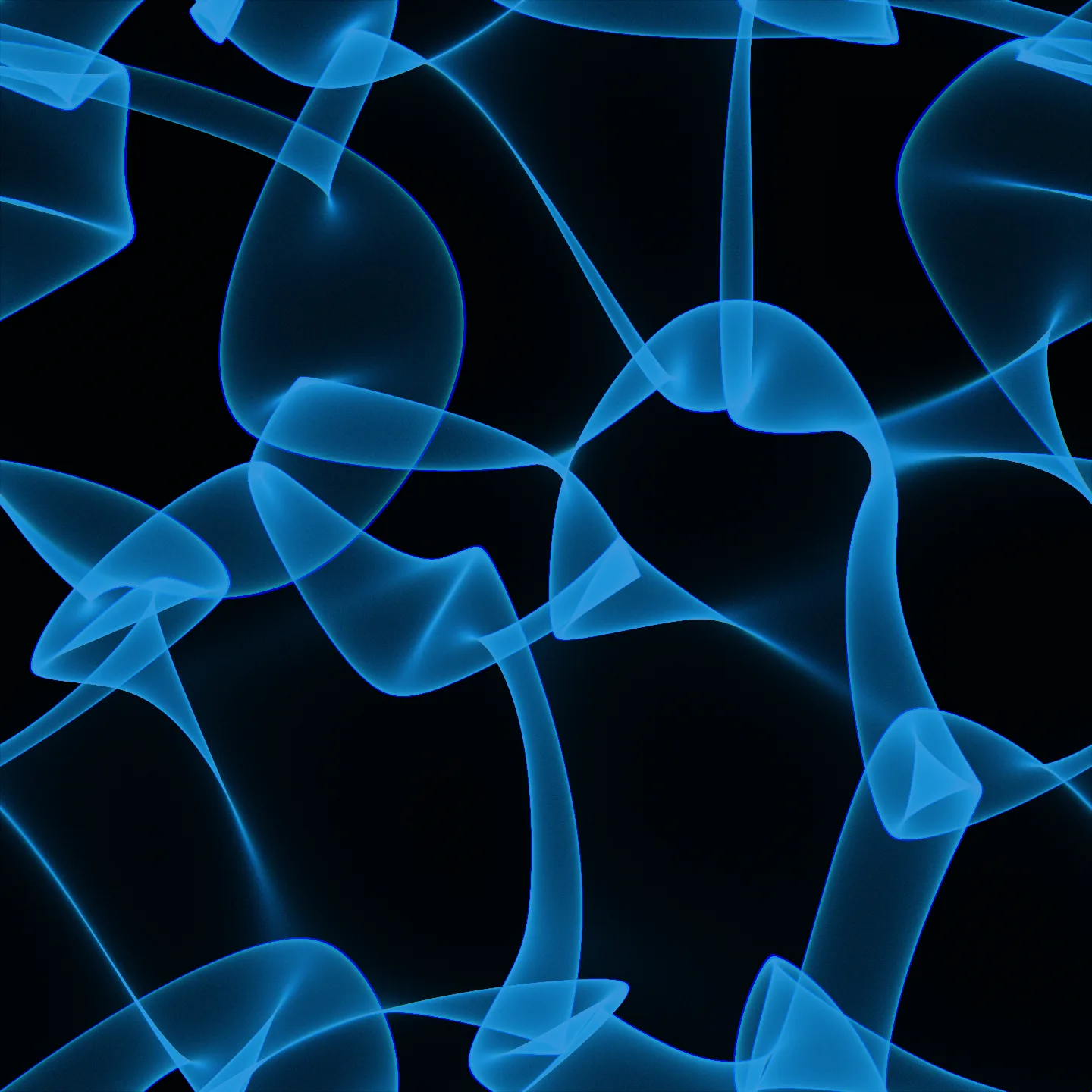
Caustics are the bright dancing lines on the bottom of a pool. A waving water surface acts as a field of lenses: refracted sunlight folds over itself, and where the ray map folds, light piles up into a luminous web. Catastrophe optics classifies the stable singularities of such maps — smooth folds and pointed cusps are the only letters, whatever the sea happens to look like. Where study #06 added waves as phases, here the light is bent as rays — the web is the fold of a map, not an interference pattern.
This study implements the ray map directly: a sum-of-sines water surface (deep-water dispersion ω = √(gk)) refracts millions of photons by vector Snell's law onto the floor plane. It runs in real time on the GPU, and the depth of the floor — measured in focal lengths of the surface — is the single dial that moves the picture through its regimes.
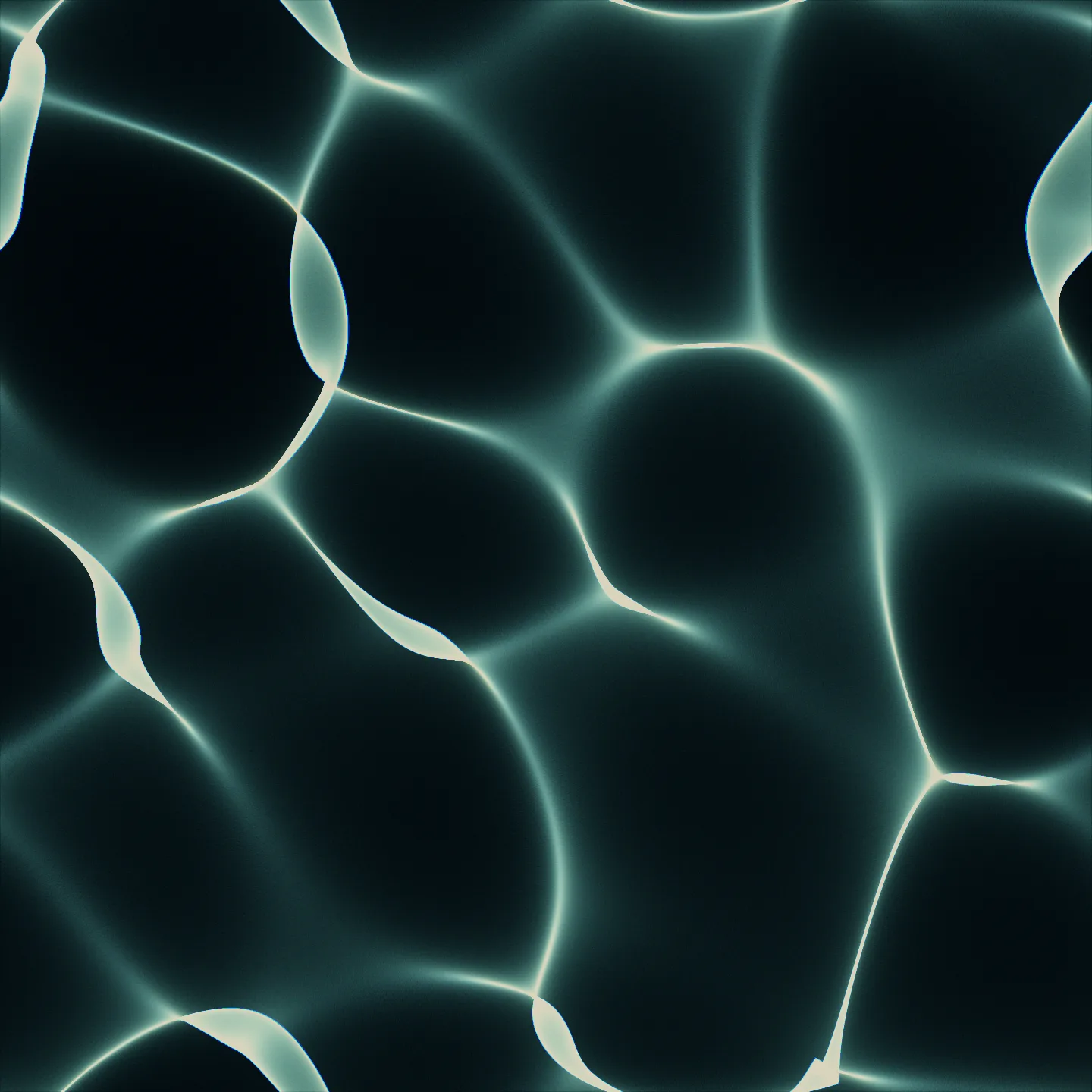
This is not a scientific simulation result, but a visual interpretation of the phenomenon.
PARAMETERS EXPLORED
Each image below records its exact parameter set.
SELECTED STILLS — 5
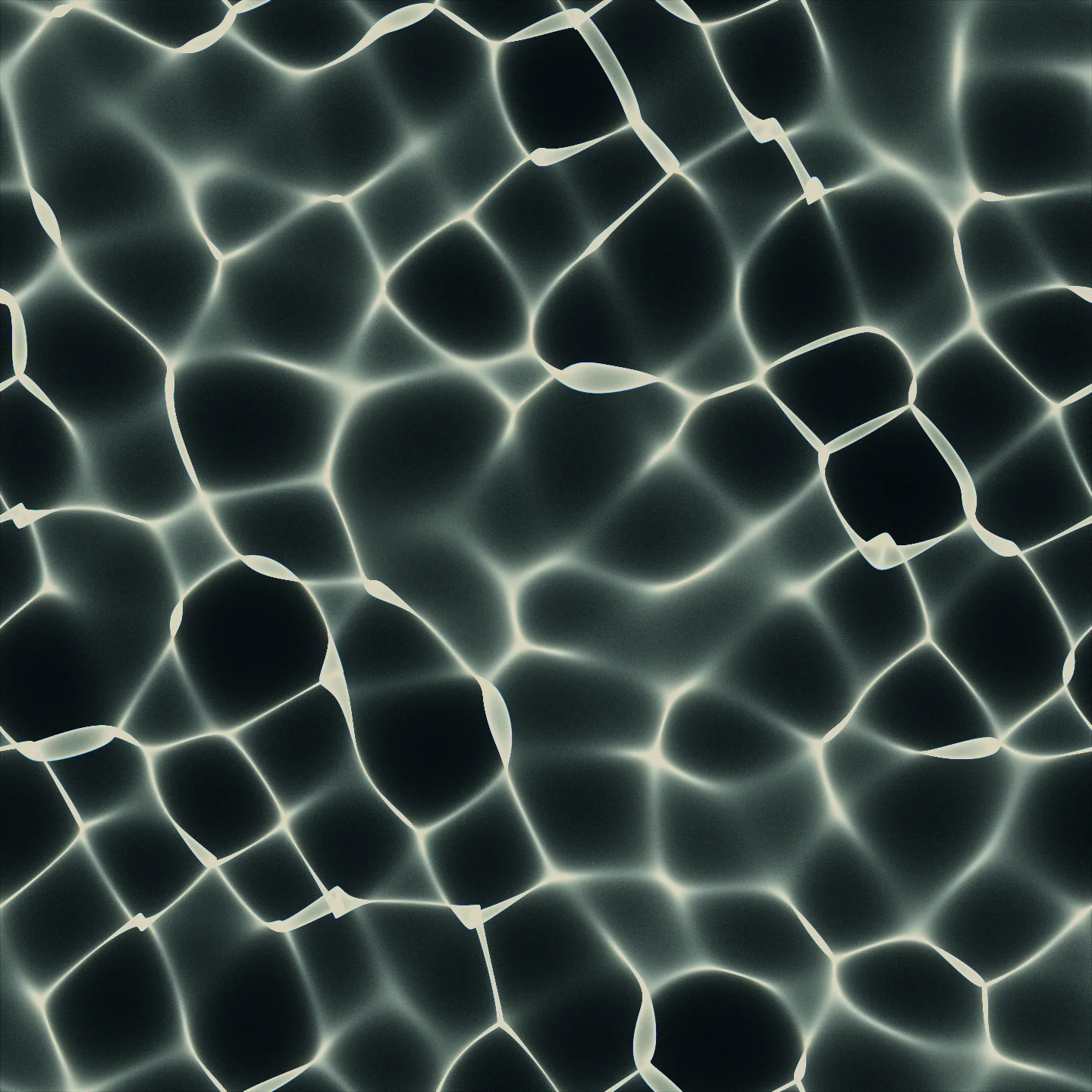
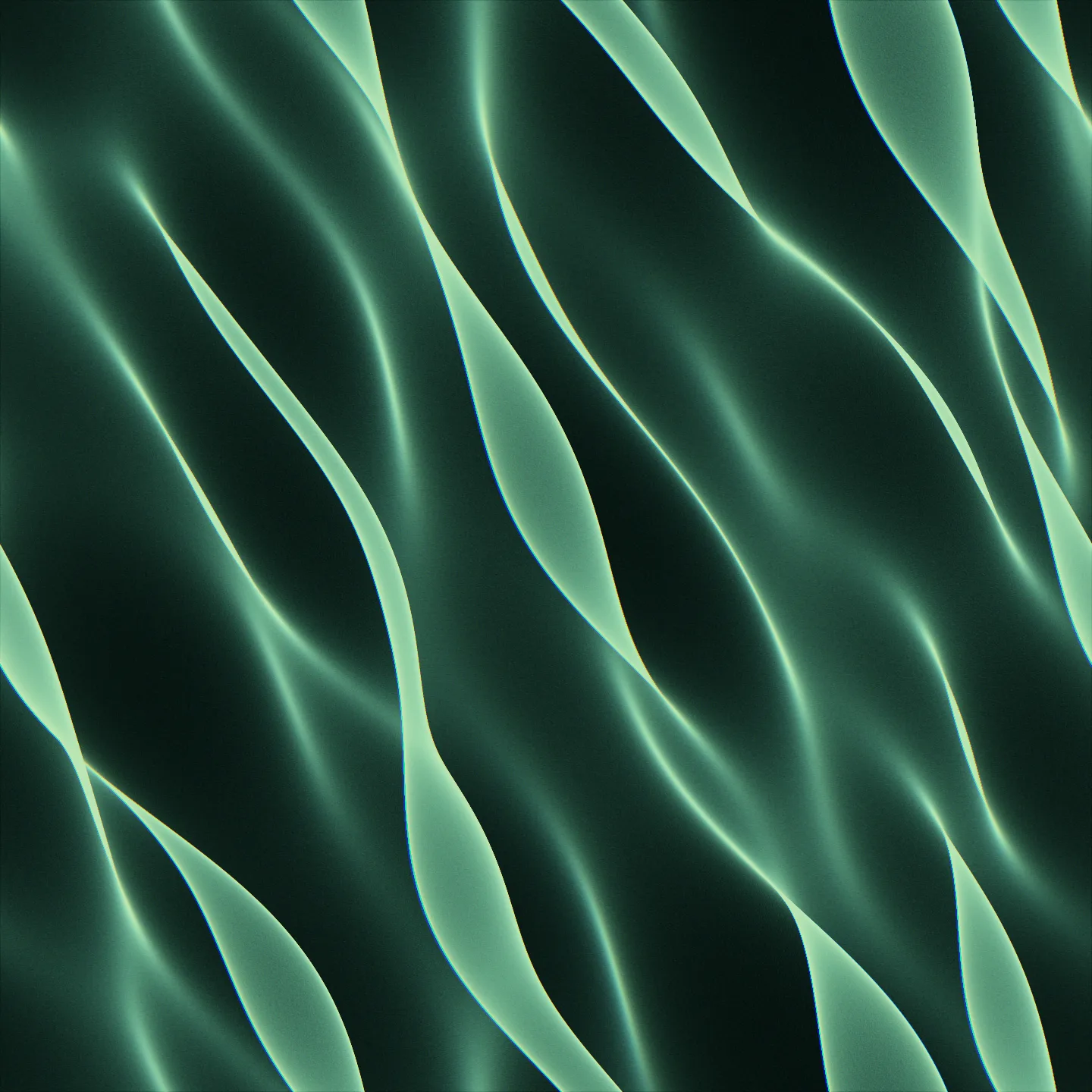
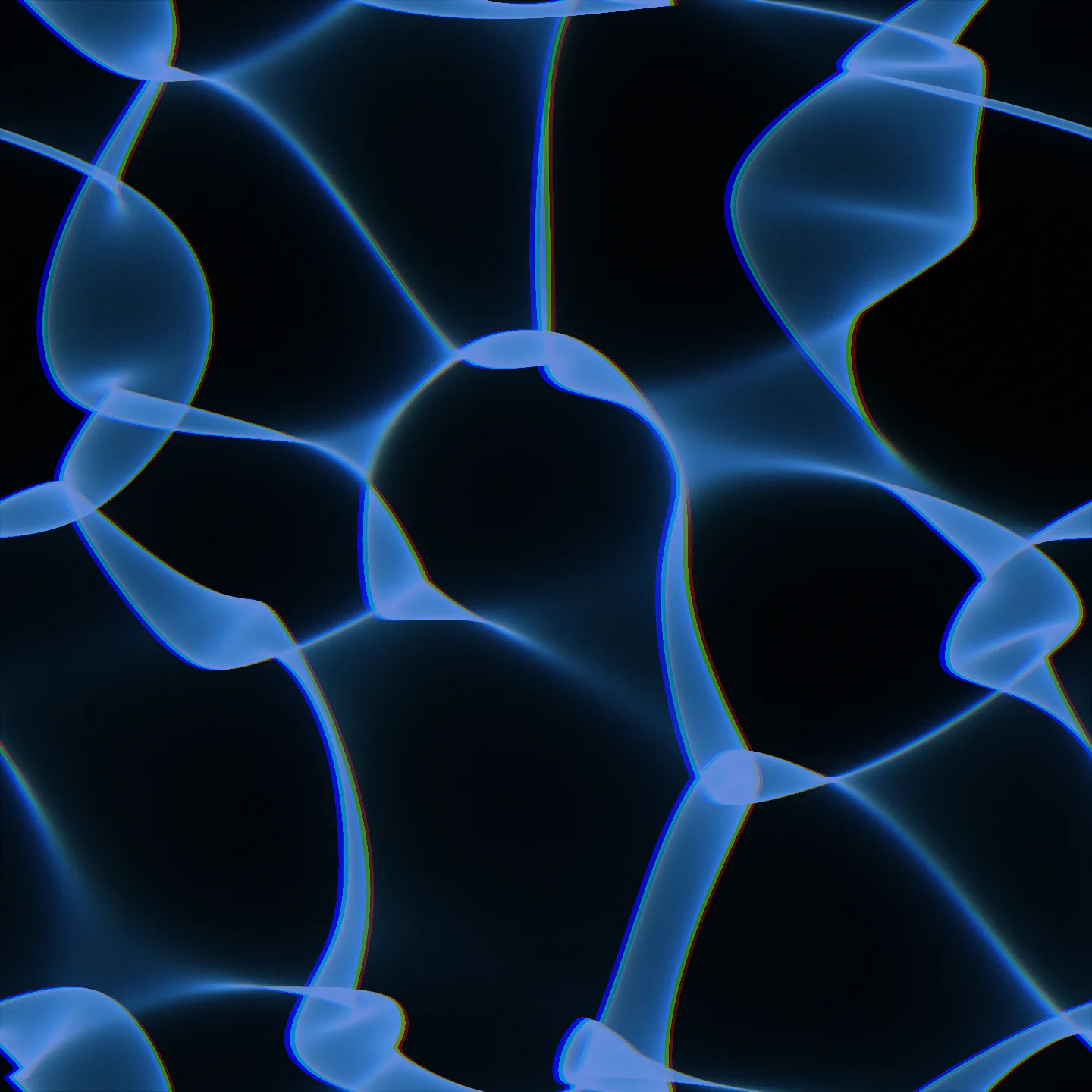
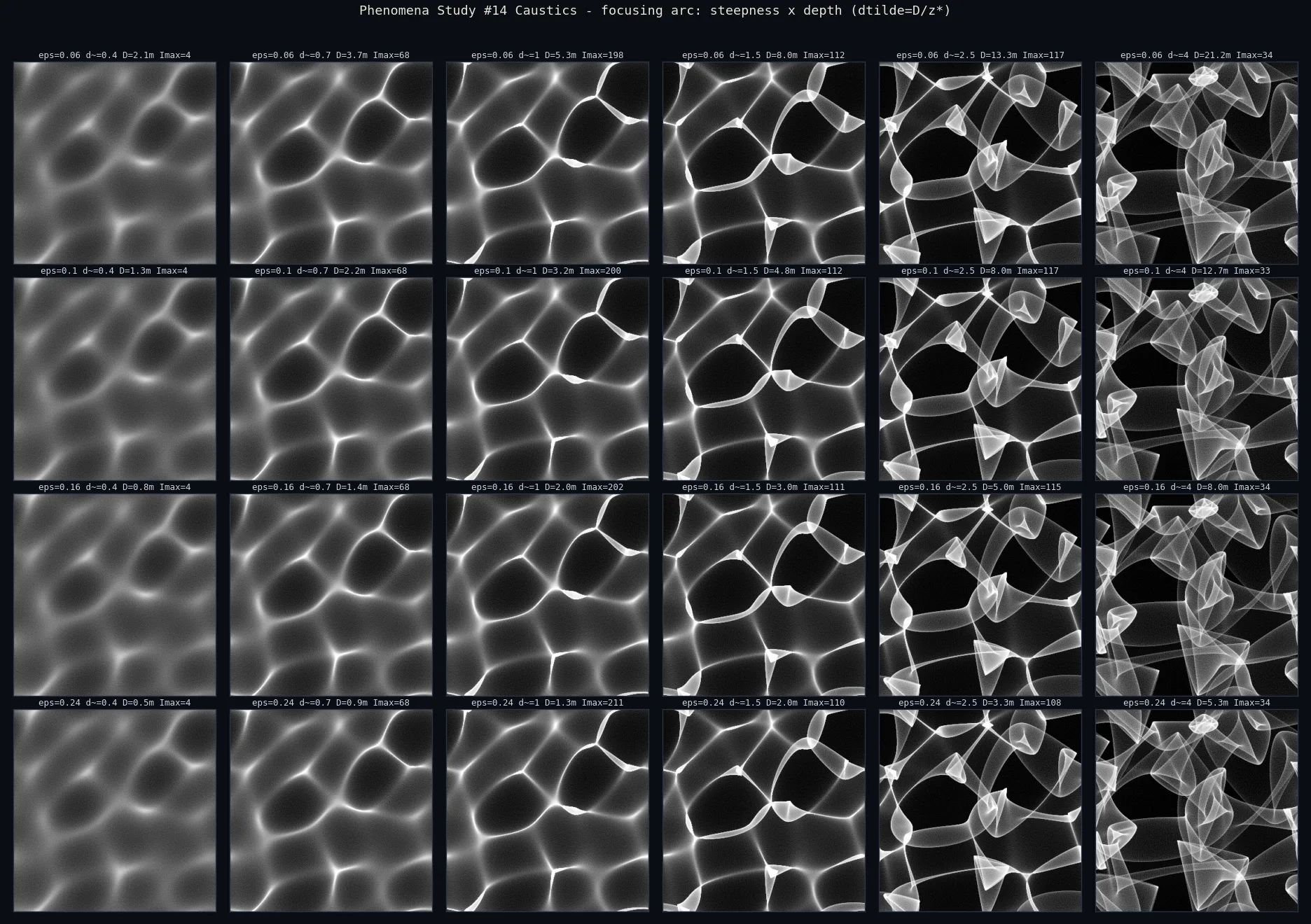
PROCESS — PARAMETER SWEEPS
The focusing arc as a contact sheet — the same surface, the floor diving through the regimes: soft cells above focus, the single sharpest net at d̃ ≈ 1, folded nets beyond.
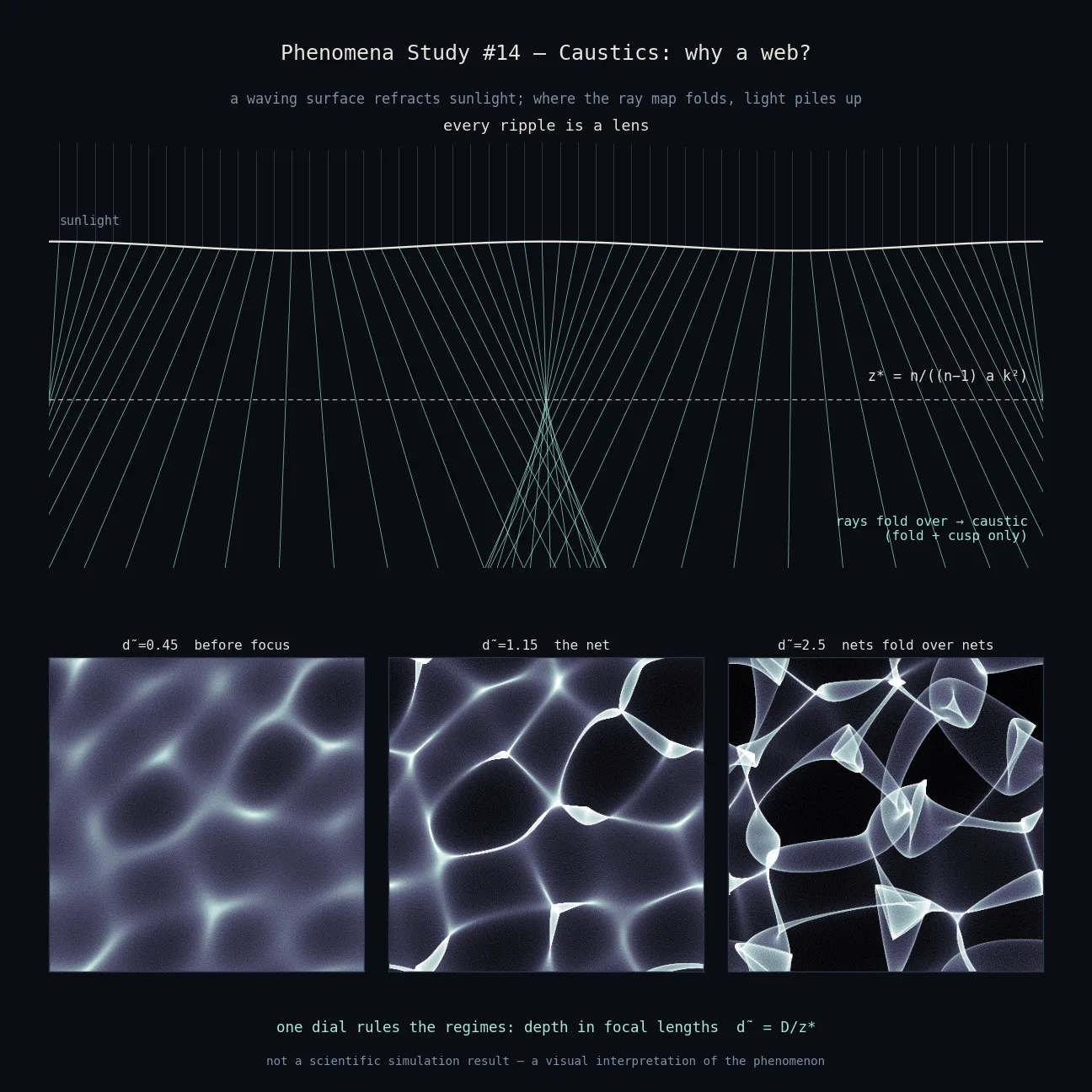
SIGNATURE — THE DEPTH GAUGE
One dial rules the picture — depth, measured in focal lengths.
A water surface has a focal length, like any lens. Measure the floor's depth in that unit — d̃ = D/z* — and every random sea behaves the same way: blur above focus, one sharpest net at d̃ ≈ 1, and past it the web folds over itself again and again. The hero film runs that dial up and down; the regimes arrive on schedule.
The letters never change — smooth folds and pointed cusps are the only stable singularities a ray map can carry. Any pool, any sea, any light: the same two letters, written at every depth.
COLOUR = OPTICS
Nothing here is coloured by hand. The rainbow fringe on every bright line is dispersion: red, green and blue photons are refracted separately with the refractive indices of water (n ≈ 1.331 / 1.335 / 1.340), so blue focuses slightly shallower than red — the fringes are physics, not post-processing.
The palette of each piece is Beer-Lambert absorption: water eats red light first (α ≈ 0.34 /m at 650 nm vs 0.015 /m at 450 nm), so the deeper the floor, the more the ambient light sinks toward teal and blue. And the forms — smooth ribbons, and the pointed stars where they pinch — are the fold and cusp singularities of catastrophe optics.
Refractive indices and absorption coefficients are artistic approximations of published values, not measurements.
REFERENCES
- M. V. Berry, C. Upstill. "Catastrophe optics: morphologies of caustics and their diffraction patterns." Progress in Optics, vol.18, 257-346 (1980).
INTERACTIVE STUDY
The whole study turns on one number. Focus depth is live — drag d̃ across the tick at 1 and the soft pre-focal cells sharpen into a single bright net, then fold over themselves beyond it. Every frame, tens of thousands of photons refract through a moving three-wave surface and splat onto the floor. It is a deliberately simplified instrument — single-wavelength (n = 1.333, no dispersion), capped in resolution with a few curated knobs and no export — separate from the full engine with real RGB dispersion used to author the finished works.
This interactive study is not intended as a scientifically validated reproduction. It is a visual interpretation generated from an implemented model and curated parameter exploration — and it is a deliberately simplified instrument, separate from the full engine used to author the finished works.