STUDY #17 · 2026 · IN OBSERVATION
XY Model — Vortex Unbinding
A model-driven visual study of topological defects in a two-dimensional field of directions.
WHAT IS THIS
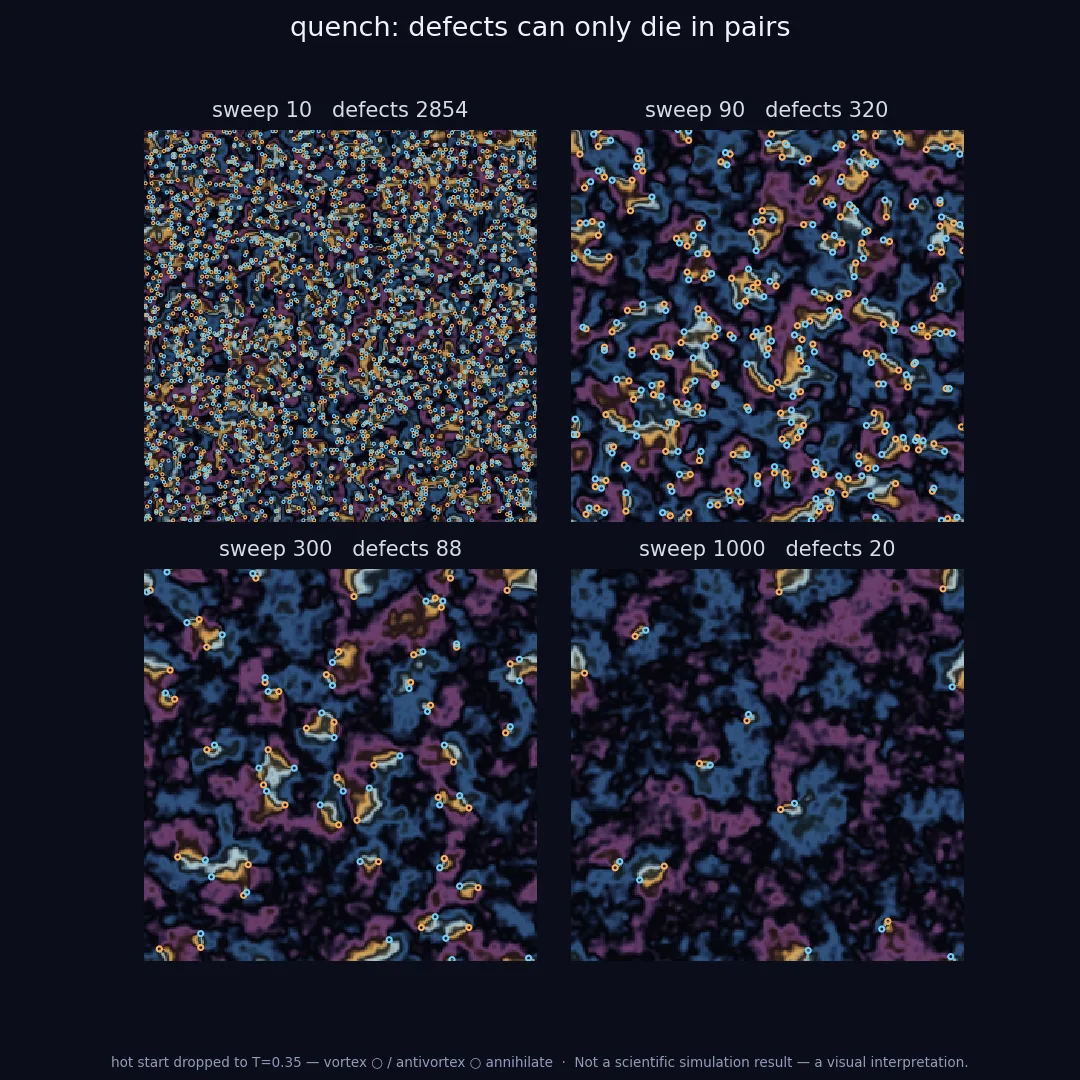
Take a flat lattice where every site holds a single arrow, free to point in any direction, and let neighbouring arrows prefer to align while heat jiggles them. In two dimensions this system can never truly order — waves of gentle disagreement always destroy perfect alignment. Yet it still has a phase transition, one carried entirely by topology: point defects where the direction winds a full turn (vortices and antivortices), which are born and die only in pairs. Below the Kosterlitz-Thouless temperature they hold each other in bound pairs; above it they unbind into a swarm and erase the field's memory.
This study runs the 2D XY model — a checkerboard Metropolis Monte Carlo on continuous angles — in real time on the GPU, and images the field the way a liquid-crystal film looks between crossed polarizers.
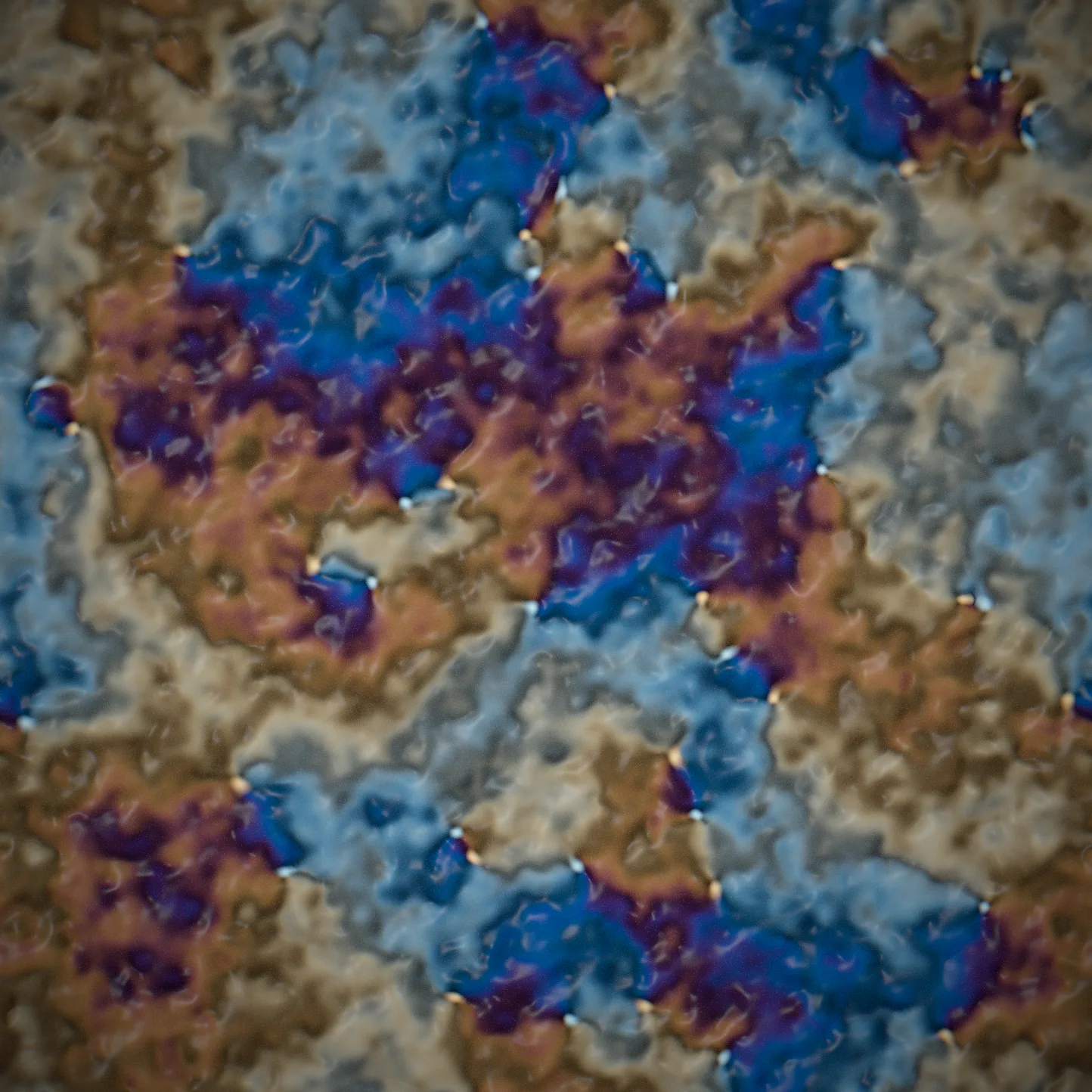
This is not a scientific simulation result, but a visual interpretation of the phenomenon.
SAME ENGINE, A DIFFERENT TOPOLOGY
Ising decides by domains. The XY model decides by defects.
PARAMETERS EXPLORED
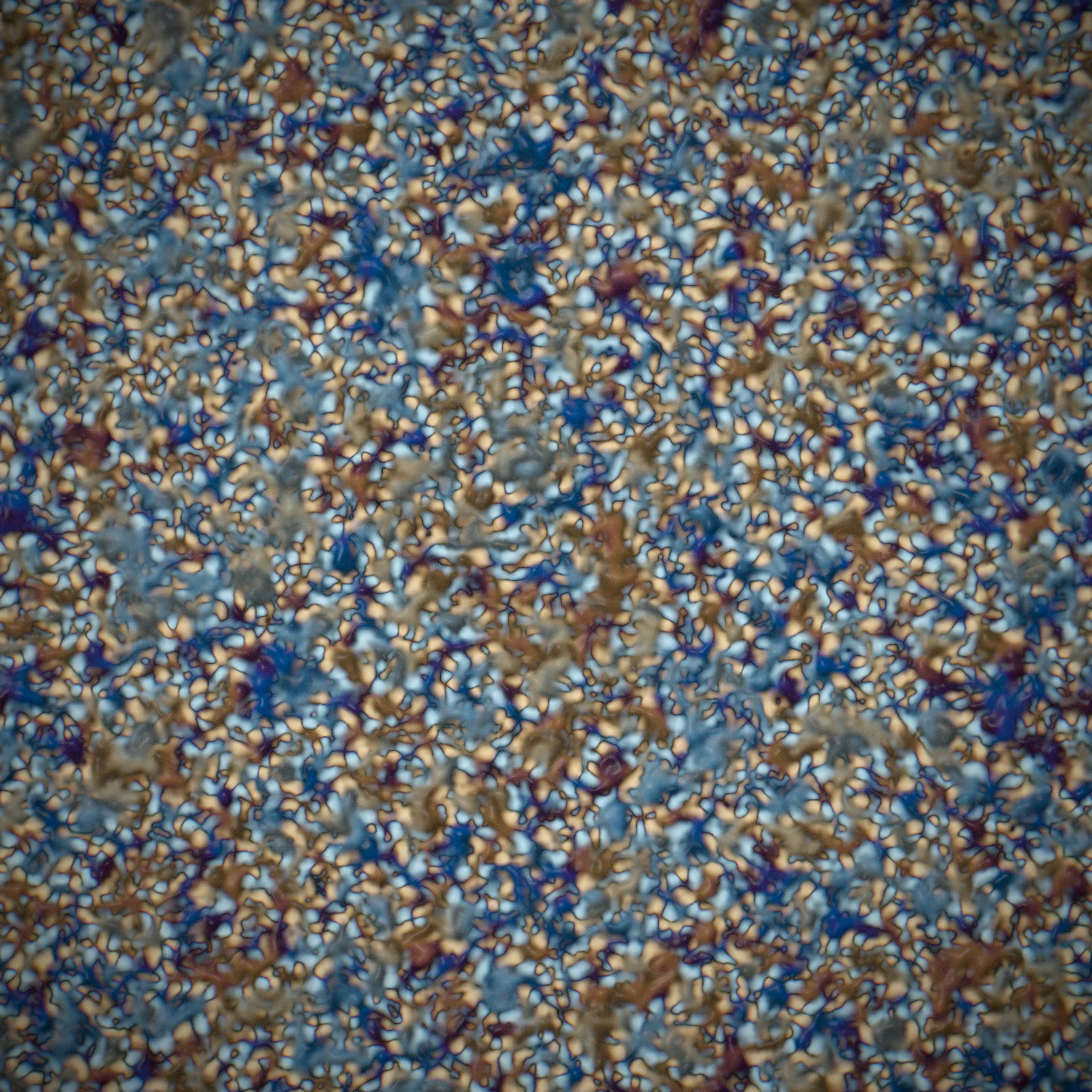
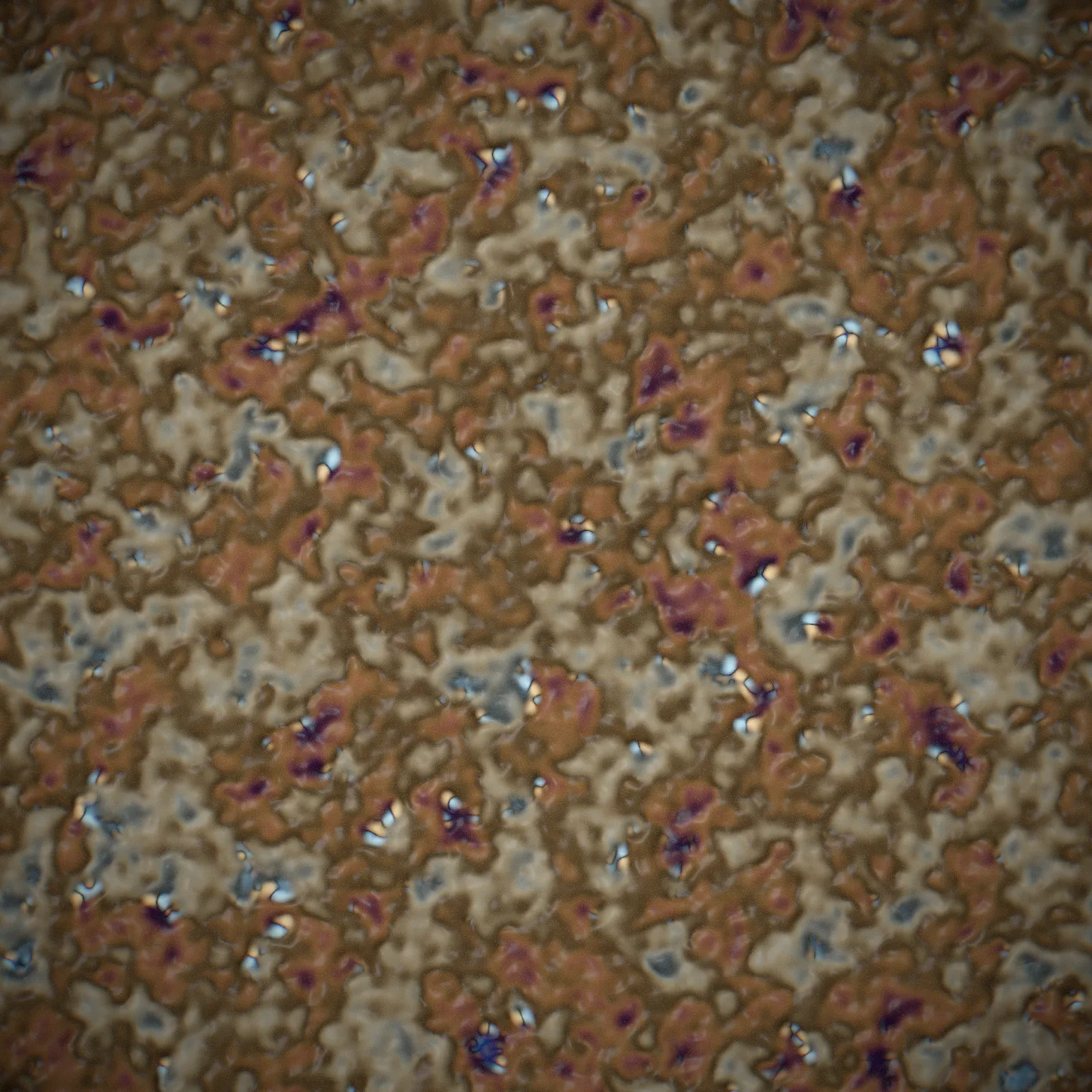
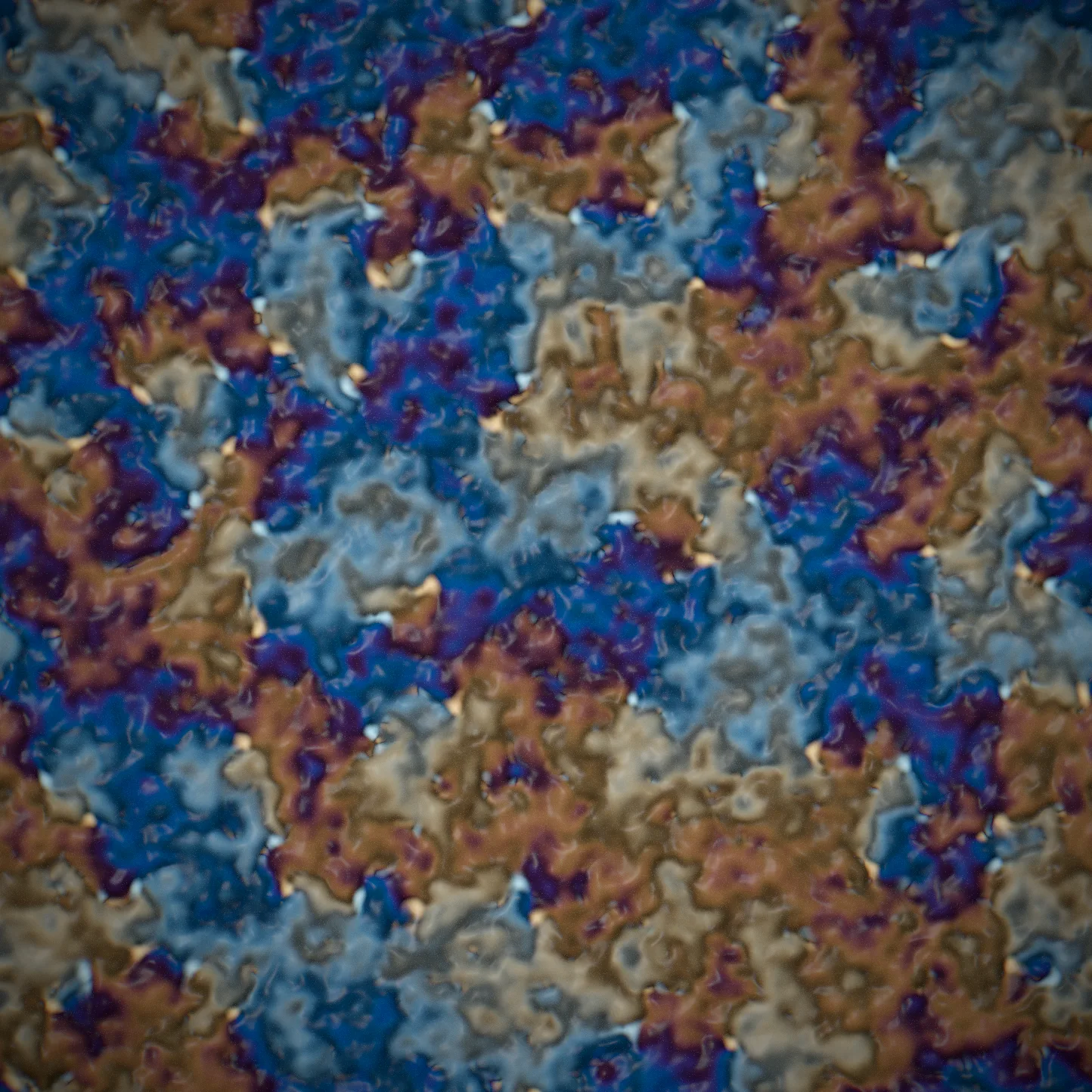
Each image below records its exact parameter set.
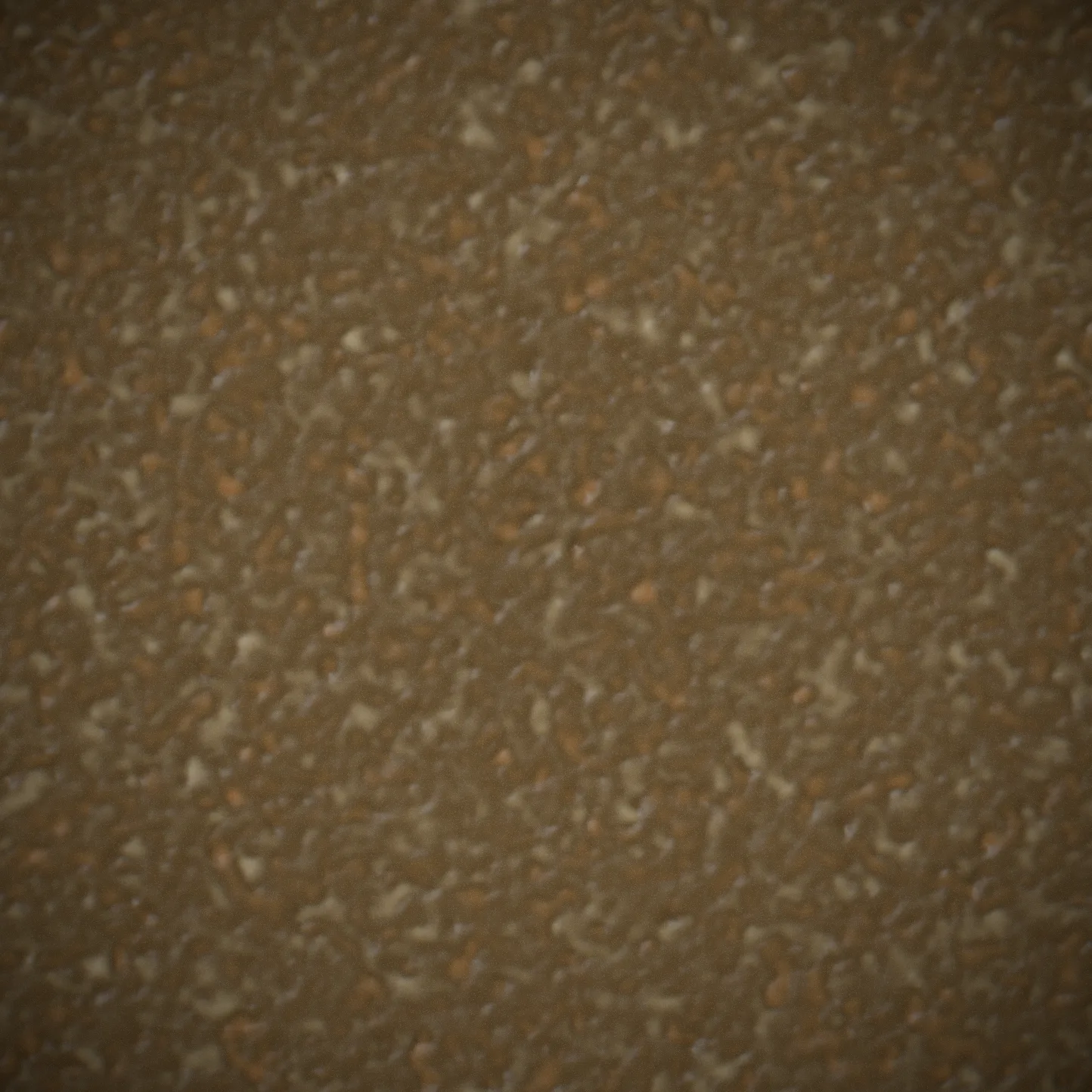
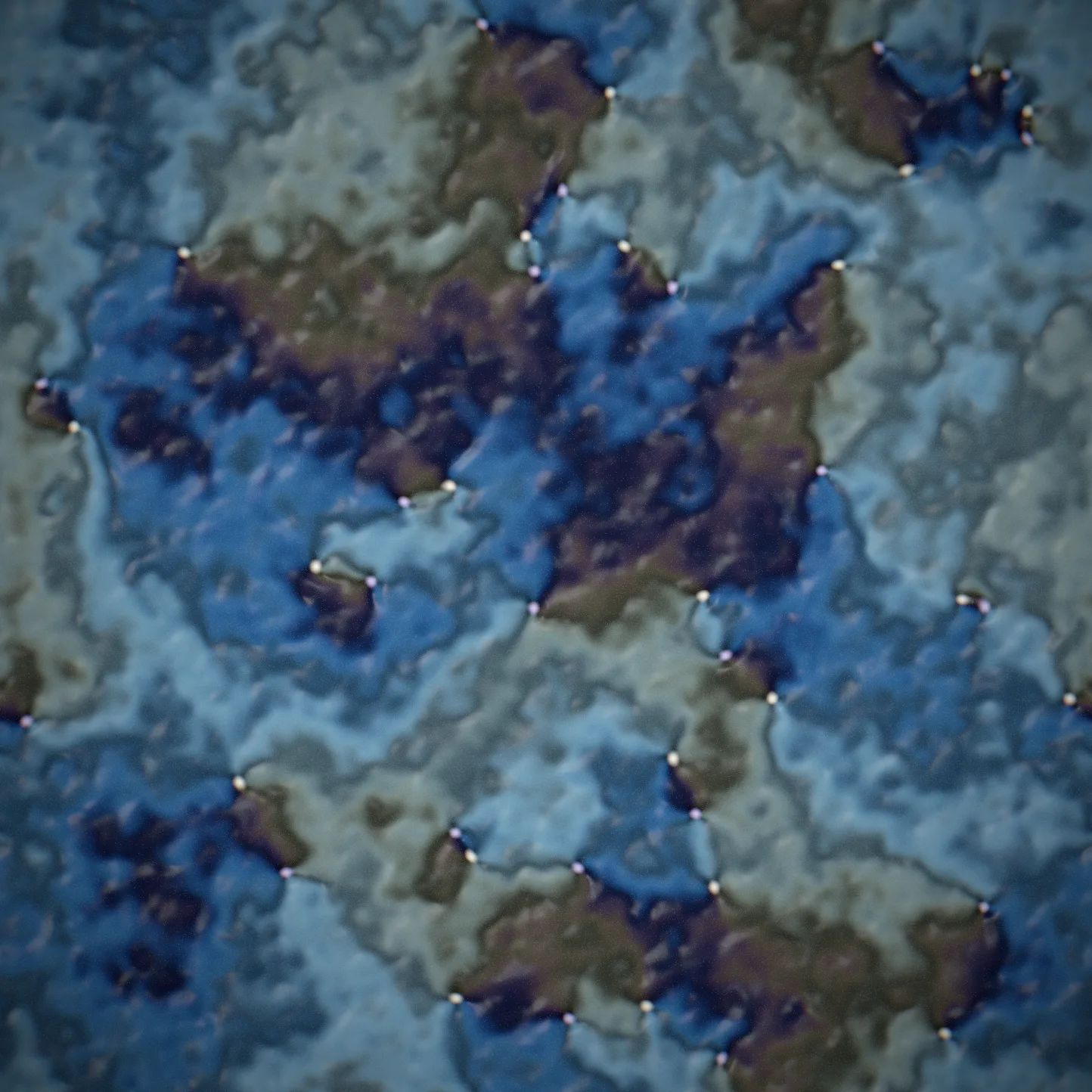
SELECTED STILLS — 6
PROCESS — PARAMETER SWEEPS
The quench as a strip — a hot plasma of tens of thousands of defects dropped cold, annihilating in pairs frame by frame until only a handful survive. Coarsening slows as it goes; the Monte-Carlo clock is ramped to keep the on-screen rate steady.
SIGNATURE — ORDER WITHOUT ORDER
A transition with no broken symmetry — topology alone decides it.
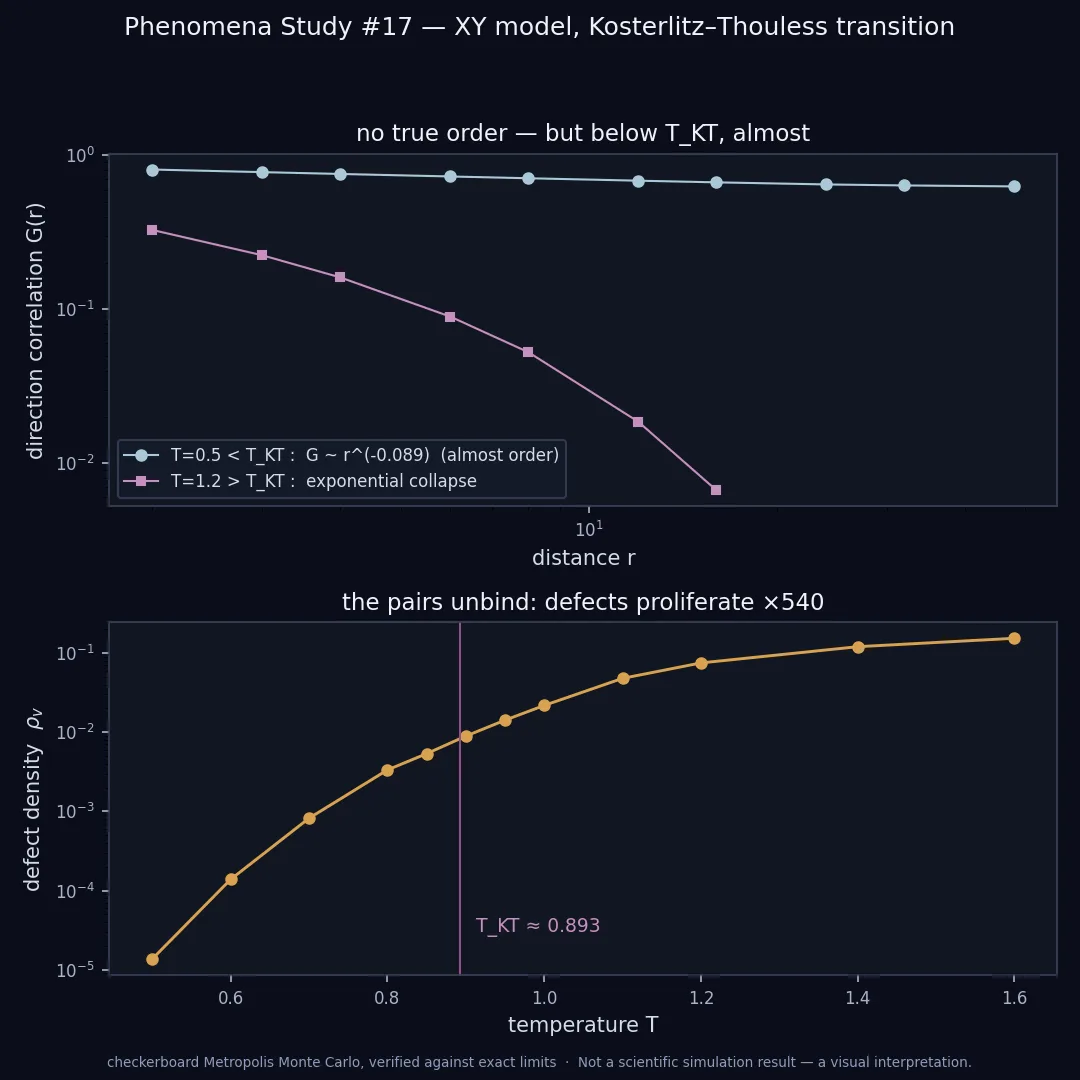
Mermin and Wagner proved a two-dimensional field of directions can never truly order — and yet Berezinskii, Kosterlitz and Thouless found a transition hiding there anyway. Below T_KT the correlations die slowly, as a power law; above it, exponentially fast. The difference is not symmetry but topology: whether vortex-antivortex pairs hold each other bound.
This engine was checked against that signature before any image was kept: the measured correlation function crosses from power law to exponential at the transition, the vortex density explodes 540-fold, and the total topological charge stays exactly zero — every vortex born with its antivortex, every death a pair annihilation.
COLOUR = CROSSED POLARIZERS
A field of directions is exactly what a thin liquid-crystal film shows under a polarizing microscope: dark brushes where the director lines up with a polarizer axis (intensity ∝ sin²2θ), filled between with birefringence interference colours, and defects wearing four-armed brush crosses. The palette here is an artistic take on that interference sequence — indigo, steel, champagne, straw gold, orchid.
Defect cores are tinted by their topological charge — a quantity of the model itself — vortices warm, antivortices cool.
The colours are a visual interpretation of the angle field, not spectroscopic measurements.
REFERENCES
- V. L. Berezinskii. "Destruction of Long-range Order in One-dimensional and Two-dimensional Systems having a Continuous Symmetry Group I. Classical Systems." Soviet Physics JETP, vol.32, 493-500 (1971).
- J. M. Kosterlitz, D. J. Thouless. "Ordering, metastability and phase transitions in two-dimensional systems." Journal of Physics C: Solid State Physics, vol.6, 1181-1203 (1973).
- J. M. Kosterlitz. "The critical properties of the two-dimensional xy model." Journal of Physics C: Solid State Physics, vol.7, 1046-1060 (1974).
- N. D. Mermin, H. Wagner. "Absence of Ferromagnetism or Antiferromagnetism in One- or Two-Dimensional Isotropic Heisenberg Models." Physical Review Letters, vol.17, 1133-1136 (1966).
- N. Metropolis, A. W. Rosenbluth, M. N. Rosenbluth, A. H. Teller, E. Teller. "Equation of State Calculations by Fast Computing Machines." The Journal of Chemical Physics, vol.21, 1087-1092 (1953).
INTERACTIVE STUDY
A field where every site holds a direction, read the way a liquid-crystal film looks between crossed polarizers. Temperature is live — drag it across the T_KT tick and bound vortex pairs unbind into a plasma, then refreeze as you come back. QUENCH reheats the field for a moment and drops it cold: a burst of defects — warm vortices, cool antivortices — annihilates pair by pair, because a knot in the direction field can only die with its partner. It is a deliberately simplified instrument, capped in resolution with a few curated knobs and no export, separate from the full engine used to author the finished works.
This interactive study is not intended as a scientifically validated reproduction. It is a visual interpretation generated from an implemented model and curated parameter exploration — and it is a deliberately simplified instrument, separate from the full engine used to author the finished works.