STUDY #34 · 2026 · IN OBSERVATION
Kelvin Wake — Ship Waves
A model-driven visual study of ship waves and the angle that will not move.
WHAT IS THIS
The V-shaped wake behind a ship looks like it should depend on the ship. It does not: in deep water the envelope always spreads at arcsin(1/3) = 19.47° from the track, whatever the speed — Kelvin proved it in 1887. A racing ferry and a rowing duck drag the same wedge; speed only picks the wavelength woven inside (λ = 2πU²/g on the track).
The model is the linear water-wave equation: every Fourier mode of the surface is an independent oscillator with the dispersion law ω² = gk·tanh(kh), forced by a moving, volume-free pressure bump — the hull displaces water, it does not remove it. This study runs it in real time on the GPU, with the nonlocal deep-water operator rebuilt as a saturated cubic of blurred Laplacians so that a shader can hold the wedge.
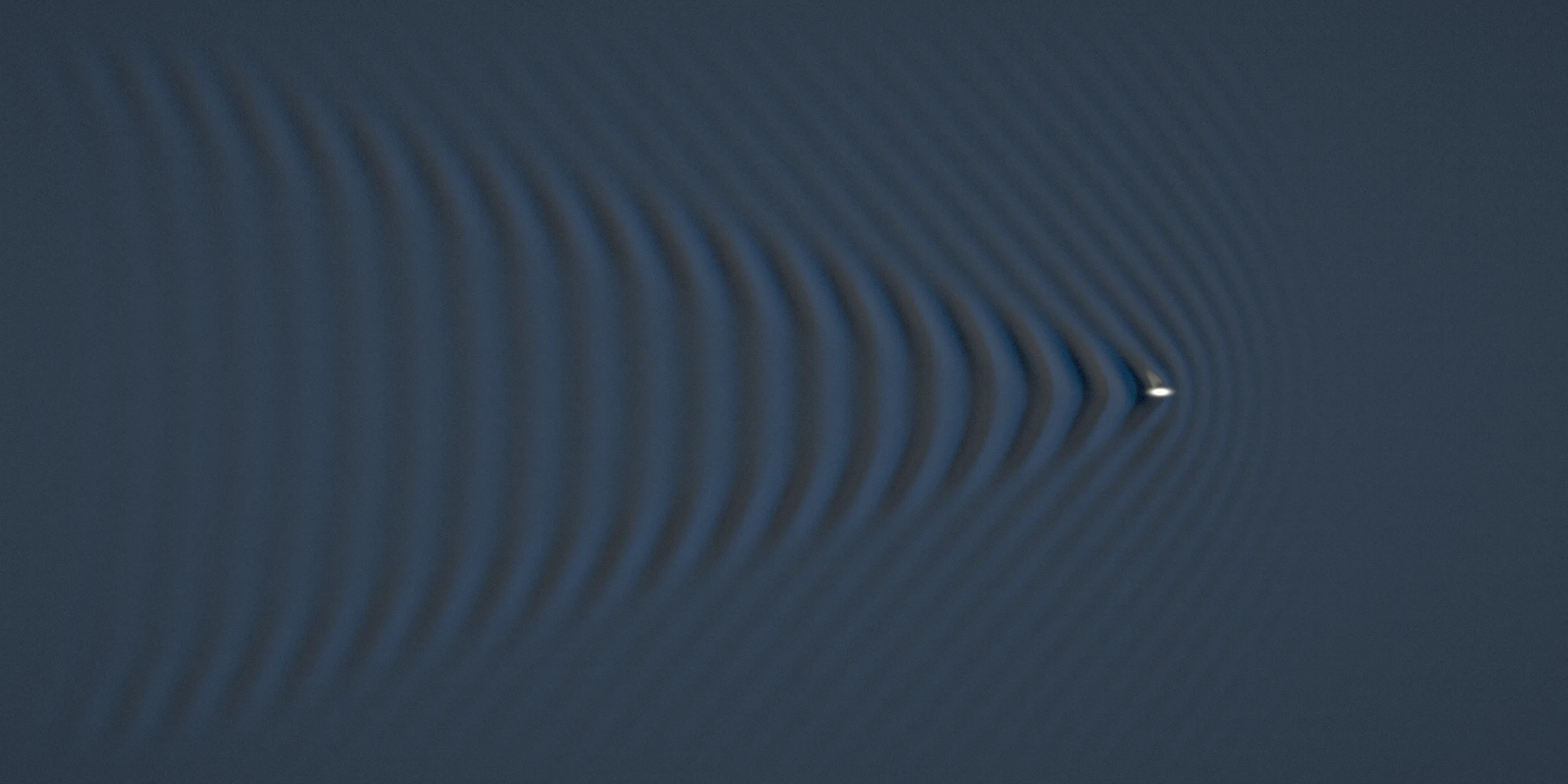
This is not a scientific simulation result, but a visual interpretation of the phenomenon.
SAME ENGINE, THE DRIVE NOW RUNS
Faraday's liquid is shaken in place. Kelvin's is merely passed through — and answers with a wedge.
PARAMETERS EXPLORED
Each image below records its exact parameter set.
THE MATHEMATICS the model behind the images
One oscillator per wavelength, one moving bump to excite them, and one ratio that decides the whole picture.
A visual interpretation of the model, not a claim of scientific precision. Block one is the engine: every surface mode an independent damped oscillator (the same second-order skeleton as Study #29, the drive now a running, volume-free pressure point). Block two is Kelvin's argument: in deep water energy travels at exactly half the crest speed, so the envelope angle is fixed and the hull's speed cancels; finite depth breaks the ratio, and past Froude 1 the wedge is a Mach cone. Block three is the GPU water: deep-water dispersion is nonlocal and no polynomial in the Laplacian can follow √k, so the operator variable is saturated — a 9-point Laplacian seen through a squared Fejér smoother — and the cubic is pinned by three exact geometry locks (transverse wavelength, cusp wavenumber, cusp group speed), solved identically in Python and JavaScript to 6.6e-12. The honest cost: the shader's caustic sits about 1.2° inside the exact 19.47°; the speed-invariance survives exactly.
SELECTED STILLS — 4
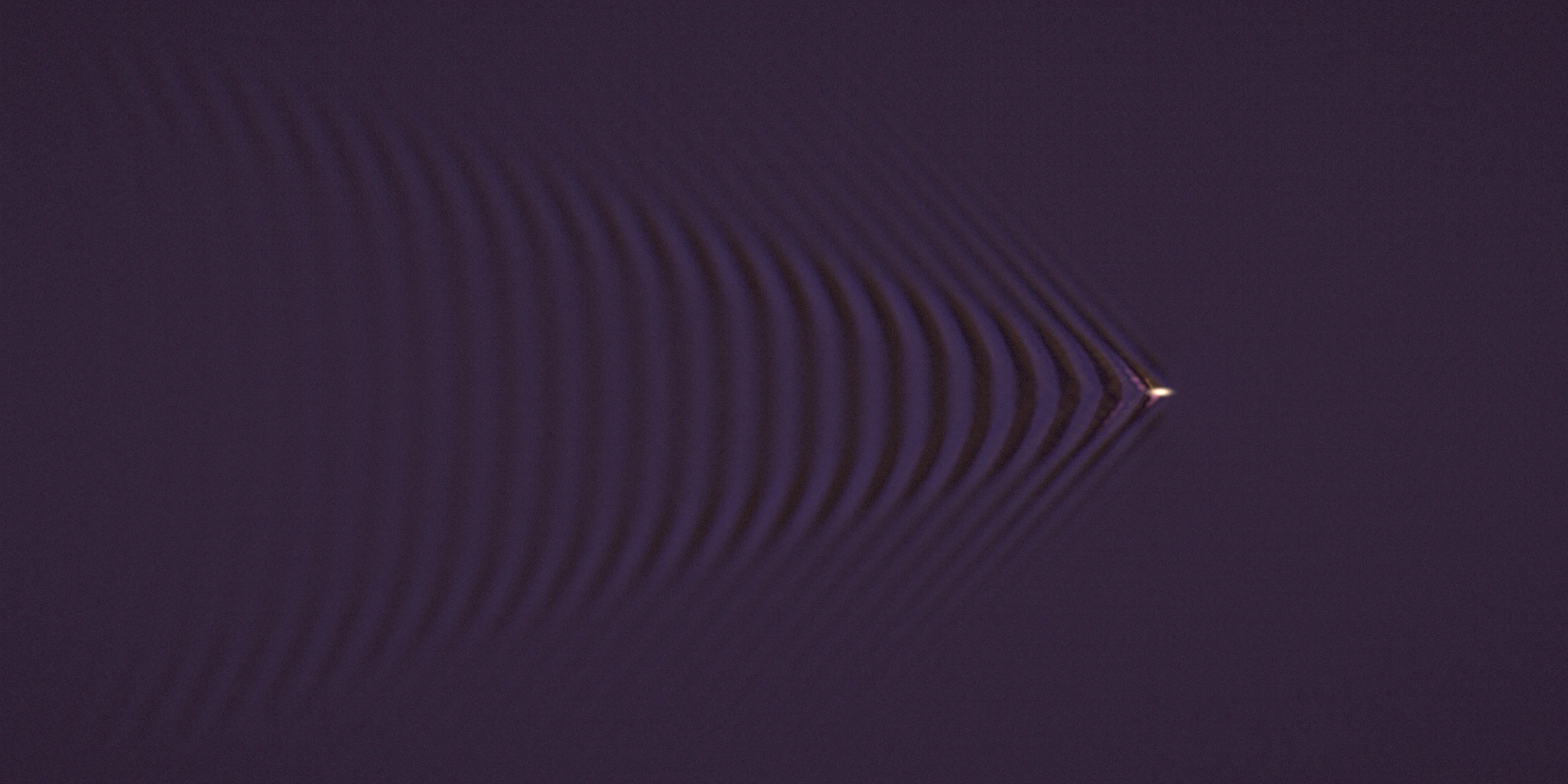
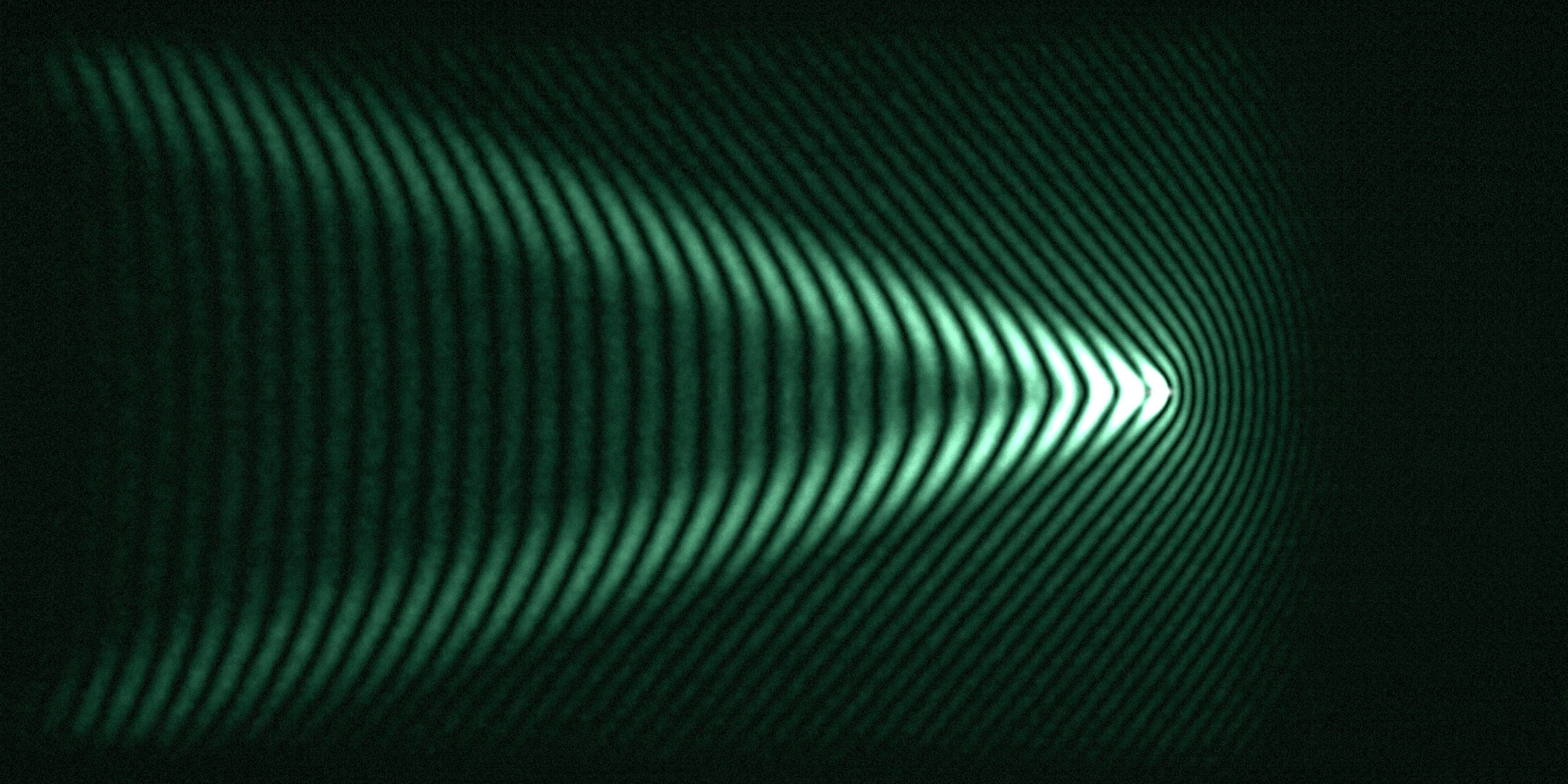
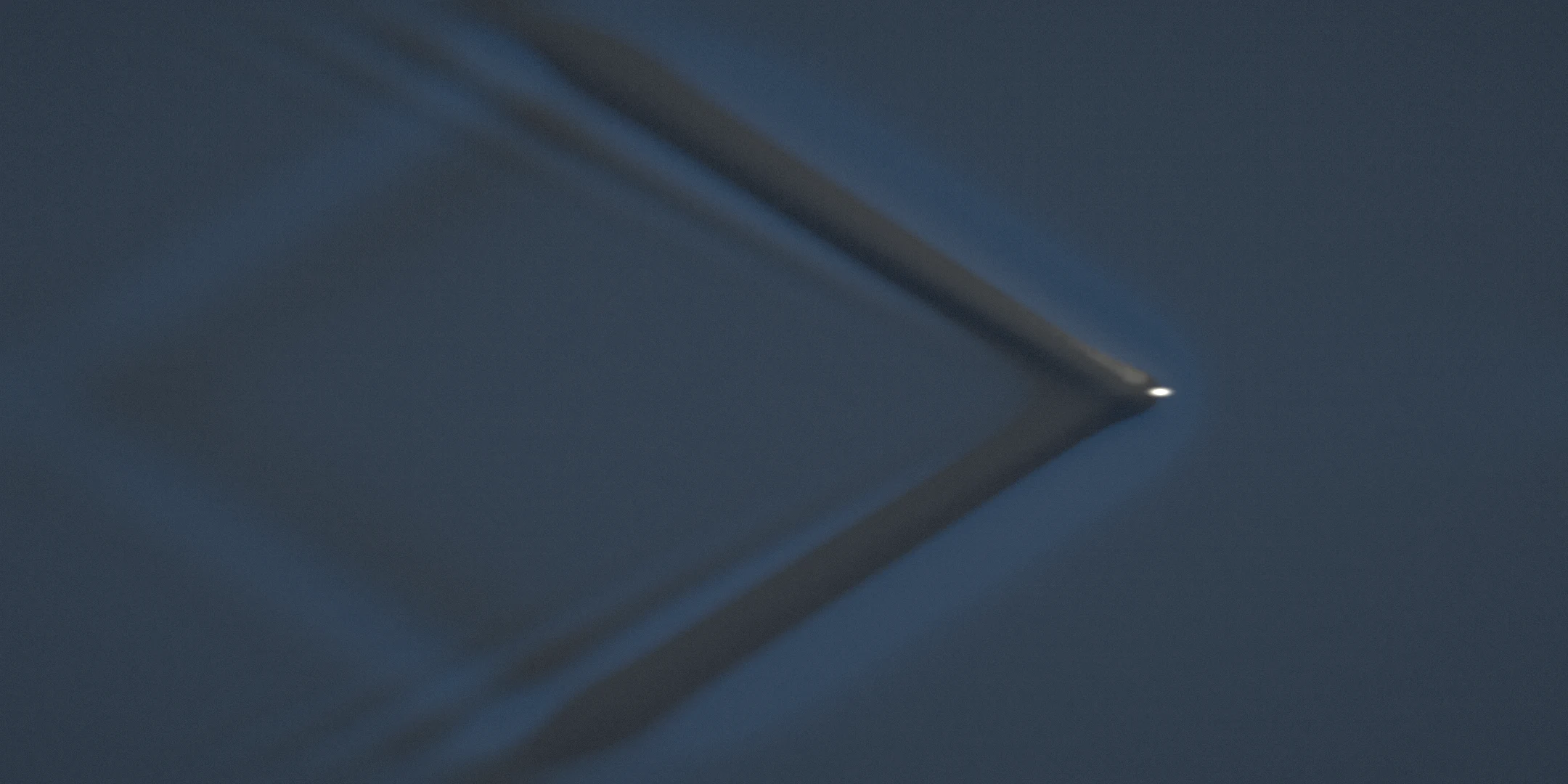
PROCESS — PARAMETER SWEEPS
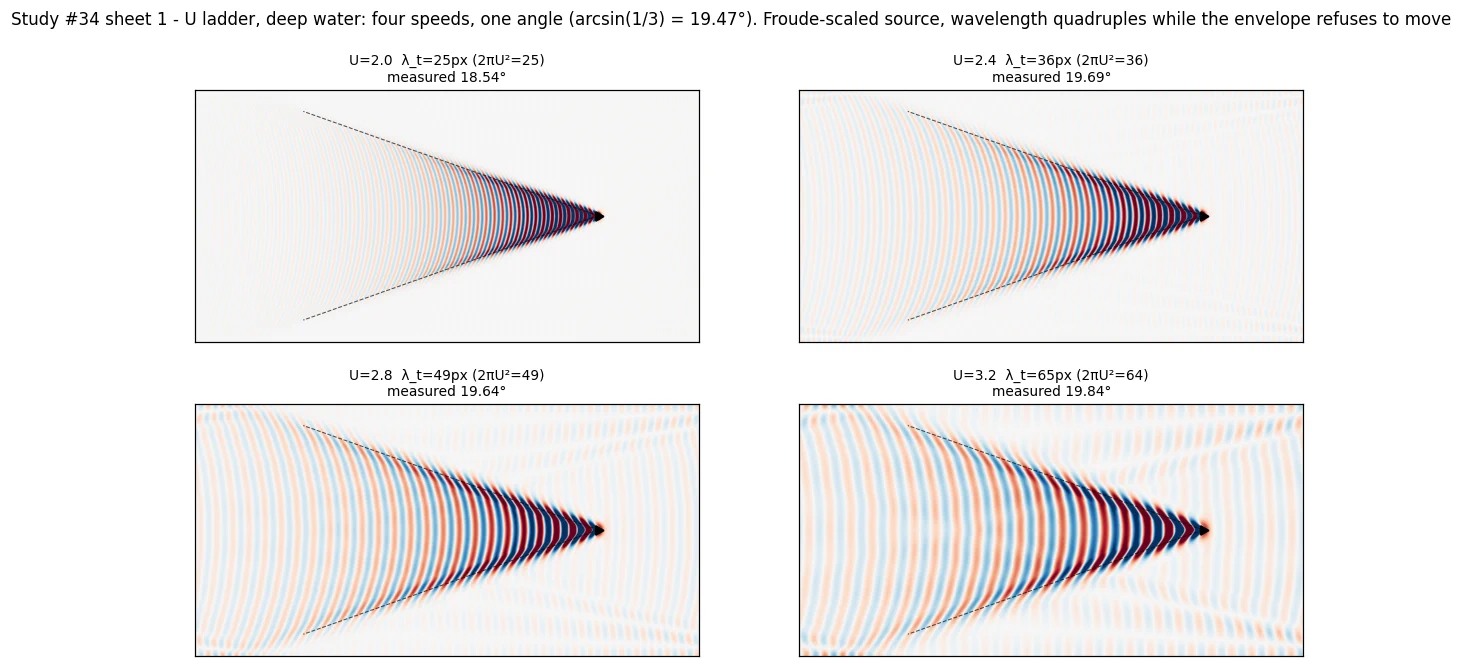
The claim, run as a ladder — four hull speeds spanning 1.6×, the source Froude-scaled the way model basins scale their hulls. The wavelength on the track quadruples, 25 to 65 px, tracking 2πU² exactly; the measured half-angle stays on 19.47° to within half a degree. The angle belongs to the water, the wavelength to the ship.
SIGNATURE — THE STUBBORN ANGLE
Speed cannot turn the wedge. Depth can.
A wave can keep station with the hull only if its crests match the hull's shadow: c(k) = U·cosθ. In deep water, energy travels at exactly half that speed — and the envelope of every half-speed messenger, taken over all directions, is a wedge of sin α = 1/3. The hull's speed cancels out of the geometry. Measured here: half-angles 18.98–19.78° across a 1.55× speed range against Kelvin's 19.4712°, while the track wavelength obeyed 2πU²/g to better than one percent.
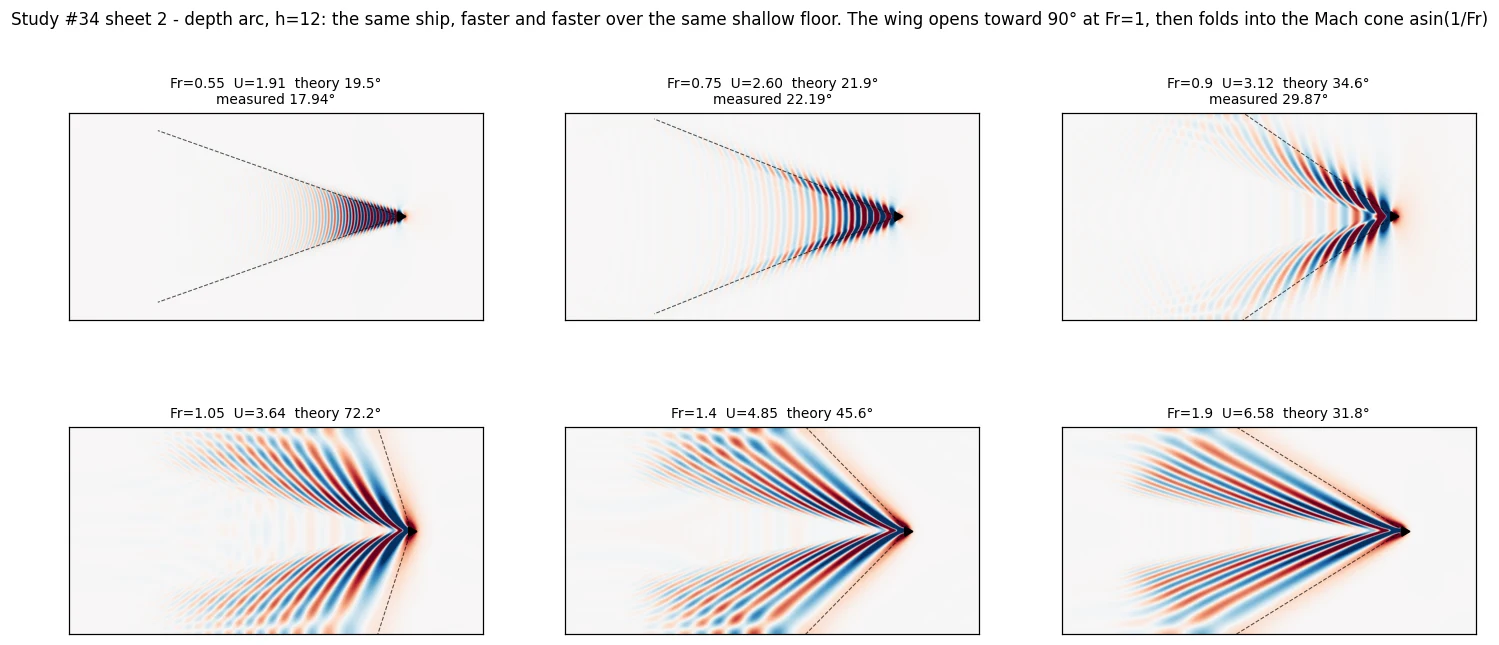
Only depth breaks the one-half ratio. Over a shallow floor the same wedge opens along Havelock's stationary-phase curve — measured 24.3° against a predicted 24.3° at Fr 0.8 — passes wide open at Fr = 1, and past it folds into the water's own sonic boom, the Mach cone asin(1/Fr). And photographed in spectral space, the whole wake — transverse arcs, divergent lace, cusp — sits on one curve, ω(|k|) = kₓU, to median 1.7%: the wake is the dispersion relation, drawn on water.
COLOUR = THE CHANNELS WAKES ARE SEEN THROUGH
The palettes are the channels through which wakes are actually seen: the sun-glitter blues of satellite photography — the glint density is the wave-slope statistics — the low bronze sun of dusk, the black-green backscatter of SAR radar, where a ship's wake writes a bright V on a dark sea from orbit, and the Prussian-blue wash of a nautical chart.
The scalloped bright edge of the wedge is the cusp caustic, where the transverse and divergent wave systems meet and reinforce — the reason the wings of a real wake are their own brightest line. The hull itself is kept to a single white highlight; gold on this page is reserved for Kelvin's constant.
All palettes are artistic approximations of these observation channels, not measurements.
REFERENCES
- Lord Kelvin (Sir William Thomson). "On ship waves." Proceedings of the Institution of Mechanical Engineers, vol.38, no.1, 409-434 (1887). https://doi.org/10.1243/PIME_PROC_1887_038_028_02
- T. H. Havelock. "The propagation of groups of waves in dispersive media, with application to waves on water produced by a travelling disturbance." Proceedings of the Royal Society of London A, vol.81, no.549, 398-430 (1908).
- M. Rabaud, F. Moisy. "Ship wakes: Kelvin or Mach angle?." Physical Review Letters, vol.110, 214503 (2013).
INTERACTIVE STUDY
The whole theorem fits under one finger. Hold the sea and the hull opens its throttle ×1.8 — in deep water the measured needle shrugs at arcsin(1/3) = 19°28′, and only the depth slider can swing it, through wide open at Fr = 1 to the Mach cone. The wedge angles here are exact — 96 station-keeping waves of the true dispersion — while the water itself is a portrait. It is a deliberately simplified instrument, capped in resolution with a few curated knobs and no export, separate from the full engine used to author the finished works.
This interactive study is not intended as a scientifically validated reproduction. It is a visual interpretation generated from an implemented model and curated parameter exploration — and it is a deliberately simplified instrument, separate from the full engine used to author the finished works.