PHENOMENA STUDIES WEAVER AXIOM
Studies Archive About
← INDEX

STUDY #08  ·  2026 · IN OBSERVATION

Phase Separation

A model-driven visual study of spinodal decomposition and coarsening.

MOVING IMAGE — COARSENING spinodal · c₀ 0 · κ 1 · alloy

WHAT IS THIS

Phase separation is what happens when a mixture that can no longer stay mixed comes apart into two phases — the way a cooled alloy, a glass, or a polymer blend unmixes into two interwoven materials. When the split is symmetric, the phases form an interpenetrating labyrinth (spinodal decomposition); when it is lopsided, the minority phase gathers into droplets. Afterwards the pattern coarsens: to shrink the energy stored in its boundaries, small domains dissolve and large ones grow.

The Cahn–Hilliard model describes this with a single field — the local composition — driven downhill in a double-well energy, with a penalty on sharp interfaces. It is a conserved model: the total amount of each phase never changes, so separation only rearranges material. This study runs the model in real time on the GPU.
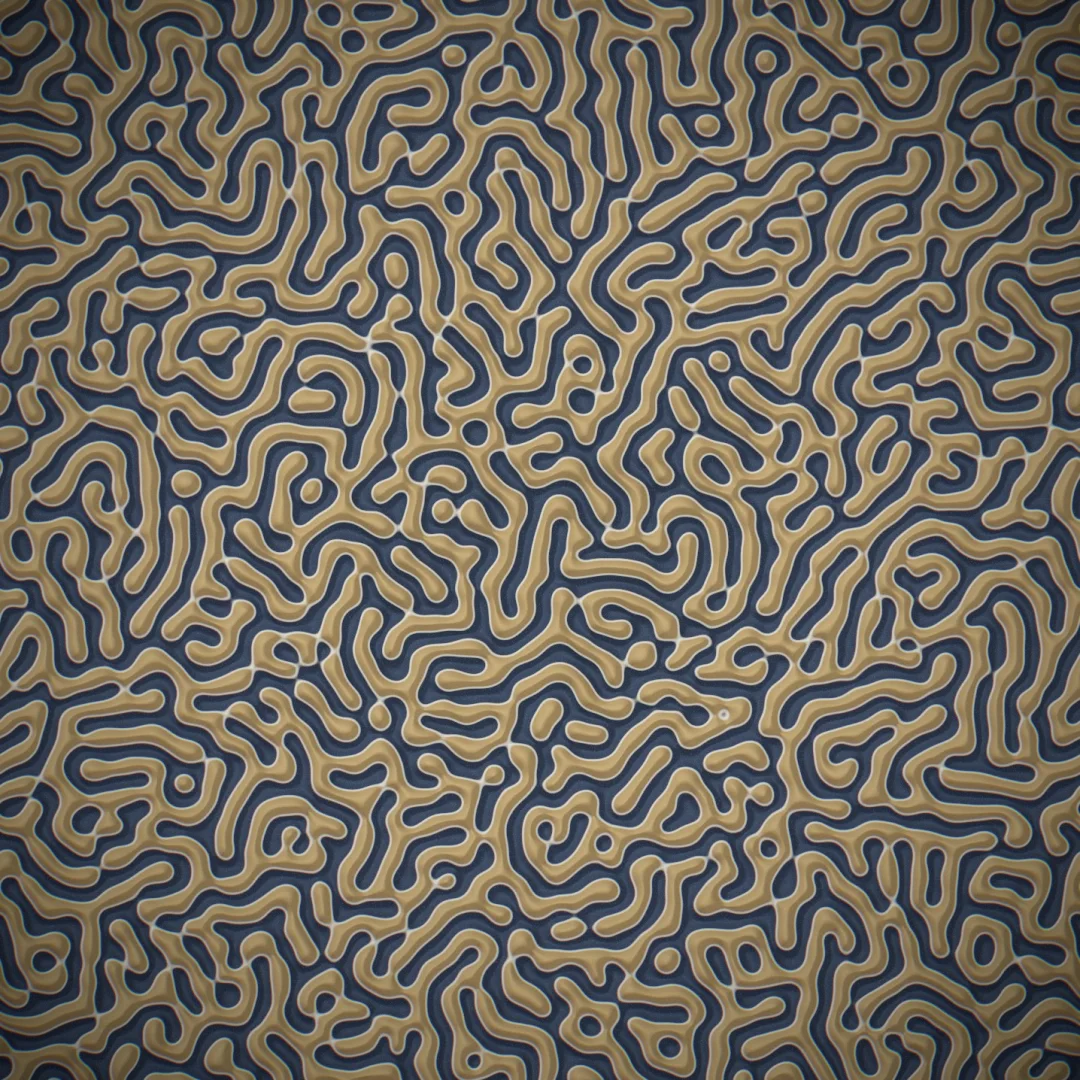
an interpenetrating labyrinth — a symmetric quench
an interpenetrating labyrinth — a symmetric quench spinodal · c₀ 0 · κ 1 · alloy
Motif Cahn–Hilliard model / spinodal decomposition / conserved dynamics / coarsening
Method A small simulator was generated and modified with AI assistance, then ported to a real-time GPU (GLSL) renderer. The visual output was selected through parameter exploration.
Observation A uniform mixture, quenched, unmixes into two phases everywhere at once, and the domains then coarsen — small ones dissolving into large. The mean composition is conserved, so morphology (interpenetrating labyrinth vs. isolated droplets) is fixed by the initial mix, not by time.
Reference J. W. Cahn, "On Spinodal Decomposition," Acta Metallurgica, vol.9, 795-801 (1961); J. W. Cahn & J. E. Hilliard, "Free Energy of a Nonuniform System. I," The Journal of Chemical Physics, vol.28, 258-267 (1958).
Tools Python / NumPy / three.js / React / GLSL / ffmpeg / AI coding assistant
Year 2026

This is not a scientific simulation result, but a visual interpretation of the phenomenon.

OPEN VS CONSERVED

The same shapes as

Study #02 — Gray-Scott Study #08 — Cahn-Hilliard
The system open and driven — fed with fresh substance from outside closed and conserved — a fixed amount of material, only rearranged
How it moves a seed grows structure into empty space a full field unmixes at once, then domains merge and swell
What sets the shape the feed and kill rates the mean composition — the mix, not time

PARAMETERS EXPLORED

param meaning effect on the image
c₀ the mean composition (a conserved quantity) the mix ratio: 0 gives an interpenetrating labyrinth, off-centre gives isolated minority droplets. Fixed by the quench, never by time
κ the gradient (interface) energy the feature size — a larger κ gives a coarser pattern (fastest wavelength λ* ≈ 2π√(2κ))
M the mobility the time-scale — how fast the domains coarsen
coarsening time how far the coarsening has run the domains thicken as a power law, L(t) ~ t^(1/3) — fine just after the quench, bold much later

Each image below records its exact parameter set.

THE MATHEMATICS the model behind the images

A single field — the local composition c, ≈ −1 in one phase and ≈ +1 in the other — driven downhill in a double-well energy, conserved by a divergence form.

∂c∂t=M ∇2μ\frac{\partial c}{\partial t} = M\,\nabla^2 \mu∂t∂c​=M∇2μ
Conserved dynamics: the flux is −M∇μ, so the divergence form keeps the total ∫c fixed — separation only rearranges material.
μ=f′(c)−κ ∇2c=(c3−c)−κ ∇2c\mu = f'(c) - \kappa\,\nabla^2 c = (c^3 - c) - \kappa\,\nabla^2 cμ=f′(c)−κ∇2c=(c3−c)−κ∇2c
The chemical potential: the double-well force c³−c drives toward the two phases c = ±1; the −κ∇²c term penalises sharp interfaces and sets the feature size.
∂c∂t=M[ ∇2(c3−c)−κ ∇4c ]\frac{\partial c}{\partial t} = M\big[\,\nabla^2(c^3 - c) - \kappa\,\nabla^4 c\,\big]∂t∂c​=M[∇2(c3−c)−κ∇4c]
Expanded — the biharmonic ∇⁴ (fourth-order) term is what makes this Cahn–Hilliard rather than ordinary diffusion.
λ∗≈2π2κ ,L(t)∼t1/3\lambda^{*} \approx 2\pi\sqrt{2\kappa}\,,\qquad L(t)\sim t^{1/3}λ∗≈2π2κ​,L(t)∼t1/3
The fastest-growing wavelength at the quench, and the power law by which the domains coarsen afterward.

Inspired by the Cahn–Hilliard model — a visual interpretation, not an exact reproduction.

SELECTED STILLS — 5
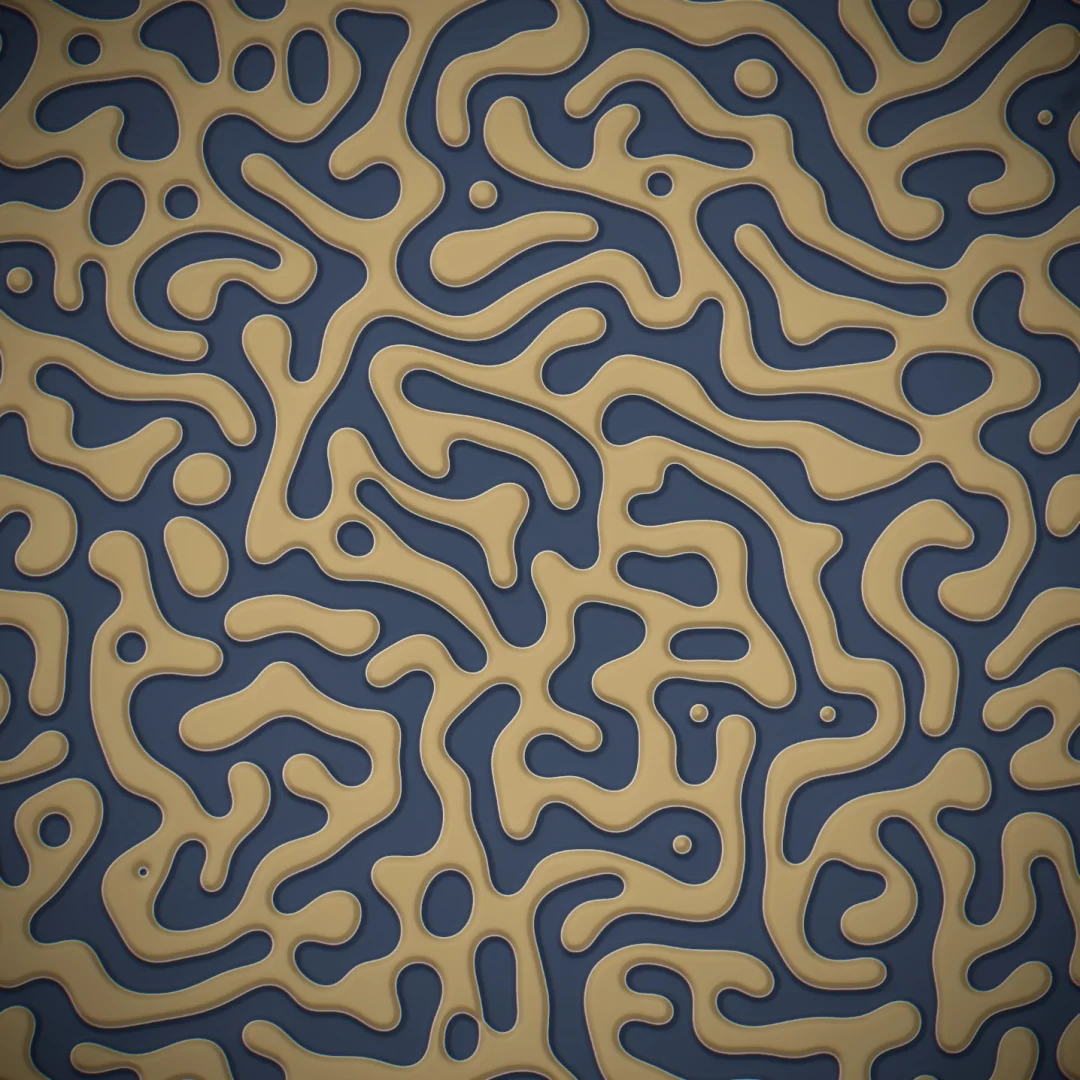
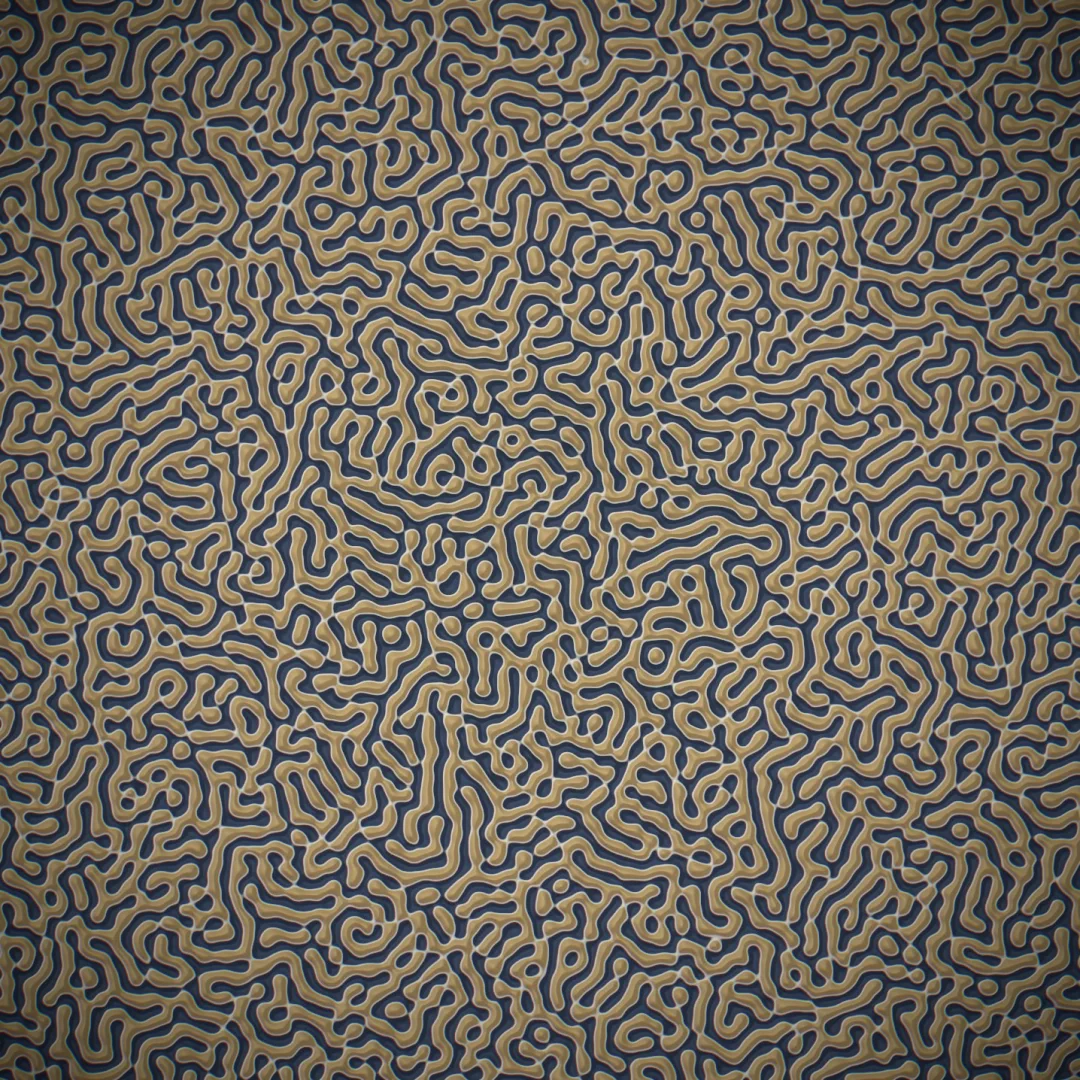
fine labyrinth — just after the quench
fine labyrinth — just after the quench spinodal · c₀ 0 · κ 1
coarse labyrinth — the same field
coarse labyrinth — the same field spinodal · c₀ 0 · coarsened
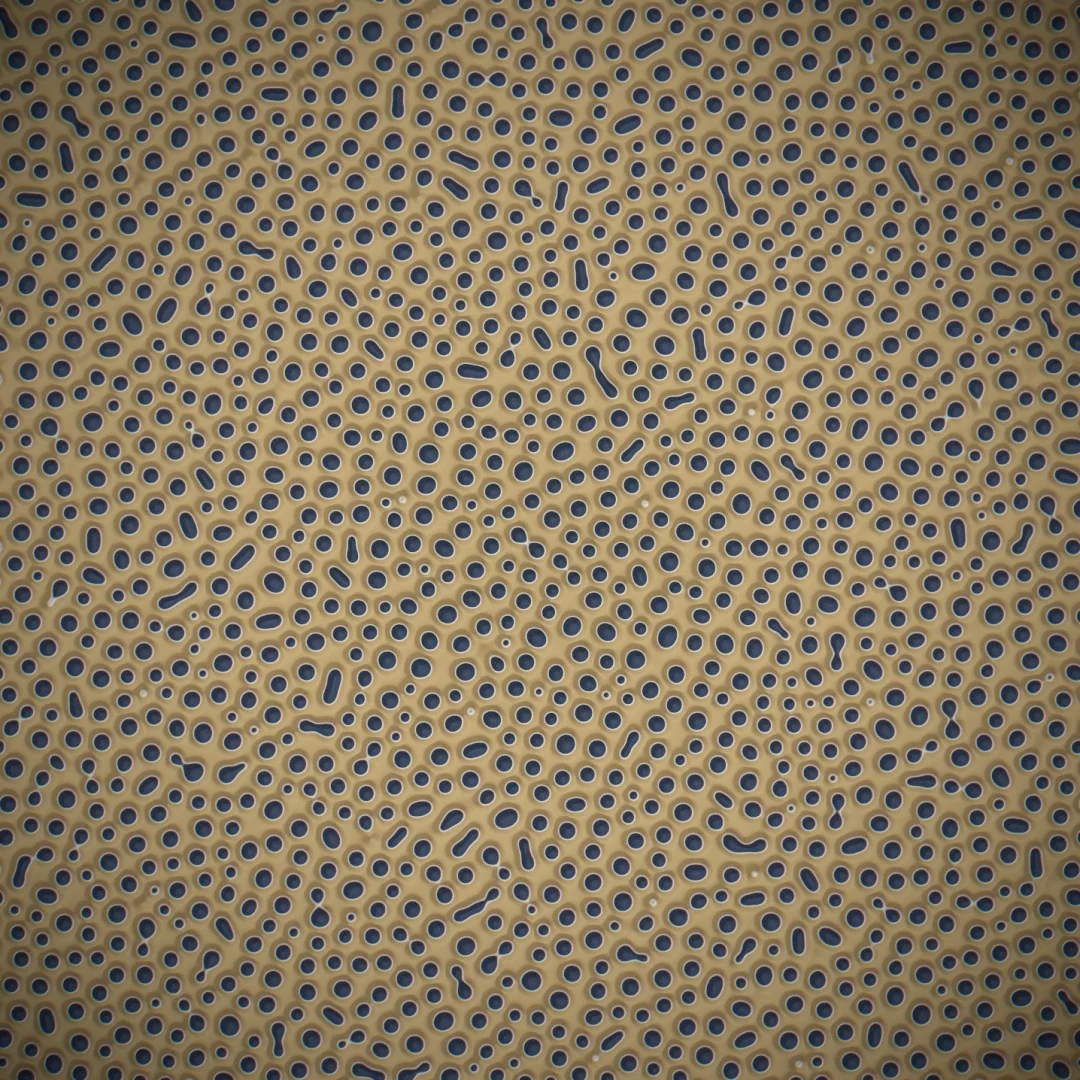
minority droplets — an off-critical quench
minority droplets — an off-critical quench c₀ 0.35 · Ostwald ripening
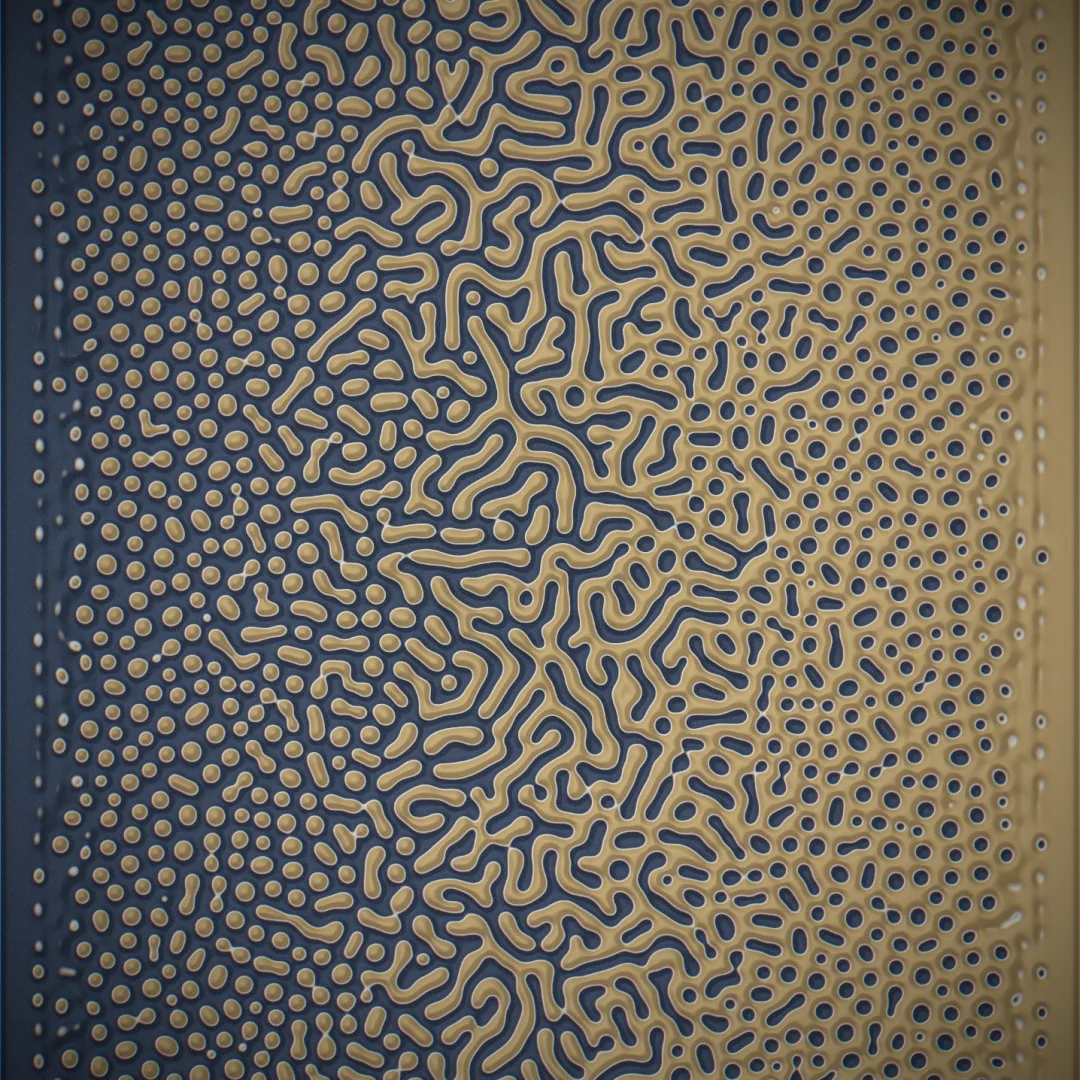
a composition gradient — the whole phase diagram in one frame
a composition gradient — the whole phase diagram in one frame gradient · c₀ 0 → 0.5
a brain-coral maze — a wider interface
a brain-coral maze — a wider interface spinodal · κ 2

PROCESS — PARAMETER SWEEPS

Because the mean composition is conserved, morphology is set by the mix, not by time. The whole phase diagram in one grid — rows are feature size κ, columns are composition c₀: labyrinth → worms → droplets → sparse droplets.
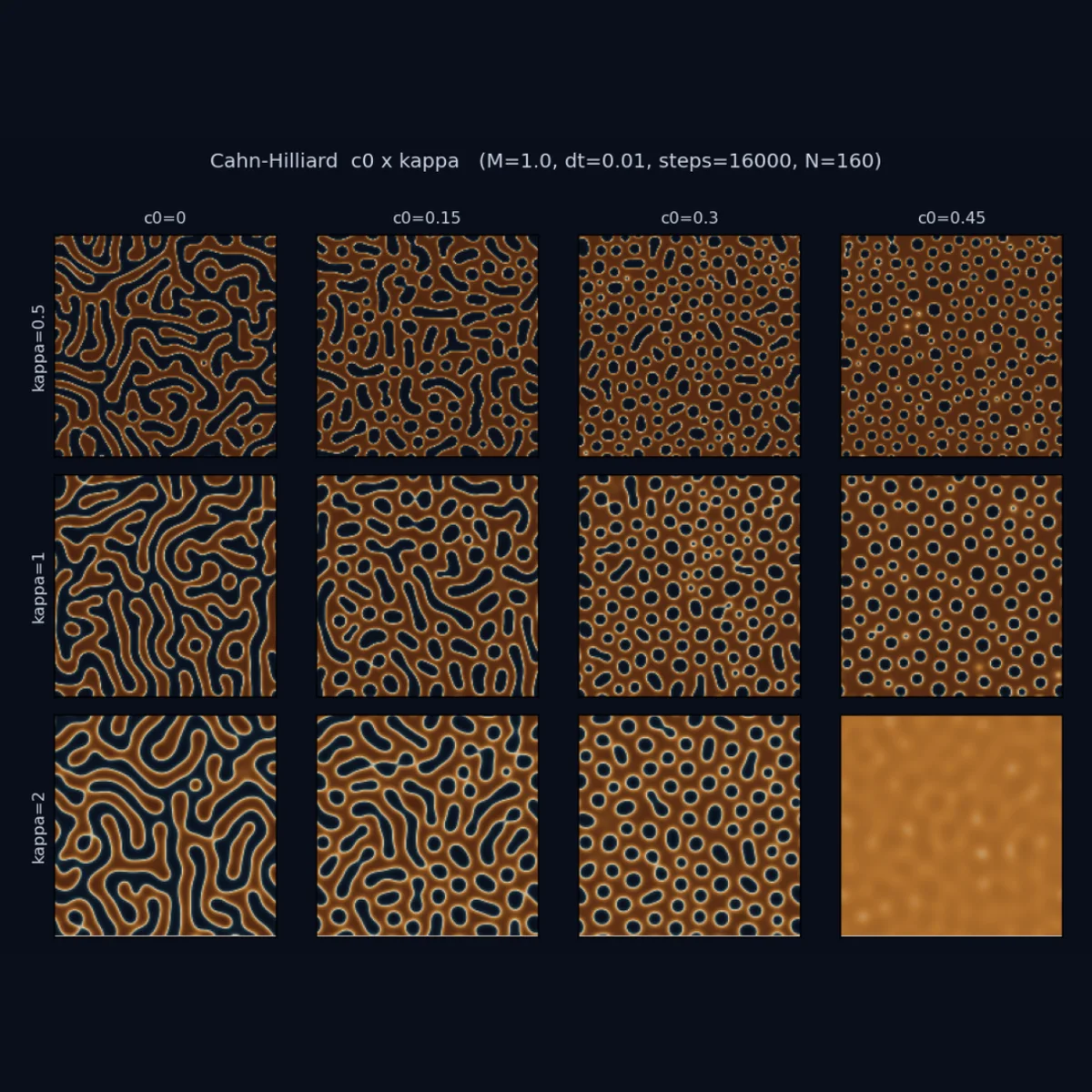
The c₀ × κ morphology map
The c₀ × κ morphology map rows = κ (feature size) · columns = c₀ (composition)

COLOUR = COMPOSITION

Phase separation is the classic route to two-phase microstructures in alloys, glasses (the borosilicate split that makes porous Vycor glass), bronze patinas, and polymer blends — so the two phases are read here as two metals: a cool steel (phase A) and a warm copper (phase B).

The bright seam between them is the domain wall — the interface that carries the surface energy driving the coarsening, the light-catching boundary of an etched alloy cross-section.

The colours are an artistic mapping of the model's own field c and its interface |∇c|, not spectroscopic measurements.

one still that sweeps the whole phase diagram — solid steel to copper droplets to a central labyrinth to steel droplets
one still that sweeps the whole phase diagram — solid steel to copper droplets to a central labyrinth to steel droplets gradient · c₀ 0 → 0.5 · κ 1 · alloy

Palette alloy — hue = composition c (steel ⇄ copper) · the bright seam = the interface |∇c| that drives coarsening.

REFERENCES

  1. J. W. Cahn, "On Spinodal Decomposition," Acta Metallurgica, vol.9, 795-801 (1961).
  2. J. W. Cahn & J. E. Hilliard, "Free Energy of a Nonuniform System. I. Interfacial Free Energy," The Journal of Chemical Physics, vol.28, 258-267 (1958).

INTERACTIVE STUDY

The same conserved dynamics run live in your browser — a mixture that unmixes and slowly coarsens. It is a deliberately simplified instrument, capped in resolution with a few curated knobs and no export, separate from the full engine used to author the finished works. Because the mean composition is conserved, moving Composition re-quenches the mixture — the mix, not time, fixes the shape.

SIMPLIFIED INSTRUMENTCAHN–HILLIARD · CONSERVED · LIVE

This interactive study is not intended as a scientifically validated reproduction. It is a visual interpretation generated from an implemented model and curated parameter exploration — and it is a deliberately simplified instrument, separate from the full engine used to author the finished works.

← ALL STUDIES STUDY #09 · DIFFUSION-LIMITED AGGREGATION →
PHENOMENA STUDIES — WEAVER AXIOM PERSONAL VISUAL RESEARCH · © 2026