STUDY #12 · 2026 · IN OBSERVATION
Kármán Vortex Street
A model-driven visual study of the alternating vortices shed in a wake.
WHAT IS THIS
In a steady flow past a blunt body, above a critical speed the wake sheds vortices alternately from its two sides, forming the staggered double row known as a Kármán vortex street — the pattern behind fluttering flags, aeolian tones and the ribbons of cloud trailing downwind of an island.
Rather than resolving a continuous flow, this study models the wake as a small set of point vortices that induce one another, with a cloud of passive tracers carried along to reveal the streaklines — the smoke, essentially. This study runs that point-vortex model in real time on the GPU.
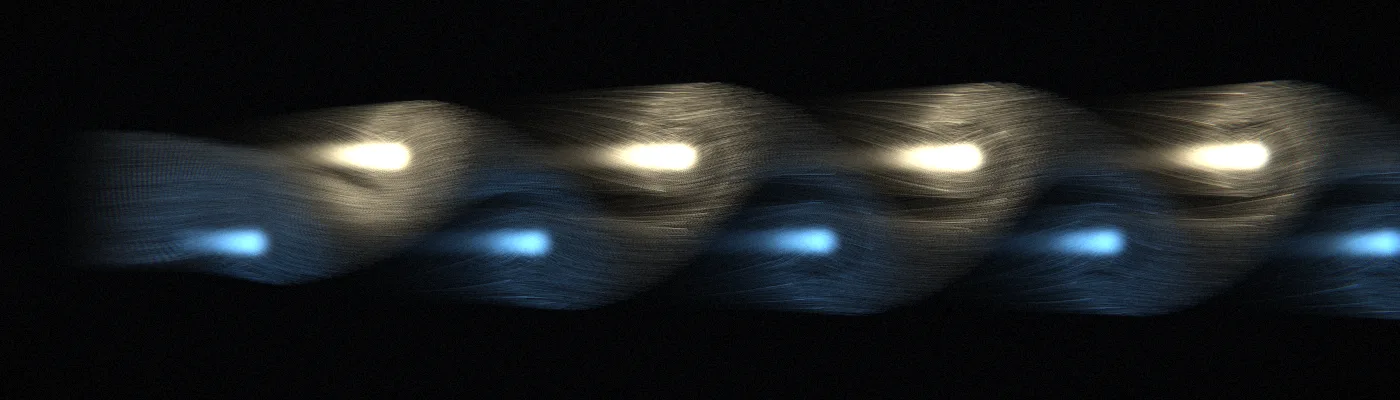
This is not a scientific simulation result, but a visual interpretation of the phenomenon.
PARAMETERS EXPLORED
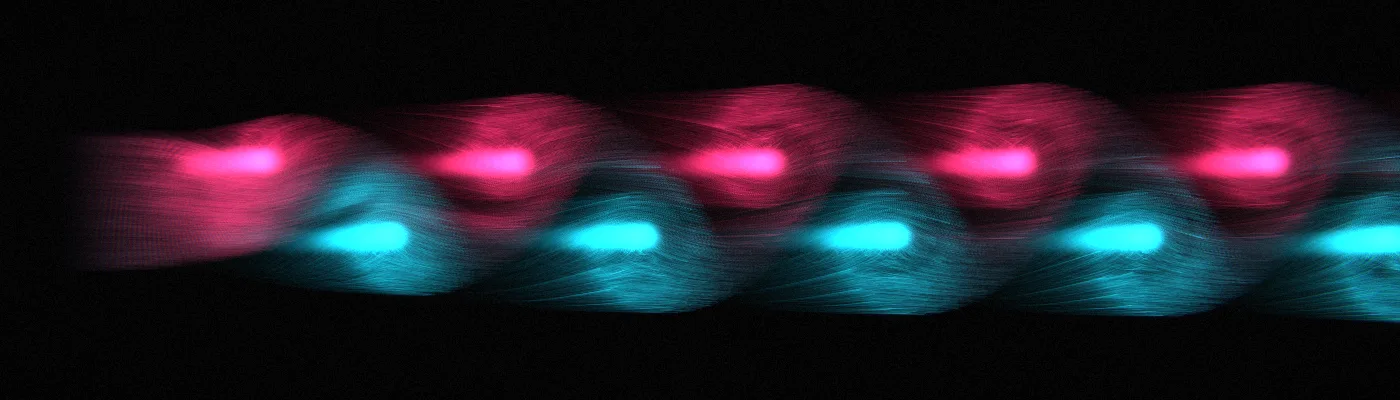
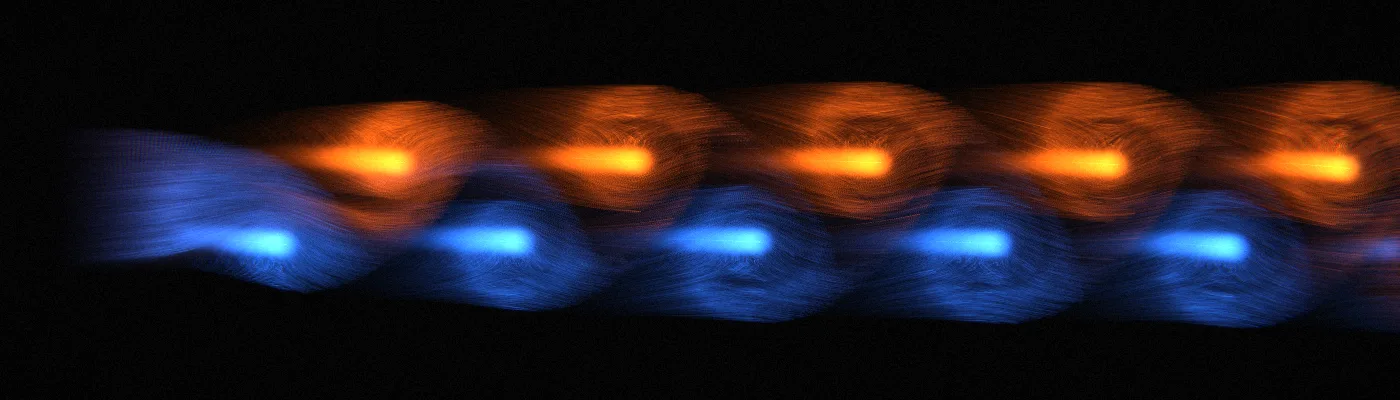
Each image below records its exact parameter set.
SELECTED STILLS — 3
PROCESS — PARAMETER SWEEPS
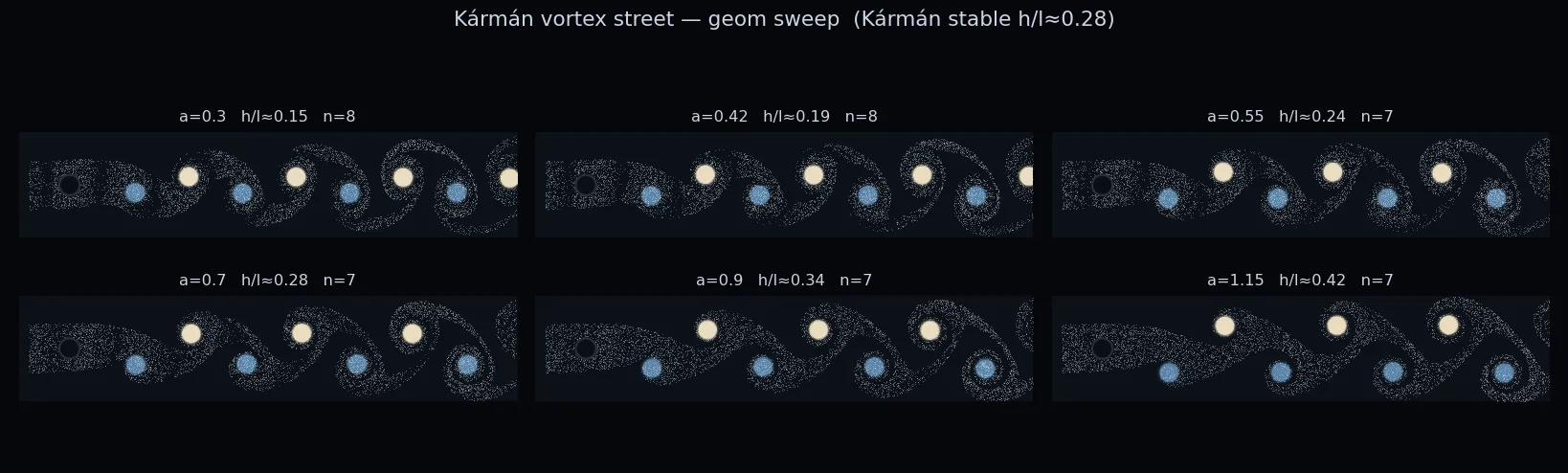
The geometry dial: sweeping the shoulder spacing a moves the row-to-spacing ratio h/l through von Kármán's stable value — the sweep lands on 0.28 near a ≈ 0.70.
SIGNATURE — ONE NUMBER IN THE TURBULENCE
Left to itself, the wake chooses 0.28.
Of all the ways two rows of vortices could stagger, von Kármán showed in 1911 that exactly one geometry is stable: a row-to-spacing ratio h/l ≈ 0.281. Flags, wires and island wakes all settle toward the same number.
The same happens inside this model: the Python engine measures h/l = 0.281 at a ≈ 0.70, and the GPU renderer drifts at ≈ 0.30 — order hiding just inside the turbulence.
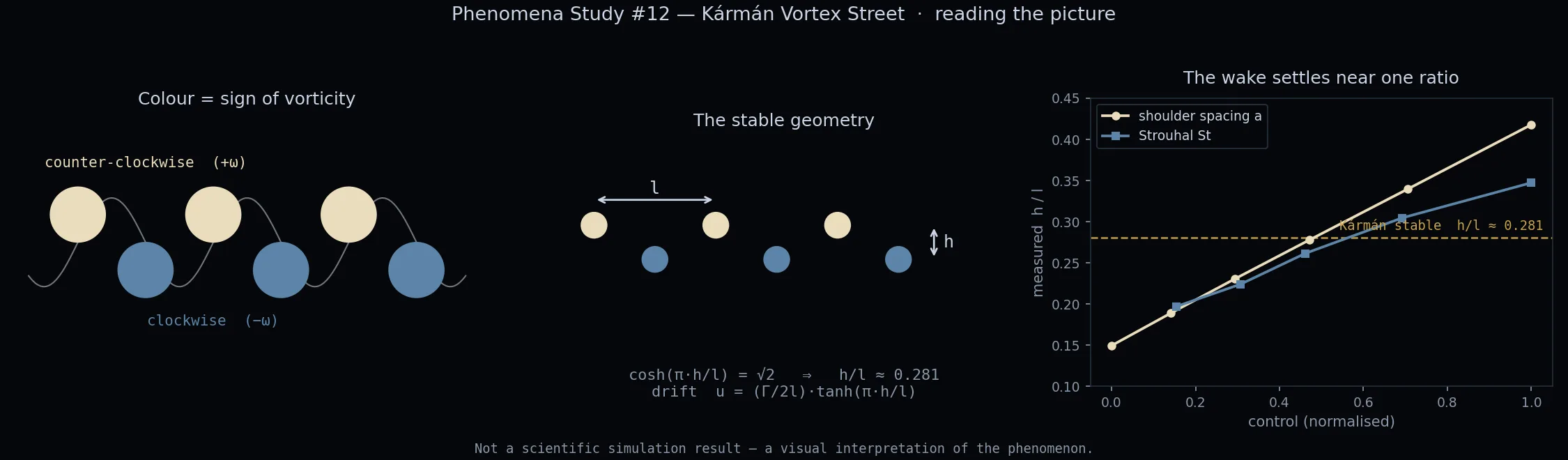
COLOUR = VORTICITY
The colour encodes the sign of vorticity: warm for counter-clockwise vortices, cool for clockwise ones. Because a Kármán street is precisely an alternation of the two, this diverging map is an encoding of a physical quantity rather than a decorative choice.
The tracer streaklines stand in for smoke or dye — brightness reads as dye density, and the strands trace where the flow has stretched and rolled the sheet up around each core.
Palettes (satellite cloud street / dye-tunnel pair / hot-cold shear) are artistic approximations, not measurements.
REFERENCES
- Th. von Kármán. "Über den Mechanismus des Widerstandes, den ein bewegter Körper in einer Flüssigkeit erfährt." Nachrichten von der Gesellschaft der Wissenschaften zu Göttingen, Math.-Phys. Klasse, 509-517 (1911).
- Th. von Kármán, H. Rubach. "Über den Mechanismus des Flüssigkeits- und Luftwiderstandes." Physikalische Zeitschrift, vol.13, 49-59 (1912).
INTERACTIVE STUDY
A wake reduced to its skeleton: a handful of point vortices shed alternately from two shoulders, inducing one another while a sheet of tracers rides the same field and draws the streaklines — the smoke. The readout keeps measuring the live street, row separation over vortex spacing, against h/l ≈ 0.281 — the one geometry von Kármán found stable. Drag row spacing and watch the wake find that ratio, or lose it. It is a deliberately simplified instrument, capped in resolution with a few curated knobs and no export, separate from the full engine used to author the finished works.
This interactive study is not intended as a scientifically validated reproduction. It is a visual interpretation generated from an implemented model and curated parameter exploration — and it is a deliberately simplified instrument, separate from the full engine used to author the finished works.