STUDY #13 · 2026 · IN OBSERVATION
Vicsek Model
A model-driven visual study of flocking and collective motion.
WHAT IS THIS
Starlings, sardines, marching locusts — large groups that move as one with no conductor. The Vicsek model (1995) captures this collective motion with a single rule: each particle moves at a fixed speed and, each step, turns toward the average heading of the neighbours within a small radius, plus a little noise. That is all — yet as the noise falls the group crosses a threshold and suddenly flows together, an order-disorder transition.
This study runs the model in real time on the GPU: headings are splatted into an orientation field, and every particle reads back the neighbours in its cell — a shortcut that lets tens of thousands of particles align at once.
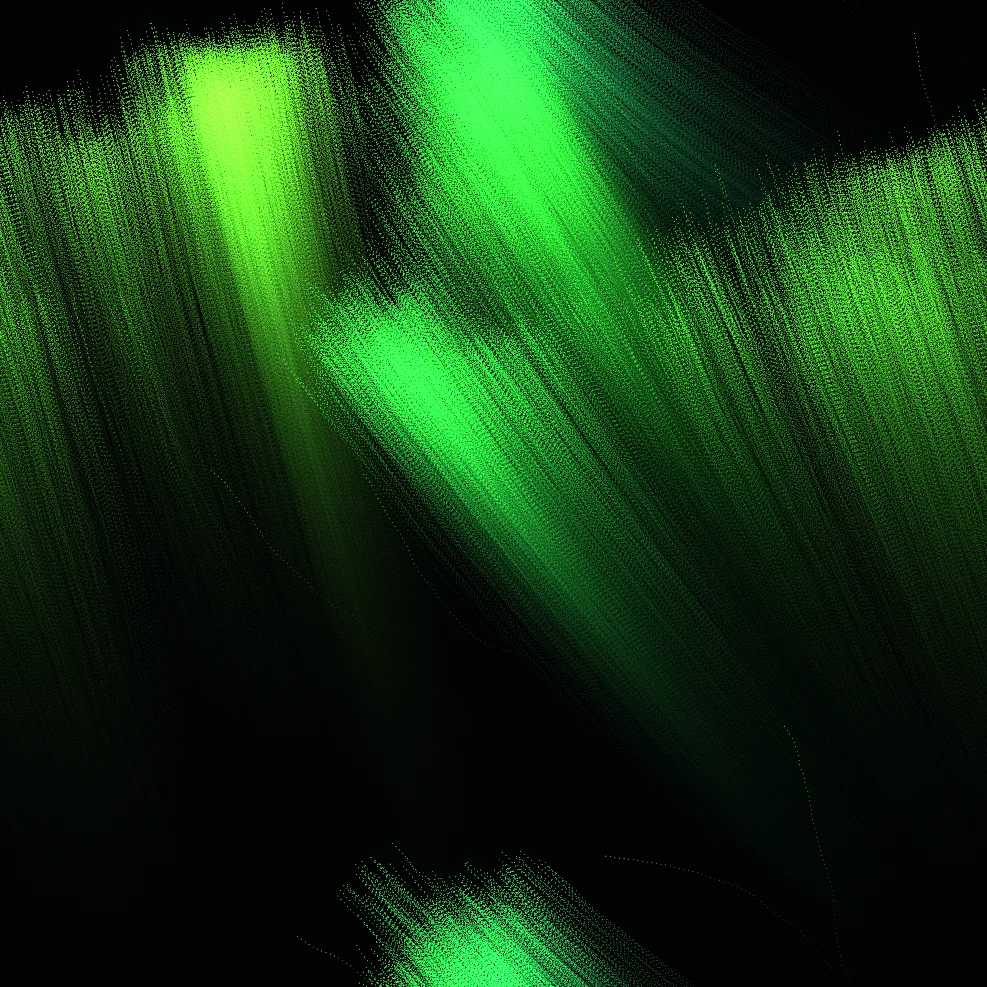
This is not a scientific simulation result, but a visual interpretation of the phenomenon.
THE SYNCHRONIZATION TRILOGY
After Kuramoto and Ising — order that moves.
PARAMETERS EXPLORED
Each image below records its exact parameter set.
SELECTED STILLS — 4
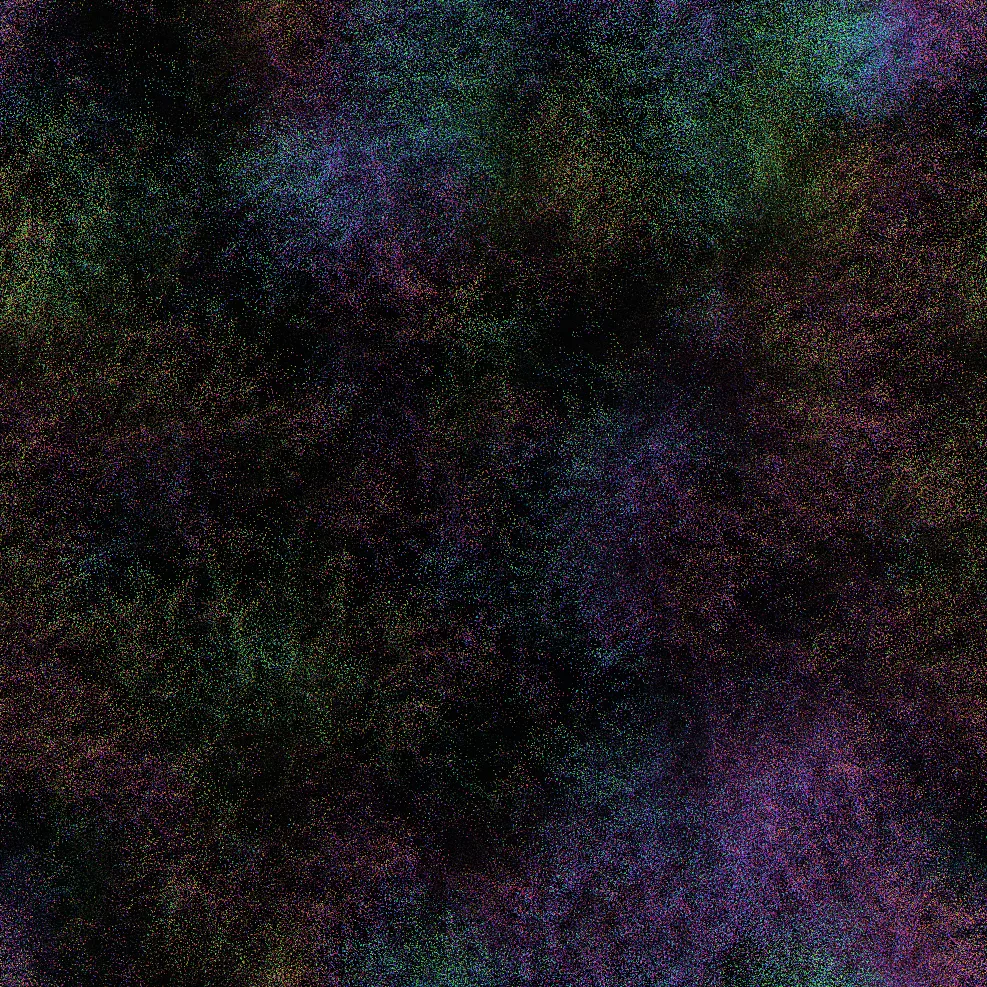
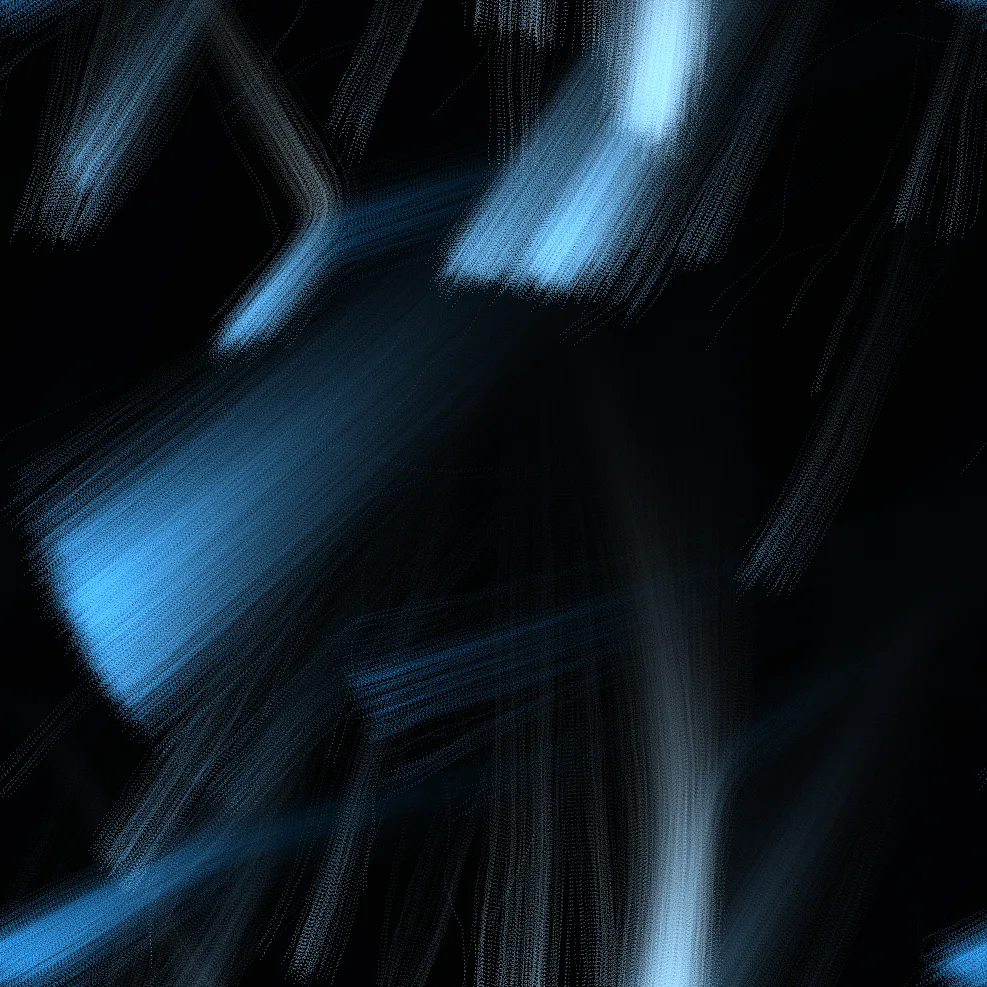
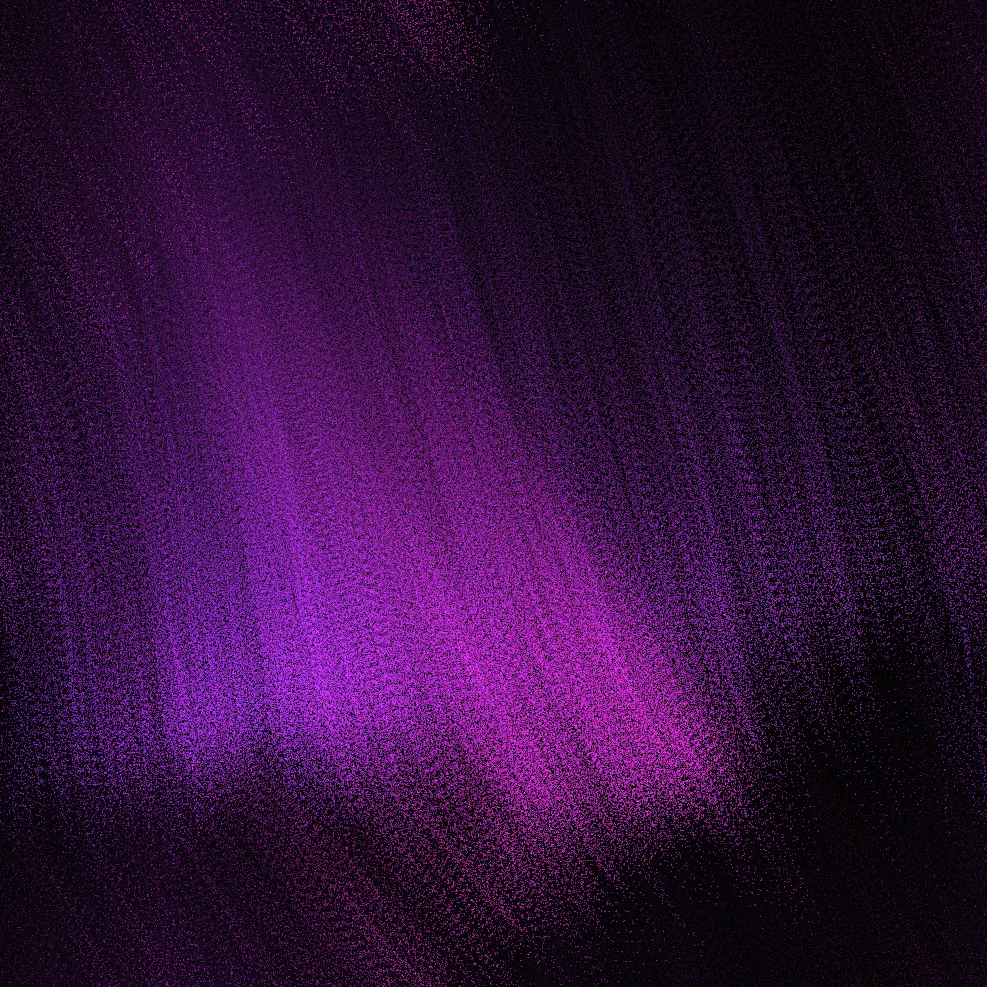
PROCESS — PARAMETER SWEEPS
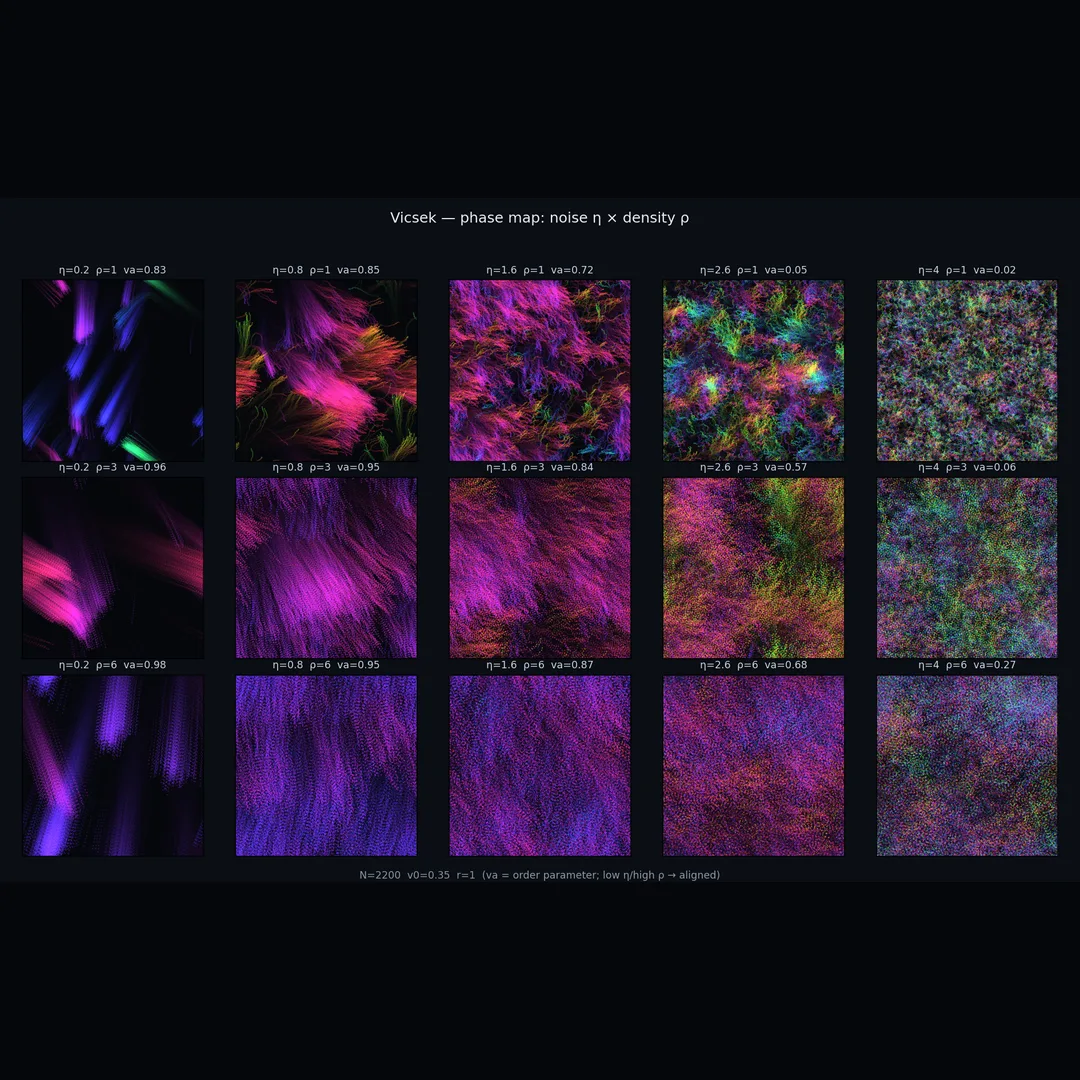
The two dials that matter, swept against each other — noise η against density ρ. The ordered phase (one hue) grows out of the gas corner, and the dilute-band regime appears along the low-density edge.
SIGNATURE — COLOUR IS THE ORDER PARAMETER
When the screen turns one colour, the flock has decided.
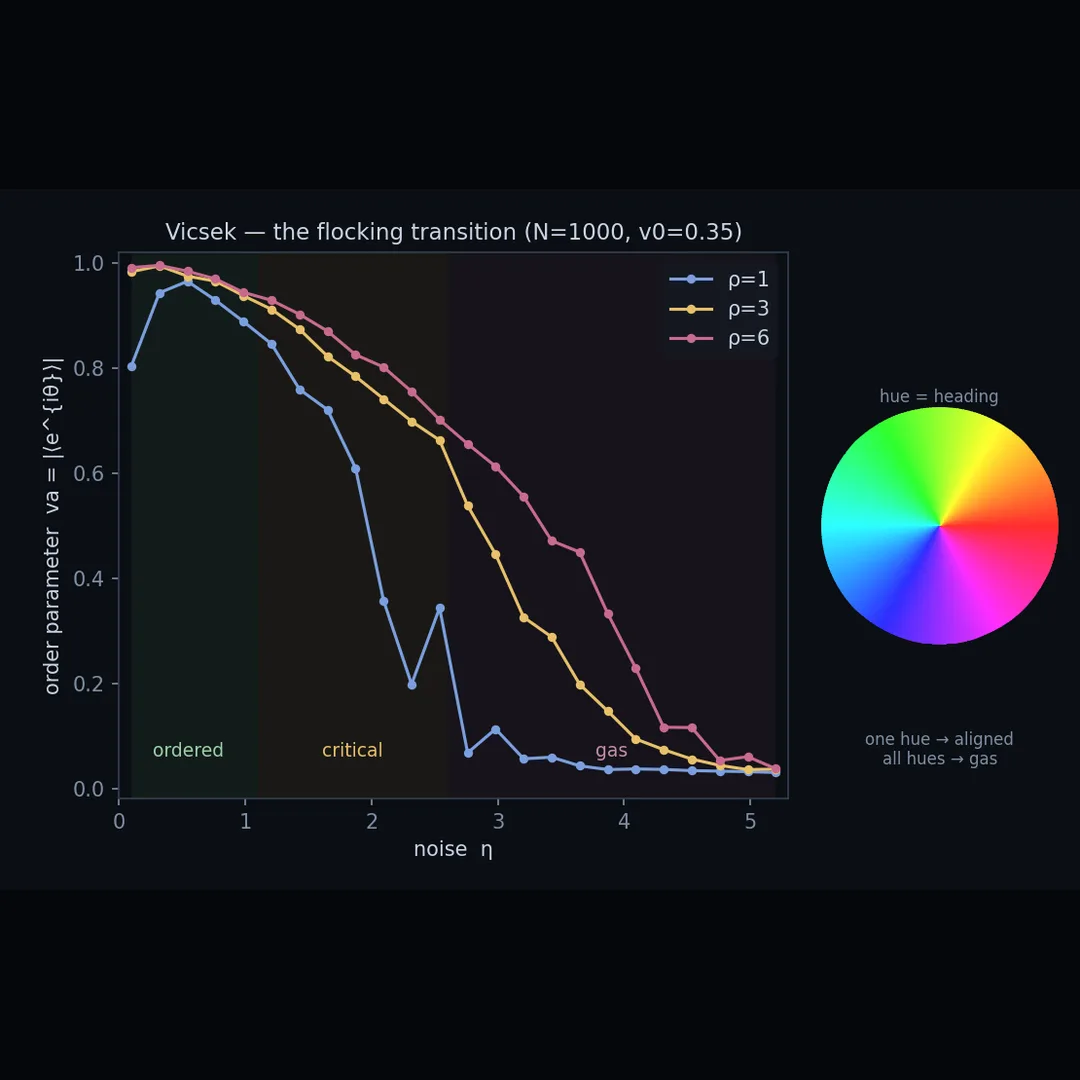
Colour encodes each particle's heading (angle → hue), the natural way to show a direction. It makes the physics visible with no instrument in between: in the ordered flock almost every particle points the same way, so the frame is nearly one hue; in the gas every hue appears together. The spread of colour on screen is, quite literally, the order parameter va.
The hero film is one slow arc of the noise dial — a gas igniting into a flock and dissolving back. You can read va off the screen the whole way.
COLOUR = HEADING
Colour encodes each particle's heading (angle → hue). In the ordered flock the frame collapses to nearly one hue; in the gas the headings point everywhere and every hue appears at once — the colour you see IS the order parameter va.
The trailing streaks are time — each particle's recent path — which is what makes a still read as a murmuration rather than a scatter of dots.
Palettes (starling / sardine / locust) are artistic nods to real flocks, not measurements.
REFERENCES
- T. Vicsek, A. Czirók, E. Ben-Jacob, I. Cohen, O. Shochet. "Novel Type of Phase Transition in a System of Self-Driven Particles." Physical Review Letters, vol.75, 1226-1229 (1995).
INTERACTIVE STUDY
The whole study fits on one slider again. Alignment noise η is live — drag it down across the transition and the rainbow gas condenses into a single-hue flock, the va readout climbing as order forms; drag it back up and the flock evaporates. Colour is heading, so the spread of hue on screen is the order parameter itself. It is a deliberately simplified instrument, capped in resolution with a few curated knobs and no export, separate from the full engine used to author the finished works.
This interactive study is not intended as a scientifically validated reproduction. It is a visual interpretation generated from an implemented model and curated parameter exploration — and it is a deliberately simplified instrument, separate from the full engine used to author the finished works.