PHENOMENA STUDIES WEAVER AXIOM
Studies Archive About
← INDEX

STUDY #16  ·  2026 · IN OBSERVATION

Snowflake

A model-driven visual study of snow crystal growth.

MOVING IMAGE — THE LETTER WRITES ITSELF ρ .38 · β 1.06 · σ 0 · 768² lattice · letter palette

WHAT IS THIS

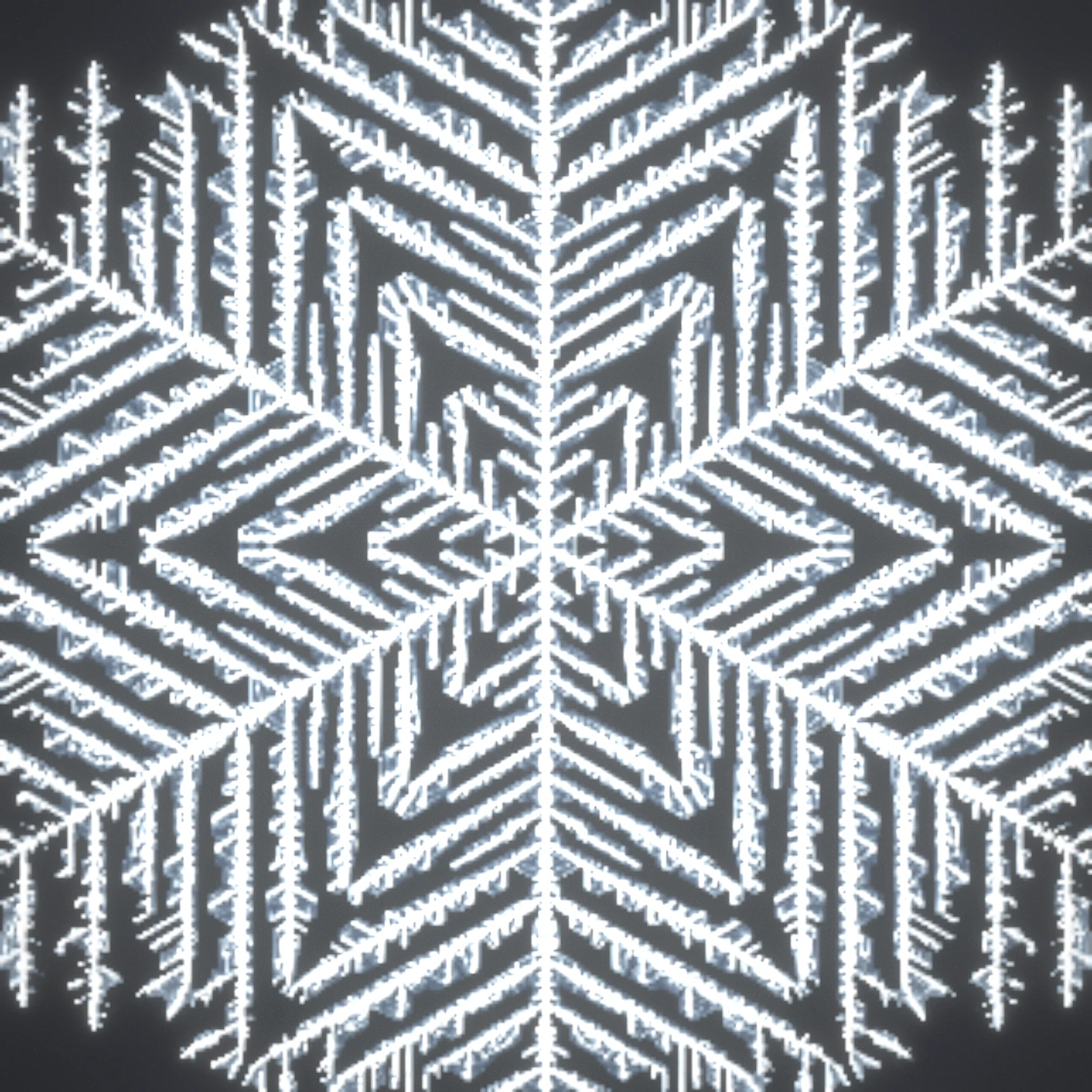
A snow crystal grows when water vapour freezes onto a tiny hexagonal seed. Two forces shape it: the six-fold symmetry of the ice lattice, and the instability of diffusion-limited growth — protruding tips reach fresher vapour and race ahead. Their balance turns one seed into plates, sectored plates, stellar dendrites or ferns.

This study implements the Gravner–Griffeath "snowfake" model (2008): a deterministic lattice map on a hexagonal grid where each cell carries ice, quasi-liquid and vapour mass. The full map — diffusion, freezing, anisotropic attachment, melting — runs in real time on the GPU.
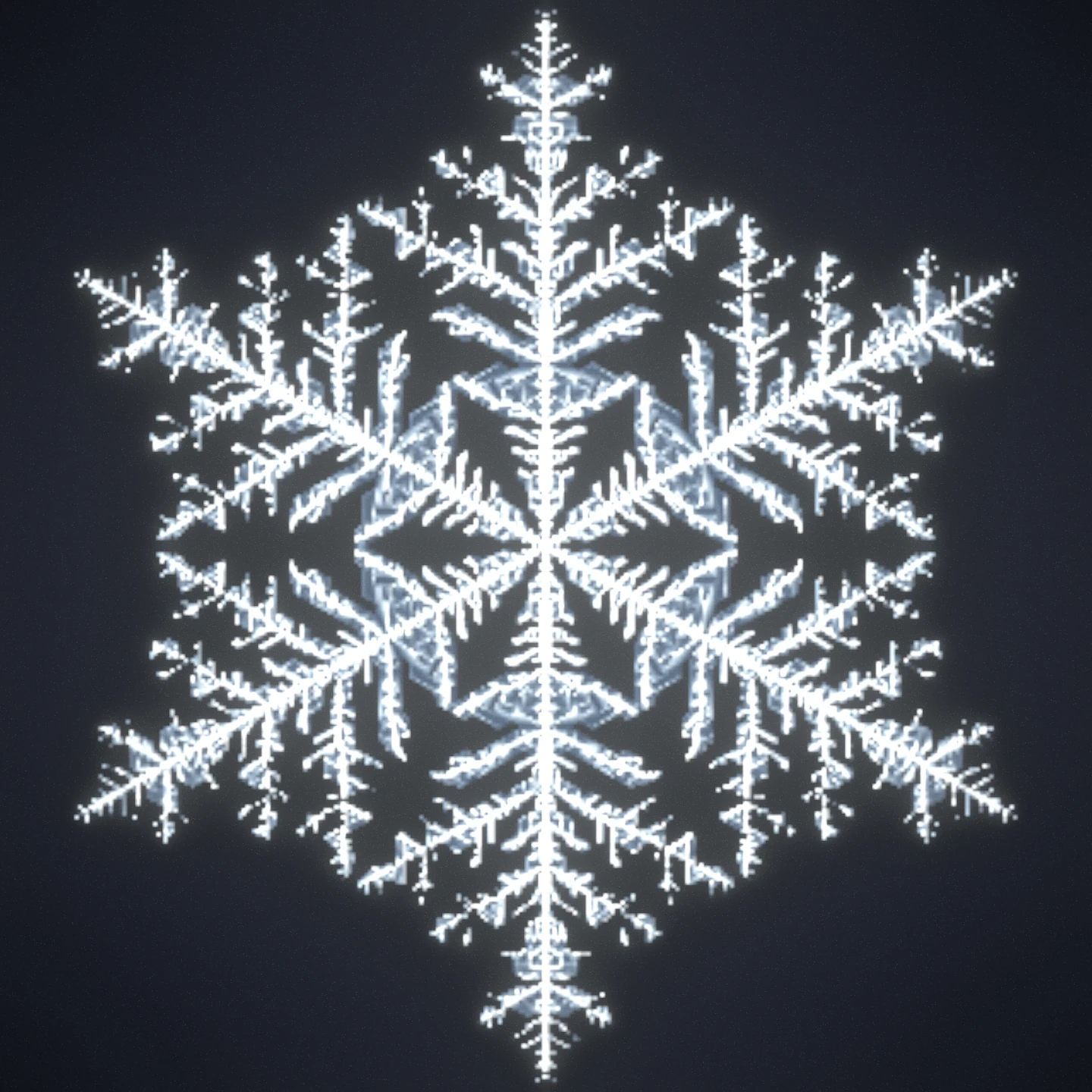
plate with dendrite ends — plates and dendrites in one letter, the map's richest regime
plate with dendrite ends — plates and dendrites in one letter, the map's richest regime ρ .38 · β 1.06 · κ .001 · µ .14 · γ 6e-5 · α .35 · θ .112 · σ 0 · t 20000 · glacier
Motif snow crystal growth / Gravner-Griffeath mesoscopic lattice map / faceting vs dendritic instability / a letter from the sky
Method A small simulator was generated and modified with AI assistance, then ported to a real-time GPU (GLSL) renderer. The visual output was selected through parameter exploration.
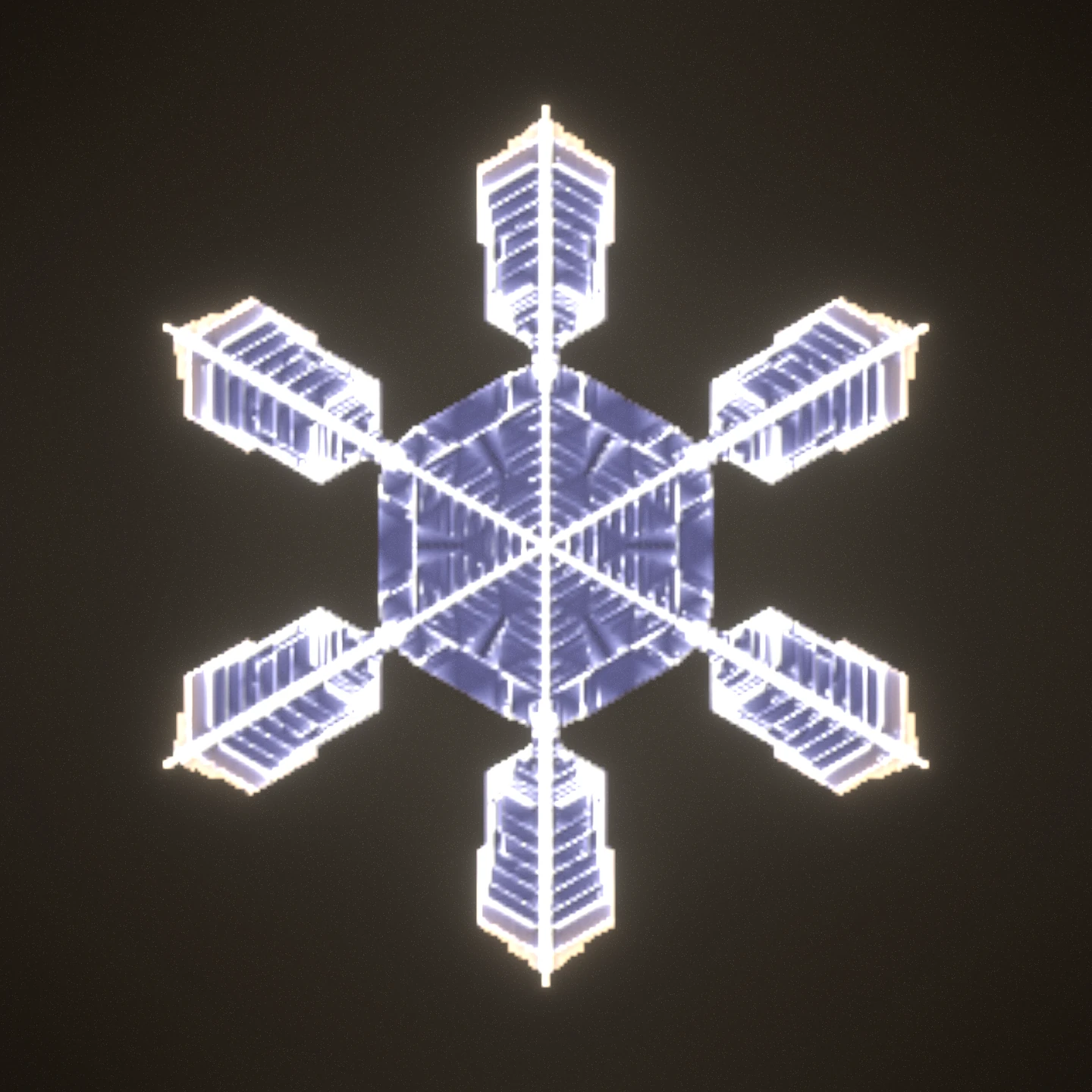
Observation With the attachment anisotropy low, vapour density rewrites the letter — sectored plates (.34), plates with dendrite ends (.38), classic stellar dendrites (.44), dense stars (.52), ferns (.62); raising the anisotropy freezes the story into a ridged hexagonal plate. Without noise the map is exactly six-fold symmetric; noise of one part in 100,000 already gives each arm its own handwriting.
Reference Janko Gravner & David Griffeath, "Modeling snow crystal growth II: A mesoscopic lattice map with plausible dynamics," Physica D, vol.237, 385-404 (2008).
Tools Python / NumPy / three.js / React / GLSL / ffmpeg / AI coding assistant
Year 2026

This is not a scientific simulation result, but a visual interpretation of the phenomenon.

SAME FAMILY, THE OPPOSITE AUTHOR

DLA is written by chance. The snowflake is written by determinism.

Study #09 — DLA Study #16 — Snowflake
What builds the branch chance — random walkers frozen where they first touch a deterministic map — no randomness anywhere
The symmetry statistical — no two arms alike exact D₆ — six arms identical, cell for cell
The surface fractal roughness at every scale hexagonal facets — flat faces from anisotropic attachment
The role of noise the builder — noise writes every branch the breaker — σ gives each arm its own handwriting

PARAMETERS EXPLORED

param meaning effect on the image
ρ vapour density (≈ supersaturation) the master knob: plates → sectored plates → stellar dendrites → ferns; also sets the tempo of growth
β attachment anisotropy — how reluctant flat faces are higher = harder facets and fewer branches, until the story freezes into a ridged hexagonal plate
κ direct freezing, skipping the quasi-liquid thins the branches; too strong and growth stalls entirely (non-monotone)
µ melting back to vapour in this regime the plate ⇄ dendrite valve — raised, the branches come out
α, θ knife-edge instability thin plates creep back between the branches — aftergrowth wings, the source of the plate's interior markings
σ vapour noise 0 = perfect six-fold symmetry; one part in 100,000 already gives each arm its own hand

Each image below records its exact parameter set.

THE MATHEMATICS the model behind the images

Gravner-Griffeath (2008), on a hexagonal lattice: every cell carries four numbers — attachment a, quasi-liquid b, ice c and vapour d. One growth cycle is four moves applied everywhere at once; with σ = 0 the map is fully deterministic.

d′(x)  =  17∑y∈Nxd(y)d'(x) \;=\; \tfrac{1}{7} \textstyle\sum_{y \in N_x} d(y)d′(x)=71​∑y∈Nx​​d(y)
Diffusion: vapour relaxes as a seven-point average over a cell and its six neighbours; attached cells reflect it back.
b′=b+(1−κ) d,c′=c+κ d,d′=0(x∈∂A)b' = b + (1-\kappa)\,d, \qquad c' = c + \kappa\,d, \qquad d' = 0 \qquad (x \in \partial A)b′=b+(1−κ)d,c′=c+κd,d′=0(x∈∂A)
Freezing: at the crystal boundary a fraction κ of the vapour freezes directly to ice; the rest joins the quasi-liquid layer.
n≤2: b≥βn=3: b≥1  or  (∑Nxd<θ and b≥α)n≥4: attachn \le 2:\ b \ge \beta \qquad n = 3:\ b \ge 1 \ \ \text{or}\ \ \big( \textstyle\sum_{N_x} d < \theta \ \text{and}\ b \ge \alpha \big) \qquad n \ge 4:\ \text{attach}n≤2: b≥βn=3: b≥1  or  (∑Nx​​d<θ and b≥α)n≥4: attach
Attachment — the anisotropy: the fewer attached neighbours n a site has, the more quasi-liquid it must gather, and β > 1 is what makes facets. The (α, θ) clause is the knife-edge instability: vapour-starved hollows let thin plates creep back in.
b′=(1−μ) b,c′=(1−γ) cb' = (1-\mu)\,b, \qquad c' = (1-\gamma)\,cb′=(1−μ)b,c′=(1−γ)c
Melting: a little of the boundary returns to vapour each cycle — in the regime explored here, µ is the valve between plates and dendrites.

A visual interpretation of the model, not an exact reproduction of the paper's figures. With σ = 0 this implementation conserved total mass b + c + d to 1.8e-16 and held exact six-fold symmetry.

SELECTED STILLS — 6
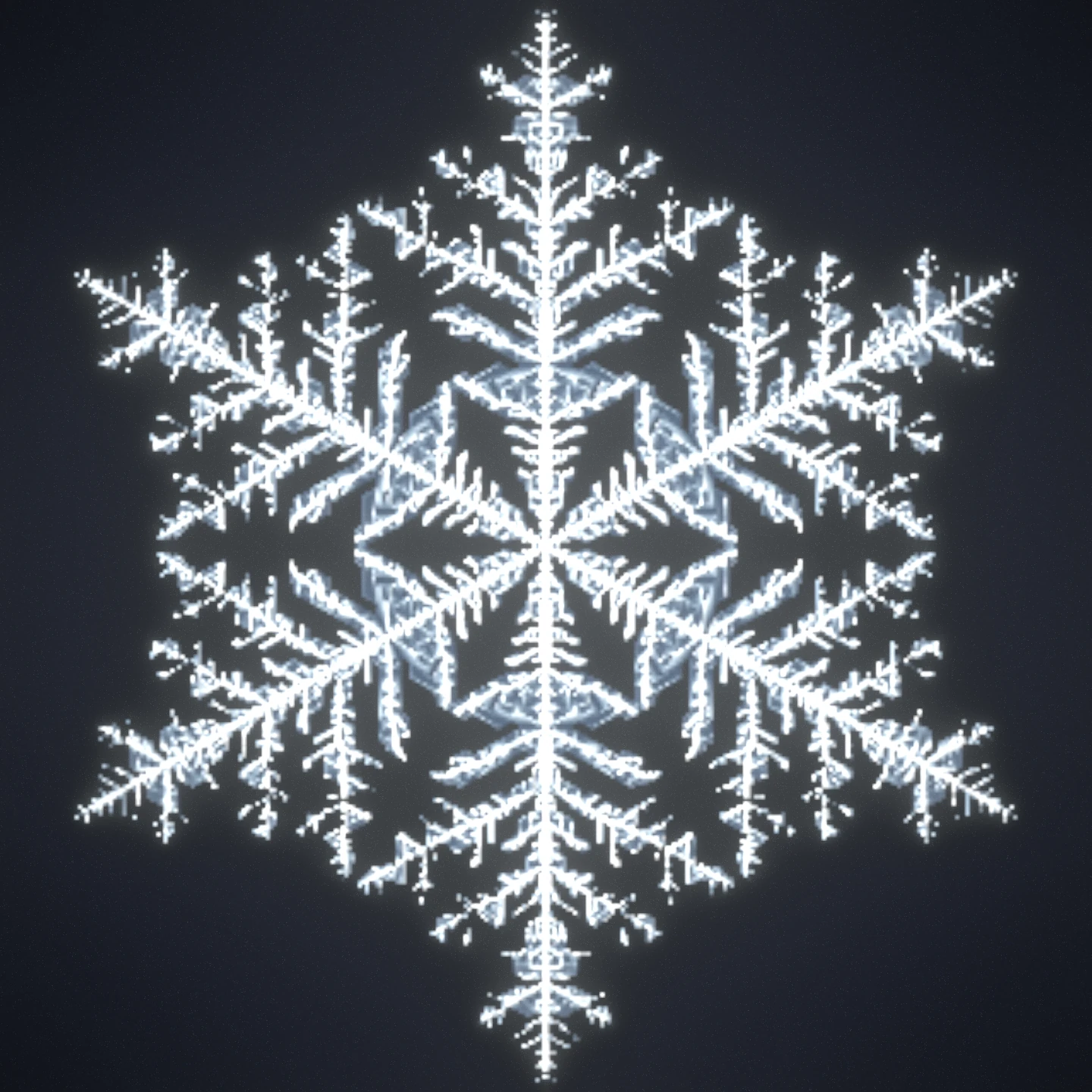
plate with dendrite ends — the hero letter
plate with dendrite ends — the hero letter ρ .38 · β 1.06 · κ .001 · µ .14 · γ 6e-5 · α .35 · θ .112 · σ 0 · t 20000 · glacier
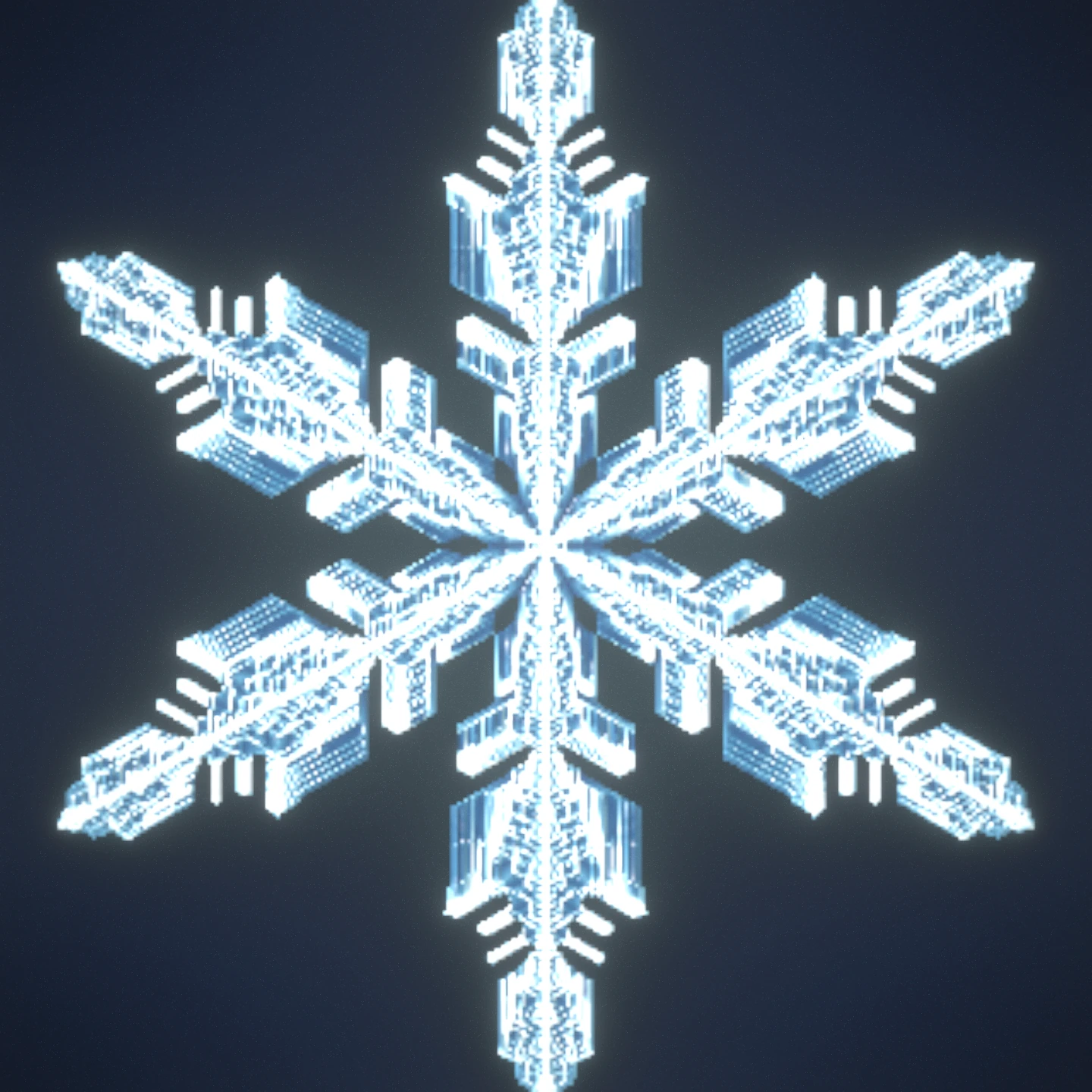
classic stellar dendrite — what everyone calls a snowflake
classic stellar dendrite — what everyone calls a snowflake ρ .44 · β 1.03 · κ .001 · µ .14 · γ 6e-5 · α .35 · θ .112 · σ 0 · t 6000 · darkfield
dense stellar — crowded and ornate
dense stellar — crowded and ornate ρ .5 · β 1.06 · κ .001 · µ .14 · γ 6e-5 · α .35 · θ .112 · σ 0 · t 6000 · darkfield
six-arm star — thick arms
six-arm star — thick arms ρ .52 · β 1.15 · κ .001 · µ .14 · γ 6e-5 · α .35 · θ .112 · σ 0 · t 10000 · glacier
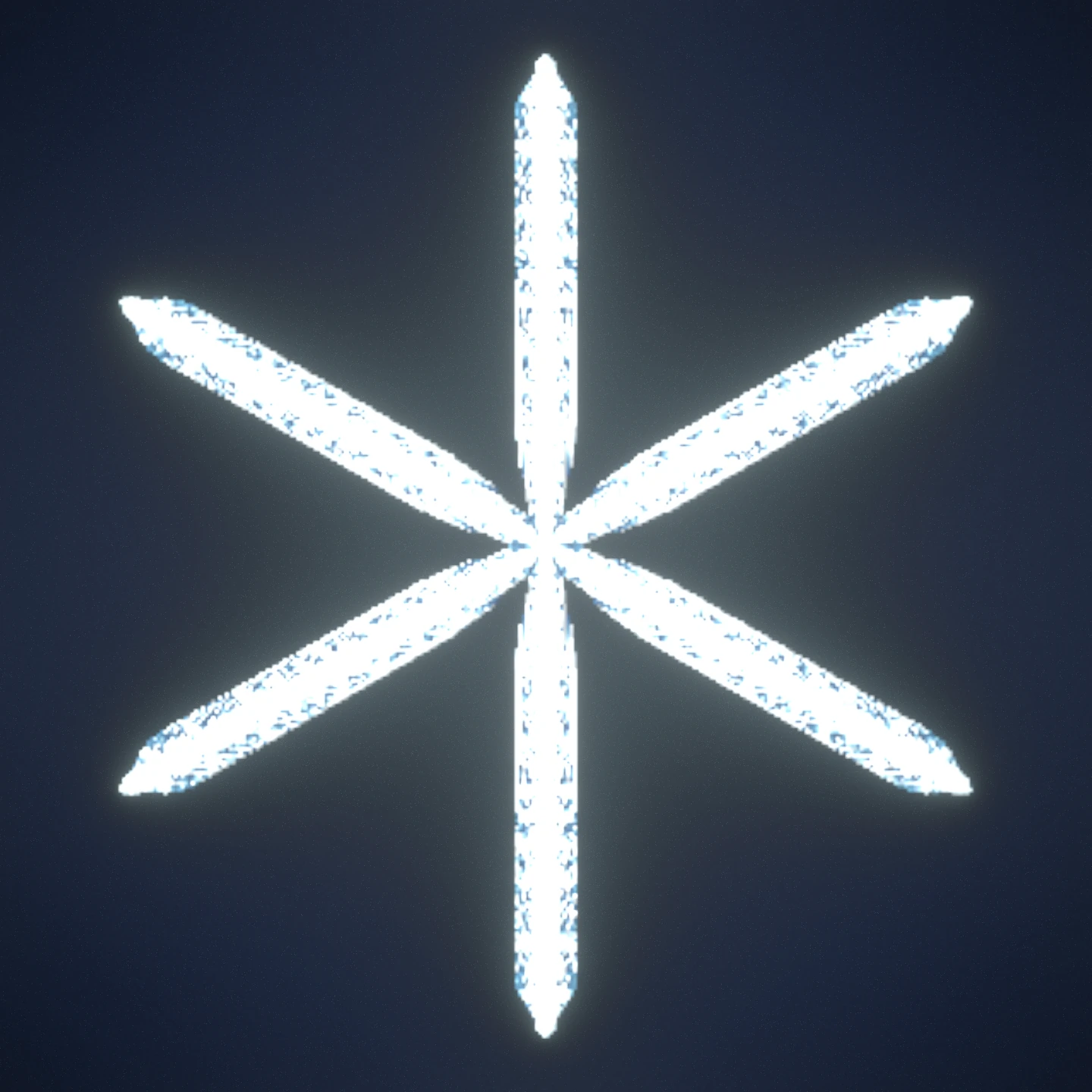
simple star — bones only
simple star — bones only ρ .65 · β 1.75 · κ .15 · µ .015 · γ 1e-5 · α .2 · θ .026 · σ 0 · t 15000 · glacier
mid-growth — the pen still warm
mid-growth — the pen still warm ρ .38 · β 1.06 · κ .001 · µ .14 · γ 6e-5 · α .35 · θ .112 · σ 0 · t 9000 · letter · front glow

PROCESS — PARAMETER SWEEPS

The exploration as a morphology map — vapour density against attachment anisotropy, twenty-five deterministic runs, six-fold symmetry checked on every cell. Along the low-anisotropy edge ρ rewrites the letter — sectored plates, plates with dendrite ends, stellar dendrites, dense stars, ferns; raise β and every one of them freezes into a ridged hexagonal plate.
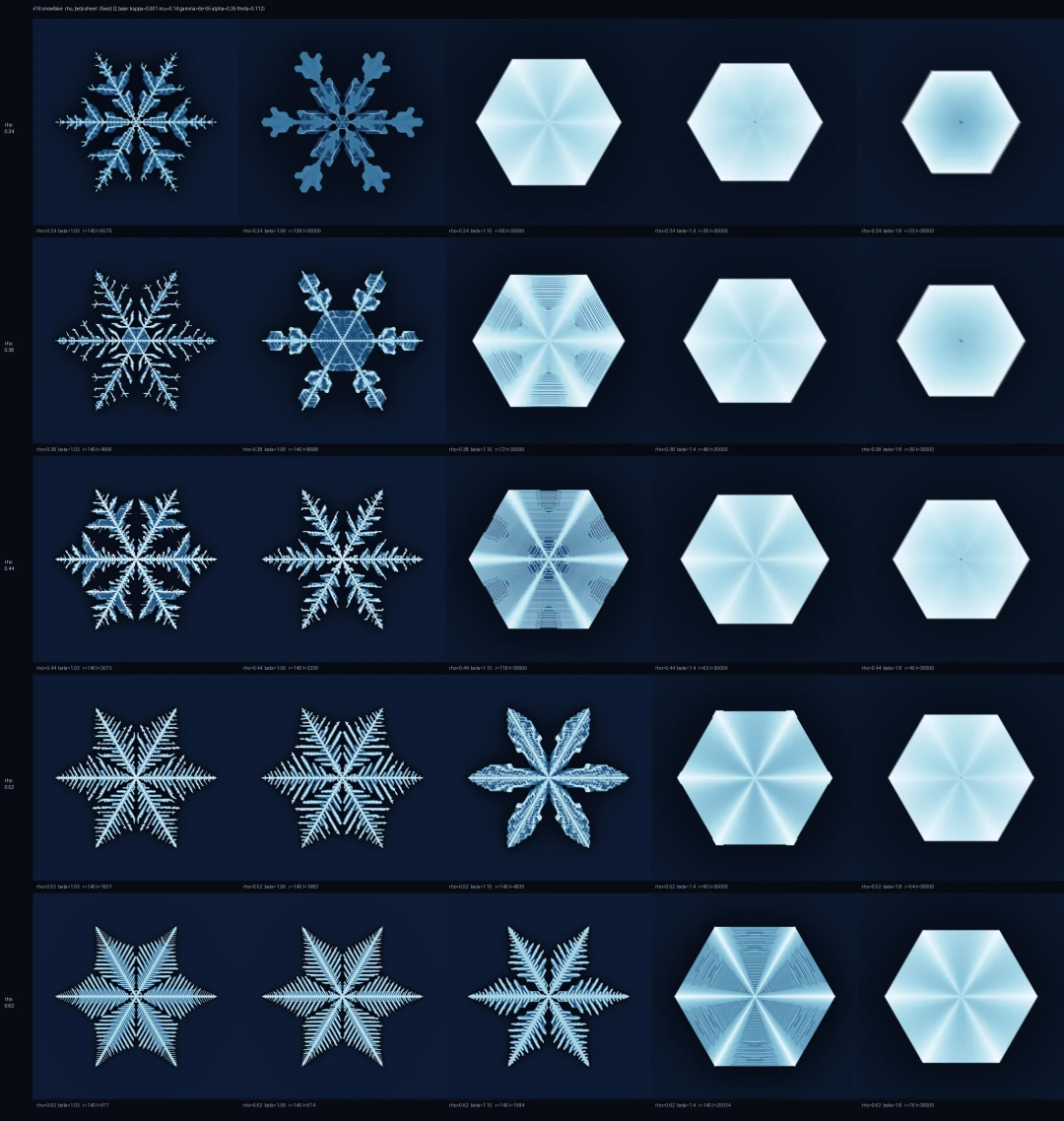
the ρ×β morphology sheet — a computed cousin of Nakaya's diagram
the ρ×β morphology sheet — a computed cousin of Nakaya's diagram ρ .34–.62 × β 1.03–1.8 · 25 deterministic runs · σ 0 · D₆ checked on every cell

SIGNATURE — WHY ALL SIX ARMS MATCH

The arms never talk to each other. The growth is simply deterministic — noise is what breaks the spell.

The old riddle of the snowflake — how do six arms, growing far apart, write the same story? — has a quiet answer in this model: they do not communicate, and they do not need to. The map is deterministic, so six arms reading the same sky grow the same shape. Run noiseless, the flake here is exactly six-fold symmetric — measured mismatch zero — and total mass is conserved to machine precision (1.8 × 10⁻¹⁶).

Add the faintest vapour noise and the spell breaks by degrees: at σ = 10⁻⁴ each arm finds its own handwriting; by 5 × 10⁻³ it is the irregular snow of the real sky. Nakaya called snow crystals "letters from the sky" — the shape a record of the air it grew in. Determinism writes the symmetry; noise writes the personality.
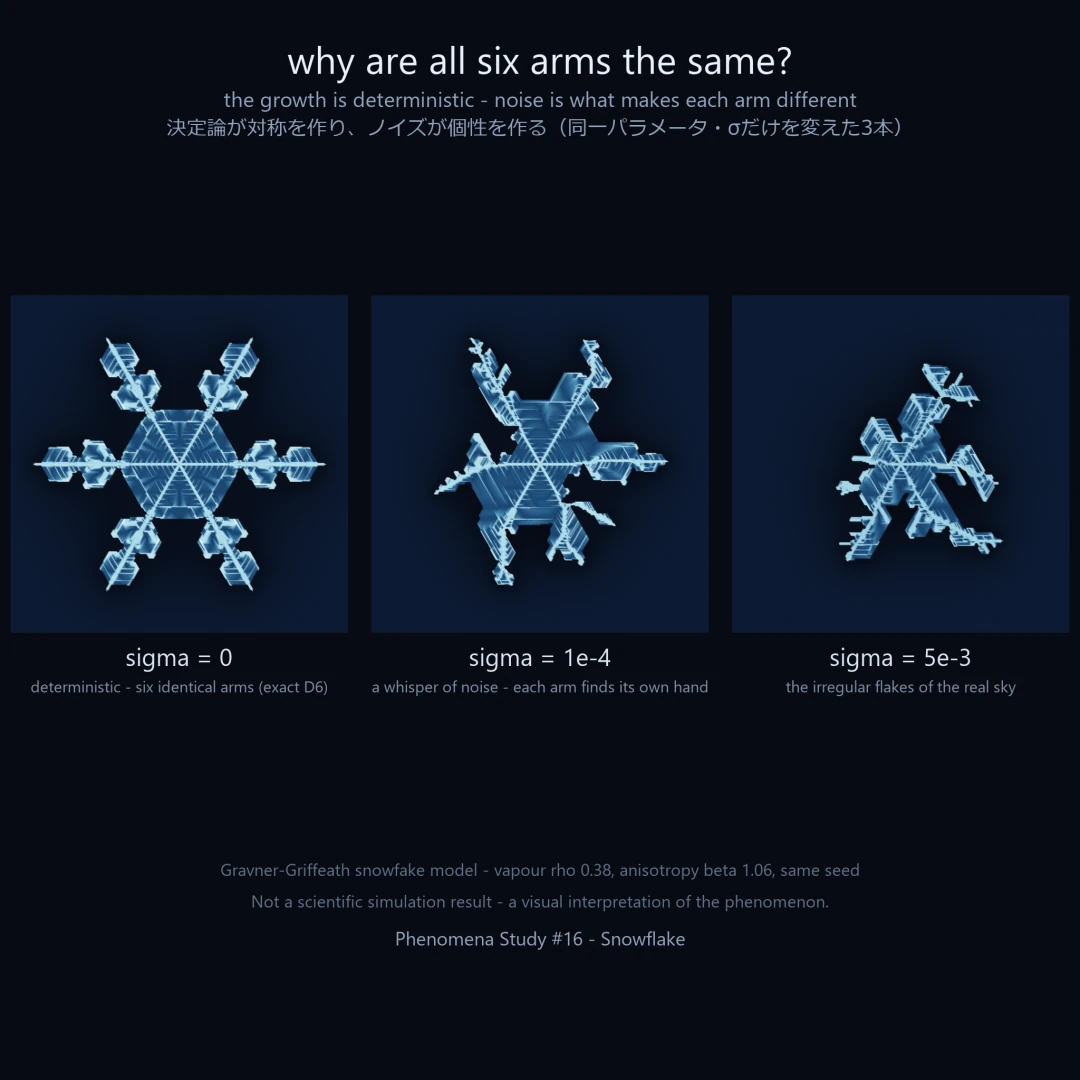
the σ series — same sky, only the noise differs
the σ series — same sky, only the noise differs σ 0 → 1e-4 → 5e-3 · same params · D₆ exact at σ 0

COLOUR = ICE OPTICS

Thick ice absorbs a little red light (the O–H overtones), which is why glaciers and crevasses glow blue — and the main palette grounds the flake in that optic: deep blue where the ice is thin, rising to white where the ridges pile up.

The interior markings are not painted. The model's crystal-mass field records macrostep waves, ridges and ribs exactly where real flakes carry them, and it is rendered as relief-lit thickness. The glow at the rim marks ice that attached moments ago — the growth front itself, the nib of the pen.

the letter palette — the rim glowing where the newest ice attached
the letter palette — the rim glowing where the newest ice attached ρ .38 · β 1.06 · t 9000 · σ 0 · letter · front glow

The colours are artistic approximations of ice optics, not measurements.

REFERENCES

  1. Janko Gravner, David Griffeath. "Modeling snow crystal growth II: A mesoscopic lattice map with plausible dynamics." Physica D: Nonlinear Phenomena, vol.237, 385-404 (2008). https://doi.org/10.1016/j.physd.2007.09.008
  2. Kenneth G. Libbrecht. "The physics of snow crystals." Reports on Progress in Physics, vol.68, 855-895 (2005).
  3. Ukichiro Nakaya. "Snow Crystals: Natural and Artificial." Harvard University Press (1954).
  4. Clifford A. Reiter. "A local cellular model for snow crystal growth." Chaos, Solitons & Fractals, vol.23, 1111-1119 (2005).

INTERACTIVE STUDY

One frozen cell, a field of vapour, and a six-fold rule — nothing else. Because the map is deterministic, all six arms write the same story without ever talking to each other. Drag vapour ρ and the letter is regrown from its seed with new content — plate, star or fern — while a whisper of noise σ gives each arm its own hand. It is  a deliberately simplified instrument, capped in resolution with a few curated knobs and no export, separate from the full engine used to author the finished works.

SIMPLIFIED INSTRUMENTGRAVNER–GRIFFEATH · HEX LATTICE · LIVE

This interactive study is not intended as a scientifically validated reproduction. It is a visual interpretation generated from an implemented model and curated parameter exploration — and it is a deliberately simplified instrument, separate from the full engine used to author the finished works.

← ALL STUDIES STUDY #17 · XY MODEL — VORTEX UNBINDING · IN OBSERVATION →
PHENOMENA STUDIES — WEAVER AXIOM PERSONAL VISUAL RESEARCH · © 2026