STUDY #18 · 2026 · IN OBSERVATION
Rayleigh–Bénard Convection
A model-driven visual study of heat becoming motion.
WHAT IS THIS
A fluid layer heated from below stays perfectly still while the temperature difference is small: heat simply diffuses. Past a critical difference, buoyancy beats viscosity and the layer spontaneously organizes into convection cells — the same skeleton that appears in a soup bowl, in Earth's mantle, and in the granulation on the Sun.
The model is the two-dimensional Boussinesq equations in vorticity–streamfunction form, with the free-slip boundaries of Rayleigh's 1916 analysis — the rare convection setup where theory is exact: onset at Ra_c = 27π⁴/4 ≈ 657.5, preferred wavelength 2√2 layer depths. This study runs it in real time on the GPU (a ping-pong texture holds vorticity, temperature and streamfunction; a relaxation pass recovers the flow).
The film follows the birth of convection from silence: the boundary layer fails everywhere at once, a forest of plumes erupts, collides, winds into spirals, and settles into cells that keep the memory of their birth.
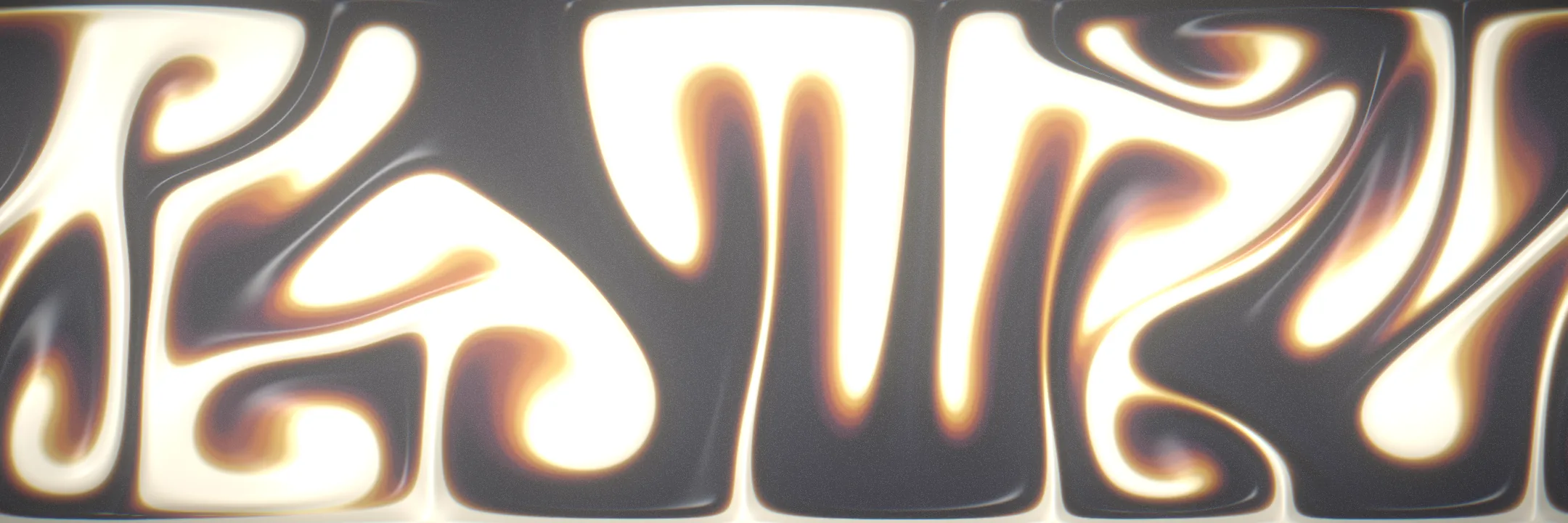
This is not a scientific simulation result, but a visual interpretation of the phenomenon.
THE SAME CONVECTION, TWO PORTRAITS
The butterfly was born in this pot — the Lorenz equations are this layer, cut to three modes.
PARAMETERS EXPLORED
Each image below records its exact parameter set.
THE MATHEMATICS the model behind the images
The model, exactly as Saltzman wrote it in 1962: the two-dimensional Boussinesq equations in vorticity–streamfunction form, with the free-slip boundaries of Rayleigh's 1916 analysis. Temperature is written as the departure θ from the still, purely conducting state; J(ψ, ·) is carriage by the flow.
Free-slip boundaries (ψ = ω = θ = 0 at the plates); lengths in layer depths, time in thermal-diffusion times. A visual interpretation of the Boussinesq description, not an exact reproduction.
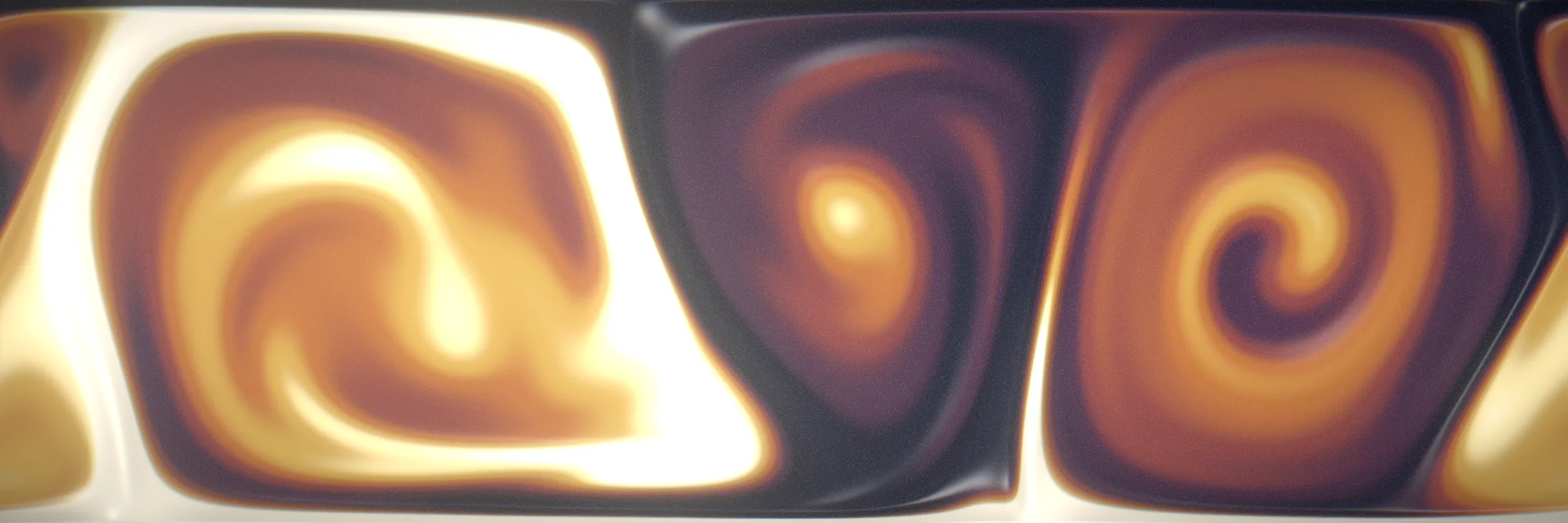
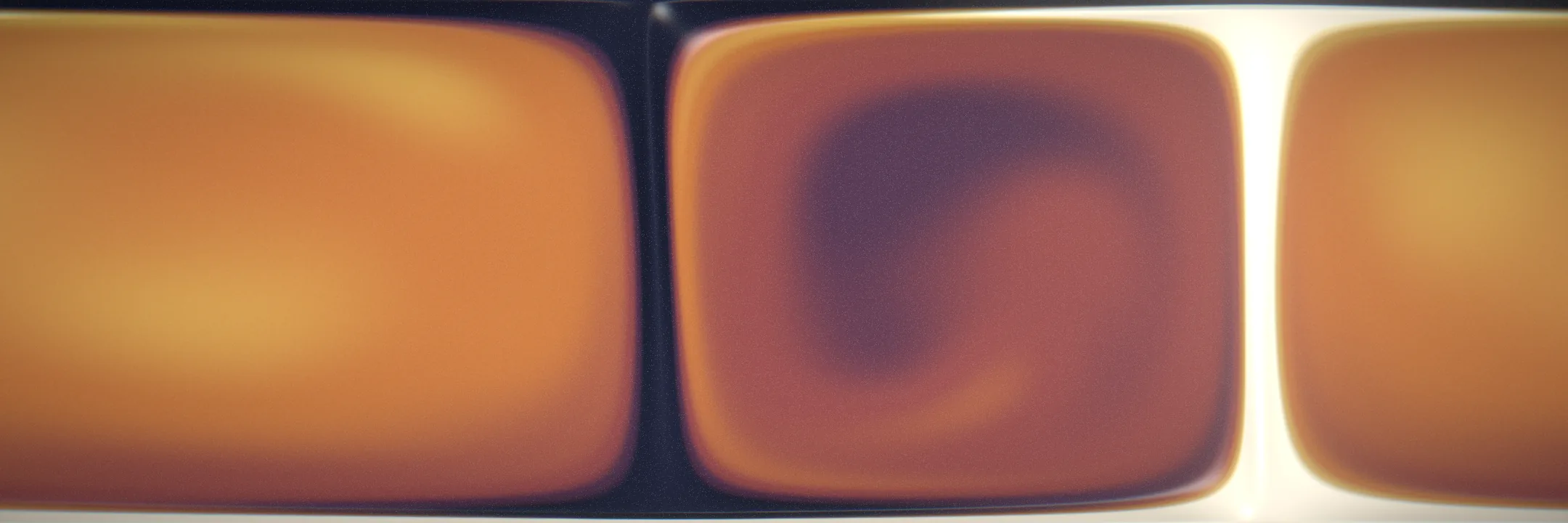
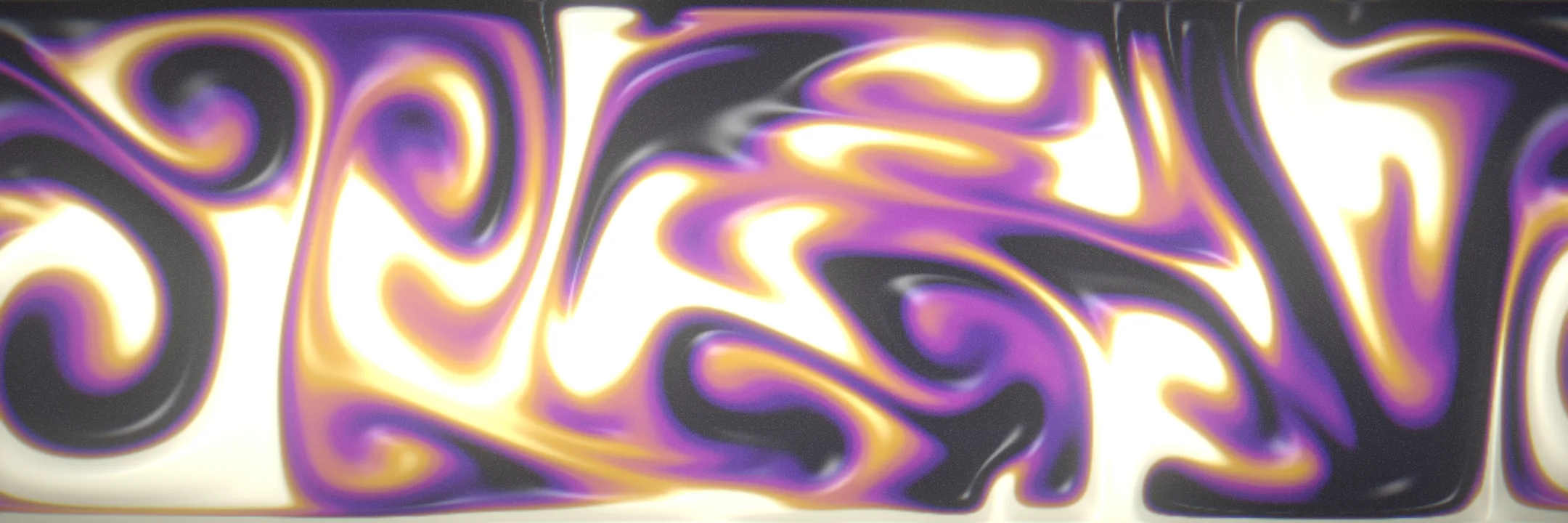
SELECTED STILLS — 4
PROCESS — PARAMETER SWEEPS
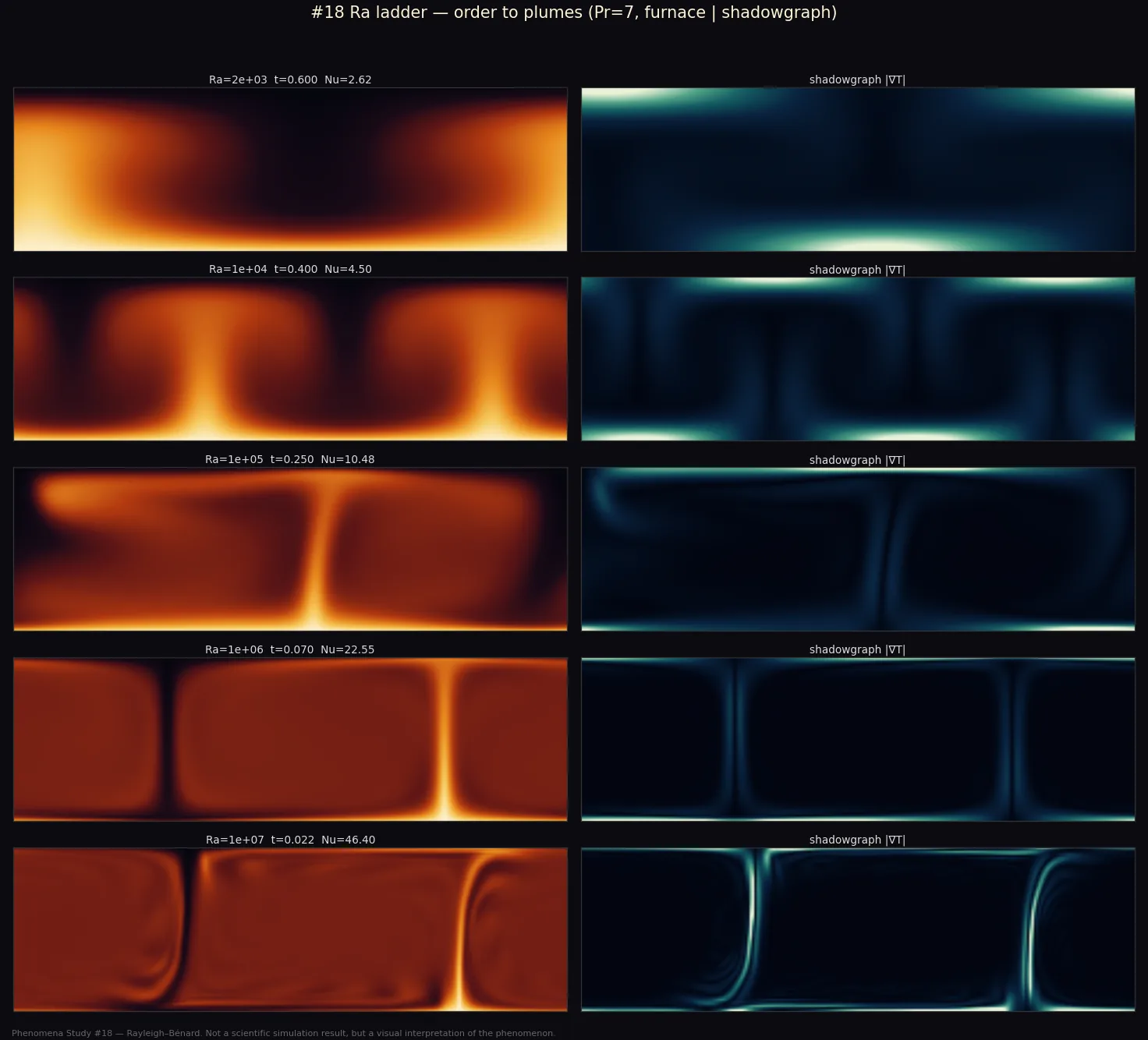
The main axis of the exploration as a contact sheet: the Rayleigh number climbing five decades at Pr 7 — a soft single roll, textbook mushroom plumes, unsteady tilting cells, glowing plume columns, turbulent filaments — each beside its shadowgraph reading (|∇T|), the way a laboratory sees invisible convection. The heat carried climbs Nu 2.6 → 46.
SIGNATURE — A UNIVERSAL NUMBER
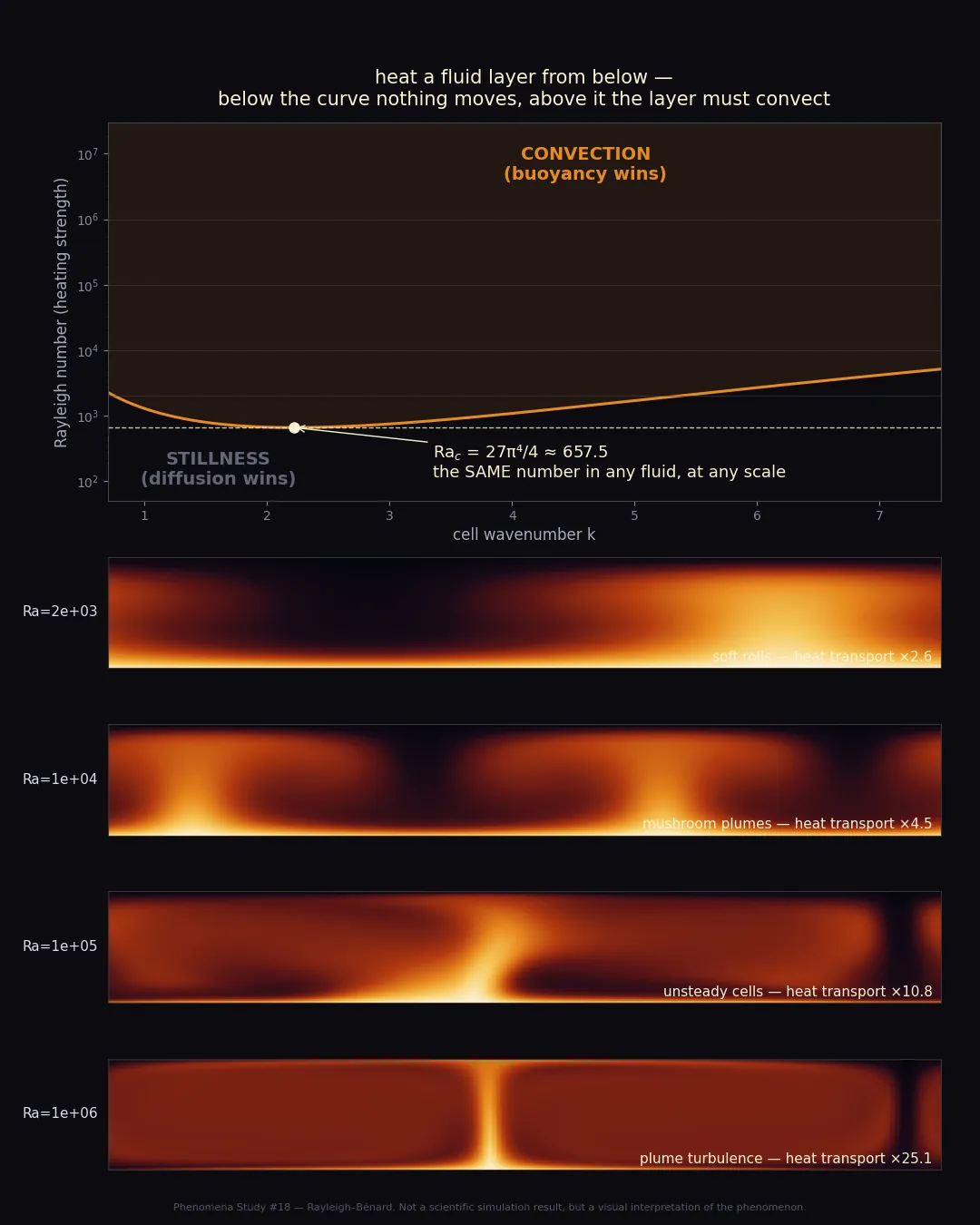
Stillness ends at 657.5 — in any fluid, at any scale.
Heated gently, the layer carries its heat in perfect stillness. Rayleigh's 1916 analysis names the exact moment that stillness must end: Ra_c = 27π⁴/4 ≈ 657.5 — a threshold with no material property left in it, the same number for air, water or oil, in a saucepan or a star.
This engine was measured against that line before any image was kept: it finds the onset at Ra_c = 657.66, 0.022% from the exact value; seeded with pure noise it selects the cell width theory predicts, k/k_c = 1.000; and the heat it carries balances the motion it stirs to a fraction of a percent.
COLOUR = HOW HEAT IS SEEN
Temperature is the protagonist, so each palette is grounded in a real way of seeing heat. furnace: black-body incandescence — matter begins to glow dull red near 800 K (the Draper point) and climbs through orange to white heat. ironbow: the standard false-colour ramp of industrial thermal cameras. granule: solar granulation — bright rising cell cores, dark sinking lanes. abyss: the cold reading, deep water.
The embossed relief follows the temperature gradient, the way schlieren and shadowgraph imaging turn invisible convection into visible lines in a laboratory.
All palettes are artistic approximations of these references, not measurements.
REFERENCES
- Henri Bénard. "Les tourbillons cellulaires dans une nappe liquide." Revue Générale des Sciences Pures et Appliquées, vol.11, 1261-1271 & 1309-1328 (1900).
- Lord Rayleigh. "On convection currents in a horizontal layer of fluid, when the higher temperature is on the under side." Philosophical Magazine Series 6, vol.32, no.192, 529-546 (1916).
- Barry Saltzman. "Finite Amplitude Free Convection as an Initial Value Problem — I." Journal of the Atmospheric Sciences, vol.19, 329-341 (1962).
- S. Chandrasekhar. "Hydrodynamic and Hydromagnetic Stability." Oxford University Press (1961).
- Mark J. Block. "Surface tension as the cause of Bénard cells and surface deformation in a liquid film." Nature, vol.178, 650-651 (1956).
INTERACTIVE STUDY
A thin layer of fluid on a hot plate, deciding whether to boil. Rayleigh number is live — the one dial. Drag it below the Ra_c tick and the layer gives up motion: heat crosses by conduction alone and the glow settles into a smooth gradient. Drag it past, and rolls organise out of nothing; push toward the top and plumes storm off the hot plate. It is a deliberately simplified instrument — a smaller grid and fewer relaxation sweeps, capped in resolution with a few curated knobs and no export — separate from the full GPU engine used to author the finished works.
This interactive study is not intended as a scientifically validated reproduction. It is a visual interpretation generated from an implemented model and curated parameter exploration — and it is a deliberately simplified instrument, separate from the full engine used to author the finished works.