PHENOMENA STUDIES WEAVER AXIOM
Studies Archive About
← INDEX

STUDY #19  ·  2026 · IN OBSERVATION

Meinhardt Seashells

A model-driven visual study of pigment patterns as a growing edge's record in time.

MOVING IMAGE — THE GROWTH ARC spark 0.0012→0.0022 · Da 0.15→0.115 · 420 rows woven · nacre

WHAT IS THIS

A seashell grows by accreting material at its lip, where a single line of pigment cells decides, moment by moment, where to lay colour. Once placed, pigment never moves. So the pattern you see is not a picture — it is a space-time record of a one-dimensional edge: across = position along the lip, down = growth time.

Hans Meinhardt showed that one activator–inhibitor reaction-diffusion system on that edge explains almost every known shell pattern. This study runs his three-variable system (activator, inhibitor, slow refractory hormone) in real time on the GPU, accreting each instant as one new row of shell.
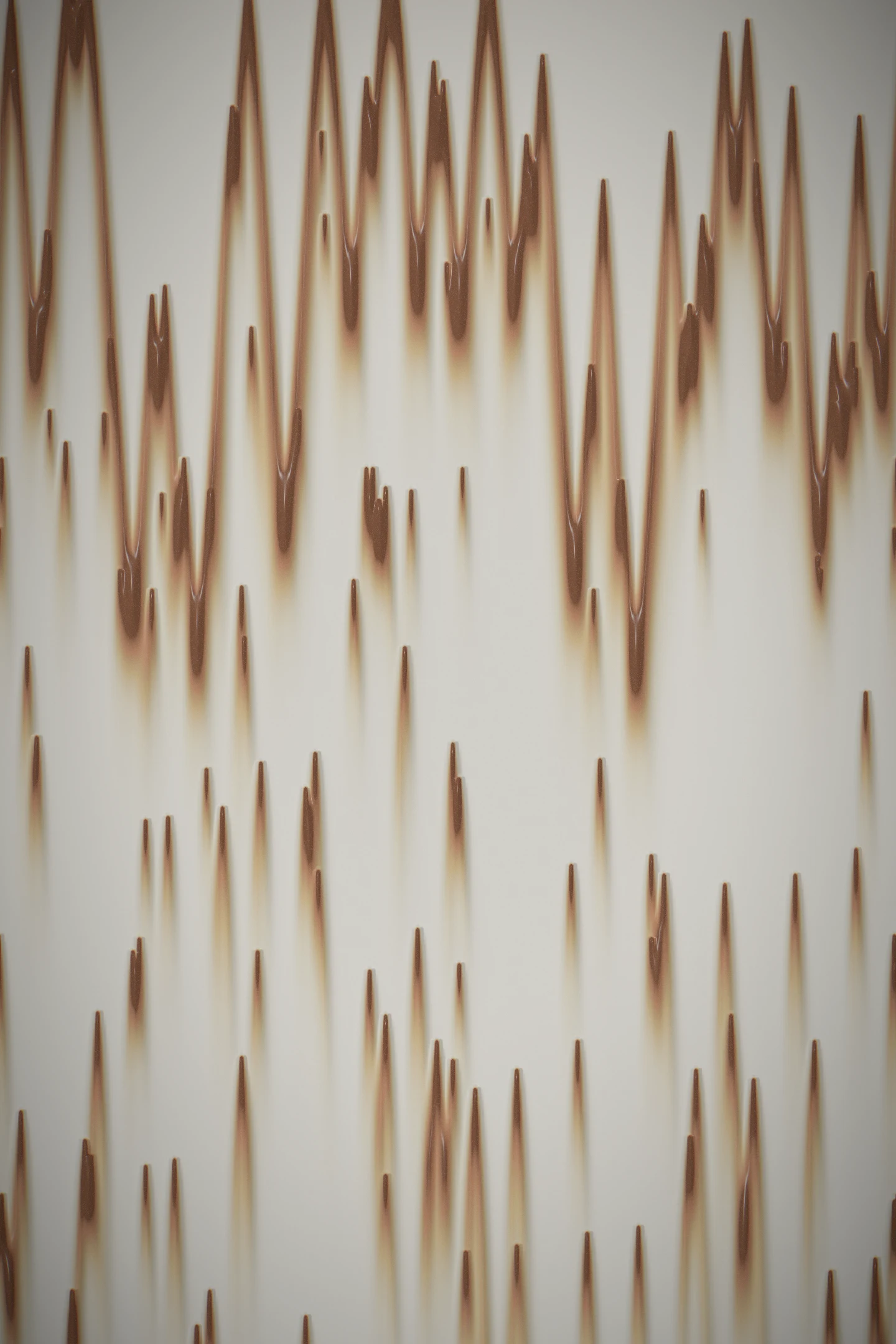
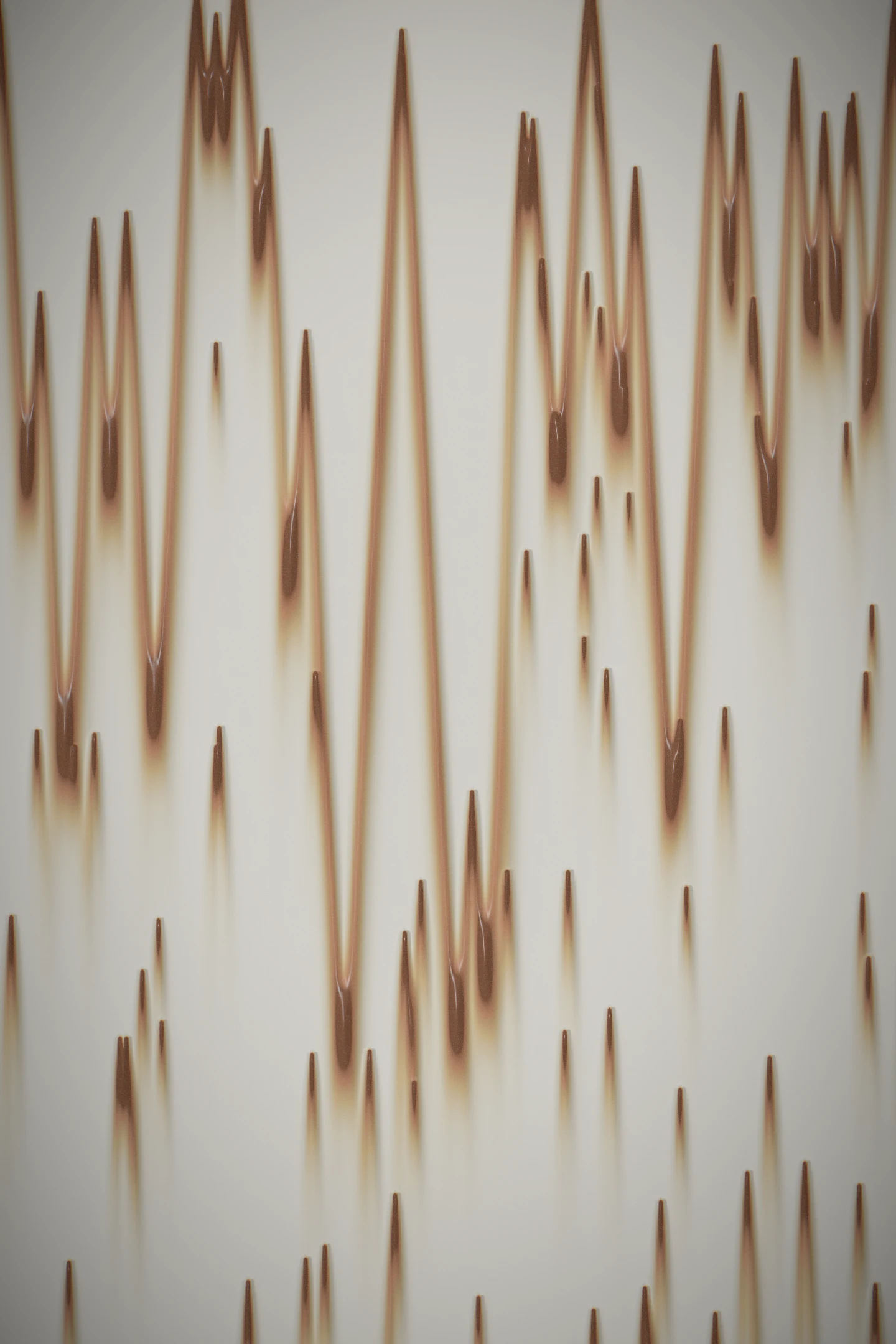
the hero shell — nested tent triangles of Oliva porphyria, written by colliding waves
the hero shell — nested tent triangles of Oliva porphyria, written by colliding waves spark 0.0022 · Da 0.12 · μc 0.015 · e 0.12 · seed 5 · N 280 · 420 rows · nacre
Motif mollusc shell pigmentation / activator–inhibitor reaction-diffusion / space-time accretion
Method A small simulator was generated and modified with AI assistance, then ported to a real-time GPU (GLSL) renderer. The visual output was selected through parameter exploration.
Observation One reaction-diffusion engine on a growing edge paints the whole zoo of real shell patterns with a few parameter changes: frozen Turing peaks leave vertical stripes, a global hormone beats horizontal growth bands, travelling excitations slant into oblique lines — and where colliding waves annihilate and the refractory gap re-ignites, the nested triangles of Oliva porphyria assemble themselves. The picture is never drawn; it is the edge's history, one row per moment.
Reference Hans Meinhardt, The Algorithmic Beauty of Sea Shells, Springer (1995); Meinhardt & Klingler, "A model for pattern formation on the shells of molluscs," Journal of Theoretical Biology, vol.126, 63-89 (1987).
Tools Python / NumPy / three.js / React / GLSL / ffmpeg / AI coding assistant
Year 2026

This is not a scientific simulation result, but a visual interpretation of the phenomenon.

SAME FAMILY, TIME MADE VISIBLE

Gray-Scott shows you a moment. The shell shows you its whole life.

Study #02 — Gray-Scott Study #19 — Meinhardt
The domain a two-dimensional field, patterning in space a one-dimensional edge — the shell's growing lip
What the image is the field now — each frame replaces the last the record — every row is one moment, kept forever
Time flows past the picture is the vertical axis of the picture itself
A decision, once made dissolves back into the dynamics is frozen into the shell — pigment never moves again

PARAMETERS EXPLORED

param meaning effect on the image
Db/Da inhibitor reach (diffusion ratio) large → stationary Turing peaks = vertical stripes; small → oscillation and travelling waves become possible
spark_rate spontaneous ignition rate of the excitable lip sparse → lone oblique waves; dense → collisions and re-ignitions = nested triangles (the hero axis)
μc refractory recovery (decay of the slow hormone) small → long quiet after each wave → large sparse triangles; large → fine mesh
e refractory coupling (c quenches a) 0 → two-variable system (stripes / bands); positive → excitable medium — waves and Oliva triangles
κ autocatalysis saturation 0 → dots; positive → peaks widen and connect into stripes and bands
g_e global hormone coupling (whole-lip inhibition) positive → the entire edge blinks in synchrony = bands parallel to the lip (local coupling alone suffers amplitude death)

Each image below records its exact parameter set.

THE MATHEMATICS the model behind the images

Three fields on a one-dimensional lip. The activator a is the pigment; the inhibitor b keeps it local; the slow hormone c remembers each wave and forbids its return — until it forgets.

∂ta=Da axx+s(a2/(1+κa2)b+ρa)−μaa−e a c\partial_t a = D_a\,a_{xx} + s\left(\frac{a^2/(1+\kappa a^2)}{b} + \rho_a\right) - \mu_a a - e\,a\,c∂t​a=Da​axx​+s(ba2/(1+κa2)​+ρa​)−μa​a−eac
The activator: saturating self-catalysis against the inhibitor, quenched by the refractory hormone. The source density s carries a small frozen per-cell fluctuation — the shell's individuality.
∂tb=Db bxx+s a2−μbb+ρb\partial_t b = D_b\,b_{xx} + s\,a^2 - \mu_b b + \rho_b∂t​b=Db​bxx​+sa2−μb​b+ρb​
The inhibitor, made wherever the activator burns. D_b ≫ D_a freezes the pattern into Turing stripes; small D_b frees it to oscillate and travel.
∂tc=Dc cxx+η a2−μcc\partial_t c = D_c\,c_{xx} + \eta\,a^2 - \mu_c c∂t​c=Dc​cxx​+ηa2−μc​c
The slow refractory hormone (μc ≪ μa): each wave leaves a trail of c that forbids re-ignition, then decays — the recovery that lets the quiet re-ignite is what nests the Oliva triangles.

A visual interpretation of the model, not a claim of scientific precision. Explicit Euler, 3-point Laplacian, periodic lip; dt held under the 1-D diffusion CFL bound. Sparse supra-threshold sparks (exact- rate Bernoulli, seeded) stand in for Meinhardt's spontaneous initiations.

SELECTED STILLS — 6
the hero shell — nested tent triangles, collisions (∧) and re-ignitions (Λ)
the hero shell — nested tent triangles, collisions (∧) and re-ignitions (Λ) oliva · spark 0.0022 · Da 0.12 · μc 0.015 · seed 5 · N 280 · 420 rows · nacre
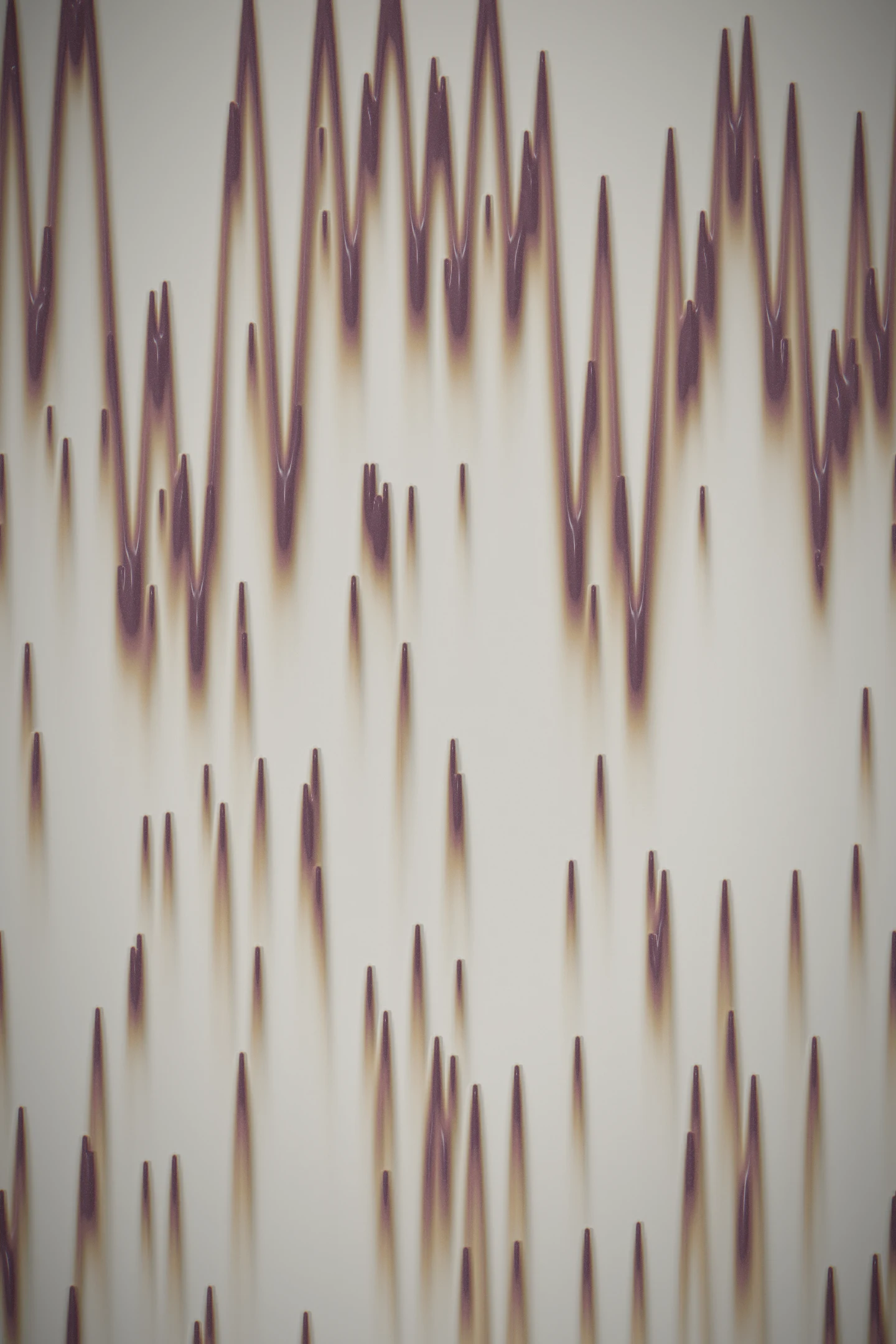
the same shell in the living animal's palette — ivory and violet-brown of Oliva porphyria
the same shell in the living animal's palette — ivory and violet-brown of Oliva porphyria oliva · same params & seed · palette porphyria
sparse ignitions — lone travelling waves and one grand collision V
sparse ignitions — lone travelling waves and one grand collision V waves · spark 0.0016 · Da 0.12 · μc 0.015 · seed 3 · nacre
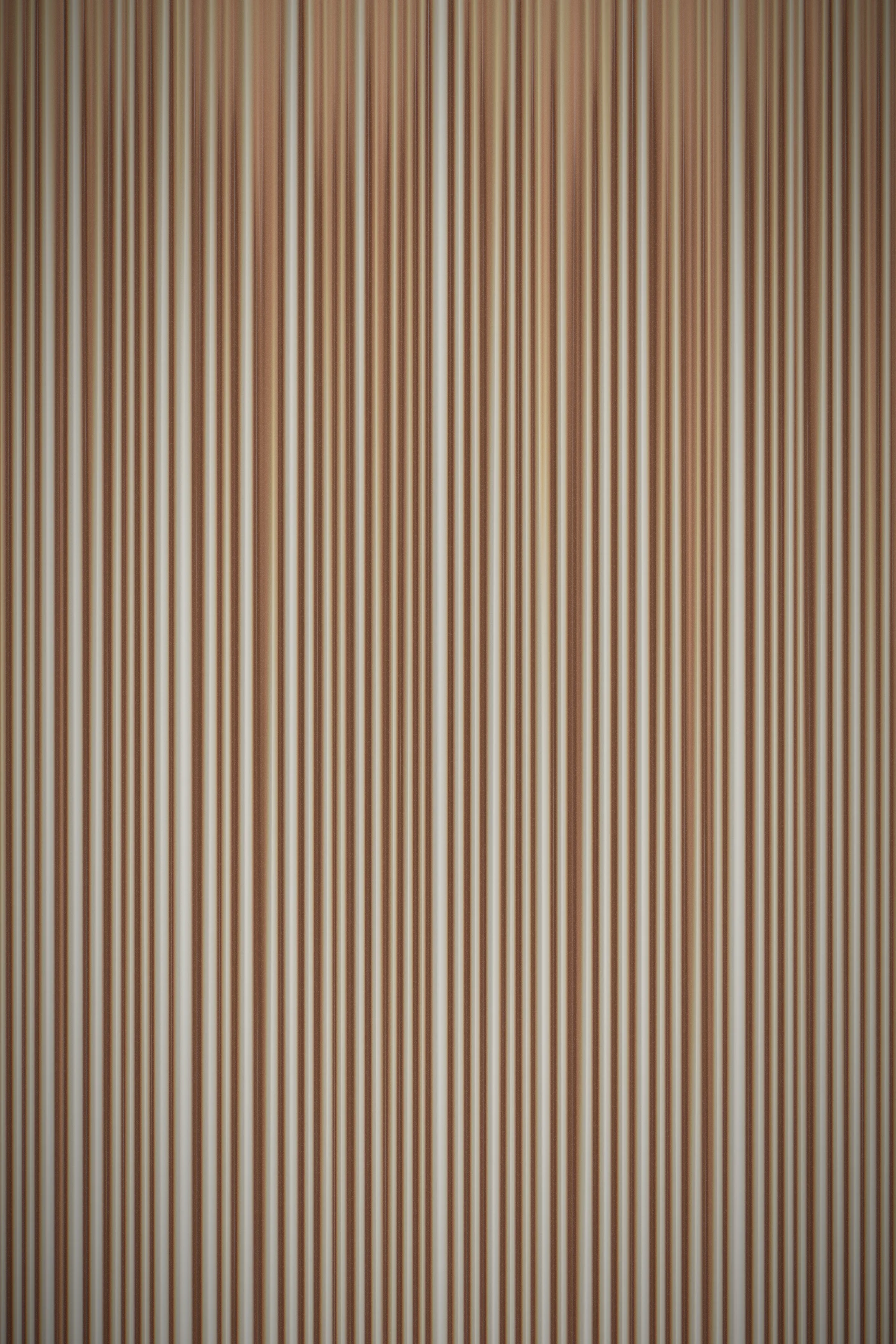
decisions frozen in time — stationary Turing peaks leave vertical pinstripes
decisions frozen in time — stationary Turing peaks leave vertical pinstripes stripes · Da 0.02 · Db 0.34 · κ 0.10 · μb 0.16 · seed 7 · nacre
the whole lip blinking in synchrony — growth bands from a global hormone
the whole lip blinking in synchrony — growth bands from a global hormone bands · g_e 0.05 · g_μ 0.07 · Da = Db 0.12 · seed 7 · nacre
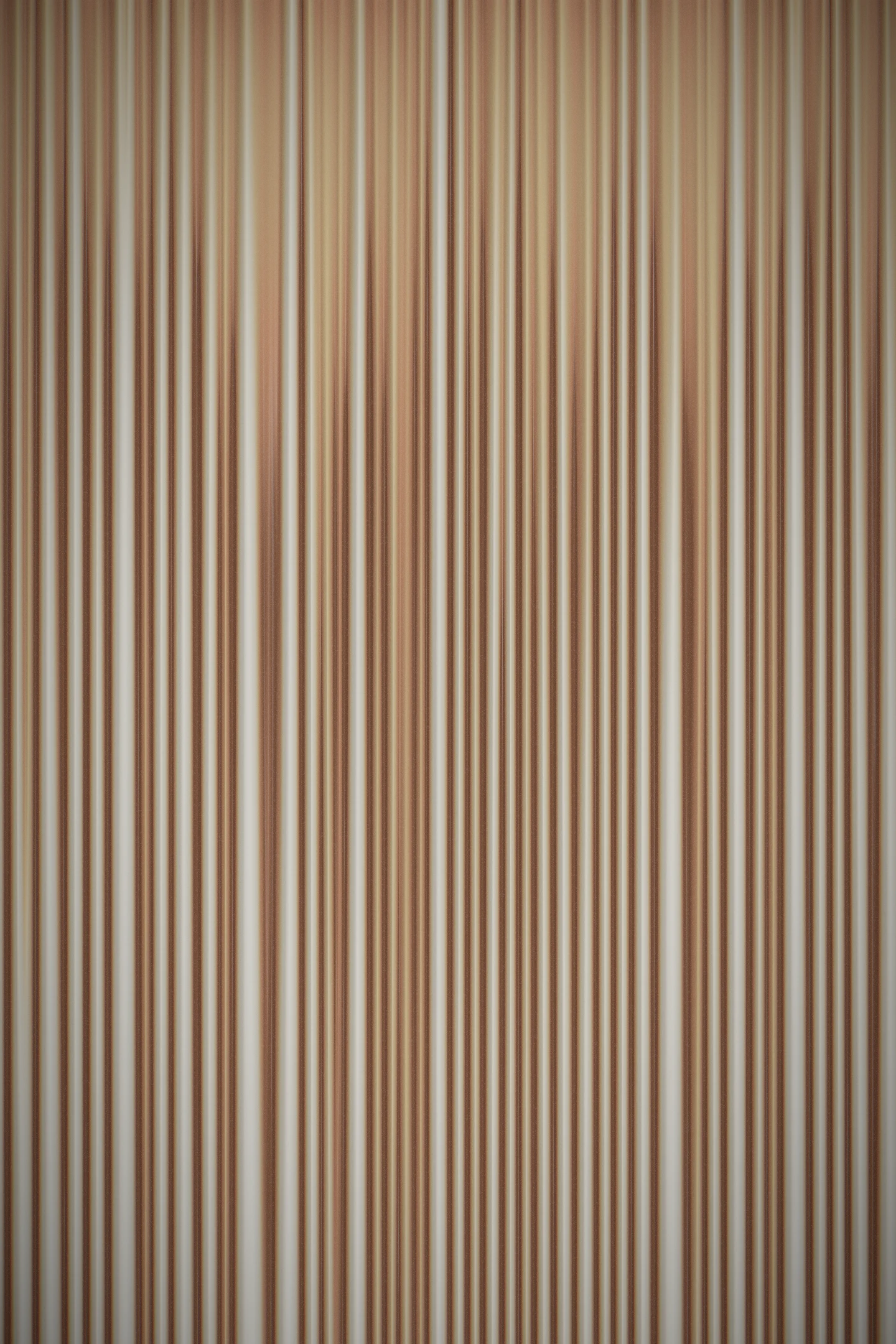
unsaturated autocatalysis — dashed columns where stripes would stand
unsaturated autocatalysis — dashed columns where stripes would stand dots · κ 0 · Db 0.20 · μa 0.09 · μb 0.13 · seed 7 · nacre

PROCESS — PARAMETER SWEEPS

The exploration ran the one engine across its regimes and pinned each pattern class to its levers: the diffusion ratio decides stationary versus dynamic, the refractory hormone decides waves versus triangles, saturation decides dots versus stripes, and a global hormone is needed for bands at all — local coupling alone dies out. The taxonomy sheet is the thesis in one image: one equation, five real shell patterns.
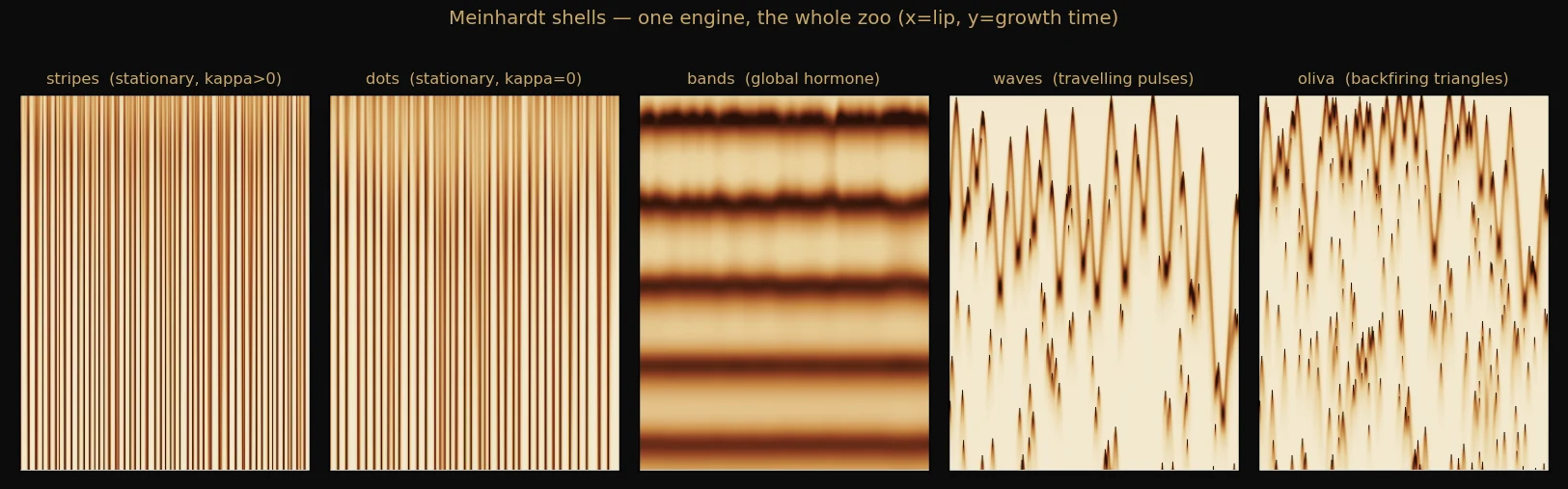
one engine, the whole zoo — the five regimes side by side
one engine, the whole zoo — the five regimes side by side stripes / dots / bands / waves / oliva · N 280 · 420 rows · row_every 10 · seed 7 · nacre

SIGNATURE — THE EDGE WRITES

A shell is not drawn. It is remembered, one row at a time.

The Oliva triangles are the purest case: a travelling excitation is ignited at a point, runs both ways along the lip, and dies where it meets another — a collision writes ∧. Behind every wave the lip is refractory, unable to fire; when the slow hormone fades, a single spark in the quiet re-ignites the line and writes Λ. Nested inside each other, these two letters spell the tent grammar of Oliva porphyria — no blueprint, only collisions and recoveries, appended row by row.

The exploration sheet maps the hero's parameter space: ignition rate down, activator reach across. Sparse sparks leave grand lone zigzags; dense sparks nest the triangles into a fine net. The finished works sit in the window where the triangles stay large enough to read — spark 0.0022 · Da 0.12, the dial the interactive study below hands to you.
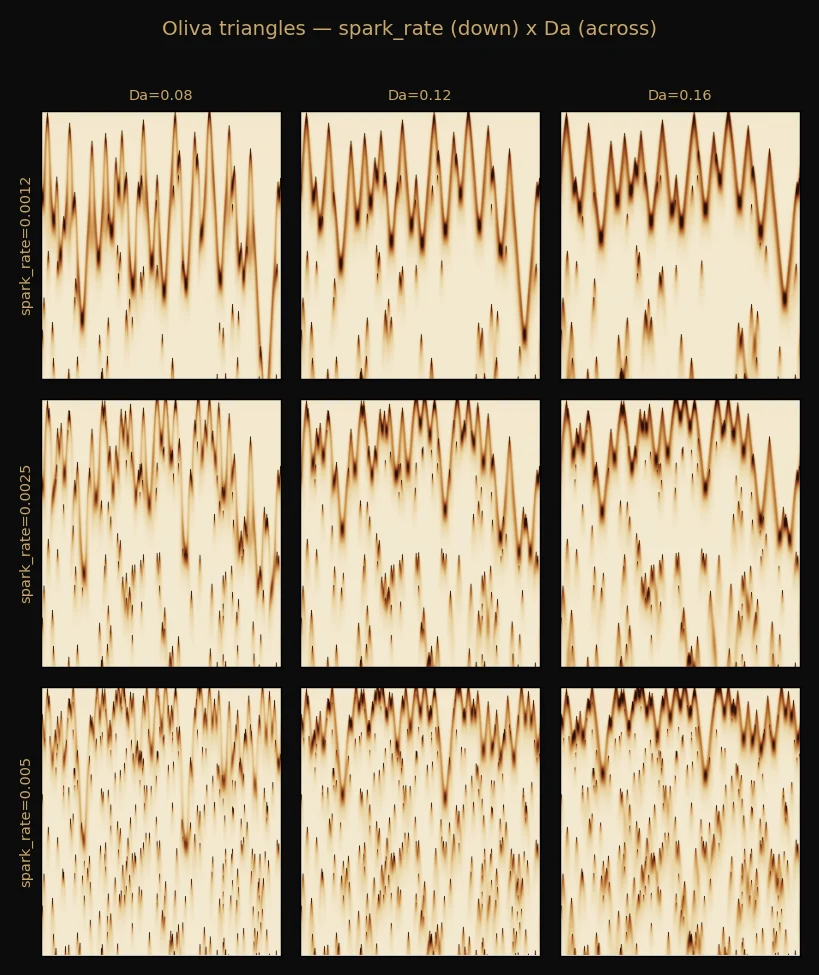
the hero's parameter space — spark rate (down) × activator reach (across)
the hero's parameter space — spark rate (down) × activator reach (across) spark 0.0012 / 0.0025 / 0.005 × Da 0.08 / 0.12 / 0.16 · N 280 · seed 7

COLOUR = SHELL PIGMENT CHEMISTRY

The ground is the cream of bare aragonite nacre; the marks are organic pigments — porphyrins and melanin-like compounds — that mantle cells secrete where the activator runs high. The ramp follows that chemistry in one direction: cream ground, warm ochre, red-brown, burnt umber at the densest crests, with a restrained wet-shell gloss on the pigment ridges.

A second palette reads the same shell — same parameters, same seed — in the ivory and violet-brown of the living Oliva porphyria, the species whose backfiring triangles this study chases.

the hero shell in the living animal's palette
the hero shell in the living animal's palette oliva · spark 0.0022 · seed 5 · palette porphyria

The hues are artistic approximations of shell pigment chemistry, not measurements.

REFERENCES

  1. Hans Meinhardt. "The Algorithmic Beauty of Sea Shells." Springer-Verlag, Berlin (4th ed. 2009) (1995).
  2. Hans Meinhardt, Martin Klingler. "A model for pattern formation on the shells of molluscs." Journal of Theoretical Biology, vol.126, no.1, 63-89 (1987).
  3. Alfred Gierer, Hans Meinhardt. "A theory of biological pattern formation." Kybernetik, vol.12, 30-39 (1972).

INTERACTIVE STUDY

The image is the growing lip’s record in time — and the pattern regime dial is live. Drag it from stripes toward oliva and the crossing itself is woven into the shell: the stripe era closes in a pale interruption stratum — like a shell that paused its growth — and out of the quiet, travelling waves nucleate, collide, annihilate, and re-ignite into nested triangles. Nothing is redrawn — the shell simply remembers what its edge was told. It is a deliberately simplified instrument, capped in resolution with a few curated knobs and no export, separate from the full engine used to author the finished works.

SIMPLIFIED INSTRUMENTMEINHARDT · 1-D EDGE · ACCRETED · REGIME LIVE

This interactive study is not intended as a scientifically validated reproduction. It is a visual interpretation generated from an implemented model and curated parameter exploration — and it is a deliberately simplified instrument, separate from the full engine used to author the finished works.

← ALL STUDIES STUDY #20 · LENIA — EMERGENT INDIVIDUALITY · IN OBSERVATION →
PHENOMENA STUDIES — WEAVER AXIOM PERSONAL VISUAL RESEARCH · © 2026