STUDY #20 · 2026 · IN OBSERVATION
Lenia — Emergent Individuality
A model-driven visual study of individuality emerging from a single continuous field.
WHAT IS THIS
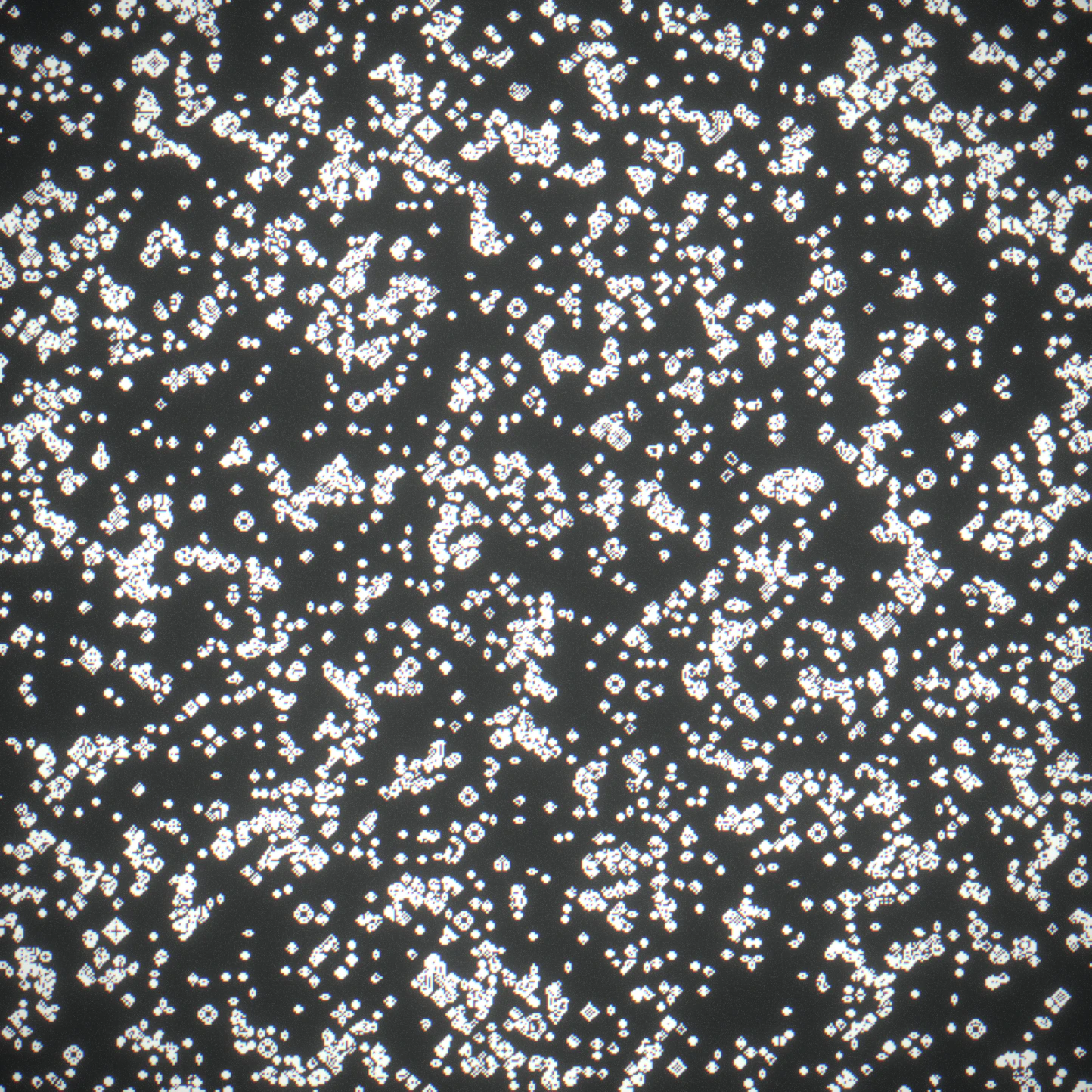
Conway's Game of Life is a rule about counting: each cell looks at the eight around it and decides whether to live. Lenia is that rule made continuous — the neighbourhood becomes a smooth ring of radius R, the state becomes a real number between 0 and 1, and time advances in small steps rather than generations. Each site measures how crowded its ring is and grows towards a preferred crowding μ, with a tolerance σ.
Nothing in that sentence mentions an object. There is one field and one rule. But for a thin band of (μ, σ) the field spontaneously knots itself into localised lumps that keep their shape, travel at a constant speed and behave like particles when they meet. This study runs that rule in real time on the GPU, and the individuals in these images were found by seeding random patches and keeping whatever survived — the same way the phenomenon was first explored.
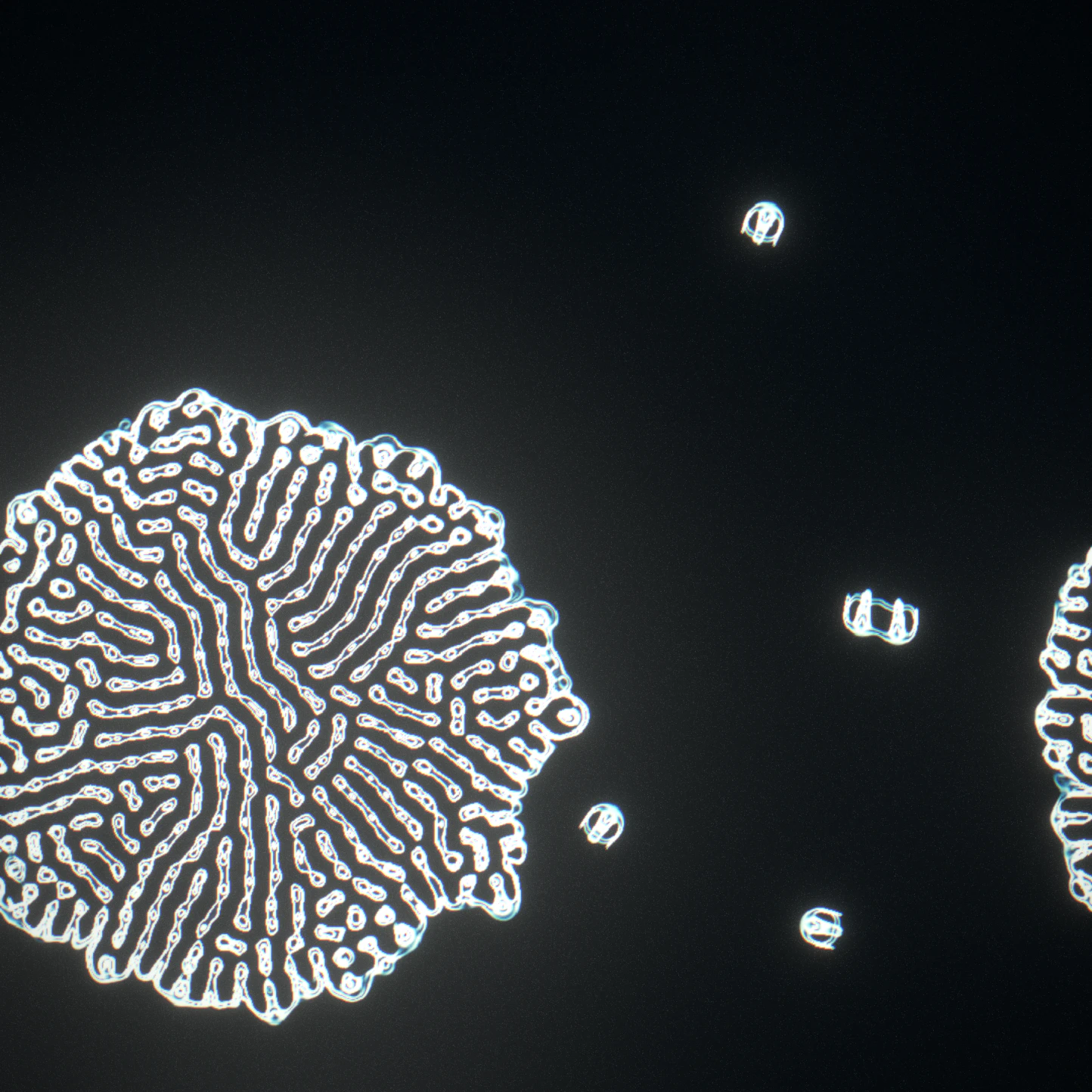
This is not a scientific simulation result, but a visual interpretation of the phenomenon.
SAME FAMILY, A MISSING VARIABLE
Kuramoto synchronises individuals. Vicsek steers them. Lenia has to make them first.
PARAMETERS EXPLORED
Each image below records its exact parameter set.
SELECTED STILLS — 6
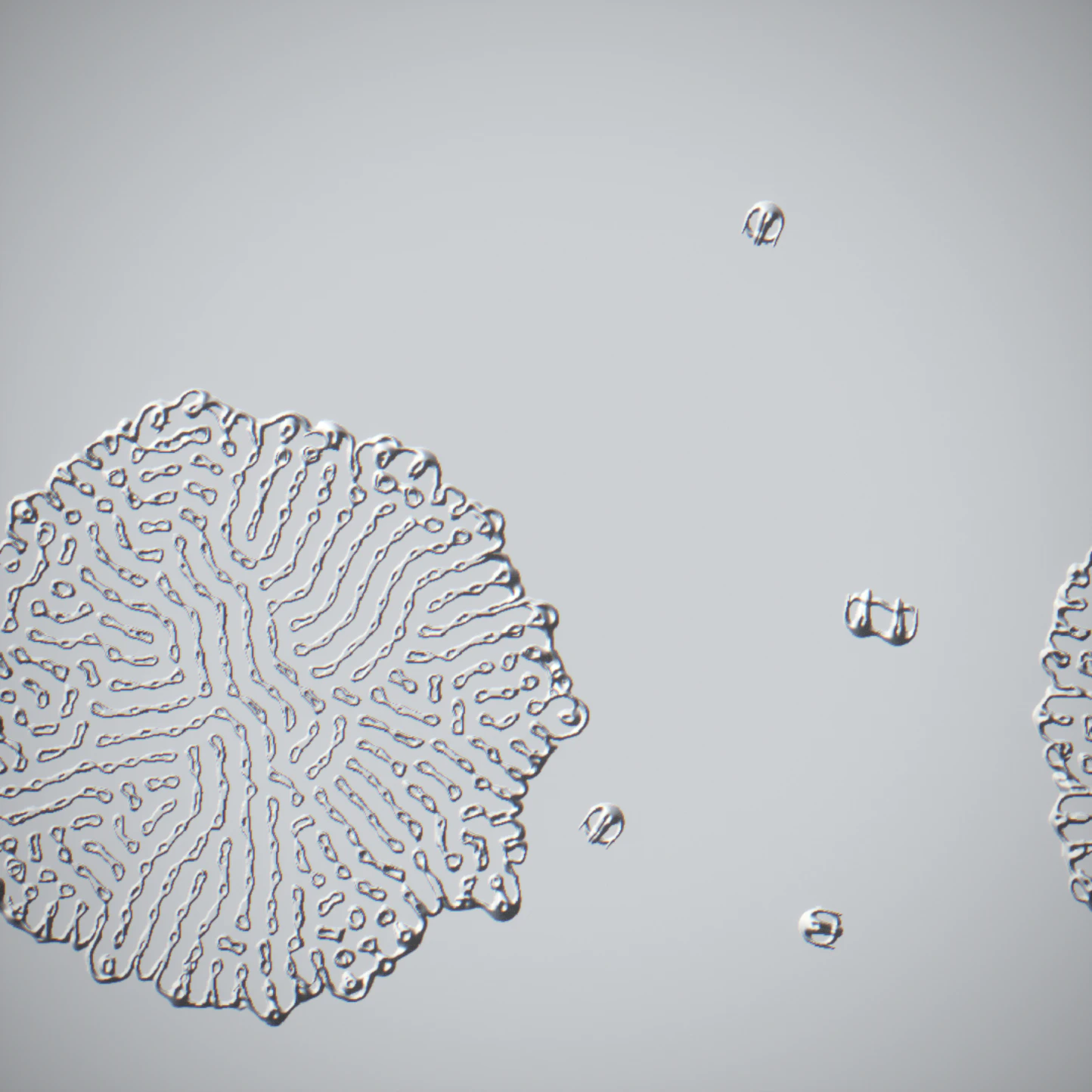
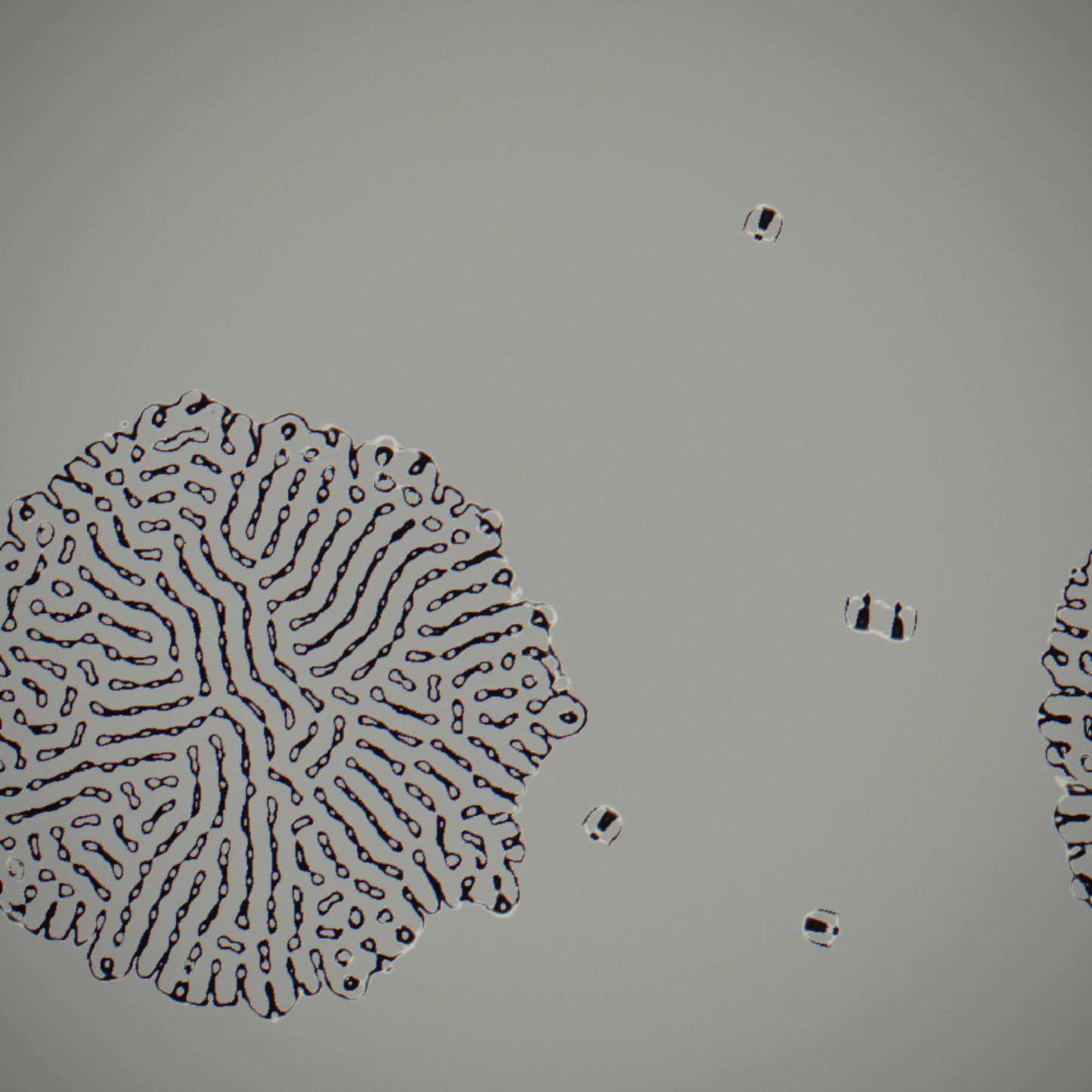
SIGNATURE — THE SOUP MAKES ONE ANIMAL
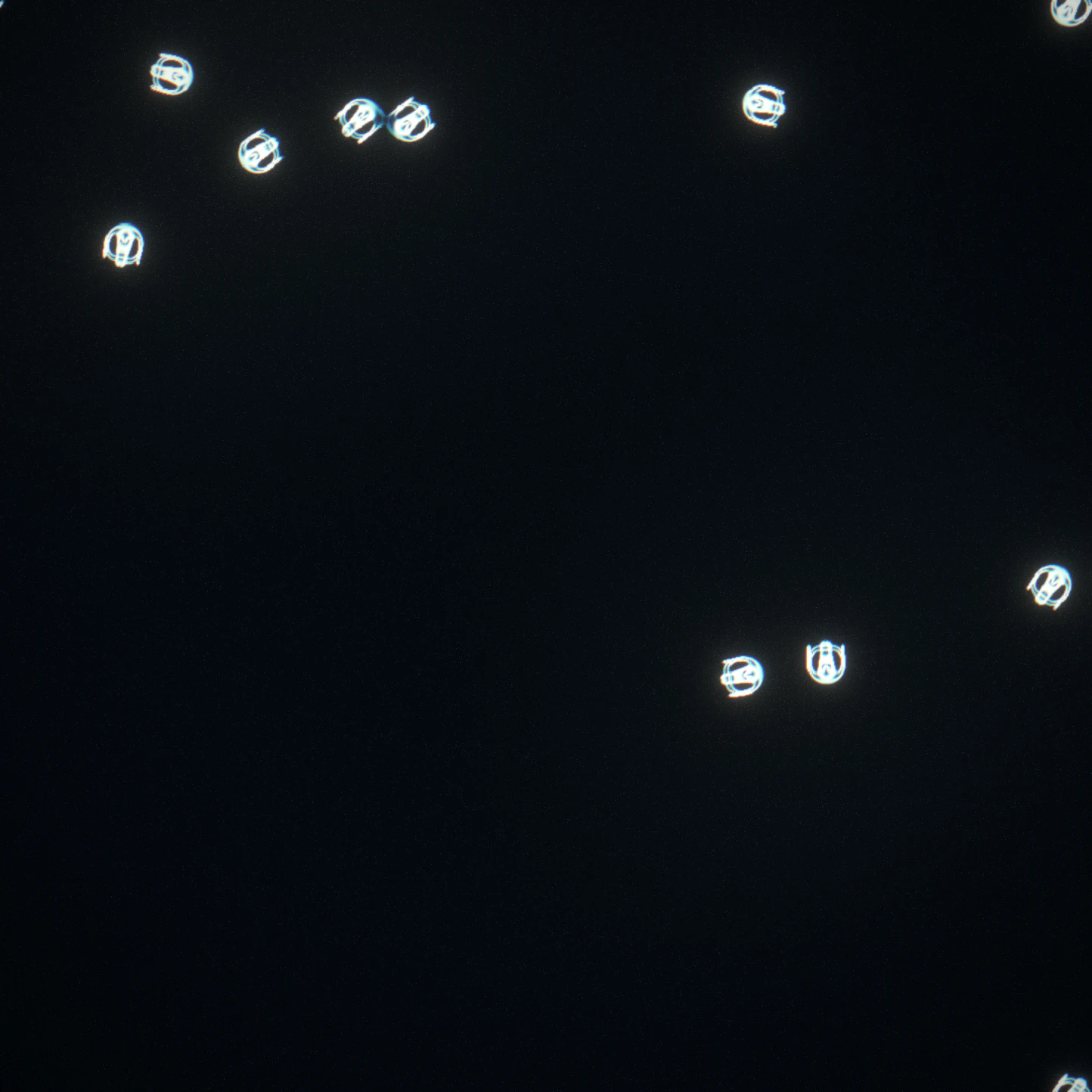
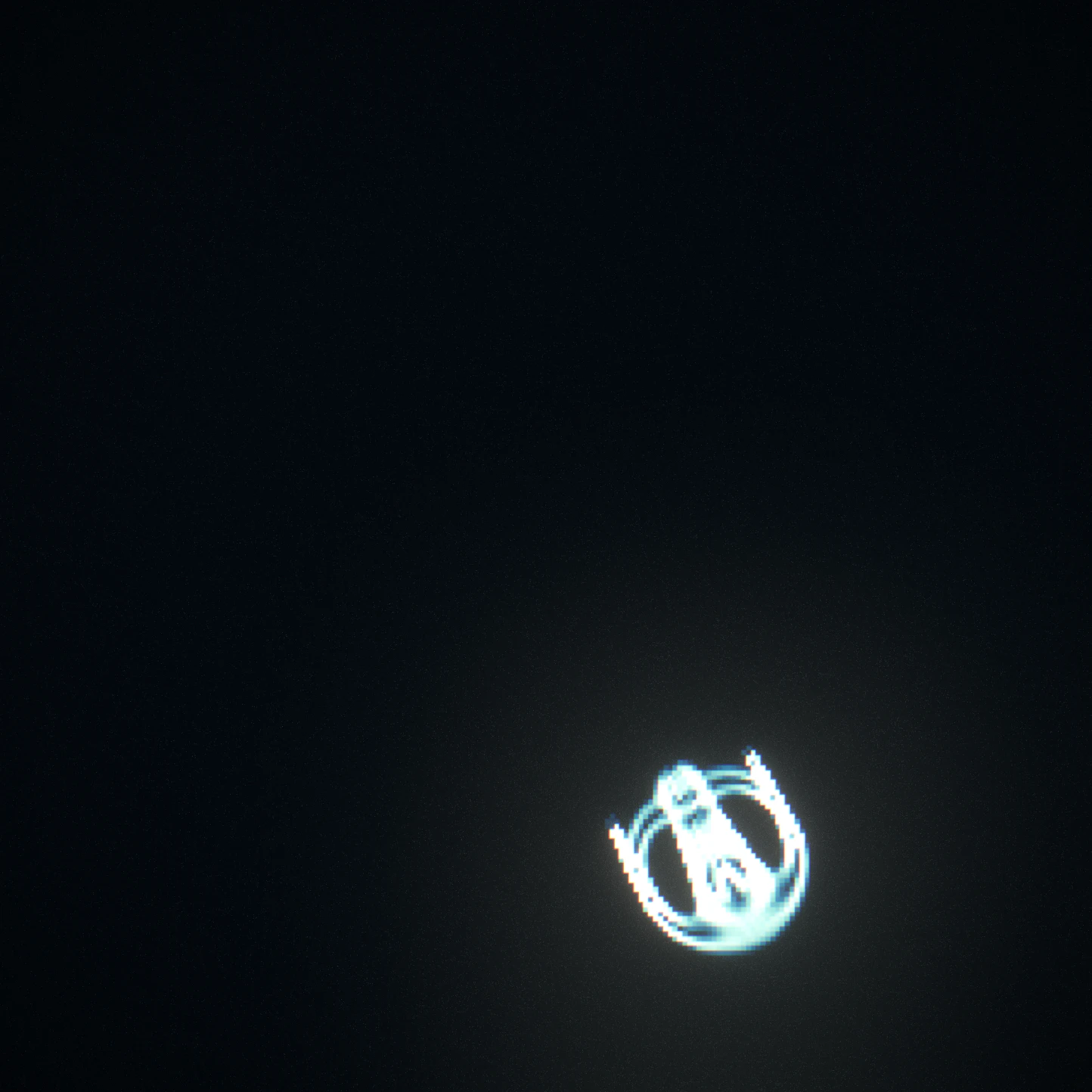
Individuality is the exception — and this rule holds exactly one shape.
Ninety-six random births, ten survivors — and all ten were the same animal, agreeing to 0.45 per cent in mass and 0.13 per cent in speed. The soup does not make a zoo. However the initial conditions are shaken, the same creature comes out: at this (μ, σ) the rule can hold essentially one shape. The search found the individuals rather than copying them, and what it found was that uniqueness — not a story about random seeds birthing endless variety.
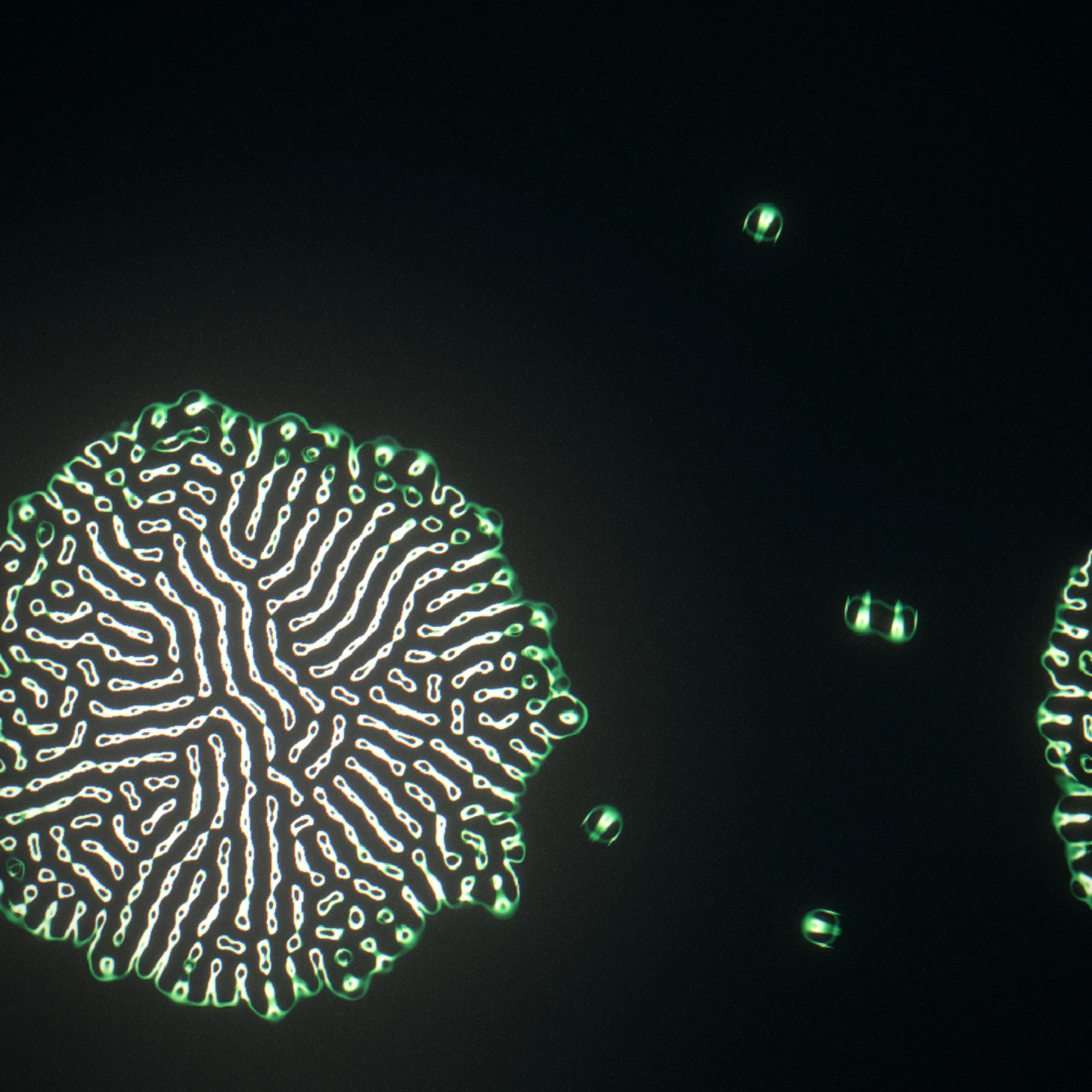
And being an individual is rare. In the μ × σ plane, solitons live on a ridge about one cell wide, pinched between dying and overgrowing — and a head-on meeting is enough to push them off it. In the film, one collision product fails to stay bounded, and what comes out is no longer a body but a colony that eats the empty water until nothing is separate again.
COLOUR = THE MICROSCOPE
Lenia is mathematics, not chemistry: there is no pigment, no catalyst, nothing whose colour could be looked up. Rather than invent a correspondence, this study grounds the palette one step away — in the optics actually used to look at things of this size. Each look is a different way of forming an image from the same specimen, and each is computed differently from the field, not merely tinted.
Dark field blocks the direct beam and collects only scattered light, so the ground is black and the density gradient blazes — edges glow, flat interiors stay dark. Phase contrast turns optical path difference into brightness: a grey ground, dark dense material, and the bright halo the technique can never quite avoid. Differential interference contrast responds to the slope of the path, so the field reads as relief lit from one side. Epifluorescence shows emission proportional to density; bright field is transmitted light attenuated through the specimen.
These are artistic approximations of the imaging modalities, not calibrated instrument output.
REFERENCES
- Bert Wang-Chak Chan. "Lenia: Biology of Artificial Life." Complex Systems, vol.28, no.3, 251-286 (2019). https://doi.org/10.25088/ComplexSystems.28.3.251
- Bert Wang-Chak Chan. "Lenia and Expanded Universe." ALIFE 2020: Proceedings of the 2020 Conference on Artificial Life, MIT Press, 221-229 (2020). https://doi.org/10.1162/isal_a_00297
- Stephan Rafler. "Generalization of Conway's "Game of Life" to a continuous domain — SmoothLife." arXiv:1111.1567 (2011).
- Martin Gardner. "Mathematical Games: The fantastic combinations of John Conway's new solitaire game "life"." Scientific American, vol.223, no.4, 120-123 (1970).
INTERACTIVE STUDY
Nothing in this rule mentions an individual — one continuous field measures its own crowding and grows toward a preferred density. Growth centre μ is live: bodies exist only on a ridge a few thousandths wide — a nudge either way and the creature dissolves; widen σ and it stops being separate, igniting a colony that eats the empty water. Reseed the Soup and a different random birth settles into the same animal, to a fraction of a percent in mass. The Conway limit is this same stepper at R = T = P = 1, where the rule collapses into the Game of Life. It is a deliberately simplified instrument — a smaller grid and kernel with a few curated knobs and no export, separate from the full engine used to author the finished works.
This interactive study is not intended as a scientifically validated reproduction. It is a visual interpretation generated from an implemented model and curated parameter exploration — and it is a deliberately simplified instrument, separate from the full engine used to author the finished works.