STUDY #21 · 2026 · IN OBSERVATION
de Jong / Clifford Maps
A model-driven visual study of strange-attractor measures.
WHAT IS THIS
The de Jong and Clifford maps are simple rules that move a point by folding the plane with sines and cosines. Each step is a teleport — no path connects one position to the next — yet where the point spends its time converges to a fixed, reproducible cloud: the strange attractor's natural measure. The image is a long exposure of one point.
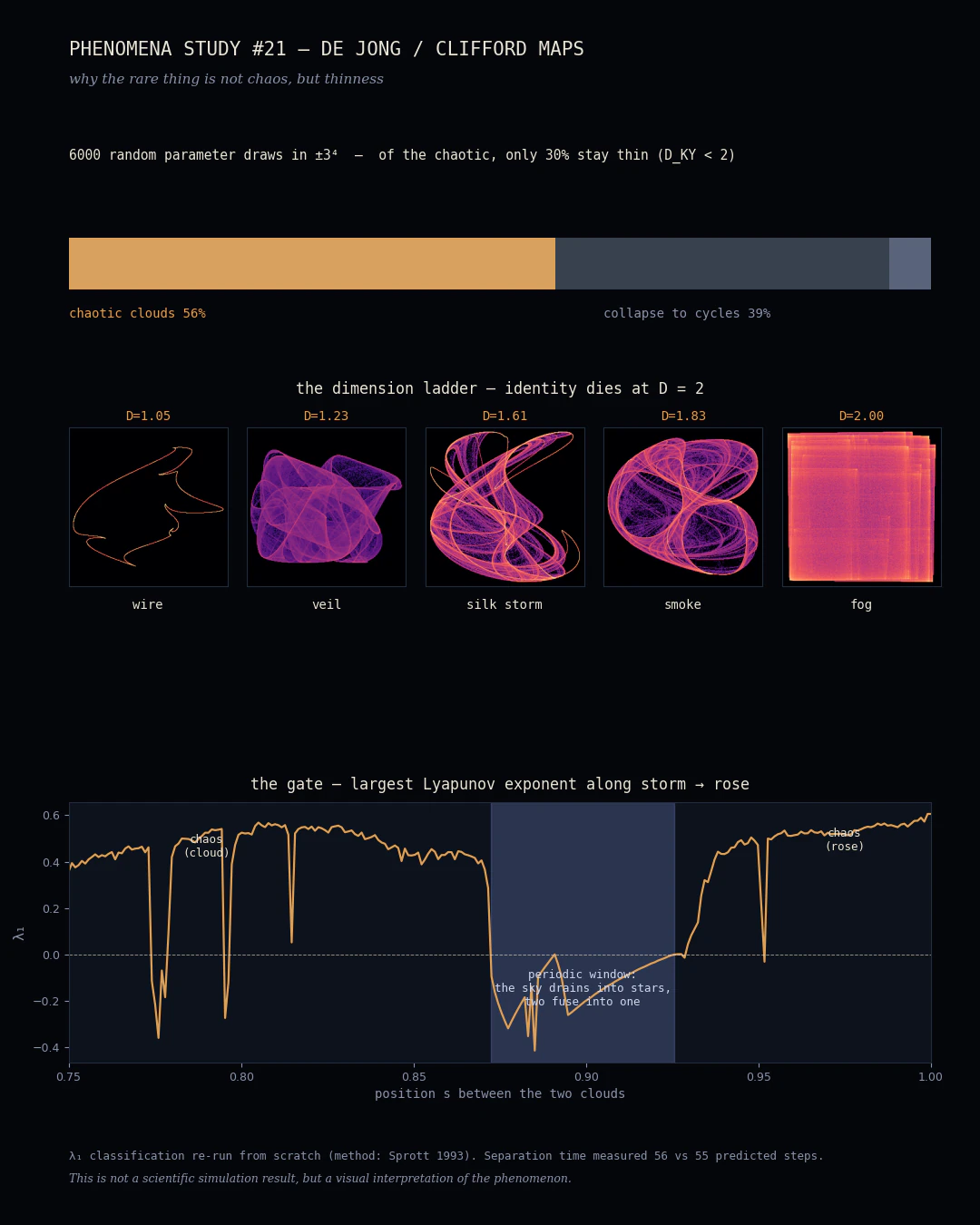
This study runs 262,144 such points in real time on the GPU, every step of every walker deposited into a shared exposure. The individual path decorrelates in about forty steps (measured 56 vs 55 predicted); the cloud does not care. The path is unpredictable; the cloud is not.
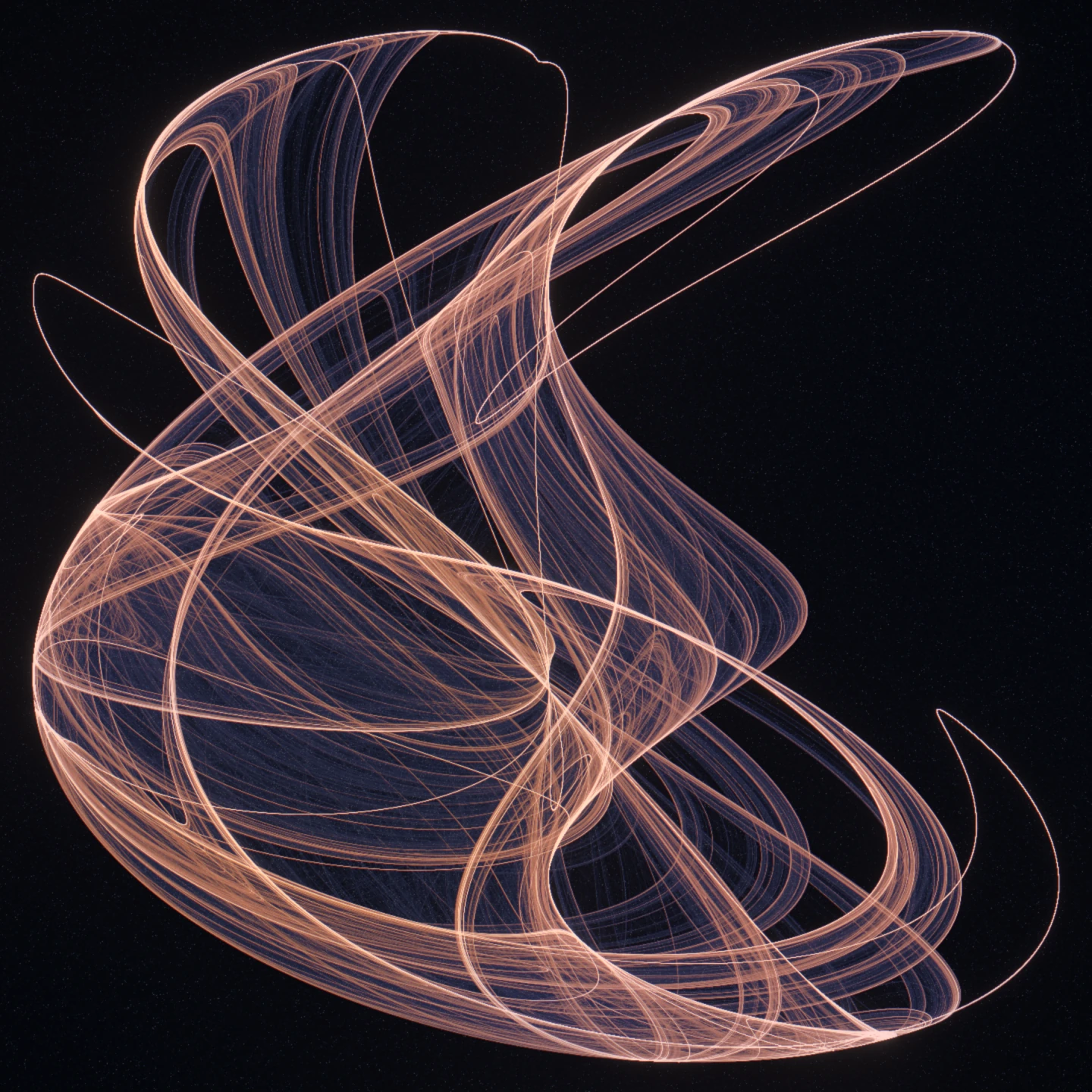
This is not a scientific simulation result, but a visual interpretation of the phenomenon.
SAME FAMILY, THE THREAD DISSOLVED
Lorenz draws the thread. de Jong draws the fog the thread leaves behind.
PARAMETERS EXPLORED
Each image below records its exact parameter set.
THE MATHEMATICS the model behind the images
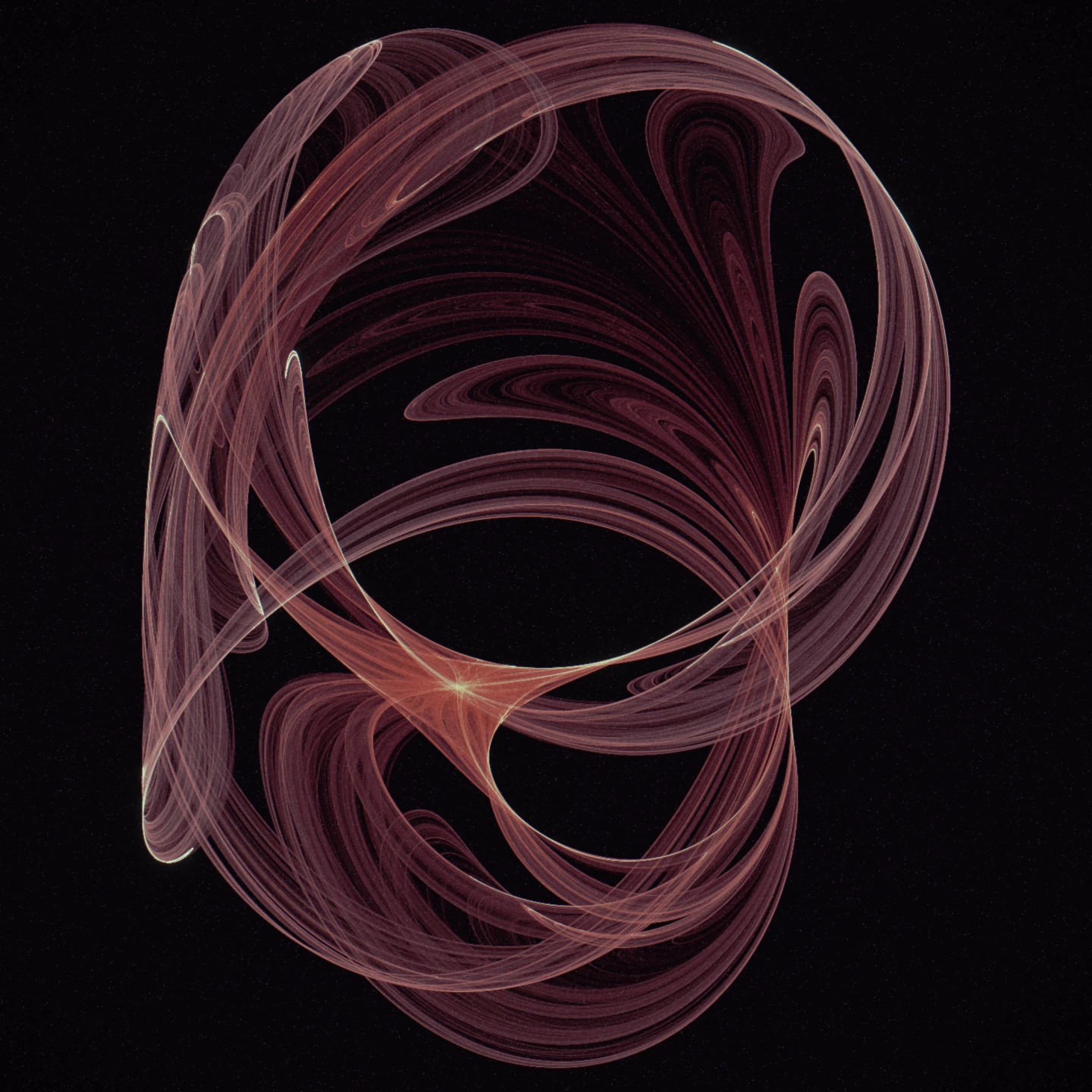
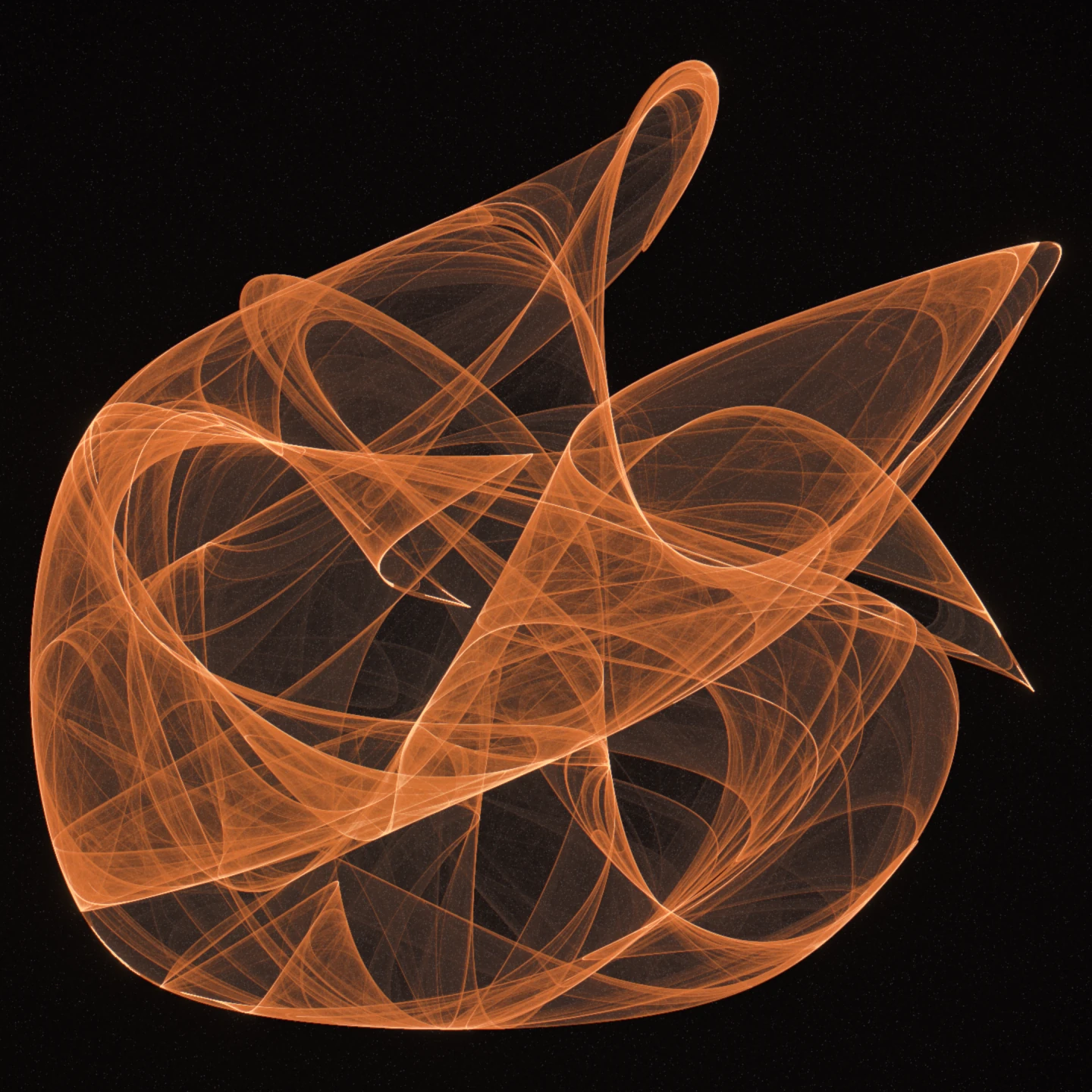
Two trigonometric folds of the plane, run by one engine. A point teleports each step; the picture is the histogram of a hundred million landings — the attractor's natural measure.
A visual interpretation of the model, not a claim of scientific precision. Ergodicity is unproven for this family; what was verified is empirical — visit histograms from independent seeds converge at the N^(−1/2) noise floor, and float32 and float64 orbits separate completely in tens of steps while their measures agree.
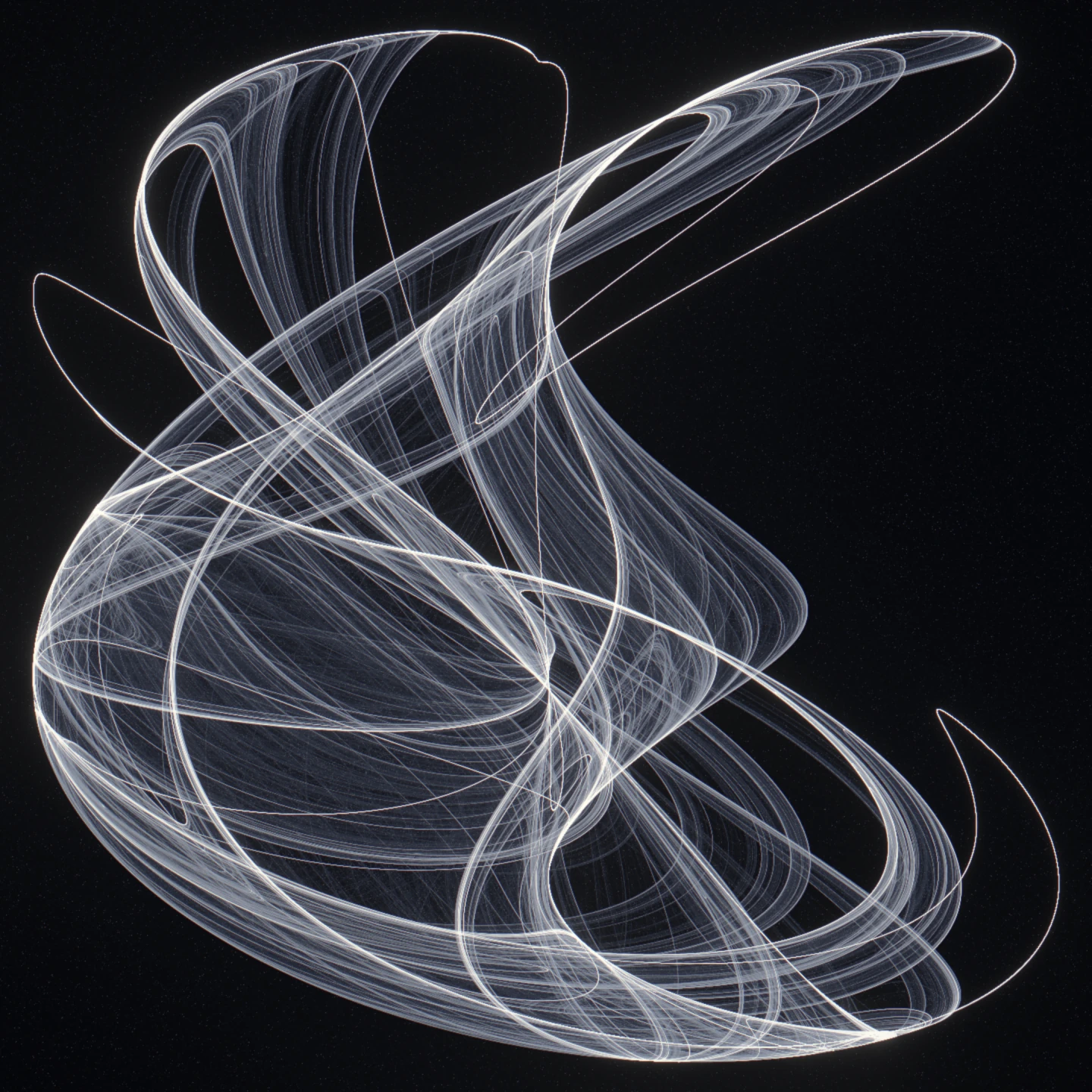
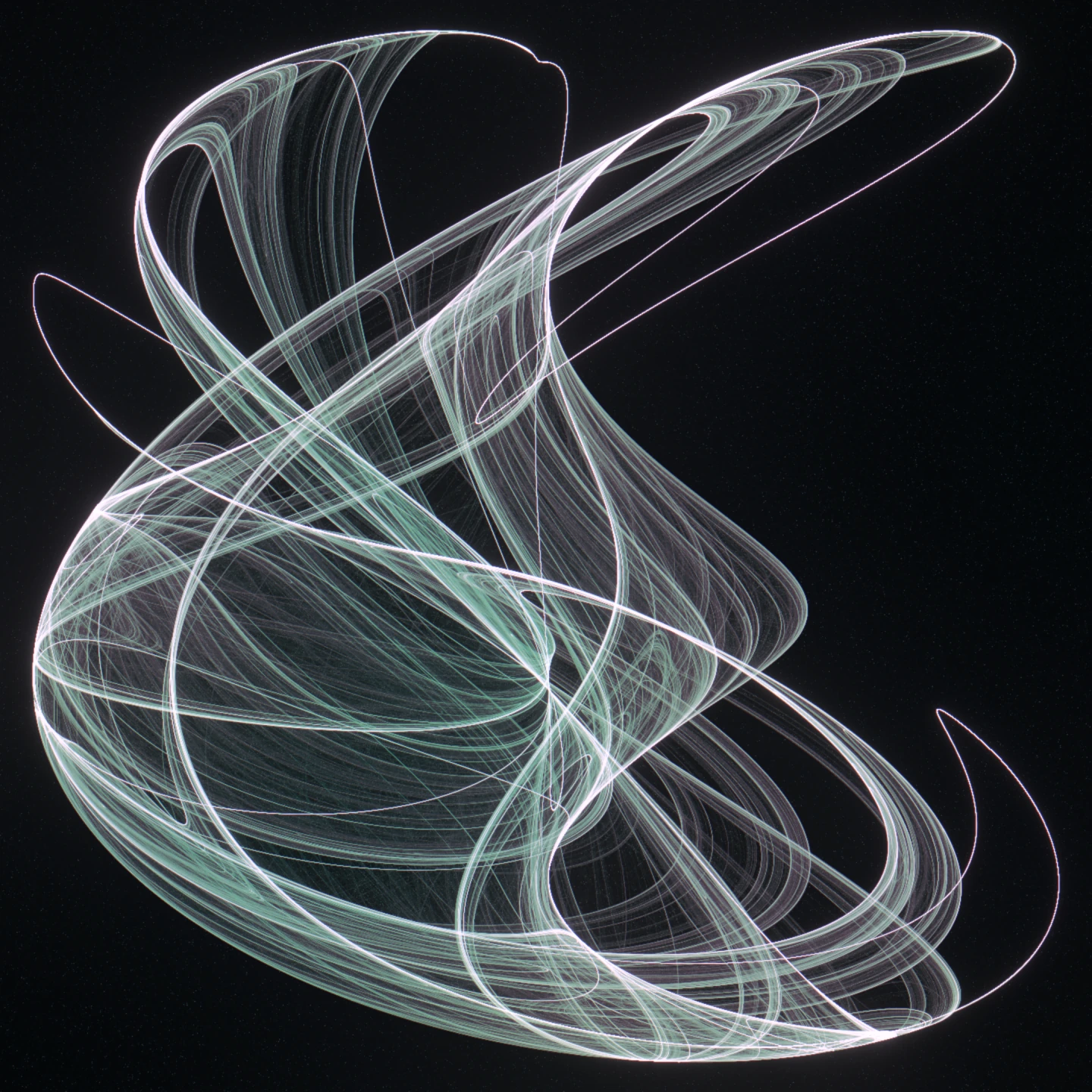
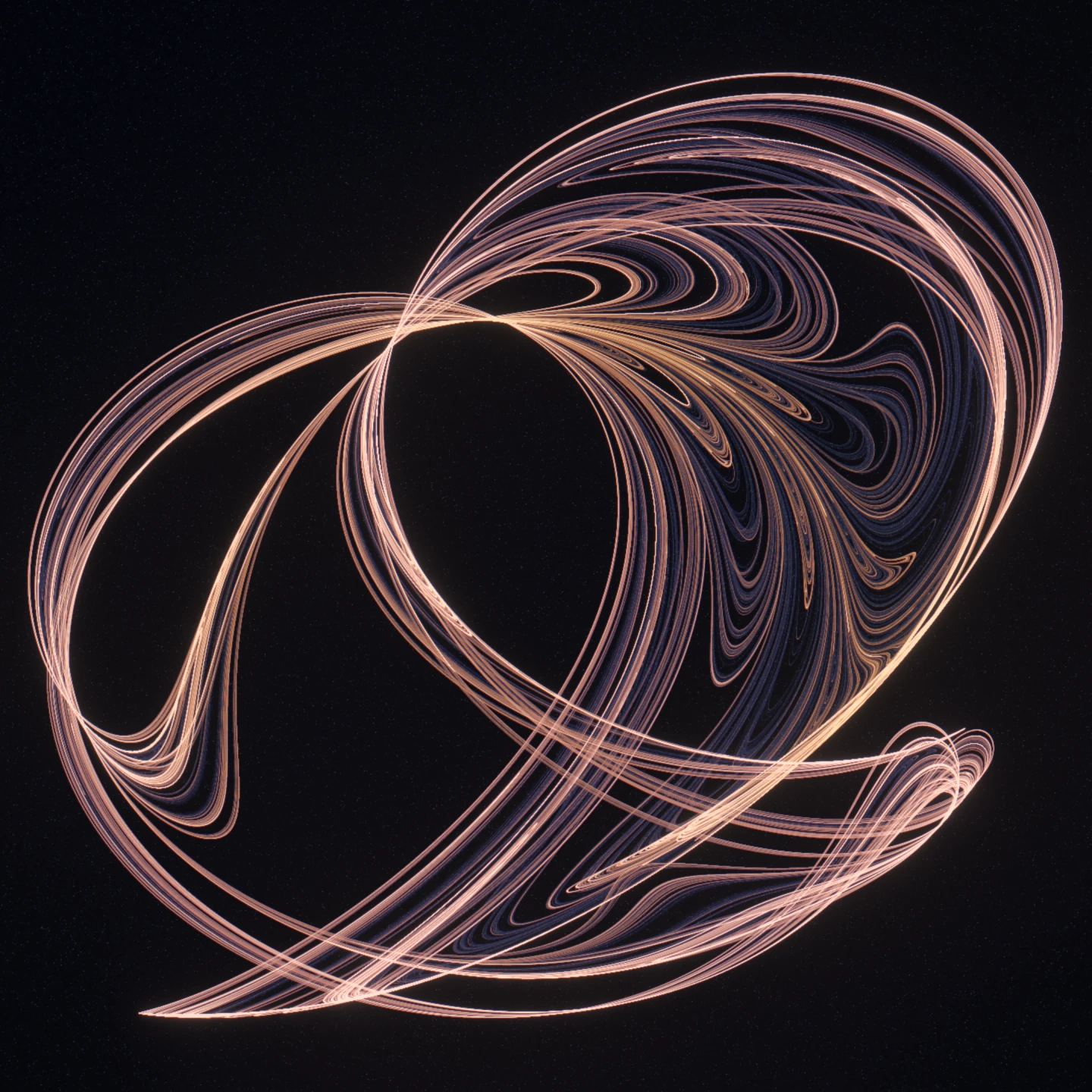
SELECTED STILLS — 6
PROCESS — PARAMETER SWEEPS
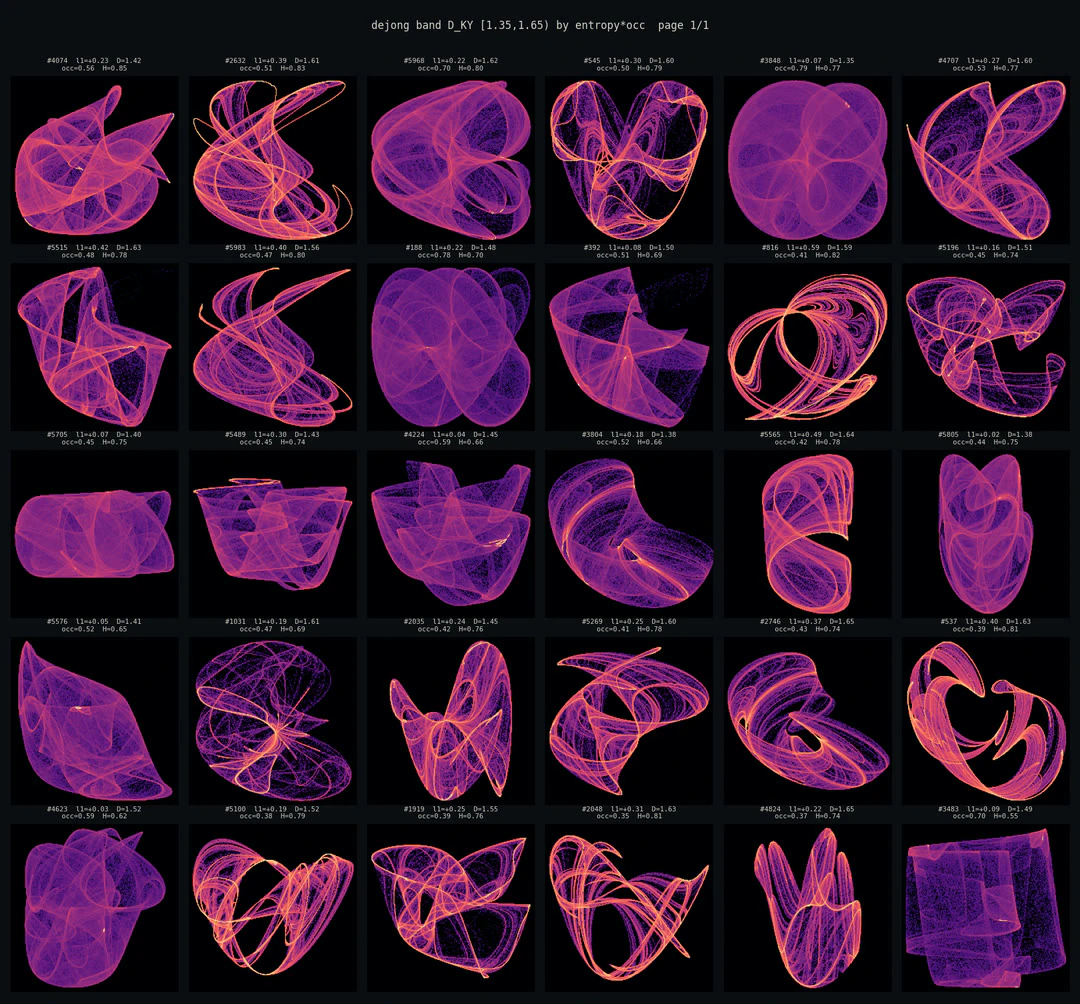
The exploration re-runs Sprott's 1993 procedure from scratch — 9,000 random parameter draws (6,000 de Jong, 3,000 Clifford) classified by Lyapunov exponent, the chaotic hits then shelved by Kaplan–Yorke dimension and ordered by entropy × occupancy. Chaos is not the rare thing: 56% of draws make a cloud. The rare thing is thinness — only a third of the clouds still contract area, and only they keep a face. The sheet shown is the silk-storm shelf, where the hero and the rose both live.
SIGNATURE — THE GATE BETWEEN TWO CLOUDS
Between any two clouds, every straight road passes stars.
Scan a straight line in parameter space between two chaotic clouds and the Lyapunov exponent does not stay positive: it dips below zero in periodic windows, where the whole sky drains into a few bright points. Nine segments were scanned; all nine crossed windows — 107 of them. No straight road avoids the stars. The hero flight rides one such gate, s ∈ [0.872, 0.926] on the segment from silk storm to rose current: inside it the attractor period-doubles, and on the ride home two stars close in and fuse — walkers crawling in pearl strings under critical slowing — until one star holds the entire plane.
For that moment the artwork's sentence turns literal. The picture was always a long exposure of a single point; at the gate, the exposure and the point coincide — the cloud remembers it is one point — before chaos re-ignites and the memory spreads back into weather.
COLOUR = NARROWBAND ASTROPHOTOGRAPHY
Colour here follows the method of narrowband astrophotography — invisible observables mapped to visible hues, the way SII / Hα / OIII become red / green / blue in the Hubble palette. Nothing in these clouds has a colour of its own; what they have is dynamics, and the same measure can be observed in more than one way.
Three dynamical observables are graded independently: density — visit frequency, the measure itself — carries luminance; stretch — the largest singular value of the local Jacobian, how violently the fold deforms a neighbourhood — steers the tint from calm blue toward worked gold; jump — how far arrivals teleported — lifts a violet halo where the map throws points across the whole plane. The storm triptych in the stills reads one cloud through each observable in turn.
The values are real dynamics; the hues are artistic approximations of the false-colour tradition, not measurements.
REFERENCES
- A. K. Dewdney. "Computer Recreations: Probing the strange attractions of chaos." Scientific American, vol.257, no.1, 108-111 (1987).
- J. C. Sprott. "Automatic generation of strange attractors." Computers & Graphics, vol.17, no.3, 325-332 (1993). https://doi.org/10.1016/0097-8493(93)90082-K
- M. Hénon. "A two-dimensional mapping with a strange attractor." Communications in Mathematical Physics, vol.50, no.1, 69-77 (1976).
- G. Benettin, L. Galgani, A. Giorgilli, J.-M. Strelcyn. "Lyapunov characteristic exponents for smooth dynamical systems and for Hamiltonian systems; a method for computing all of them. Part 1: Theory." Meccanica, vol.15, no.1, 9-20 (1980).
- J. L. Kaplan, J. A. Yorke. "Chaotic behavior of multidimensional difference equations." Functional Differential Equations and Approximation of Fixed Points, Lecture Notes in Mathematics, vol.730, Springer, 204-227 (1979).
- J. C. Sprott. "Chaos and Time-Series Analysis." Oxford University Press (2003).
INTERACTIVE STUDY
One point, teleported through a trigonometric fold — the picture is not its path but its probability, a long exposure of a single point. This is a small window onto the model behind the finished works, a deliberately simplified instrument: 16,384 walkers depositing a density-only exposure, separate from the full engine (262,144 walkers, three-observable grading) used to author the works. Presets are curated; the gate spans a real periodic window — drag fold drift slowly across the ticks and watch the sky drain into two stars that fuse into one: the cloud remembers it is one point.
This interactive study is not intended as a scientifically validated reproduction. It is a visual interpretation generated from an implemented model and curated parameter exploration — and it is a deliberately simplified instrument, separate from the full engine used to author the finished works.