STUDY #22 · 2026 · IN OBSERVATION
Viscous Fingering
A model-driven visual study of an interface that must pay for its corners.
WHAT IS THIS
Squeeze a runny fluid into a viscous one between two glass plates and the front between them breaks into fingers: any part that leads feels a steeper pressure gradient and advances faster, while surface tension charges a toll for every corner, forbidding details finer than one selected wavelength. This is the Saffman–Taylor instability, first studied as the reason waterflooded oil fields leave oil behind.
The model is one-sided Hele-Shaw flow: a Laplace pressure field in the viscous fluid, a curvature toll on the moving boundary, nothing else. This study runs it on the GPU — the pressure relaxes in a ping-pong texture while the interface advances through it — in real time.
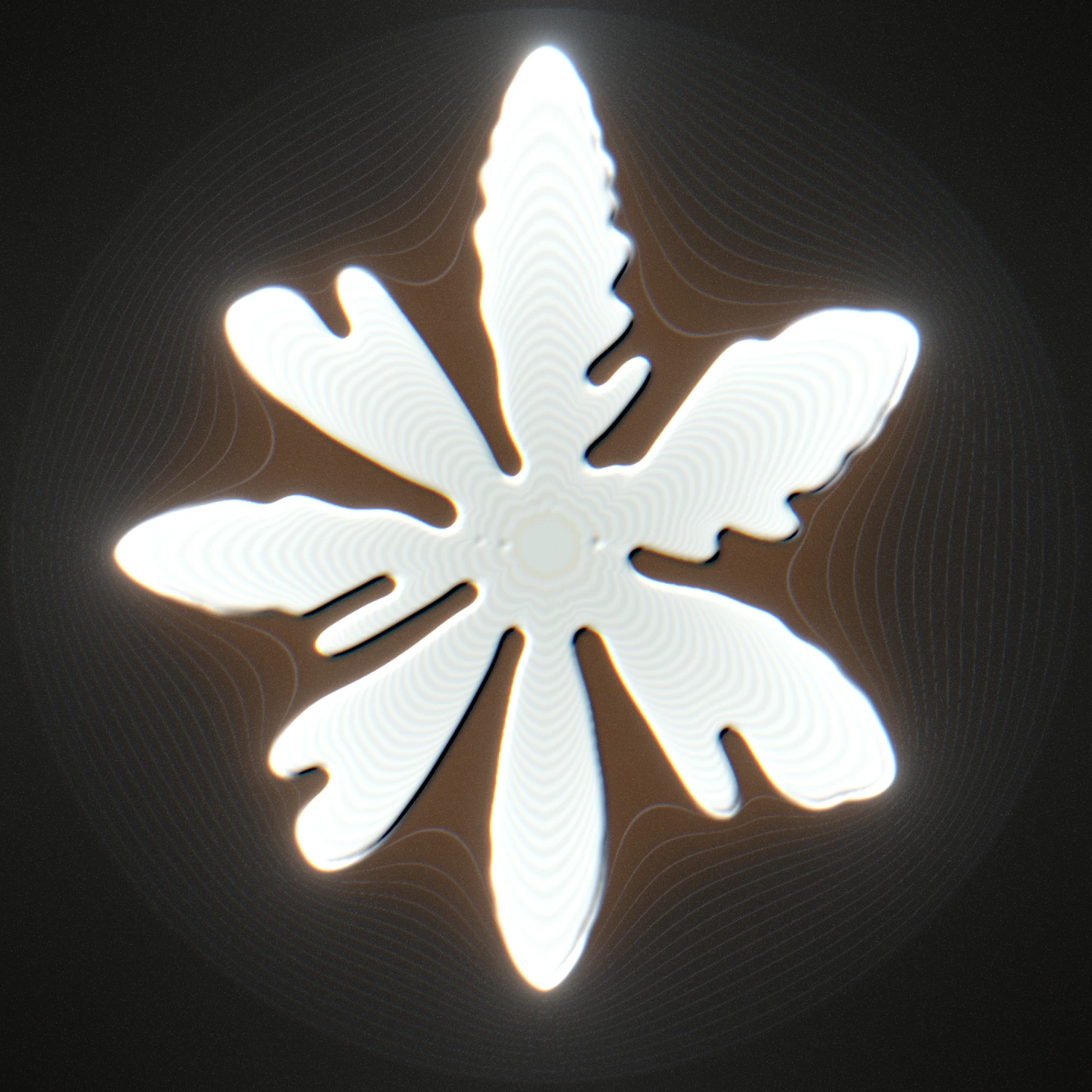
This is not a scientific simulation result, but a visual interpretation of the phenomenon.
SAME FAMILY, A THIRD AUTHOR
Noise writes DLA. The lattice writes the snowflake. A balance of forces writes the fingering.
PARAMETERS EXPLORED
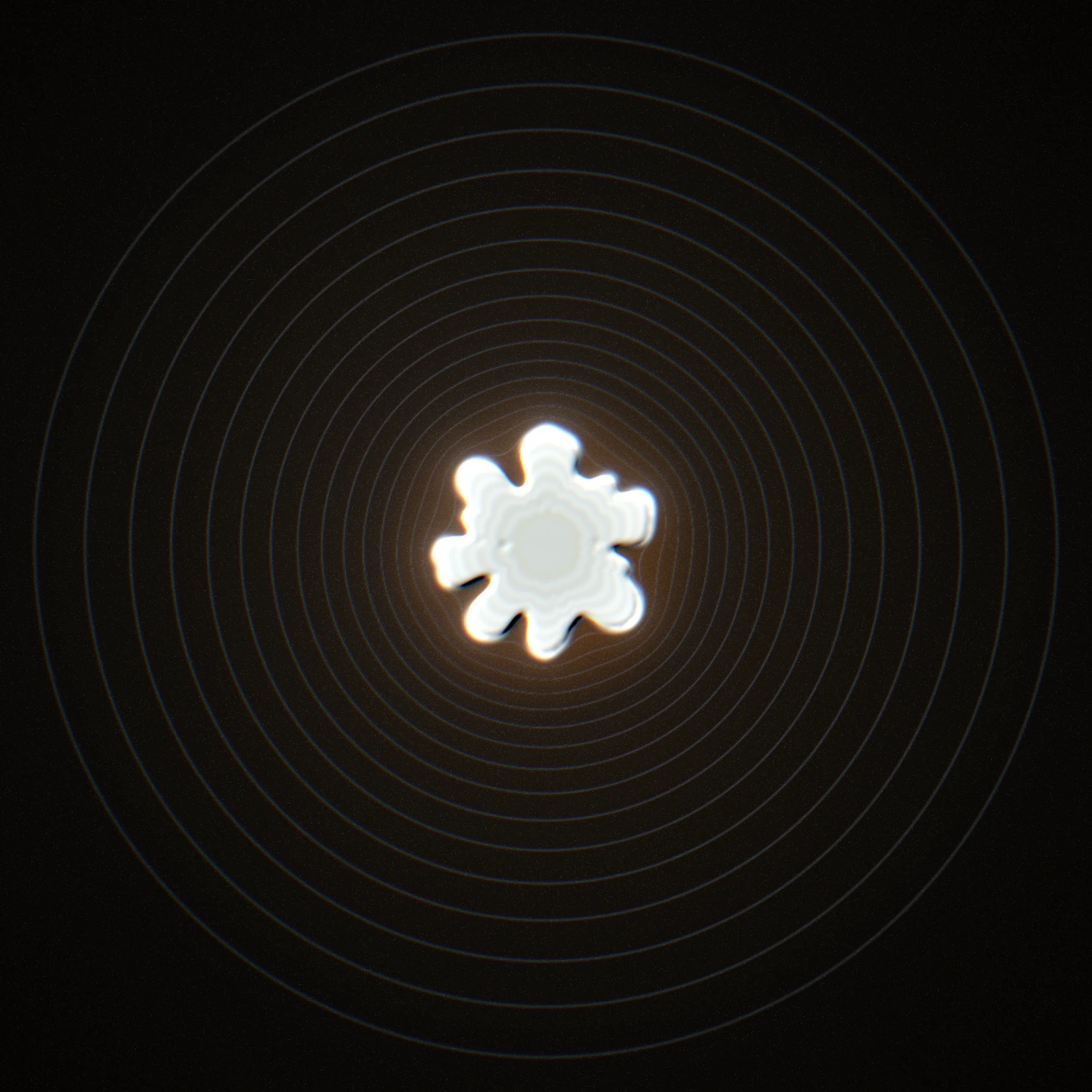
Each image below records its exact parameter set.
THE MATHEMATICS the model behind the images
One-sided radial Hele-Shaw flow: a harmonic pressure field in the viscous fluid, a curvature toll on the moving boundary, nothing else. The whole flower is written by these four lines.
A visual interpretation of the model, not a claim of scientific precision. The historic Saffman-Taylor single-finger 1/2-width limit needs a long narrow channel and was not reached in this square domain — recorded as unresolved.
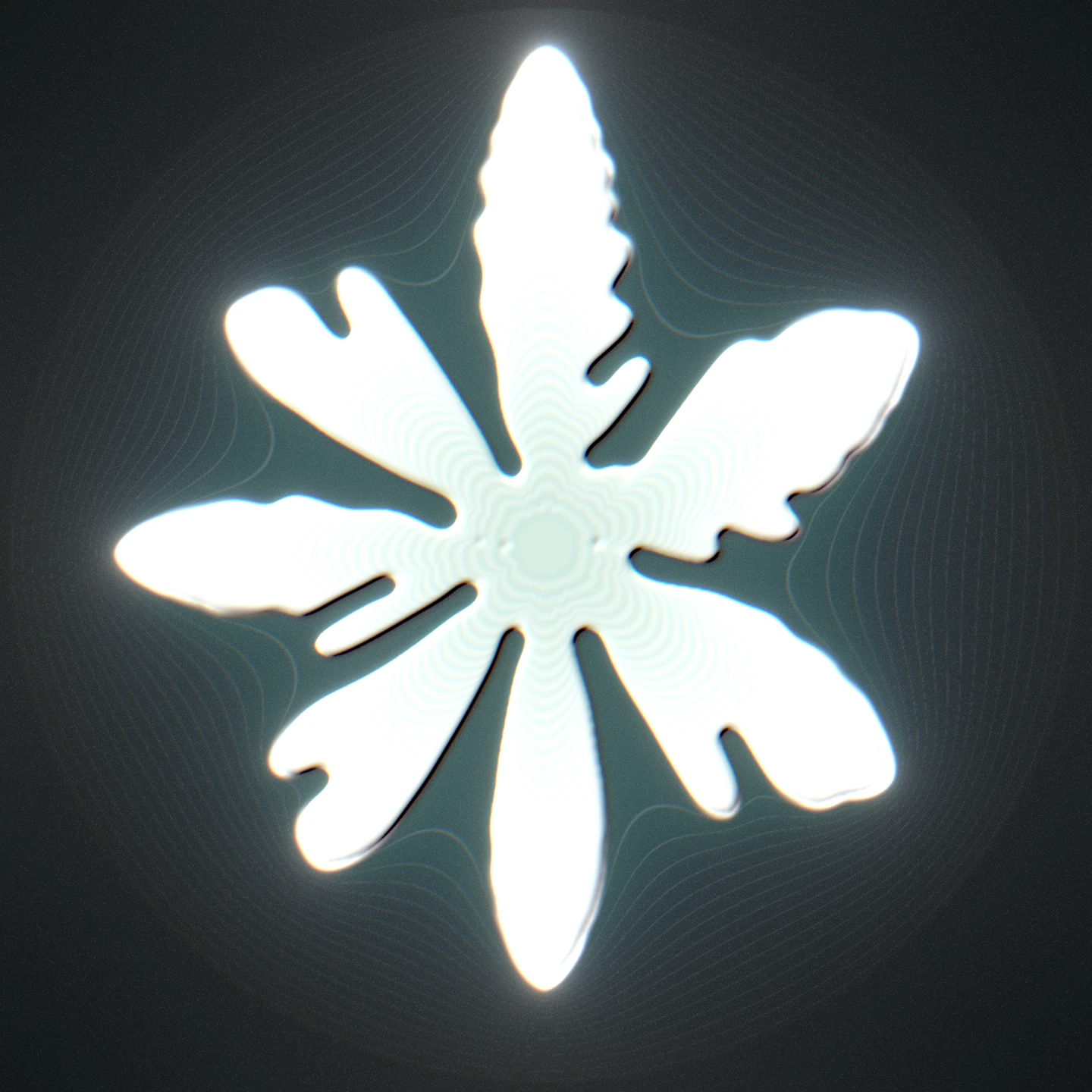
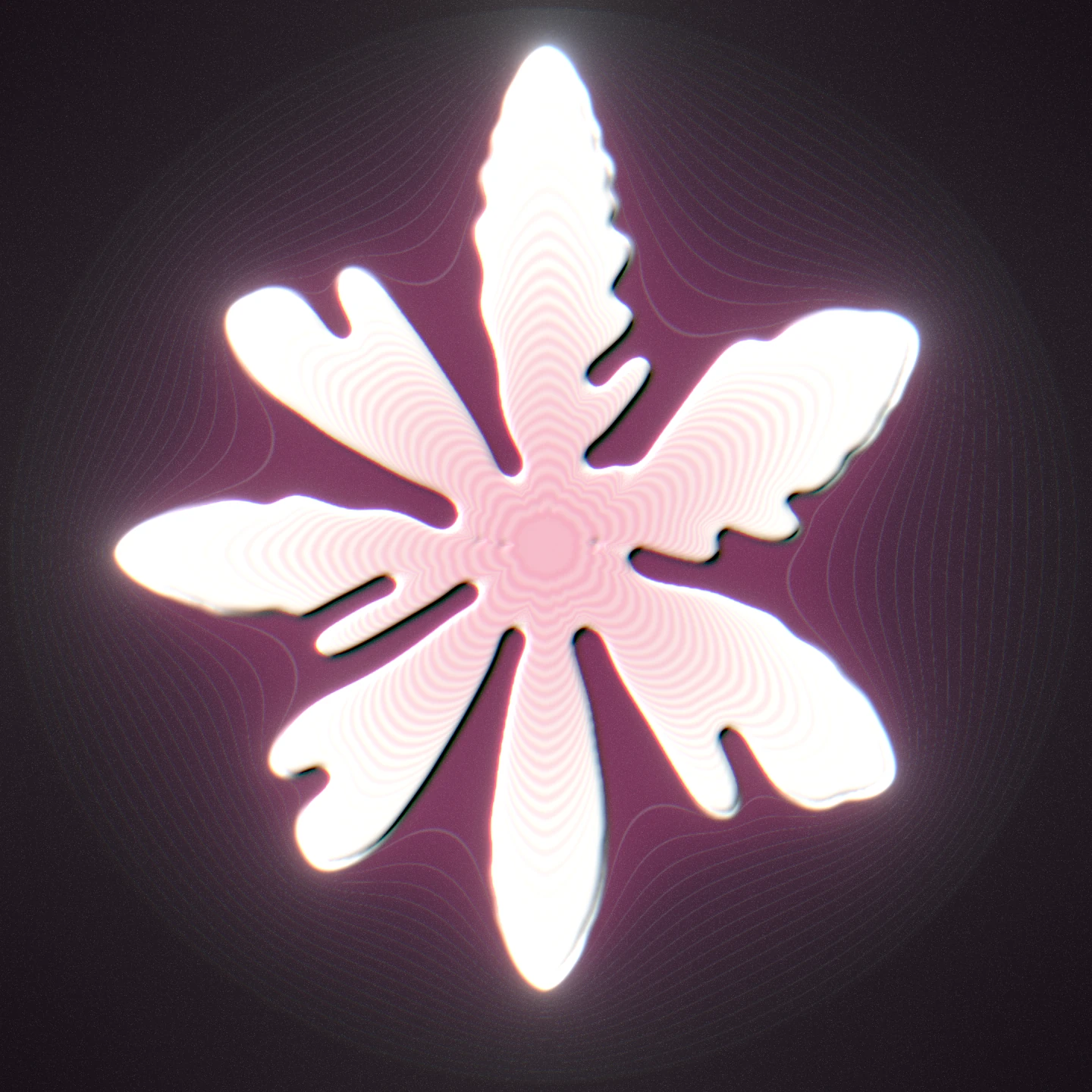
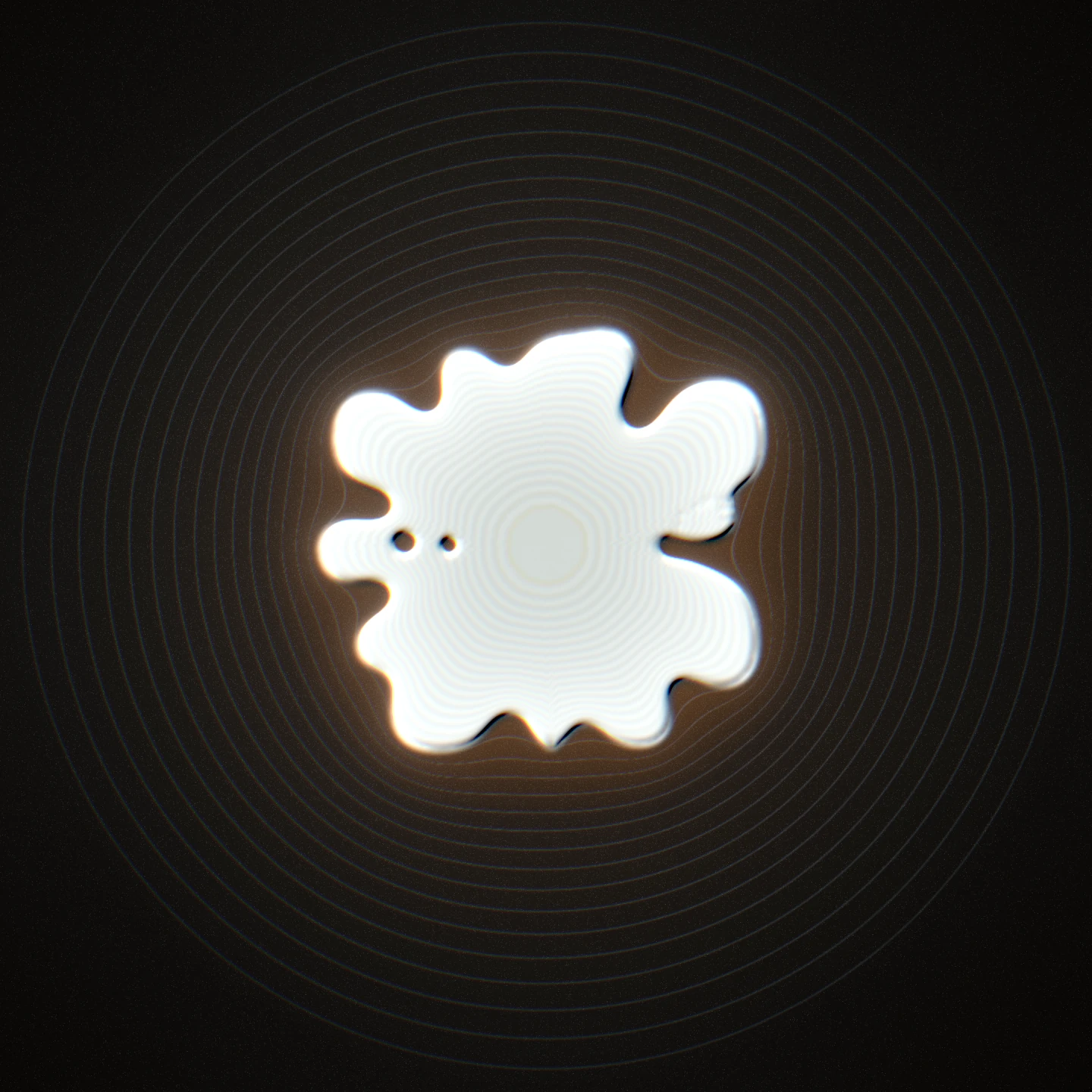
SELECTED STILLS — 6
PROCESS — PARAMETER SWEEPS
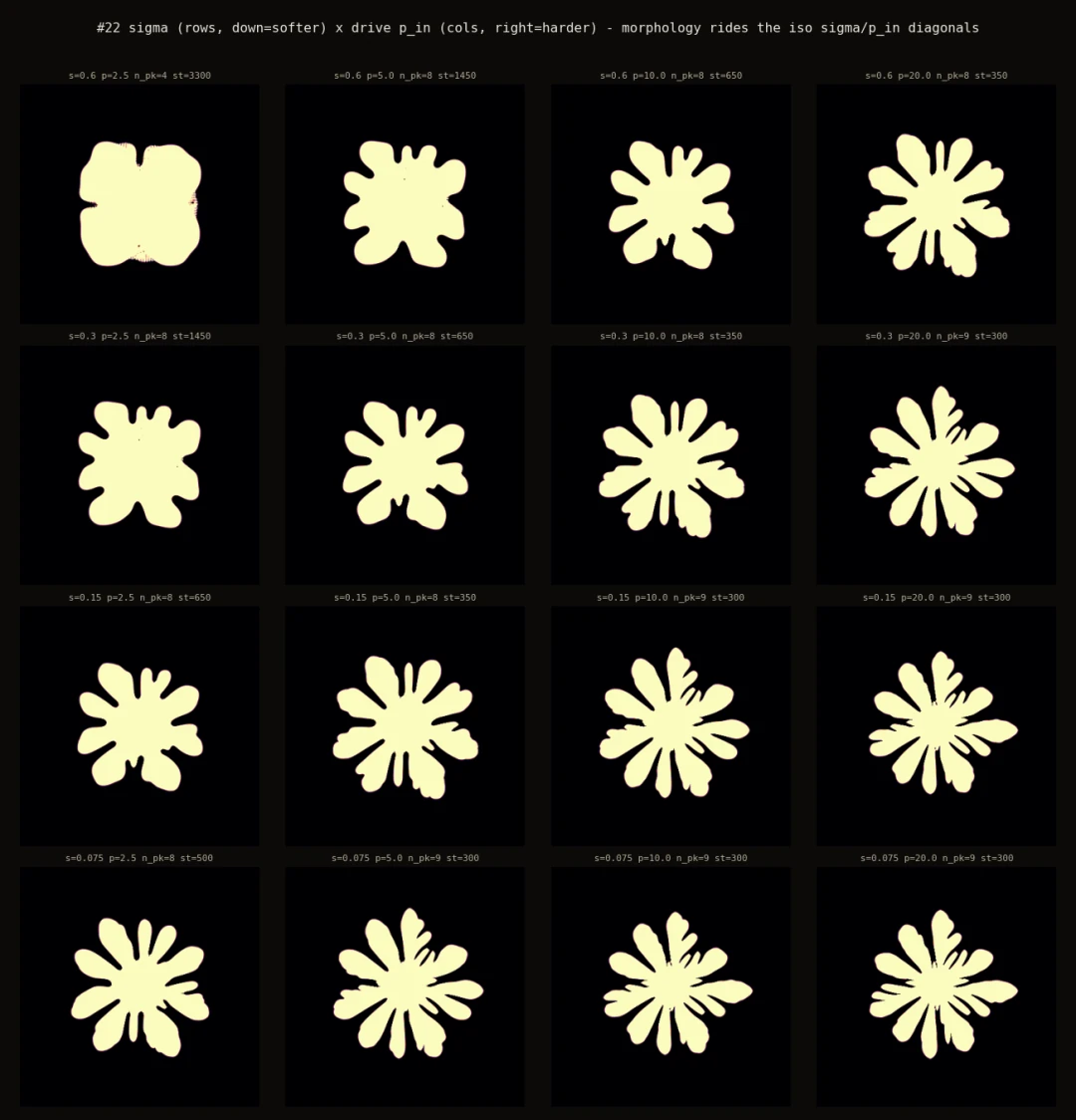
The exploration as a morphology plane — surface tension against driving pressure, sixteen runs. The same shape repeats along the iso-σ/p_in diagonals, because only the selected length λ* ∝ √(σ/V) decides the form: the "one selected length" hypothesis made visible. Down the main diagonal, the whole range from a single slow lobe to a crowd of fine fingers.
SIGNATURE — THE PRICE LIST
Every ripple wavelength has a price it can no longer pay.
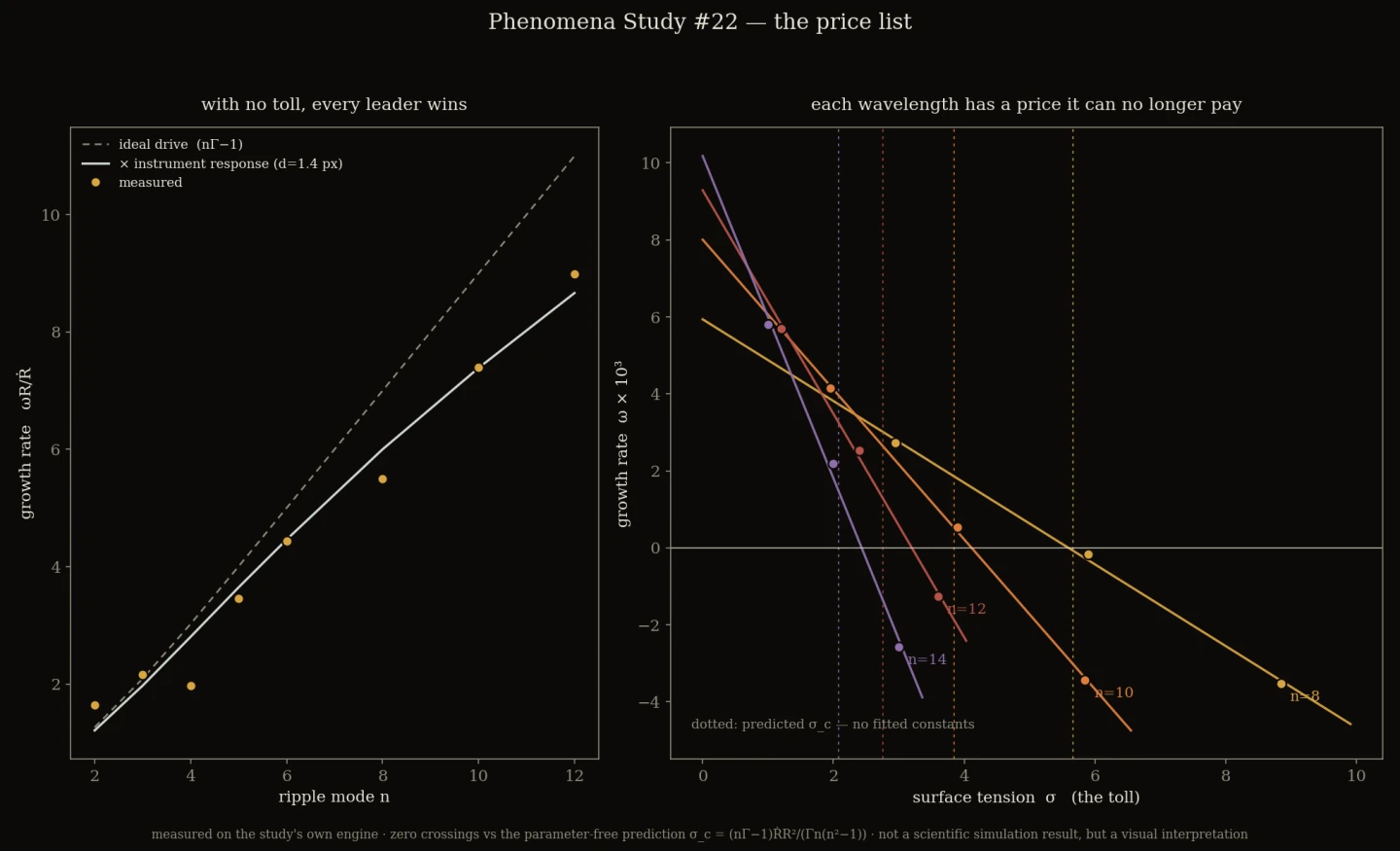
An interface pushed into a slower fluid wants to ripple, and every ripple is a bid. The drive pays each mode a wage fixed by geometry and kinematics alone — no adjustable constants — while surface tension charges for the corners, hardest on the finest ripples. Written out, the ledger becomes a dispersion relation, and each mode's growth rate crosses zero at its own critical tension σ_c: a price list for ripples.
The list was checked on the study's own engine. The measured tension where mode n stops growing follows the parameter-free prediction σ_c = (nΓ−1)ṘR²/(Γn(n²−1)) across a nearly threefold range (n 8–14, linear fits R² ≥ 0.994), and a mode pushed beyond its price — n 16 held at 1.4 σ_c — decays on cue. The check was built on σ_c deliberately: the zero crossing is an invariant, unmoved by the instrument's multiplicative response. And the other side of the ledger balances too — mass is conserved to machine precision (1.6 × 10⁻¹⁶).
COLOUR = THE WATERFLOODING STAGE
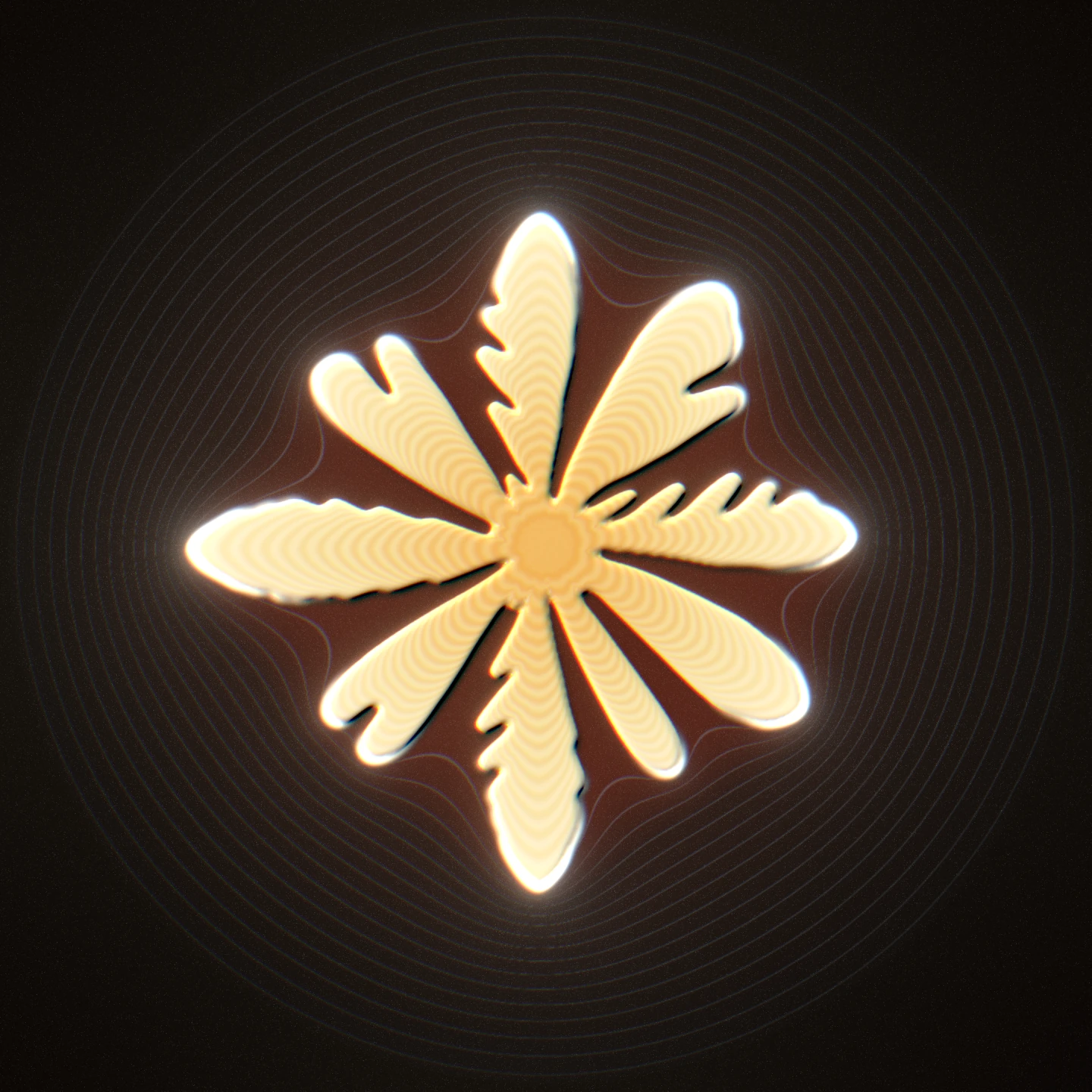
The hero palette is the phenomenon's original stage: waterflooding an oil reservoir. The dark ground is crude oil; the pale invader is brine; the amber glow around the flower is the pressure field itself — the oil that is about to yield. The faint rings inside the invader are arrival-time isochrones: the pattern is the receipt of its own invasion. In the ember variation the toll is near zero and every petal grows teeth — the same physics photographed at a different price.
Form is physics throughout: petal width is the selected wavelength λ*, tips split when they grow wider than the toll allows, and the grooves are where the slow fluid held its ground.
All palettes are artistic approximations of literature imagery, not measurements.
REFERENCES
- P. G. Saffman, G. I. Taylor. "The penetration of a fluid into a porous medium or Hele-Shaw cell containing a more viscous liquid." Proceedings of the Royal Society of London. Series A, vol.245, no.1242, 312-329 (1958). https://doi.org/10.1098/rspa.1958.0085
- L. Paterson. "Radial fingering in a Hele Shaw cell." Journal of Fluid Mechanics, vol.113, 513-529 (1981).
- H. S. Hele-Shaw. "The flow of water." Nature, vol.58, 34-36 (1898).
- L. Paterson. "Diffusion-Limited Aggregation and Two-Fluid Displacements in Porous Media." Physical Review Letters, vol.52, no.18, 1621-1624 (1984).
- G. M. Homsy. "Viscous fingering in porous media." Annual Review of Fluid Mechanics, vol.19, 271-311 (1987).
- D. Bensimon, L. P. Kadanoff, S. Liang, B. I. Shraiman, C. Tang. "Viscous flows in two dimensions." Reviews of Modern Physics, vol.58, no.4, 977-999 (1986).
- J. W. McLean, P. G. Saffman. "The effect of surface tension on the shape of fingers in a Hele-Shaw cell." Journal of Fluid Mechanics, vol.102, 455-469 (1981).
INTERACTIVE STUDY
A thin layer of viscous fluid, invaded from the centre. The pressure field decides who advances; surface tension charges every corner. surface tension and injection act live mid-invasion — the toll can be raised while the fingers grow — and noise re-injects the flower with new flaws. It is a deliberately simplified instrument, capped at a 160² lattice with a few curated knobs and no export, separate from the full engine used to author the finished works.
This interactive study is not intended as a scientifically validated reproduction. It is a visual interpretation generated from an implemented model and curated parameter exploration — and it is a deliberately simplified instrument, separate from the full engine used to author the finished works.