STUDY #23 · 2026 · IN OBSERVATION
Quantum Billiards
A model-driven visual study of quantum chaos in a stadium billiard.
WHAT IS THIS
A billiard is the simplest mechanics there is: a point bouncing inside a boundary. In a circular table the motion is perfectly ordered forever; give the table two straight walls — the Bunimovich stadium — and it becomes provably chaotic: a single ray fills the table and forgets its history.
The quantum version asks what standing waves this chaotic table can hold. This study solves the cavity's eigenmodes numerically (hundreds of them, cross-checked against exact solutions, spectral statistics and Weyl's law) and superposes them in real time on the GPU — stationary scarred states, spectral chords, and a Gaussian wave packet launched along the unstable diamond orbit, evolved exactly by phase rotation.
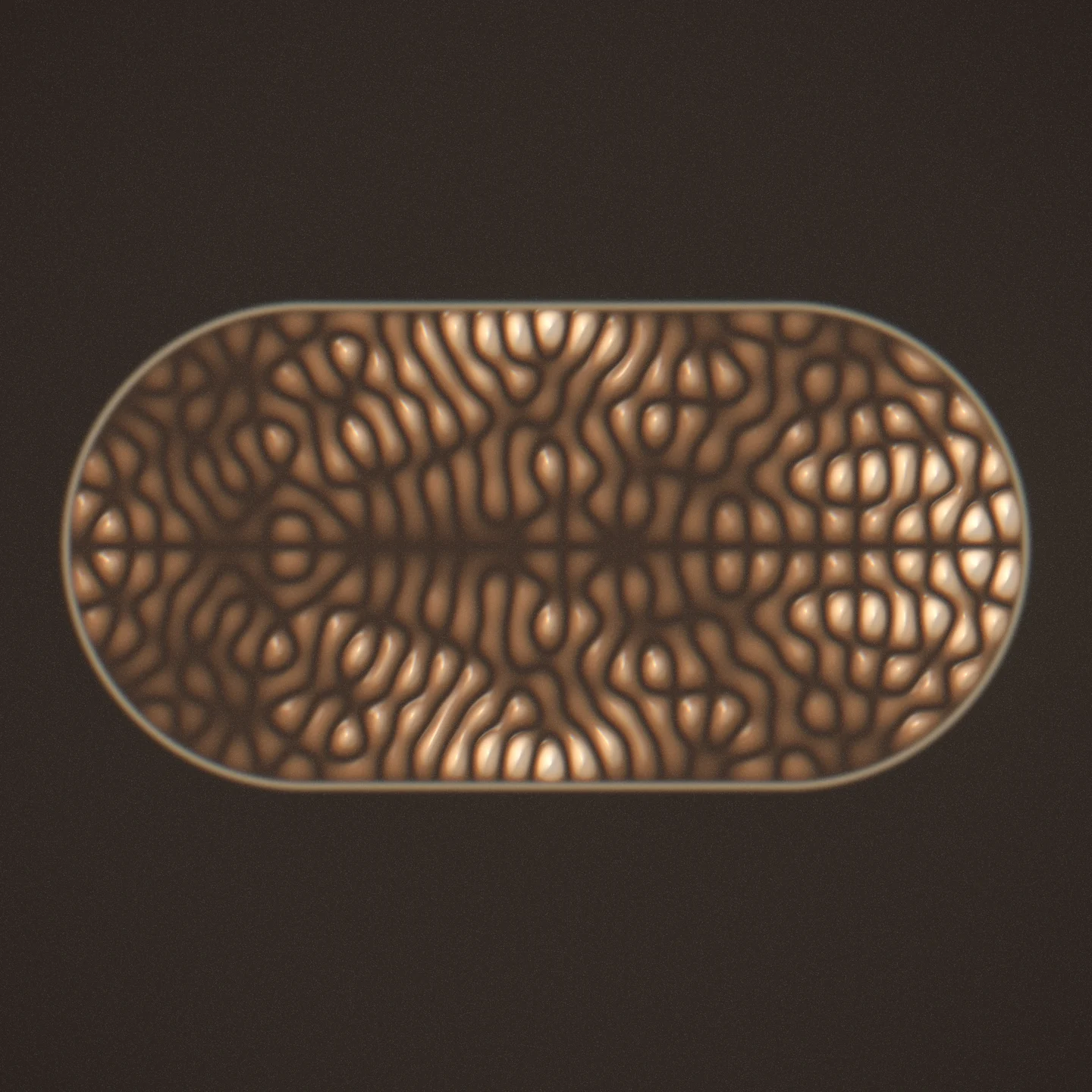
This is not a scientific simulation result, but a visual interpretation of the phenomenon.
SAME FAMILY, THE TABLE TURNS CHAOTIC
Chladni draws the nodal lines of order. The stadium draws the ghosts chaos left behind.
PARAMETERS EXPLORED
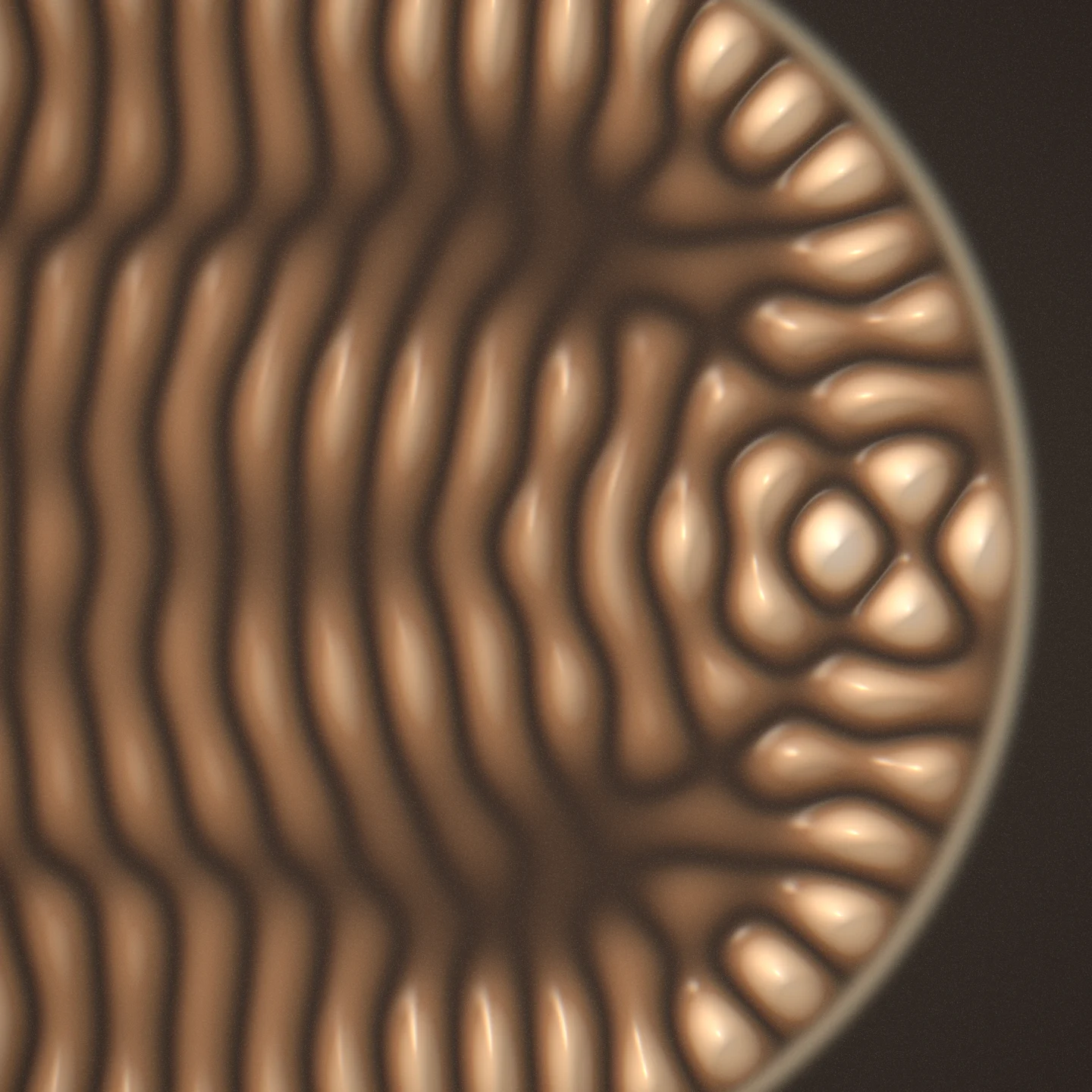
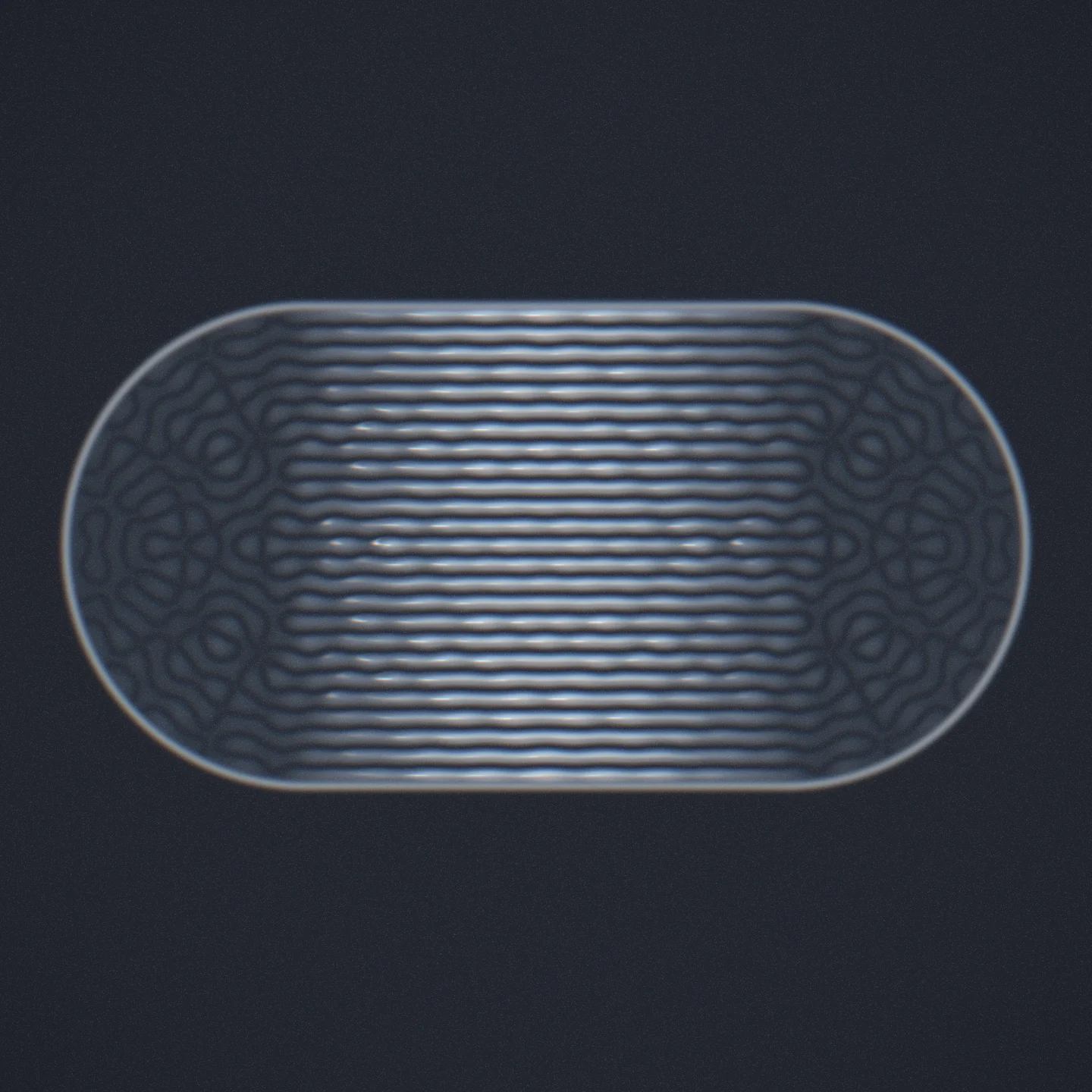
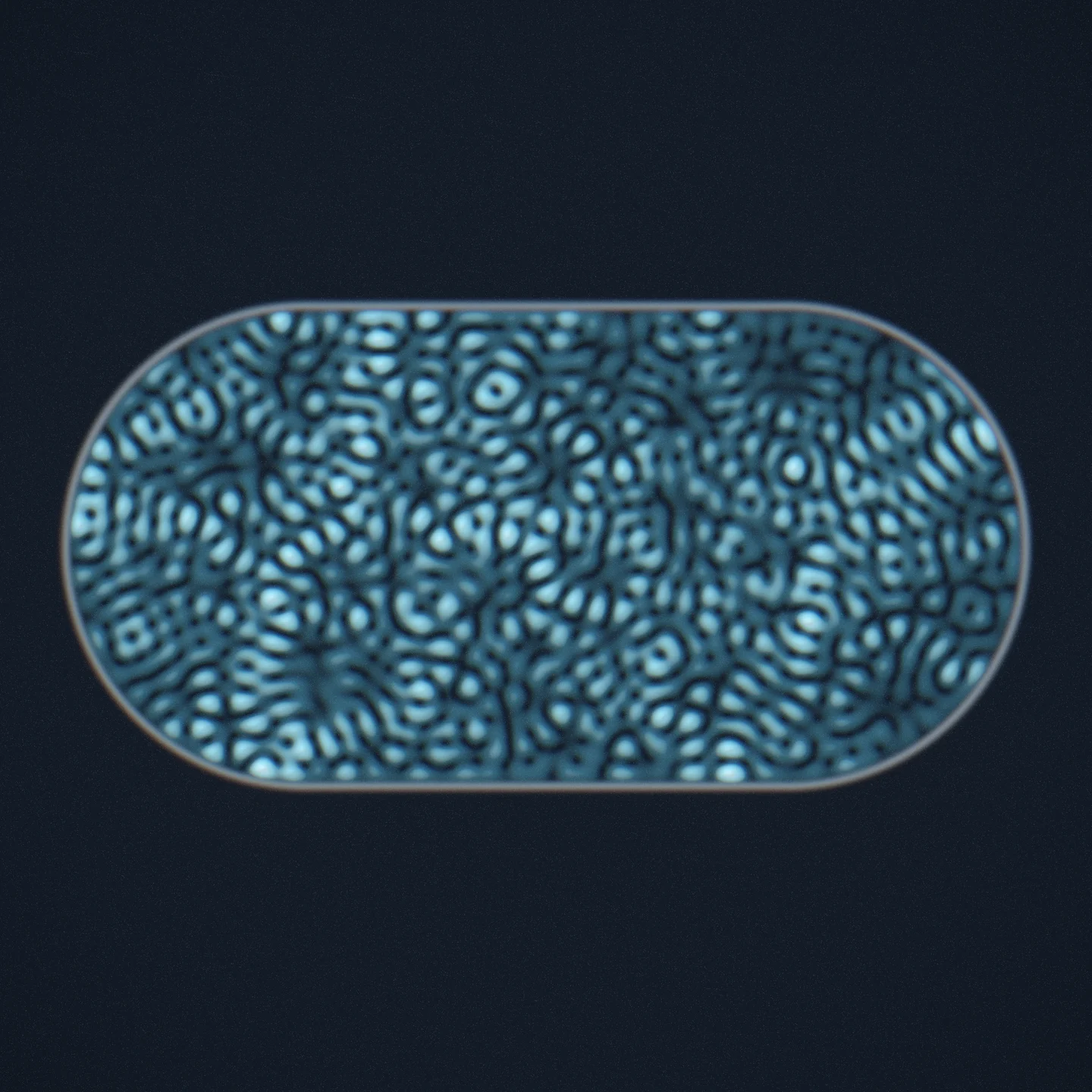
Each image below records its exact parameter set.
THE MATHEMATICS the model behind the images
One eigenproblem, run as a drum. The table is a membrane; every picture is an exact superposition of its standing waves.
A visual interpretation of the model, not a claim of scientific precision. The stadium modes are numerical (the curved wall converges at first order); the GPU field matches the reference computation to max|Δψ| = 6.9e-7, and a single mode at t = 0 is bitwise identical.
SELECTED STILLS — 7
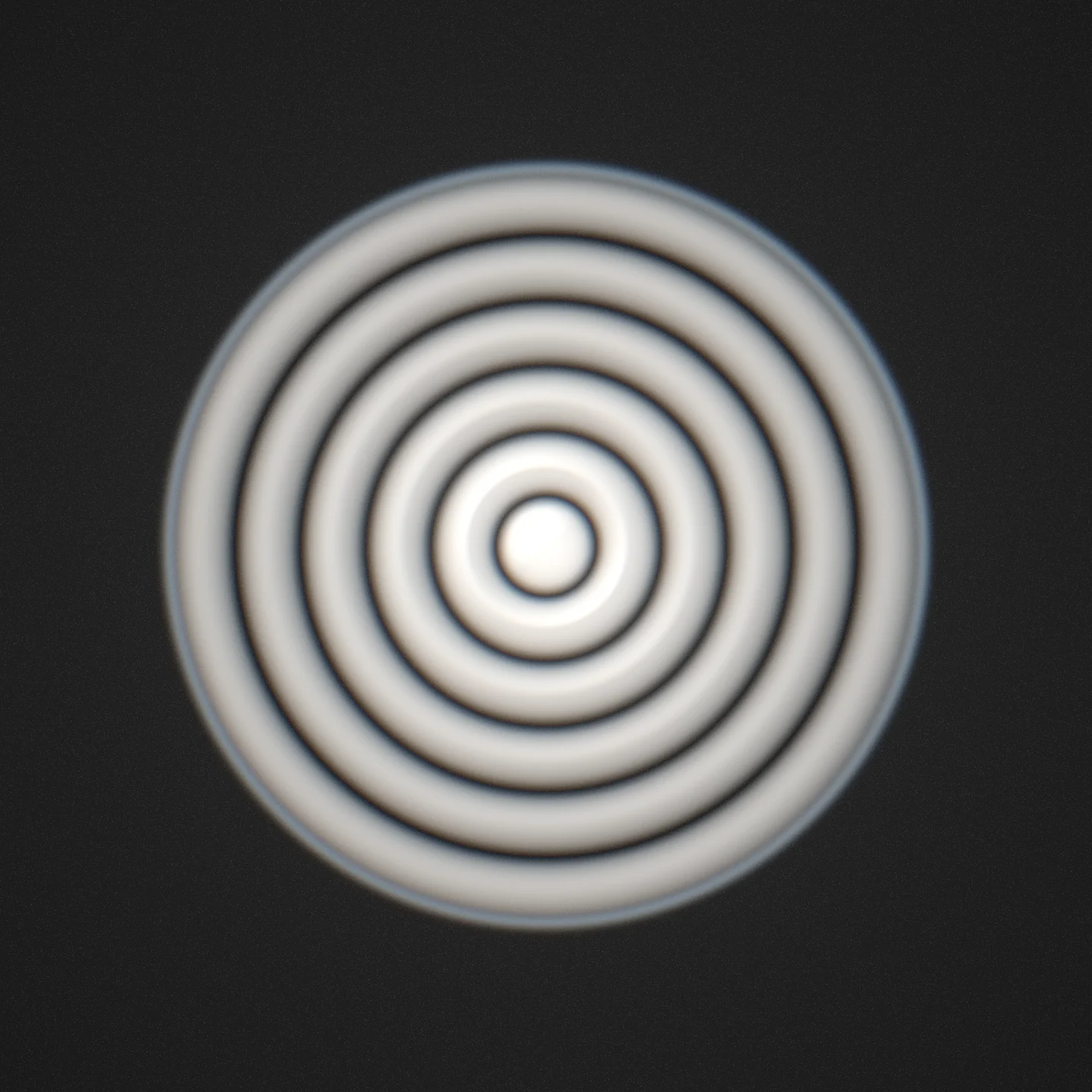
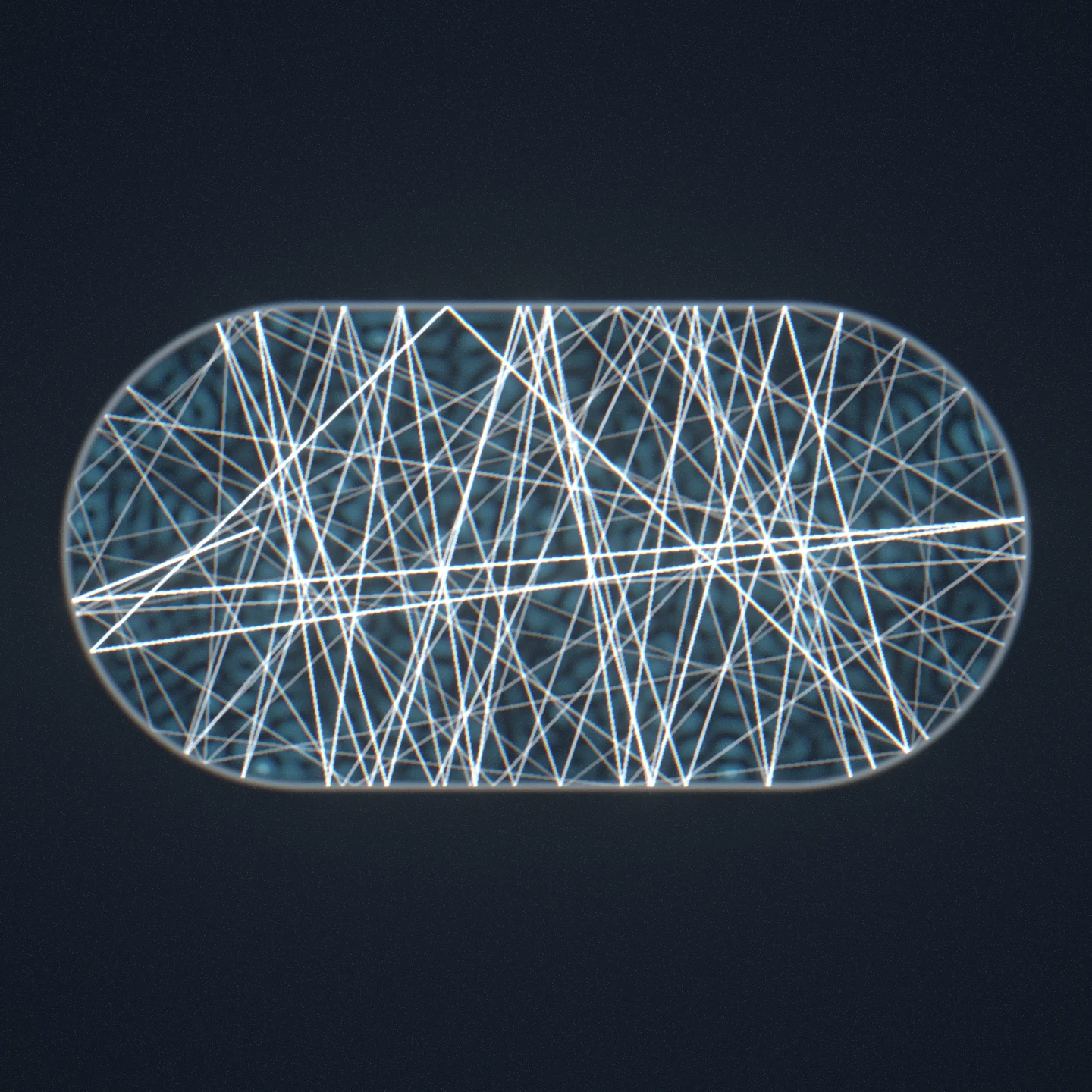
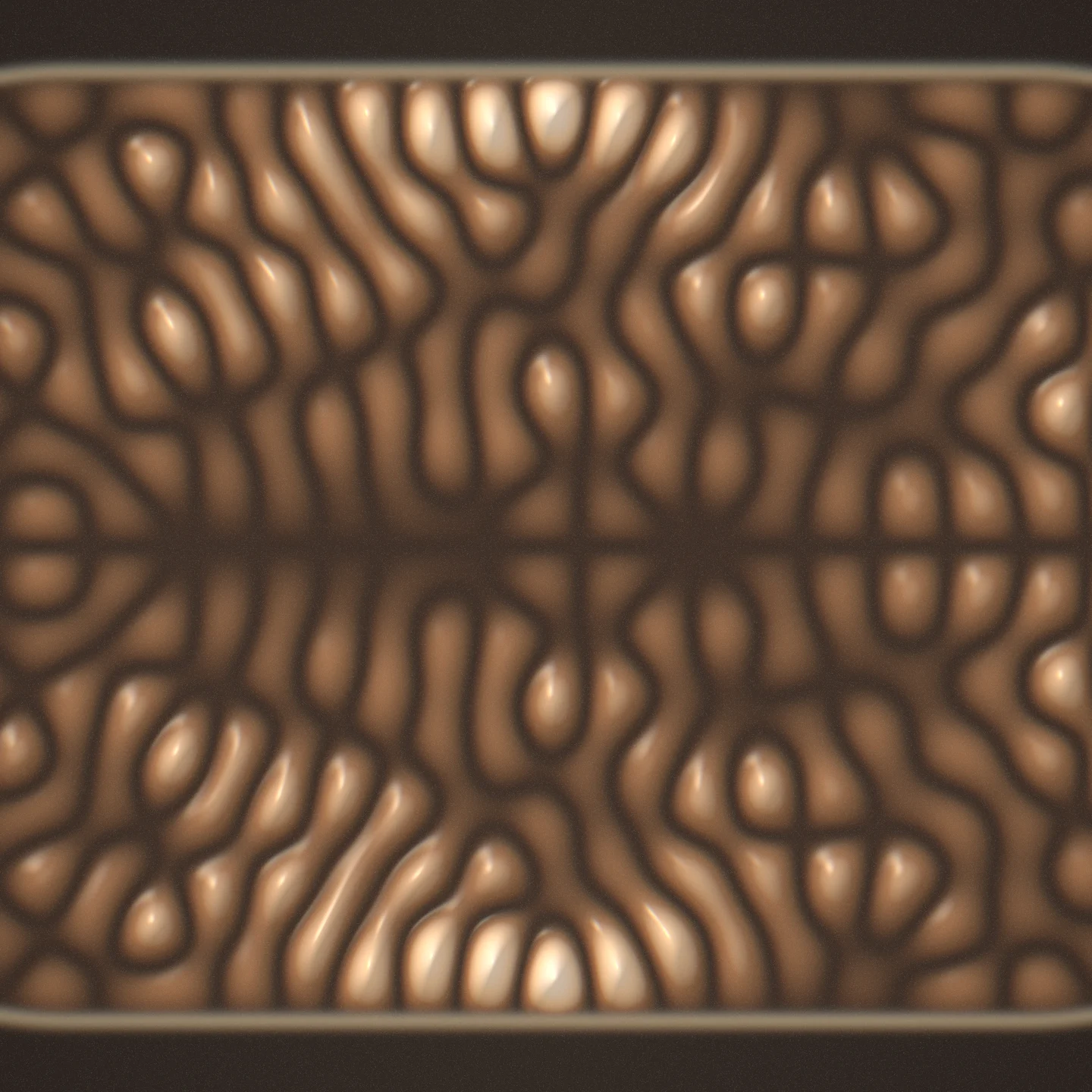
PROCESS — PARAMETER SWEEPS
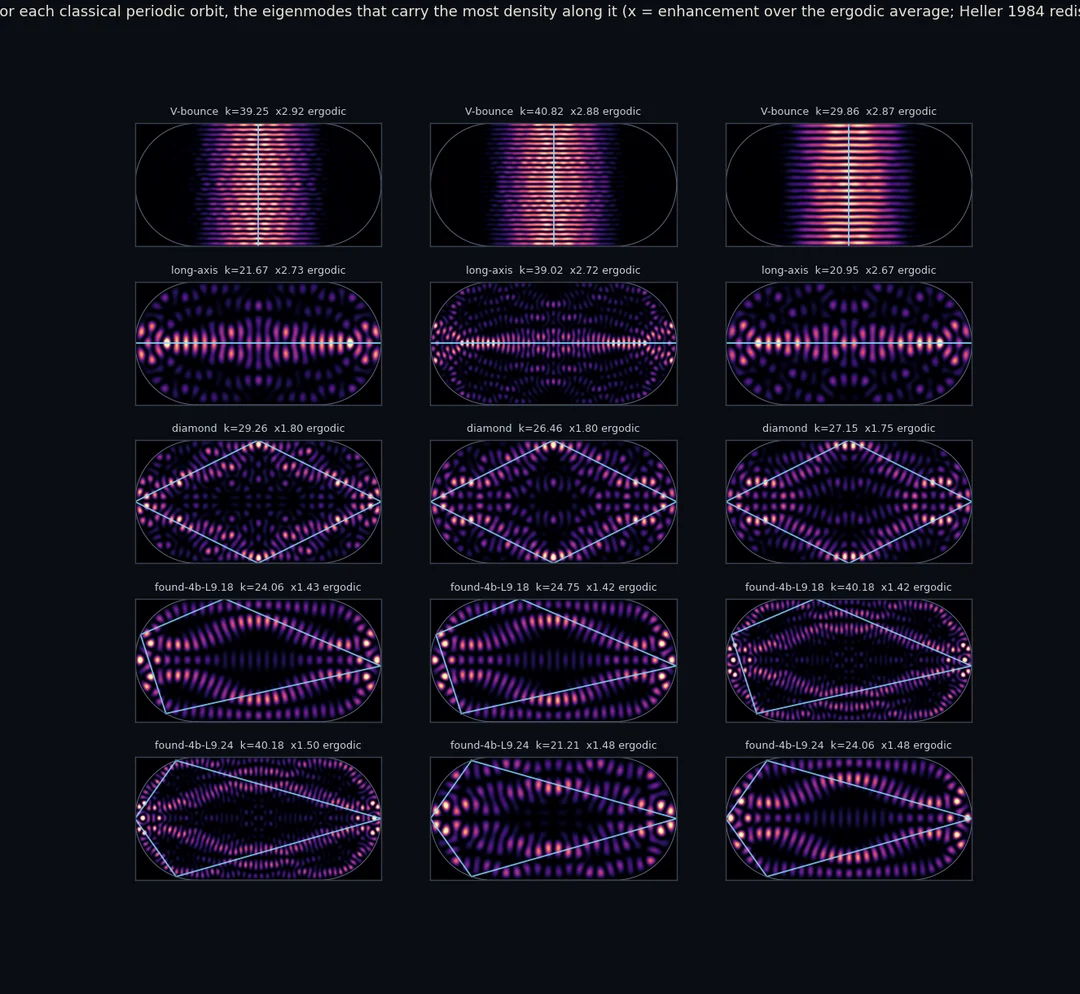
The scars were not placed; they were found. A closure search on the classical table rediscovered 44 periodic orbits, and every one of 961 computed eigenmodes was scored by its mean density inside a thin tube around each orbit. The sheet is that ledger's top three per orbit: the bouncing-ball family at ×2.92 the ergodic mean, the long axis at ×2.73, the diamond at ×1.80 — and the three states of the diamond family are the chord the hero video crystallises into.
SIGNATURE — THE SPECTRUM HEARS THE ORBITS
Chaos erases the path. Interference keeps its ghost.
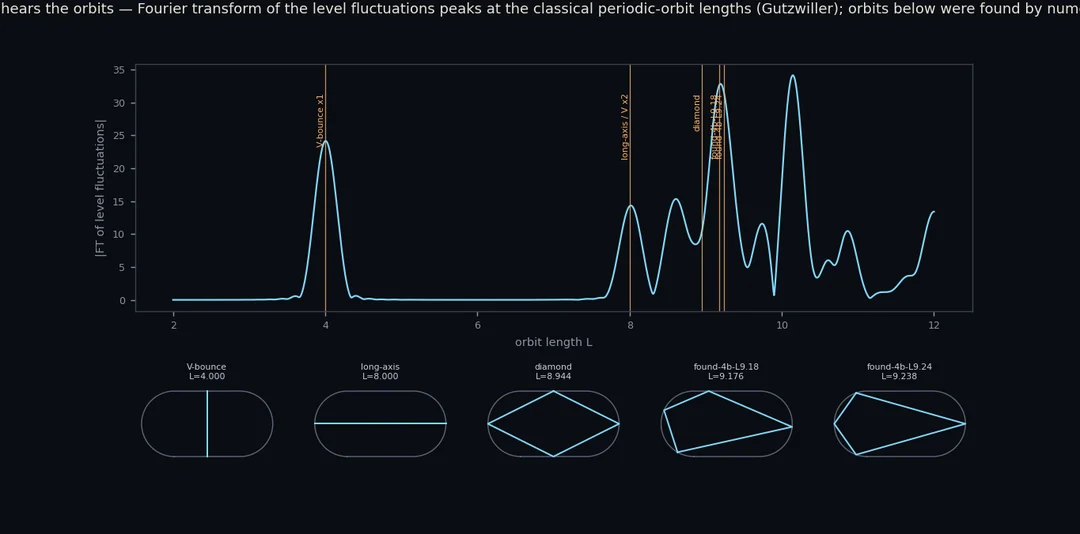
Three times over, the dead orbits come back. In the eigenstates: along the unstable diamond orbit the probability density runs ×1.80 the ergodic average — Heller's scar, with the bouncing-ball family at ×2.92 and the long axis at ×2.73. In the dynamics: a Gaussian packet launched on the diamond shatters in a few bounces, yet re-peaks every classical period (|C| ≈ 0.27 at T = 0.169), its time average redrawing the orbit.
And in the spectrum: Fourier-transform the fluctuations of the level density and peaks stand at the lengths of the classical orbits — L = 4.005 for the bouncing ball, 8.015 for the long axis, and a strong line at 9.195 that was never planned: the closure search had already found a trapezoid orbit of length 9.176, off by 0.019. The spectrum counts orbits we did not tell it about.
COLOUR = STM COPPER, CAVITY STEEL, DARK PLATE
The stadium's waves have been seen in real laboratories twice over. Electrons corralled on a Cu(111) surface stand in exactly these ripples under a scanning-tunnelling microscope — the copper-relief palette renders probability as an STM topograph, bright crests of presence over dark nodal channels of absence. Microwave cavities machined into stadium shapes obey the same Helmholtz equation; the steel-and-heat palette answers them.
The dark plates quote the numerical tradition begun by McDonald–Kaufman and Heller, whose false-colour scars first showed the ghosts.
All palettes are artistic approximations of those instruments and materials, not measurements.
REFERENCES
- L. A. Bunimovich. "On the ergodic properties of nowhere dispersing billiards." Communications in Mathematical Physics, vol.65, 295-312 (1979).
- E. J. Heller. "Bound-State Eigenfunctions of Classically Chaotic Hamiltonian Systems: Scars of Periodic Orbits." Physical Review Letters, vol.53, 1515-1518 (1984).
- S. W. McDonald, A. N. Kaufman. "Spectrum and Eigenfunctions for a Hamiltonian with Stochastic Trajectories." Physical Review Letters, vol.42, 1189-1191 (1979).
- O. Bohigas, M. J. Giannoni, C. Schmit. "Characterization of Chaotic Quantum Spectra and Universality of Level Fluctuation Laws." Physical Review Letters, vol.52, 1-4 (1984).
- M. V. Berry. "Regular and irregular semiclassical wavefunctions." Journal of Physics A: Mathematical and General, vol.10, 2083-2091 (1977).
- M. F. Crommie, C. P. Lutz, D. M. Eigler. "Confinement of Electrons to Quantum Corrals on a Metal Surface." Science, vol.262, 218-220 (1993).
INTERACTIVE STUDY
A small window onto the model behind the finished works: 24 curated eigenmodes of the chaotic stadium cavity, superposed by exact phase rotation. Climb the energy ladder from the ground state to random waves — on the way, the diamond-scar family keeps a dead classical orbit glowing. It is a deliberately simplified instrument, capped in resolution with a few curated knobs and no export, separate from the full 168-mode engine used to author the finished works.
This interactive study is not intended as a scientifically validated reproduction. It is a visual interpretation generated from an implemented model and curated parameter exploration — and it is a deliberately simplified instrument, separate from the full engine used to author the finished works.