PHENOMENA STUDIES WEAVER AXIOM
Studies Archive About
← INDEX

STUDY #25  ·  2026 · IN OBSERVATION

Kelvin–Helmholtz Instability

A model-driven visual study of how a velocity difference chooses a single wavelength and rolls a shear layer into cat's-eye vortices.

MOVING IMAGE — ROLL-UP ARC Re 12000 · Ri 0 · δ 0.05 · Γ 2.5 · tide

WHAT IS THIS

Where two fluids move past each other at different speeds, the shear layer between them is unstable: any small ripple grows, steepens, and curls over into a row of vortices — the "cat's eyes" of the Kelvin–Helmholtz instability. No obstacle and no heat source are needed; the velocity difference alone does everything. It is the same mechanism that carves billow clouds into the sky and raises the first waves on still water.

The model is the two-dimensional Boussinesq equations in vorticity–streamfunction form (the same engine as this series' convection studies), with the vertical thermal gradient replaced by a horizontal hyperbolic-tangent shear layer, U(y) = tanh(y/δ). Linear theory is the anchor: of all the wavelengths that could grow, the fastest is near k·δ ≈ 0.4446 (Michalke 1964) — so the layer selects its own billow spacing. This study runs it in real time on the GPU (a ping-pong texture holds vorticity, the density interface and the streamfunction; a relaxation pass recovers the flow).

The film follows the roll-up from a flat line: a single wavelength is chosen, the interface steepens, cat's-eye vortices wind up, and the braids between them stretch the two fluids into a thin, interleaved seam.
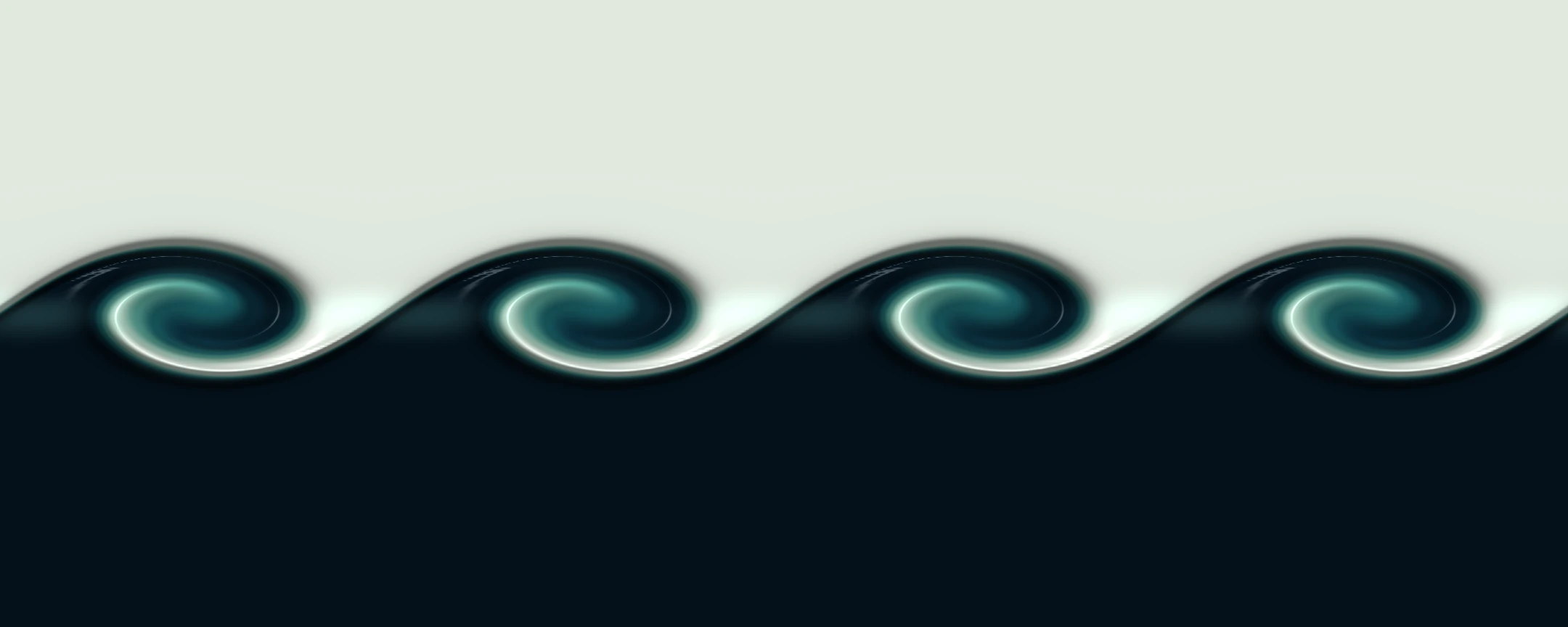
the roll-up — four cat's-eye billows at full wind
the roll-up — four cat's-eye billows at full wind Re 12000 · Ri 0 · δ 0.05 · Γ 2.5 · Sc 1 · seed 201 · t 3.9 · tide
Motif Kelvin–Helmholtz instability / stratified shear layer / billow clouds / cat's-eye vortices / Miles–Howard Ri=1/4
Method A small simulator was generated and modified with AI assistance, then ported to a real-time GPU (GLSL) renderer. The visual output was selected through parameter exploration.
Observation Shaken at every wavelength, a tanh shear layer amplifies just one (near k·δ ≈ 0.4446) and rolls it into evenly spaced cat's-eye billows (~Γ/14.1δ of them); the braids between stretch the interface into a thin seam. Stable stratification brakes the roll-up and, past a gradient Richardson number of 1/4, stops it entirely (Miles–Howard).
Reference Alfred Michalke, "On the inviscid instability of the hyperbolic tangent velocity profile," Journal of Fluid Mechanics, vol.19, 543-556 (1964); John W. Miles, J. Fluid Mech., vol.10, 496-508 (1961); Louis N. Howard, J. Fluid Mech., vol.10, 509-512 (1961).
Tools Python / NumPy / SciPy / three.js / React / GLSL / ffmpeg / AI coding assistant
Year 2026

This is not a scientific simulation result, but a visual interpretation of the phenomenon.

SAME ENGINE, THE GRADIENT TURNED ON ITS SIDE

In the convection pot, buoyancy is the engine. In the shear layer, it is the brake.

Study #18 — Rayleigh–Bénard Study #25 — Kelvin–Helmholtz
The setup one fluid layer, heated from below two streams sliding past each other — no obstacle, no heat source
What makes the pattern buoyancy — heat becoming motion the velocity difference alone — the shear picks its own wavelength
The role of weight the engine — light fluid must rise the brake — past Ri = 1/4 the roll-up stops
What is born a forest of plumes settling into cells a row of cat's-eye vortices, braids stretched between

PARAMETERS EXPLORED

param meaning effect on the image
Ri the gradient Richardson number — the weight of the stratification the story's main axis: at 0 the layer rolls freely; past 0.25 the roll-up stops entirely (Miles–Howard); between the two, a continuous throttle on the depth of the roll
Re the Reynolds number — the inverse of viscosity higher draws the braids finer and sharper, down to secondary swirls in the cores; the layer value Re_δ = δ·Re must clear ≈ 300 for the roll-up to survive viscosity at all
δ the thickness of the shear layer sets the chosen wavelength λ ≈ 14.1·δ, and with it how many billows fit the box — thinner means more and finer
Sc the Schmidt number — how slowly the dye diffuses high keeps the interface sharp as it winds, so the fine braiding survives; low blurs it early
Γ, seed, t box width, initial disturbance, observation time the billow count is Γ/λ; seed and t are casting — which take, and which moment of the roll-up → pairing arc to cut

Each image below records its exact parameter set.

THE MATHEMATICS the model behind the images

The model, in the same vessel as this series' convection studies: the two-dimensional Boussinesq equations in vorticity–streamfunction form, with the vertical thermal gradient replaced by a horizontal tanh shear layer. The field s′ is dye and density in one — pure dye at Ri = 0, weight as well when Ri > 0; J(ψ, ·) is carriage by the flow.

∂t ω=− J(ψ,ω)+1Re ∇2ω+Riδ ∂xs′\partial_t\,\omega = -\,J(\psi,\omega) + \tfrac{1}{\mathrm{Re}}\,\nabla^2\omega + \tfrac{\mathrm{Ri}}{\delta}\,\partial_x s^{\prime}∂t​ω=−J(ψ,ω)+Re1​∇2ω+δRi​∂x​s′
The spin of the flow. The shear layer itself is a sheet of vorticity; the last term is buoyancy — absent at Ri = 0, where the roll-up is free, and the brake once Ri > 0.
∂t s′=− J(ψ,s′)−∂xψ 1δ sech⁡2 ⁣(y−1/2δ)+1Re Sc ∇2s′\partial_t\,s^{\prime} = -\,J(\psi,s^{\prime}) - \partial_x\psi\,\tfrac{1}{\delta}\,\operatorname{sech}^2\!\big(\tfrac{y-1/2}{\delta}\big) + \tfrac{1}{\mathrm{Re}\,\mathrm{Sc}}\,\nabla^2 s^{\prime}∂t​s′=−J(ψ,s′)−∂x​ψδ1​sech2(δy−1/2​)+ReSc1​∇2s′
The interface: dye and density in one field — carried by the flow, peeled off the base tanh profile by the roll-up, smoothed by diffusion.
∇2ψ=ω,u=− ∂yψ,w=∂xψ\nabla^2\psi = \omega, \qquad u = -\,\partial_y\psi, \quad w = \partial_x\psi∇2ψ=ω,u=−∂y​ψ,w=∂x​ψ
The streamfunction ties spin back to motion. On the GPU a relaxation pass recovers ψ from ω each step — with the base shear seeded analytically, a large-scale flow the relaxation alone cannot raise.
k δ≈0.4446,σ δ/U0≈0.1897,λ≈14.1 δk\,\delta \approx 0.4446, \qquad \sigma\,\delta/U_0 \approx 0.1897, \qquad \lambda \approx 14.1\,\deltakδ≈0.4446,σδ/U0​≈0.1897,λ≈14.1δ
Michalke's 1964 answer for the tanh layer: the fastest-growing wavenumber, its growth rate, and the billow spacing that follows — the numbers this engine was measured against (0.1896 found, 0.05% off).
Ri(y)≥14    everywhere    ⟹    stable\mathrm{Ri}(y) \geq \tfrac{1}{4} \;\;\text{everywhere} \;\;\Longrightarrow\;\; \text{stable}Ri(y)≥41​everywhere⟹stable
The Miles–Howard theorem (1961): past a gradient Richardson number of one quarter, no disturbance of any wavelength can grow. The exact cut-off the stratified runs and the interactive study run up against.

Free-slip walls above and below, periodic in x; lengths in the domain height, velocities in half the velocity difference between the streams, s′ the departure from the base tanh interface. A visual interpretation of the Boussinesq description, not an exact reproduction.

SELECTED STILLS — 4
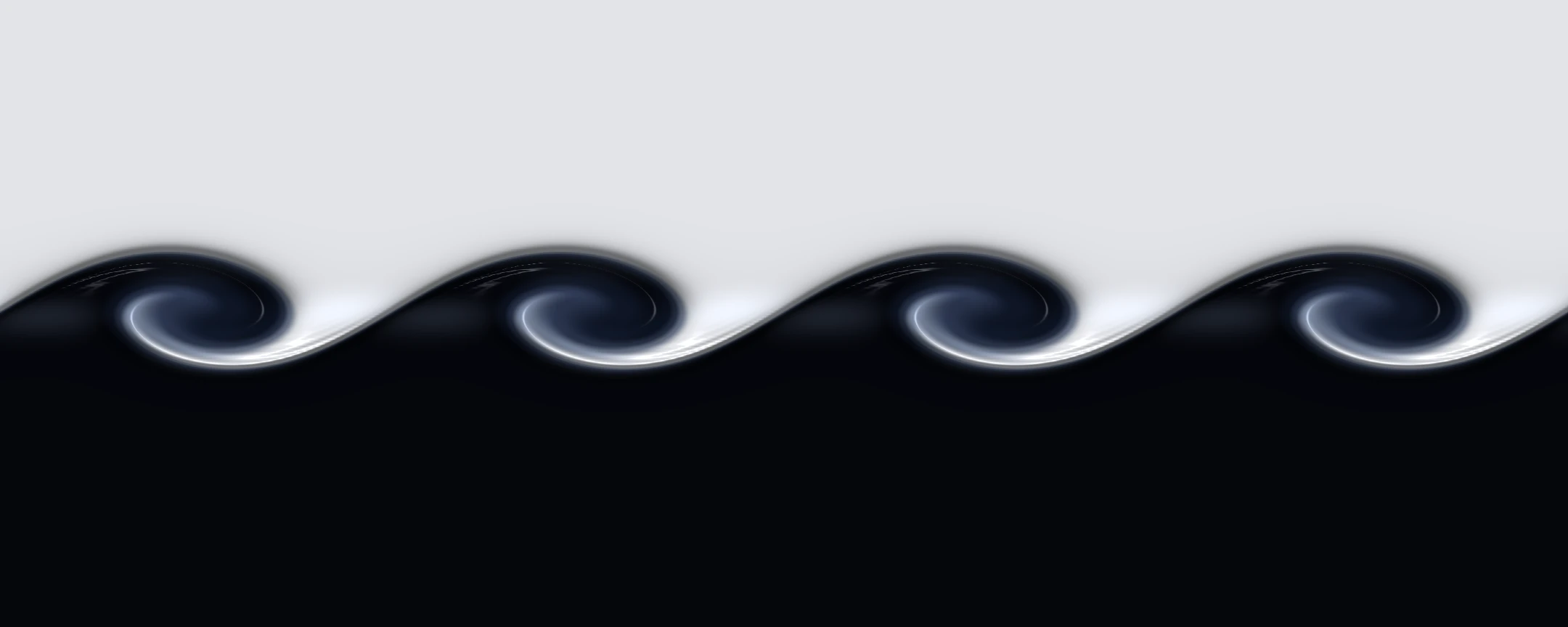
the roll-up — four cat's-eye billows at full wind, the braids tightening between
the roll-up — four cat's-eye billows at full wind, the braids tightening between Re 12000 · Ri 0 · δ 0.05 · Γ 2.5 · Sc 1 · seed 201 · t 3.9 · tide
higher Reynolds — the braids drawn finer and sharper, dye in water
higher Reynolds — the braids drawn finer and sharper, dye in water Re 18000 · Ri 0 · δ 0.05 · Γ 2.5 · Sc 1 · seed 620 · t 3.58 · ink
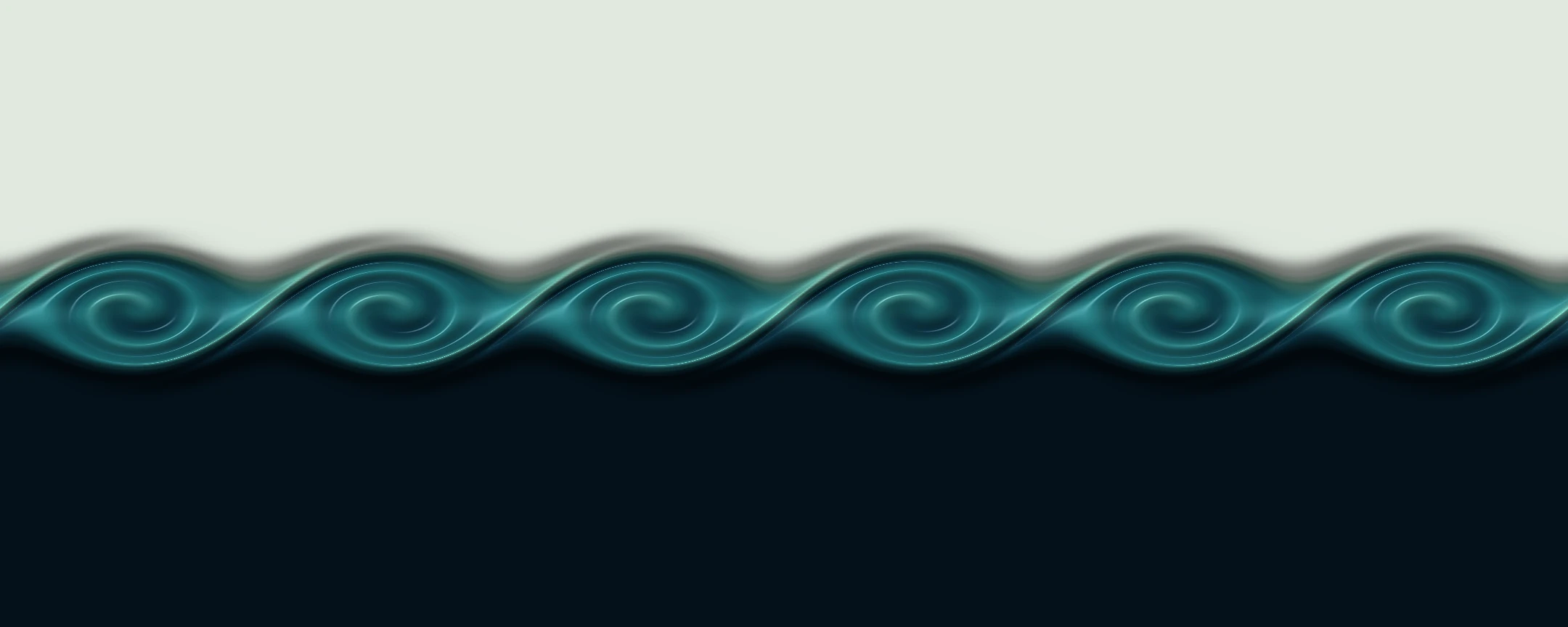
a thinner layer picks a shorter wavelength — six billows instead of four (λ ≈ 14.1·δ)
a thinner layer picks a shorter wavelength — six billows instead of four (λ ≈ 14.1·δ) Re 8000 · Ri 0 · δ 0.033 · Γ 3 · Sc 1 · seed 411 · t 4.33 · tide
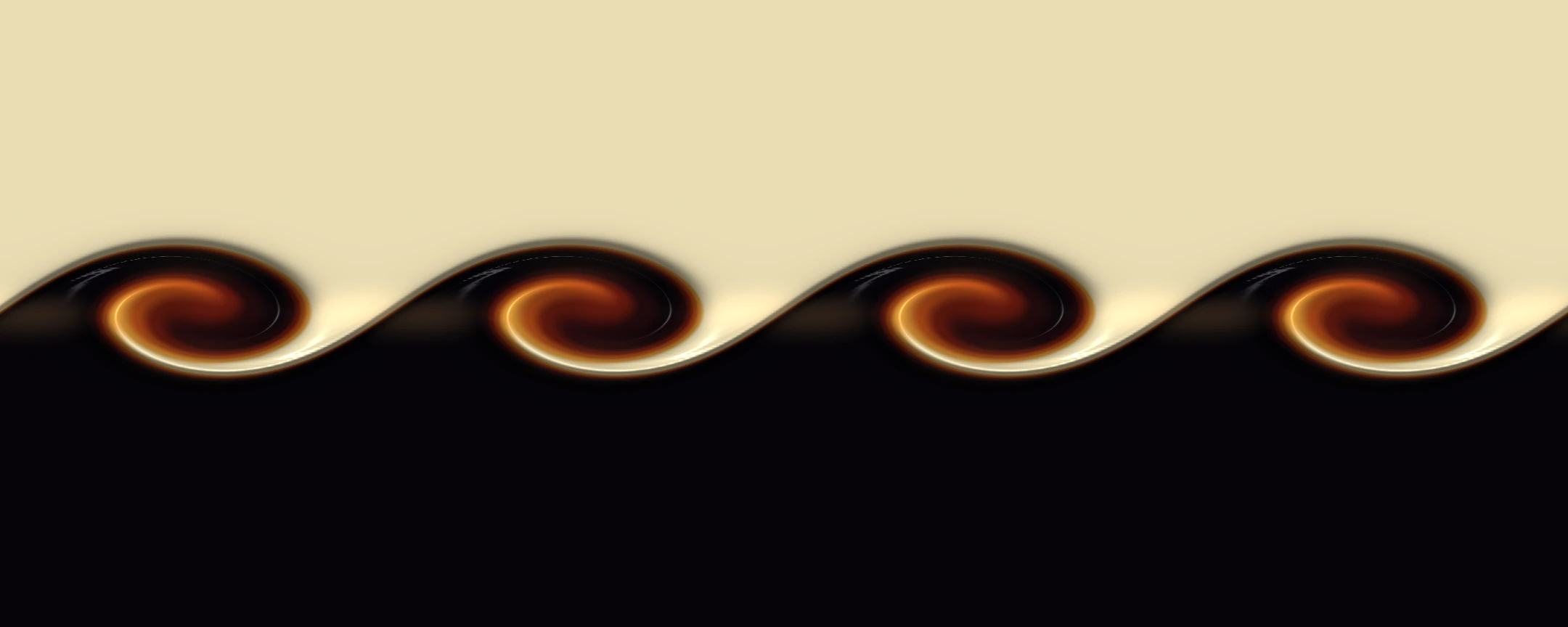
the same state read dark-field — the cores glowing warm
the same state read dark-field — the cores glowing warm Re 12000 · Ri 0 · δ 0.05 · Γ 2.5 · Sc 1 · seed 201 · t 3.9 · ember

SIGNATURE — THE QUARTER THRESHOLD

Add weight, and the roll-up stops at exactly one quarter.

No obstacle and no heat source — the velocity difference is the only author. Shaken at every wavelength at once, the tanh layer amplifies just one, near k·δ ≈ 0.4446 (Michalke 1964), and the spacing of the billows follows: λ ≈ 14.1·δ. Thin the layer and the pattern obeys — four billows become six.

Stratification sets the price of rolling. With heavier fluid below, every billow must lift weight, and Miles and Howard (1961) proved the exact cut-off: wherever the gradient Richardson number exceeds 1/4, no ripple of any wavelength can grow — the interface only waves. This engine was measured against both anchors before any image was kept: fastest growth σ·δ/U₀ = 0.1896 against Michalke's 0.1897, and amplification collapsing from 3.95 decades at Ri = 0 to none past the threshold. That quarter is the slider of this page's interactive study.

COLOUR = TWO FLUIDS, TWO COLOURS

The protagonist field is the density interface — two fluids given two colours, which the roll-up stretches into one braid. tide: two-tone water, heavy ink-teal below and pale foam above. billow: storm-cloud greys with a warm underlight, the way billow clouds actually look. ink: dye dropped in water. ember: a dark-field reading.

Placing the heavy fluid dark and low and the light fluid bright and high makes the mixing legible: at low Richardson number the roll-up lifts dark fluid up and pulls bright fluid down; past Ri = 1/4 that lifting stops. The glow along the braids traces vorticity — the cause behind the visible dye, which is only the consequence.

the dark-field reading — the glow of braids and cores tracing vorticity
the dark-field reading — the glow of braids and cores tracing vorticity Re 12000 · Ri 0 · δ 0.05 · Γ 2.5 · Sc 1 · seed 201 · t 3.9 · ember

All palettes are artistic approximations of these references, not measurements.

REFERENCES

  1. Hermann von Helmholtz. "Über discontinuirliche Flüssigkeits-Bewegungen (On discontinuous fluid motions)." Monatsberichte der Königlichen Preussischen Akademie der Wissenschaften zu Berlin, vol.23, 215-228 (1868).
  2. William Thomson (Lord Kelvin). "Hydrokinetic solutions and observations." Philosophical Magazine, ser.4, vol.42, 362-377 (1871).
  3. Alfred Michalke. "On the inviscid instability of the hyperbolic tangent velocity profile." Journal of Fluid Mechanics, vol.19, 543-556 (1964).
  4. John W. Miles. "On the stability of heterogeneous shear flows." Journal of Fluid Mechanics, vol.10, 496-508 (1961).
  5. Louis N. Howard. "Note on a paper of John W. Miles." Journal of Fluid Mechanics, vol.10, 509-512 (1961).
  6. Daniel Lecoanet, et al.. "A validated non-linear Kelvin-Helmholtz benchmark for numerical hydrodynamics." Monthly Notices of the Royal Astronomical Society, vol.455, 4274-4288 (2016).

INTERACTIVE STUDY

Two streams sliding past each other, one thin shear line between them. The line picks its own wavelength — about 14 δ, three billows in this strip — and rolls it up. Richardson  is live: drag it past the 1/4 tick and the roll-up stops mid-billow, leaving only internal waves (Miles–Howard); drag back and the shear resumes its work. It is a deliberately simplified instrument, a reduced 160-row window with a few curated knobs and no export, separate from the full engine used to author the finished works.

SIMPLIFIED INSTRUMENTSTRATIFIED SHEAR LAYER · 160 ROWS · Ri LIVE

This interactive study is not intended as a scientifically validated reproduction. It is a visual interpretation generated from an implemented model and curated parameter exploration — and it is a deliberately simplified instrument, separate from the full engine used to author the finished works.

← ALL STUDIES STUDY #26 · PERCOLATION — THE THRESHOLD · IN OBSERVATION →
PHENOMENA STUDIES — WEAVER AXIOM PERSONAL VISUAL RESEARCH · © 2026