PHENOMENA STUDIES WEAVER AXIOM
Studies Archive About
← INDEX

STUDY #26  ·  2026 · IN OBSERVATION

Percolation — The Threshold

A model-driven visual study of the moment somewhere becomes everywhere.

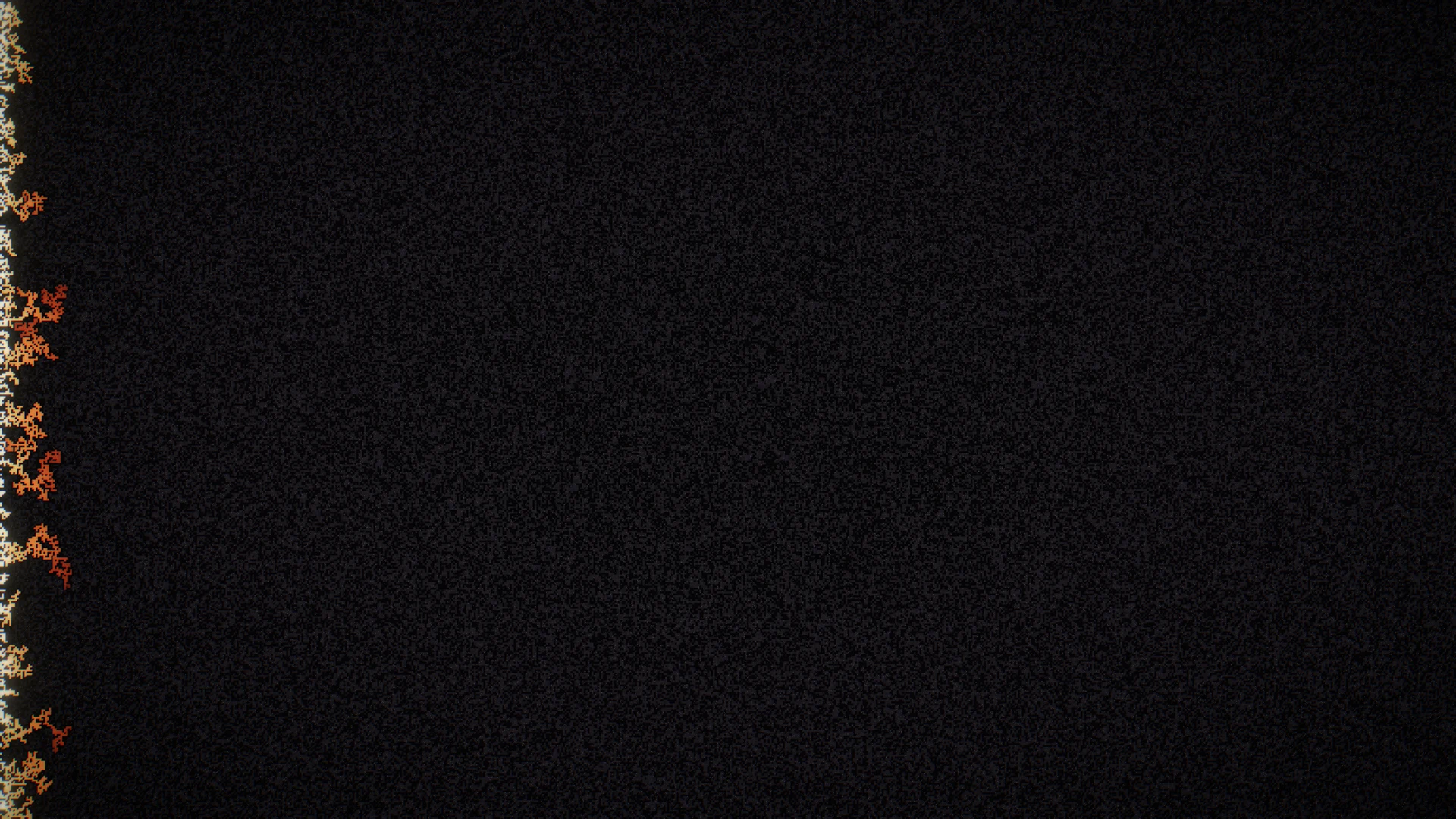
MOVING IMAGE — THE IGNITION ARC p 0.50 → 0.62 across p_c 0.5927 · seed 7 · ember

WHAT IS THIS

Percolation asks the barest possible question with a phase transition inside it: if each cell of a lattice is open with probability p, do the open cells connect one side to the other? There is no motion, no energy, no temperature — only geometry and chance. Yet at p_c ≈ 0.5927 an infinite cluster appears all at once: below it every island is finite, above it one continent spans everything, and exactly at it the islands come in every size at once, fractal to dimension 91/48.

The picture is made by pouring water in from the left edge of one fixed random labyrinth and painting every room by its arrival time — the hop-distance of the flood, run in real time on the GPU. Whether the water EVER reaches the far edge flips from never to always across a hair's breadth of p: connectivity has no half-way.
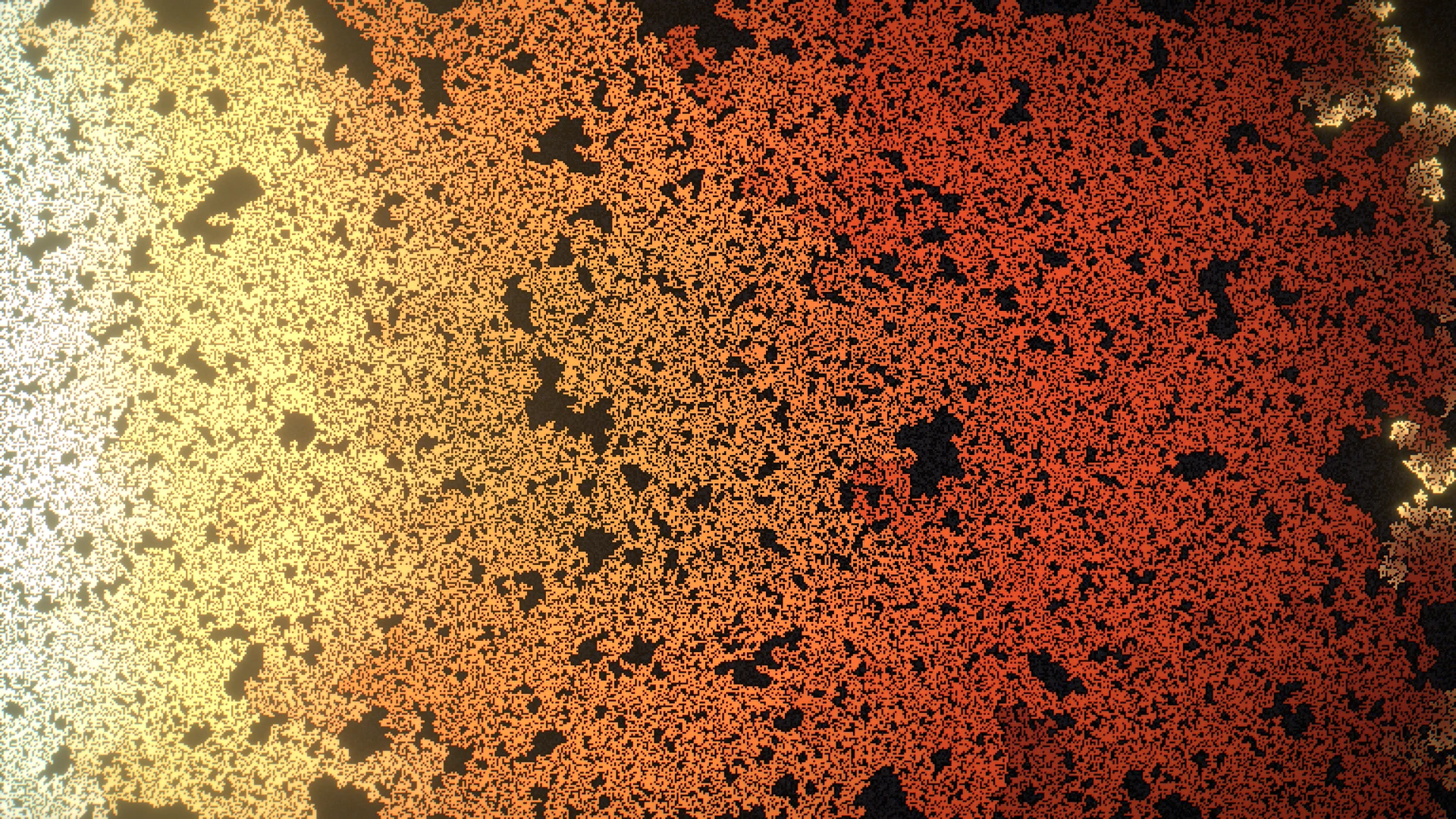
ignition — the moment somewhere becomes everywhere, the breach still blooming at the far edge
ignition — the moment somewhere becomes everywhere, the breach still blooming at the far edge p 0.62 · seed 7 · 768×432 · wet 178,453 · ember · pulse lit
Motif percolation threshold / spanning cluster / chemical distance / random labyrinth
Method A small simulator was generated and modified with AI assistance, then ported to a real-time GPU (GLSL) renderer. The visual output was selected through parameter exploration.
Observation One landscape, openness swept through the threshold: below it the flood always drowned in the first islands; a hair above, it always crossed. Across the span the wet fraction jumped 6% → 55% with no stop between. At p_c exactly, seven labyrinths were asked — two let the water through, and one crossing took a 2,395-hop pilgrimage on a 720-wide lattice.
Reference S. R. Broadbent & J. M. Hammersley, "Percolation processes I. Crystals and mazes," Proc. Camb. Phil. Soc., vol.53, 629-641 (1957); H. Kesten, "The critical probability of bond percolation on the square lattice equals 1/2," Commun. Math. Phys., vol.74, 41-59 (1980).
Tools Python / NumPy / SciPy / three.js / React / GLSL / ffmpeg / AI coding assistant
Year 2026

This is not a scientific simulation result, but a visual interpretation of the phenomenon.

SAME FAMILY, THE HEAT REMOVED

Ising and XY are decided by temperature. Percolation is decided by chance alone.

Studies #10 · #17 — thermal transitions Study #26 — Percolation
The dial temperature — heat jiggling every spin bare probability — each cell open or closed, once, by lottery
The dynamics Boltzmann relaxation — domains grow, defects annihilate none — nothing moves but the question; the flood is a measurement, not a force
What crosses the line collective order — magnetisation, bound vortex pairs connectivity itself — does a path exist, yes or no
The lesson criticality needs an energy to fight entropy criticality needs neither — geometry and chance alone speak the same critical-exponent language

PARAMETERS EXPLORED

param meaning effect on the image
p openness probability (p_c ≈ 0.5927) the whole story: islands → archipelago → (0.5927) → continent
seed which labyrinth same physics, different veins; the hero keeps one landscape throughout
L lattice size how sharp the cliff at p_c looks (width ~ L^(−3/4))
flood tempo hops per frame how fast the water asks its question
palette which real seepage ember / aquifer / orevein / circuit — places where percolation is literal

Each image below records its exact parameter set.

THE MATHEMATICS the model behind the images

One fixed random field, one inequality, one flood. The lattice never changes — only the question p asked of it.

site (i,j) open  ⟺  rij<p,rij∼U[0,1)\text{site } (i,j) \text{ open} \iff r_{ij} < p, \qquad r_{ij} \sim \mathrm{U}[0,1)site (i,j) open⟺rij​<p,rij​∼U[0,1)
Standard coupling: one uniform random number per site, fixed for ever. Raising p only ever adds open cells, so the flood heals forward monotonically — the slider, the film and the union-find sweep all ride the same landscape.
R(p,L)→L→∞Θ(p−pc),pcsite=0.59274621…R(p, L) \xrightarrow{L \to \infty} \Theta(p - p_c), \qquad p_c^{\text{site}} = 0.59274621\ldotsR(p,L)L→∞​Θ(p−pc​),pcsite​=0.59274621…
The spanning probability becomes a step function: never below, always above. On the bond lattice p_c = 1/2 exactly (Kesten 1980); the site value is the Newman–Ziff high-precision anchor, rediscovered here to 0.075%.
M(L)∼LD,D=9148,ns∼s−τ,τ=18791M(L) \sim L^{D}, \quad D = \tfrac{91}{48}, \qquad n_s \sim s^{-\tau}, \quad \tau = \tfrac{187}{91}M(L)∼LD,D=4891​,ns​∼s−τ,τ=91187​
Exactly at the threshold the largest cluster is a fractal of dimension 91/48 (measured 1.886), and clusters come in every size, distributed by the exact Fisher exponent 187/91.
π(r)=3 Γ(2/3)Γ(1/3)2 η1/3 2F1 ⁣(13,23;43;η)\pi(r) = \tfrac{3\,\Gamma(2/3)}{\Gamma(1/3)^2}\, \eta^{1/3}\, {}_2F_1\!\big(\tfrac{1}{3}, \tfrac{2}{3}; \tfrac{4}{3}; \eta\big)π(r)=Γ(1/3)23Γ(2/3)​η1/32​F1​(31​,32​;34​;η)
Cardy's crossing formula (1992): conformal field theory predicts the probability of a critical crossing as a function of the rectangle's aspect ratio. Measured at four aspect ratios to |err| ≤ 0.013 — conformal invariance touched by hand.

A visual interpretation of the model, not a claim of scientific precision. The chemical-distance flood is the measurement the pictures are made of; the five-check battery above is what was actually verified.

SELECTED STILLS — 6
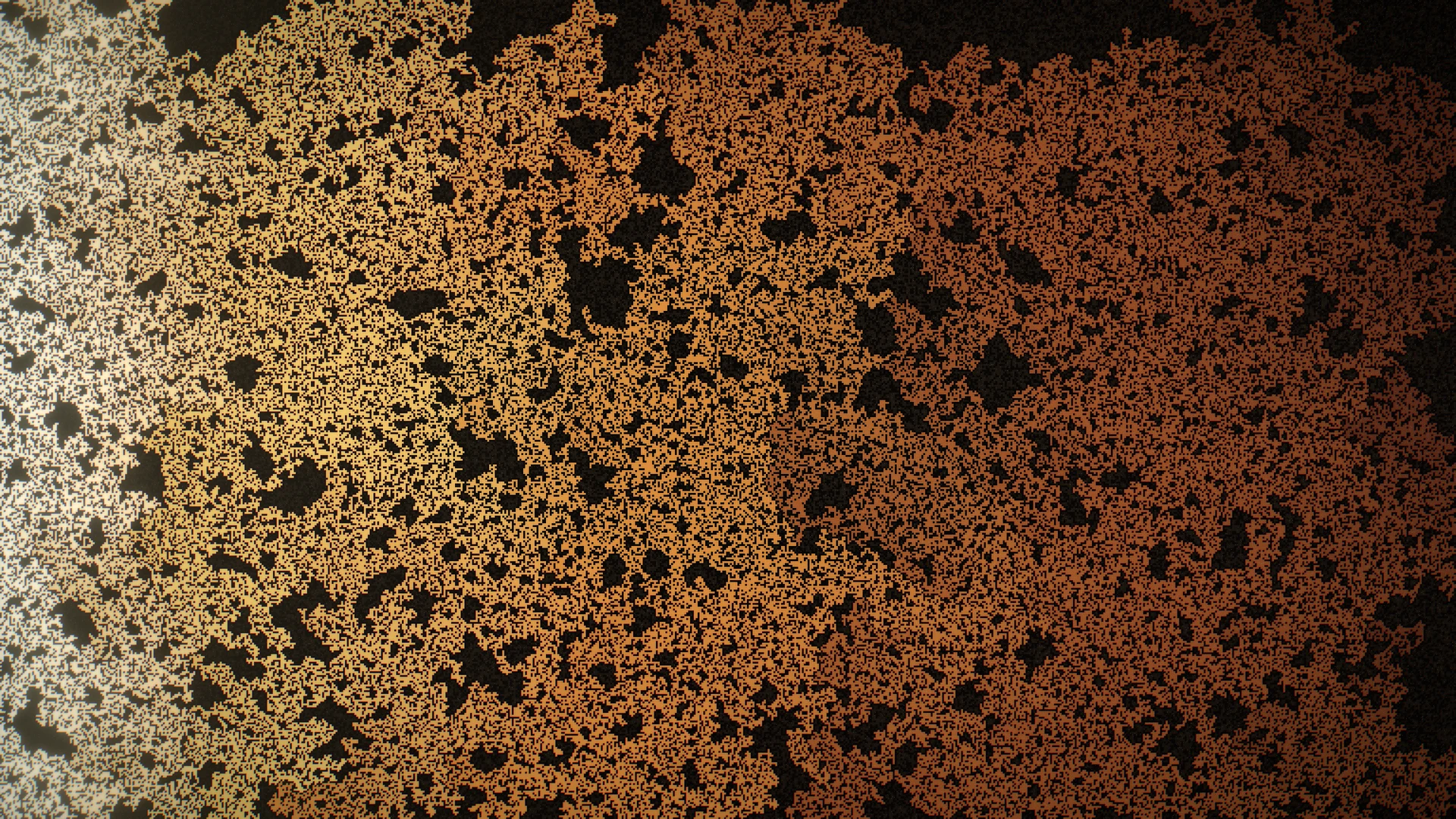
ignition — the whole continent lit the instant the far edge wets
ignition — the whole continent lit the instant the far edge wets p 0.62 · seed 7 · wet 178,453 · dmax 1248 · ember · pulse
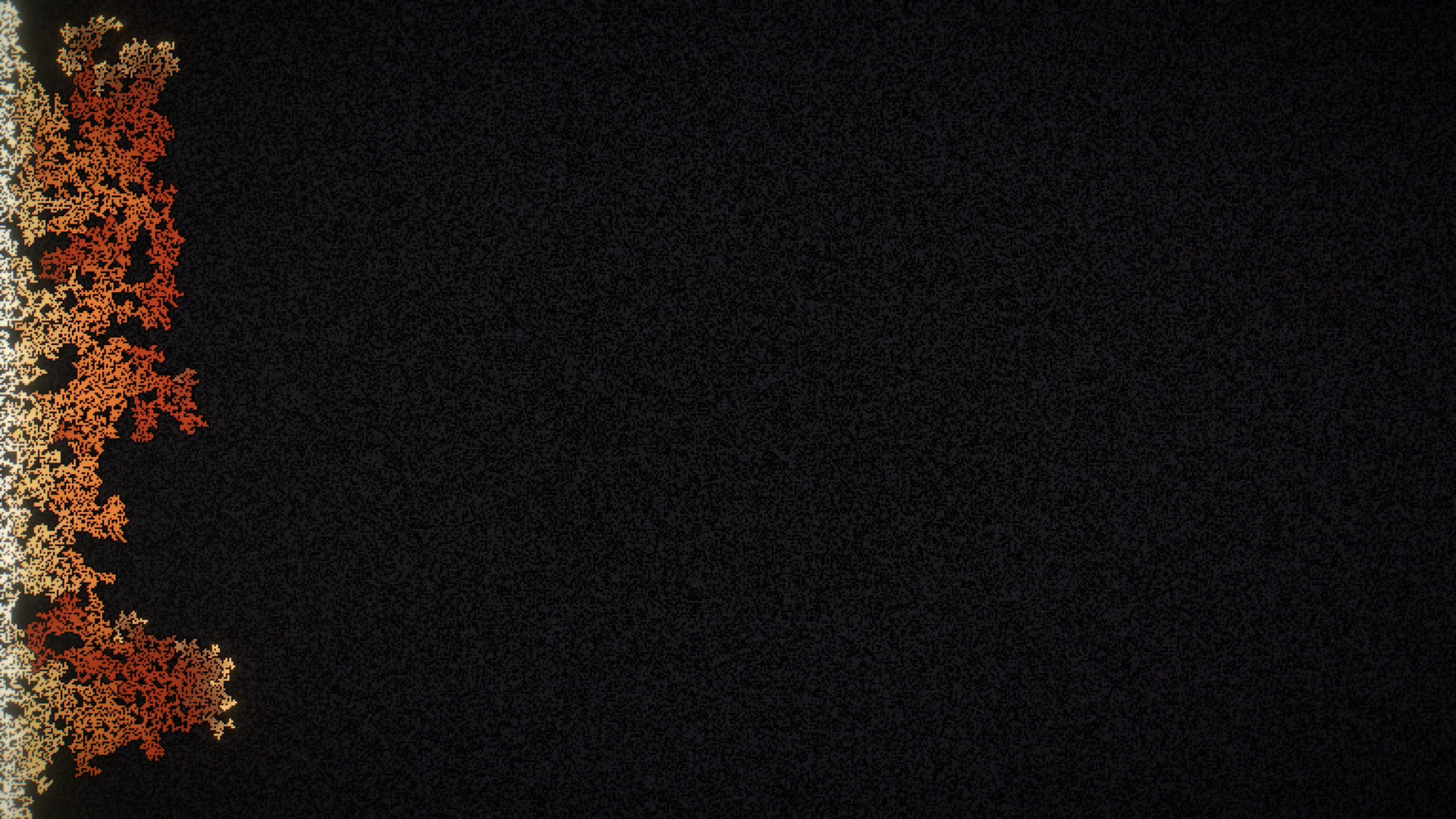
the exploring fire — critical slow motion just above the threshold
the exploring fire — critical slow motion just above the threshold p 0.593 · seed 7 · 210 hops · live front · ember
below the threshold — the flood drowns in the first islands
below the threshold — the flood drowns in the first islands p 0.55 · seed 7 · wet 3,213 · dmax 72 · ember
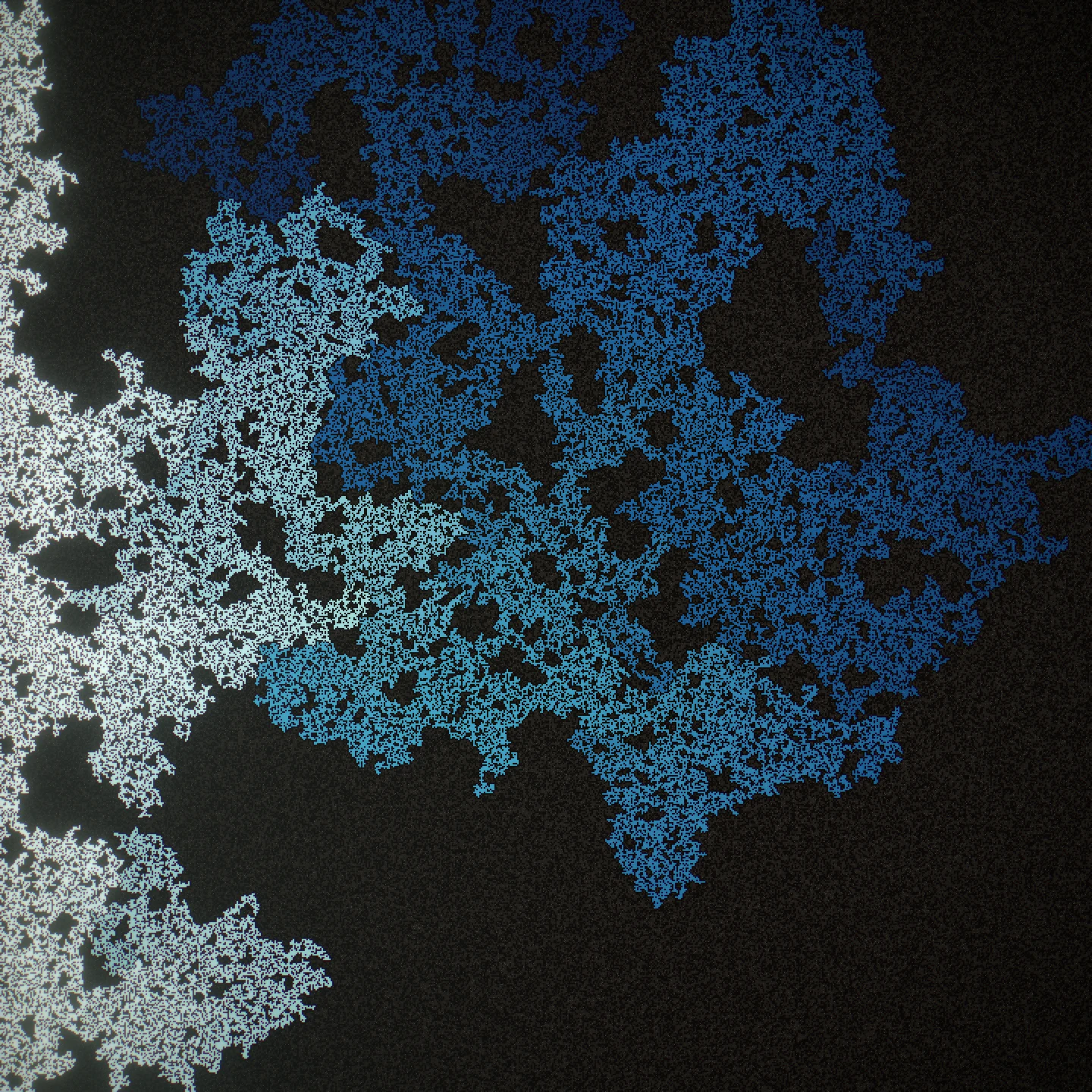
the aquifer — groundwater age exactly at p_c
the aquifer — groundwater age exactly at p_c p 0.59274621 · seed 31 · 720² · spans · aquifer
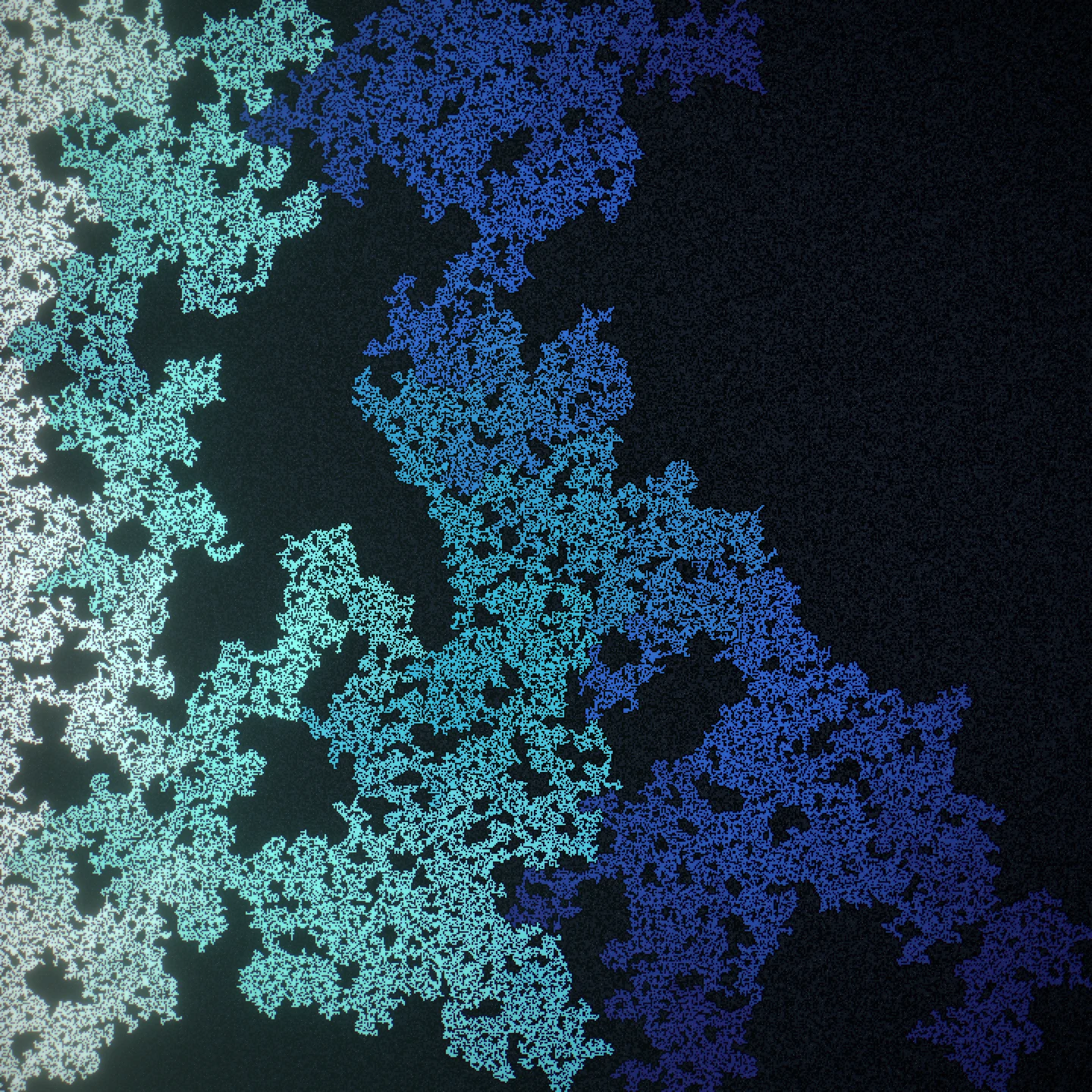
the circuit wakes — conduction arriving at the critical point
the circuit wakes — conduction arriving at the critical point p 0.59274621 · seed 47 · 720² · dmax 2244 · circuit
the lode — native copper filling the connected fractures
the lode — native copper filling the connected fractures p 0.61 · seed 3 · wet 165,013 · orevein

PROCESS — PARAMETER SWEEPS

One landscape from islands to continent — the same random labyrinth (the hero's seed 7) swept p 0.45 → 0.70 in the exploration engine: geometry, clusters rainbow-dyed by size, and the flood's arrival-time field. At p_c the lattice holds 6,674 clusters of every size at once; across the span the wet fraction jumps 6% → 55%. The web engine shares the exploration engine's landscape bit for bit, so these contact sheets and the finished works are the same rooms.
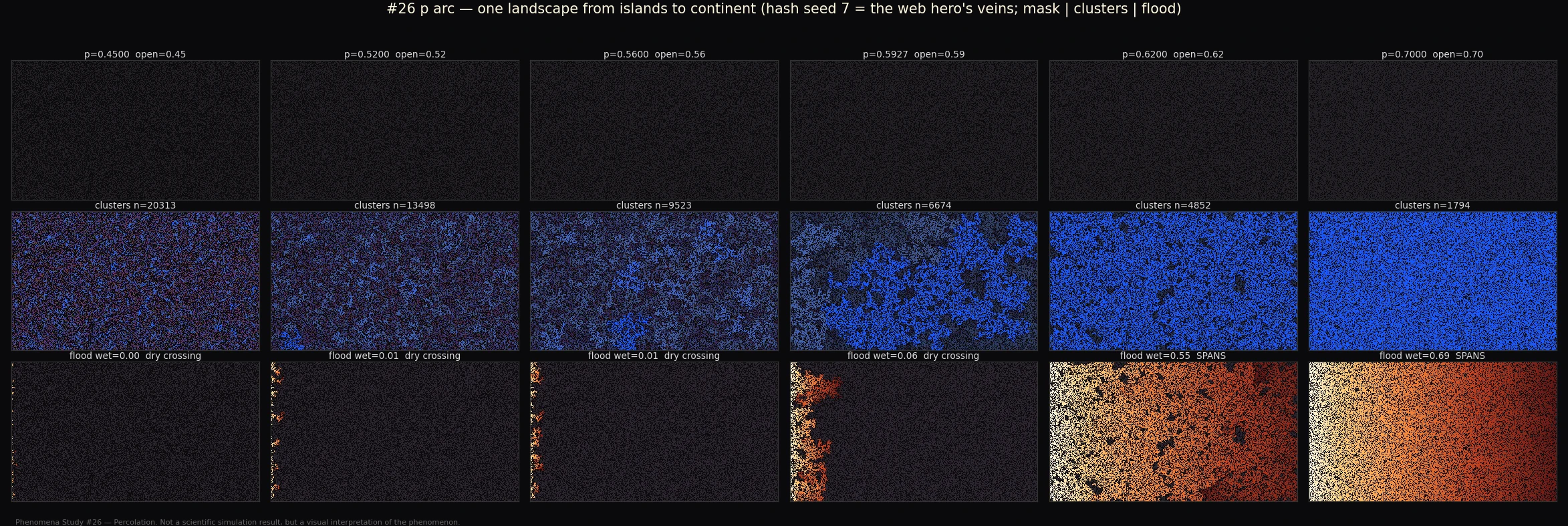
the p arc — one landscape
the p arc — one landscape seed 7 · p 0.45 → 0.70 · mask / clusters / flood · wet 0.00 → 0.69

SIGNATURE — NO HALF-WAY

At 0.5927, somewhere becomes everywhere.

Whether the flood ever reaches the far edge is not a matter of degree. Sweep the openness and the spanning probability snaps from never to always across a width that shrinks as L^(−3/4) — the S-curves for different lattice sizes pivot on one point, and that point is the threshold. Two-dimensional percolation is a feast of exact results: the bond-lattice threshold is exactly 1/2 — a theorem (Kesten 1980) — and this study's engine rediscovers it to 0.18%, the site threshold to 0.075%, the cluster fractal dimension 91/48 to 0.52%, and Cardy's conformal crossing formula at four aspect ratios.

The finished works keep the checked geometry: the GPU renderer and the exploration engine share one uint32-hash landscape, bit for bit, so the flood you watch is not an approximation of the model — its arrival-time field matches the Python engine's integer for integer. When the far edge wets, the whole connected water pulses once: the lamp of the threshold, lit at the exact moment the question is answered yes.
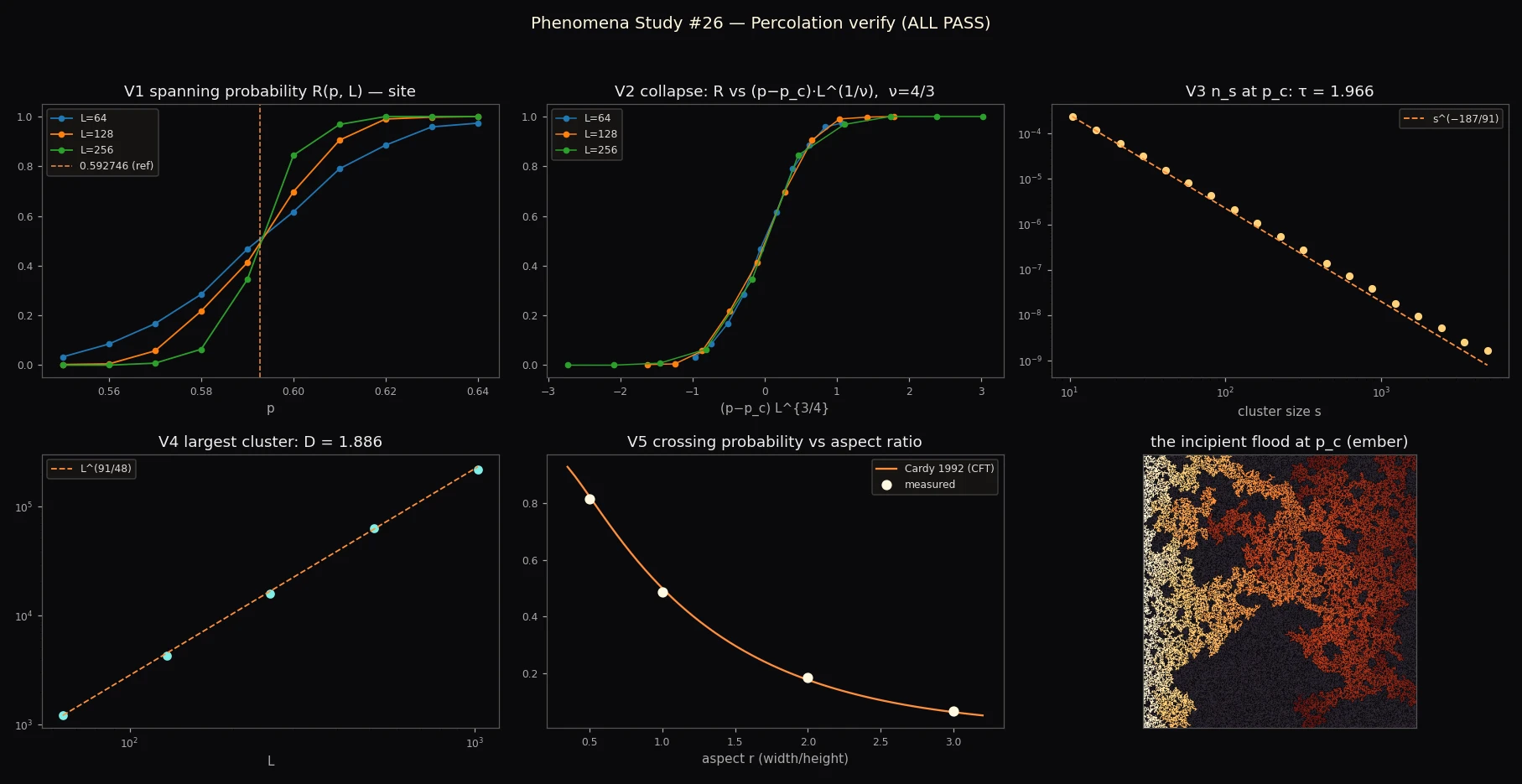
the proof of the cliff — spanning S-curves pivoting at p_c, the ν=4/3 data collapse, τ at criticality, D = 91/48, and Cardy's CFT crossing curve
the proof of the cliff — spanning S-curves pivoting at p_c, the ν=4/3 data collapse, τ at criticality, D = 91/48, and Cardy's CFT crossing curve R(p,L) level-crossing · collapse (p−p_c)·L^(3/4) · n_s ~ s^(−187/91) · M ~ L^(91/48) · Cardy 1992

COLOUR = WHERE CONNECTIVITY IS LITERAL

Every wet cell is painted by its arrival time — the hop count from the door. The palettes are artistic approximations of real places where percolation is not metaphor but mechanism. ember: fire creeping through sparse fuel, burned-area maps glowing newest-first. aquifer: groundwater age in porous rock — hydrologists really do colour water by how long it took to seep, and the original 1957 problem was gas masks and flooded coal seams. orevein: native copper filling connected fractures. circuit: a conductor-insulator composite switching on at its threshold.

The closed cells are the rock matrix, shaded by how walled-in each cell is; the open-but-dry cells are the dark pores the water never found. The advancing front is emissive — the only light the labyrinth makes itself.

the groundwater age map — white at the intake, deep blue in the oldest rooms
the groundwater age map — white at the intake, deep blue in the oldest rooms p_c exactly · seed 31 · dmax 2395 · aquifer

Colour values are artistic approximations of these references, not measurements.

REFERENCES

  1. S. R. Broadbent, J. M. Hammersley. "Percolation processes I. Crystals and mazes." Proceedings of the Cambridge Philosophical Society, vol.53, 629-641 (1957).
  2. H. Kesten. "The critical probability of bond percolation on the square lattice equals 1/2." Communications in Mathematical Physics, vol.74, 41-59 (1980).
  3. J. L. Cardy. "Critical percolation in finite geometries." Journal of Physics A: Mathematical and General, vol.25, L201-L206 (1992).
  4. M. E. J. Newman, R. M. Ziff. "Efficient Monte Carlo algorithm and high-precision results for percolation." Physical Review Letters, vol.85, 4104-4107 (2000).
  5. D. Stauffer, A. Aharony. "Introduction to Percolation Theory, 2nd ed.." Taylor & Francis (1992).

INTERACTIVE STUDY

A random labyrinth of rock and pore; water enters from the left edge and can only pass through open rooms. Whether it EVER reaches the far side is not a matter of degree — drag the openness across p_c ≈ 0.5927 and watch the lamp: below it the REACH bar stalls forever, a hair above it always completes. Raising p lets the flood heal forward without a reset; click anywhere in the labyrinth to pour from there instead. It is a deliberately simplified instrument, capped at a 192×108 lattice with a few curated knobs and no export, separate from the full engine used to author the finished works.

SIMPLIFIED INSTRUMENT · 192×108 LATTICESITE PERCOLATION · CHEMICAL-DISTANCE FLOOD

This interactive study is not intended as a scientifically validated reproduction. It is a visual interpretation generated from an implemented model and curated parameter exploration — and it is a deliberately simplified instrument, separate from the full engine used to author the finished works.

← ALL STUDIES STUDY #27 · CELLULAR FROTH — GRAIN GROWTH · IN OBSERVATION →
PHENOMENA STUDIES — WEAVER AXIOM PERSONAL VISUAL RESEARCH · © 2026