STUDY #27 · 2026 · IN OBSERVATION
Cellular Froth — Grain Growth
A model-driven visual study of curvature-driven coarsening in a two-dimensional cellular network.
WHAT IS THIS
Soap films between two glass plates, metal grains under anneal, dried mud, the cells of a leaf: in two dimensions they all settle into the same polygonal network, and it coarsens — small cells vanish, large ones swell. Two rules are enough. Films meet three at a time at 120°, the only angle at which three equal tensions balance; and every film creeps toward the side it is curved away from, at a speed set by its curvature. From those two rules a startling consequence follows exactly: walk once round a cell with n sides, count the turning, and the area must obey dA/dt = (π/3)·Mγ·(n − 6). An integer decides everything. A cell with five sides shrinks, however large it is. A cell with seven grows, however thin. A cell with six does not age.
The network cannot escape either. On a torus, a cellular network whose vertices are all threefold is forced to ⟨n⟩ = 2E/F = exactly six, so summing the law over every cell gives zero: the froth creates no area and destroys none. It passes area around, and it does so by passing sides around — every time a cell dies, its sides are dealt back out to the neighbours. The froth trades sides, not area.
The engine here is a Q-state Potts model running in real time on the GPU: each lattice site carries a crystallographic orientation, unlike neighbours cost energy, and a Metropolis sweep lets the boundaries wander. Nothing in that rule mentions sides, areas or 120°. All of it comes out.
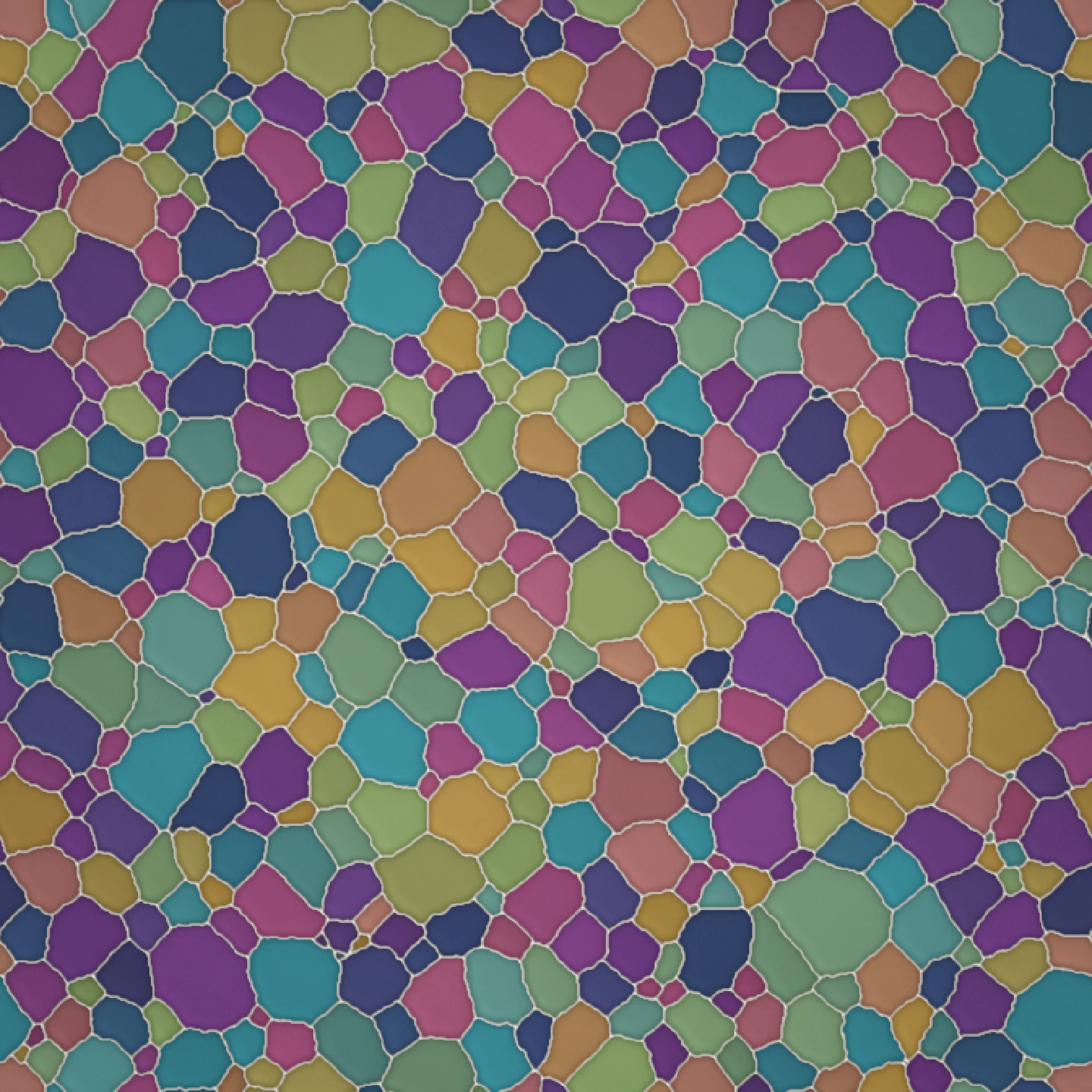
This is not a scientific simulation result, but a visual interpretation of the phenomenon.
SAME COARSENING PICTURE, A DIFFERENT MECHANISM
Cahn–Hilliard coarsens by hauling matter. The froth coarsens by counting sides.
PARAMETERS EXPLORED
Each image below records its exact parameter set.
THE MATHEMATICS the model behind the images
Two rules — tension balancing at 120°, films moving with their curvature — and one bookkeeping identity. The engine is told none of it; every line below is an output.
A visual interpretation of the model, not a claim of scientific precision. The measured coarsening exponent is 0.940 against the ideal ⟨A⟩ ∝ t, a known trait of Potts froths; Lewis's law of epithelial cells does not hold here (slope 1.9× Lewis 1928) — grain growth and cell division make different networks.
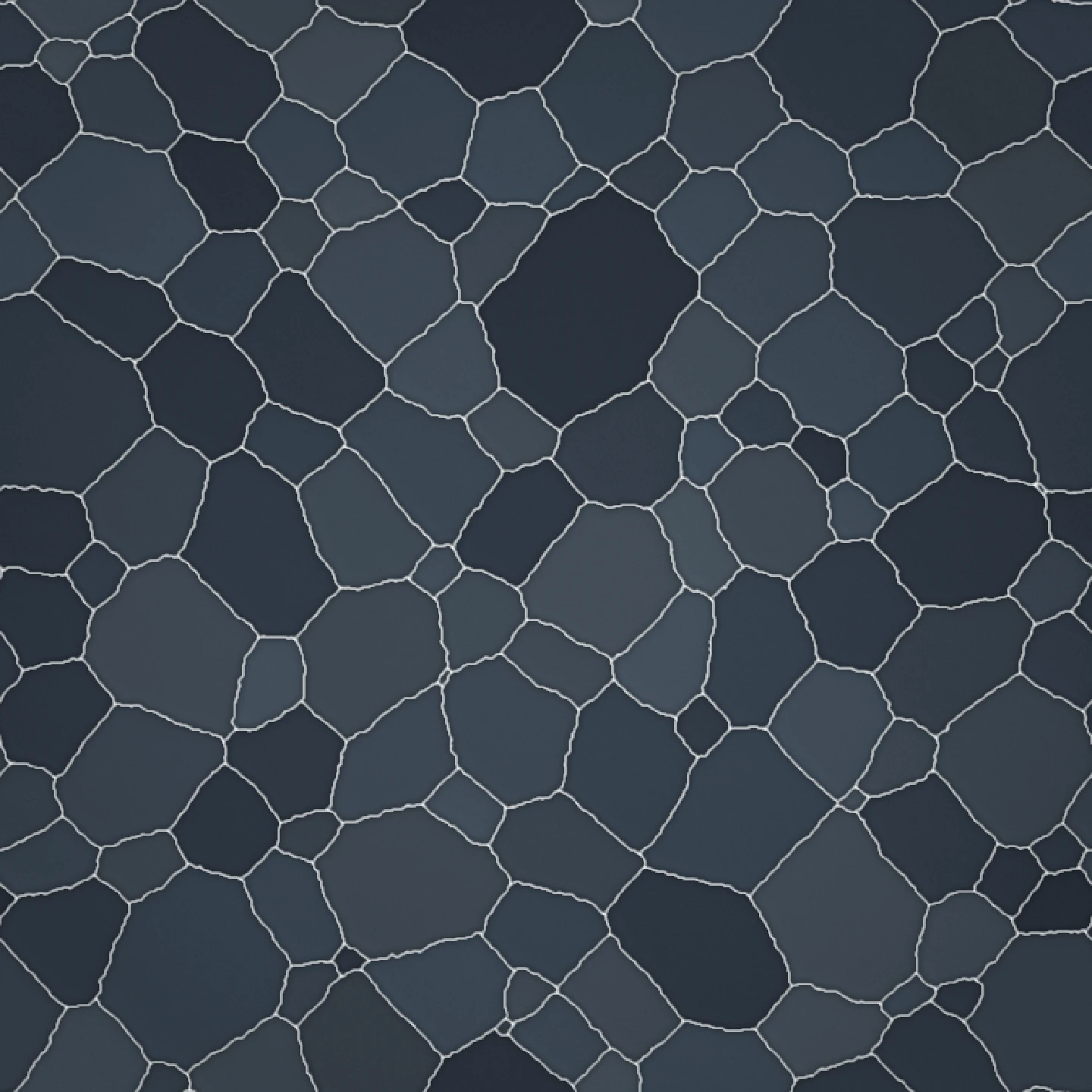
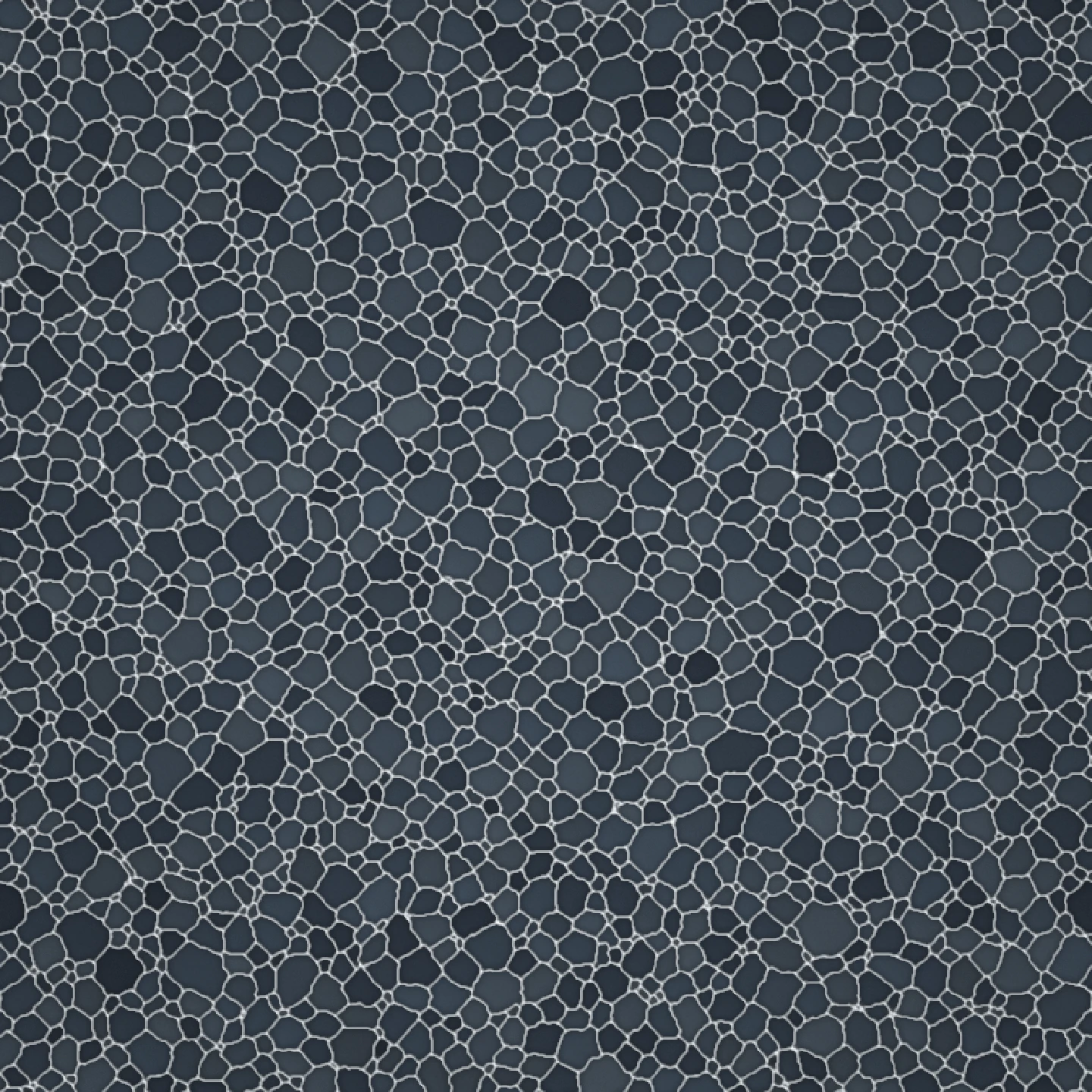
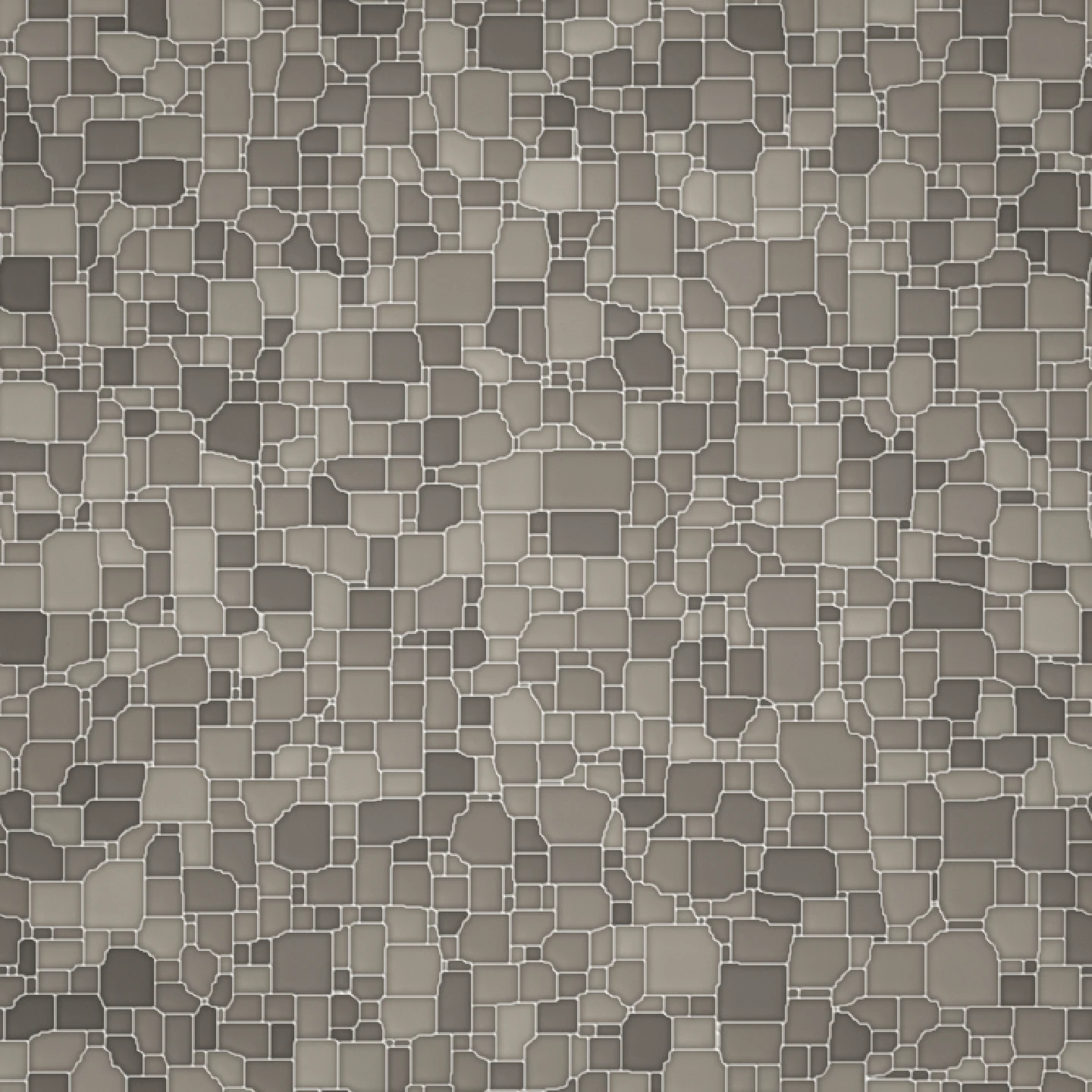
SELECTED STILLS — 6
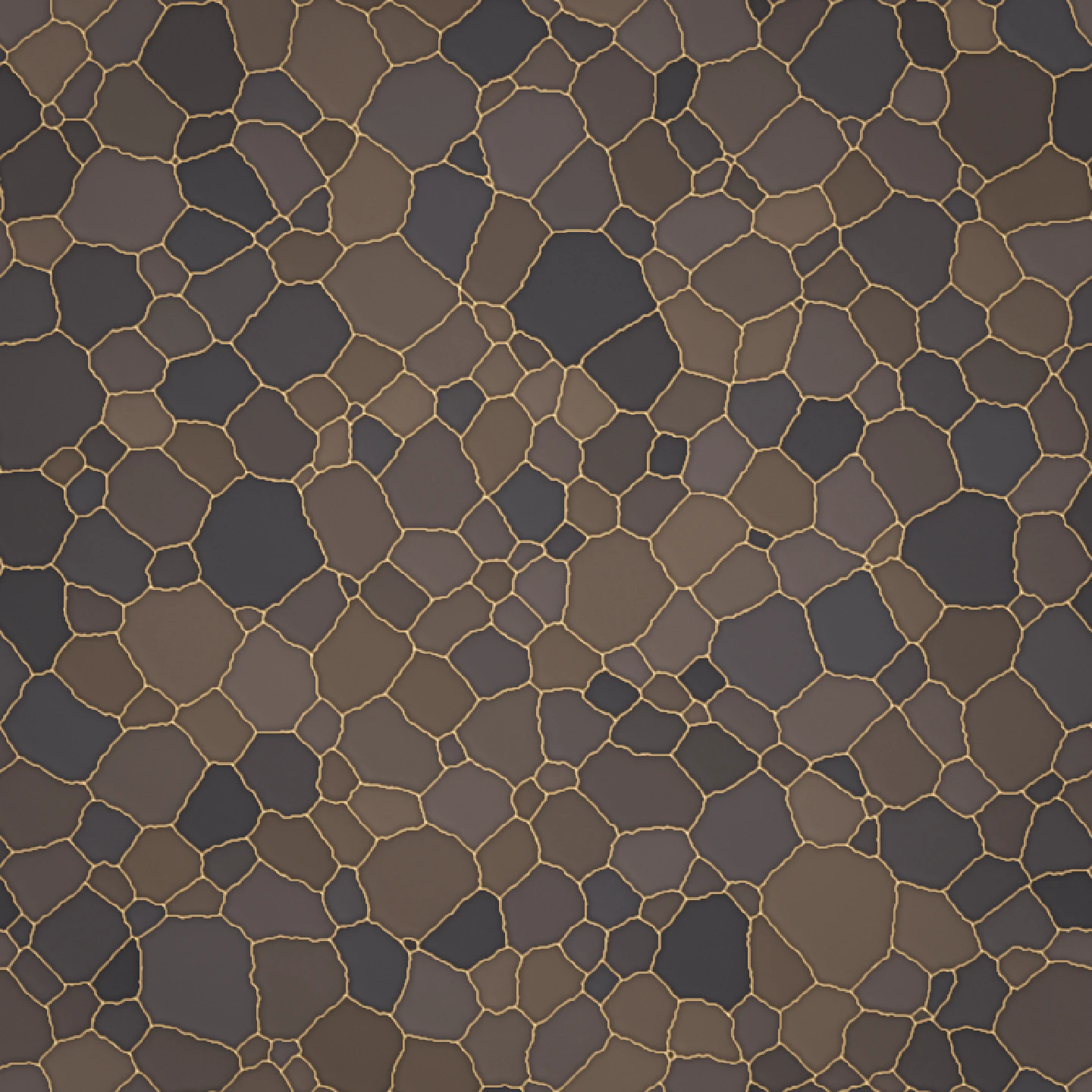
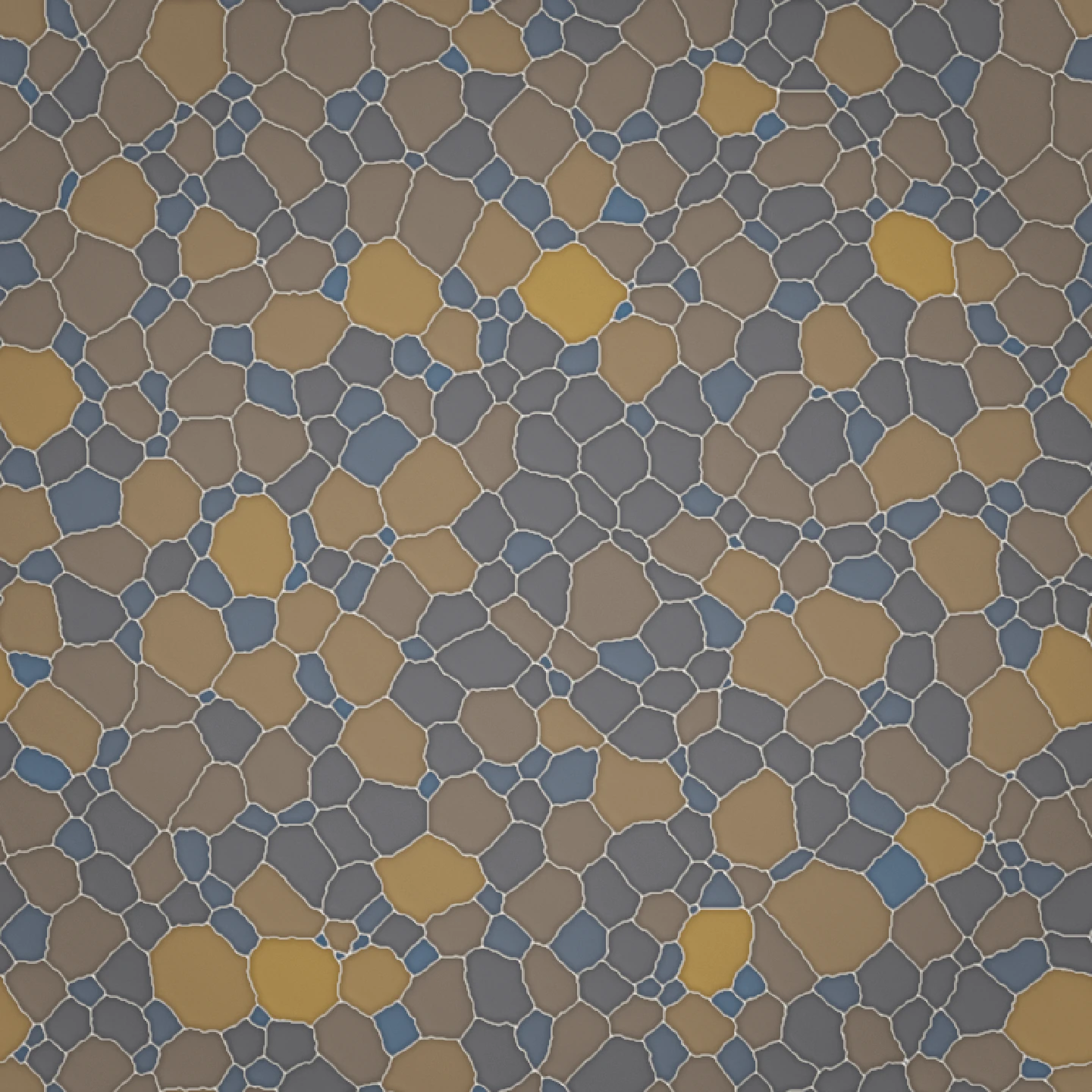
PROCESS — PARAMETER SWEEPS
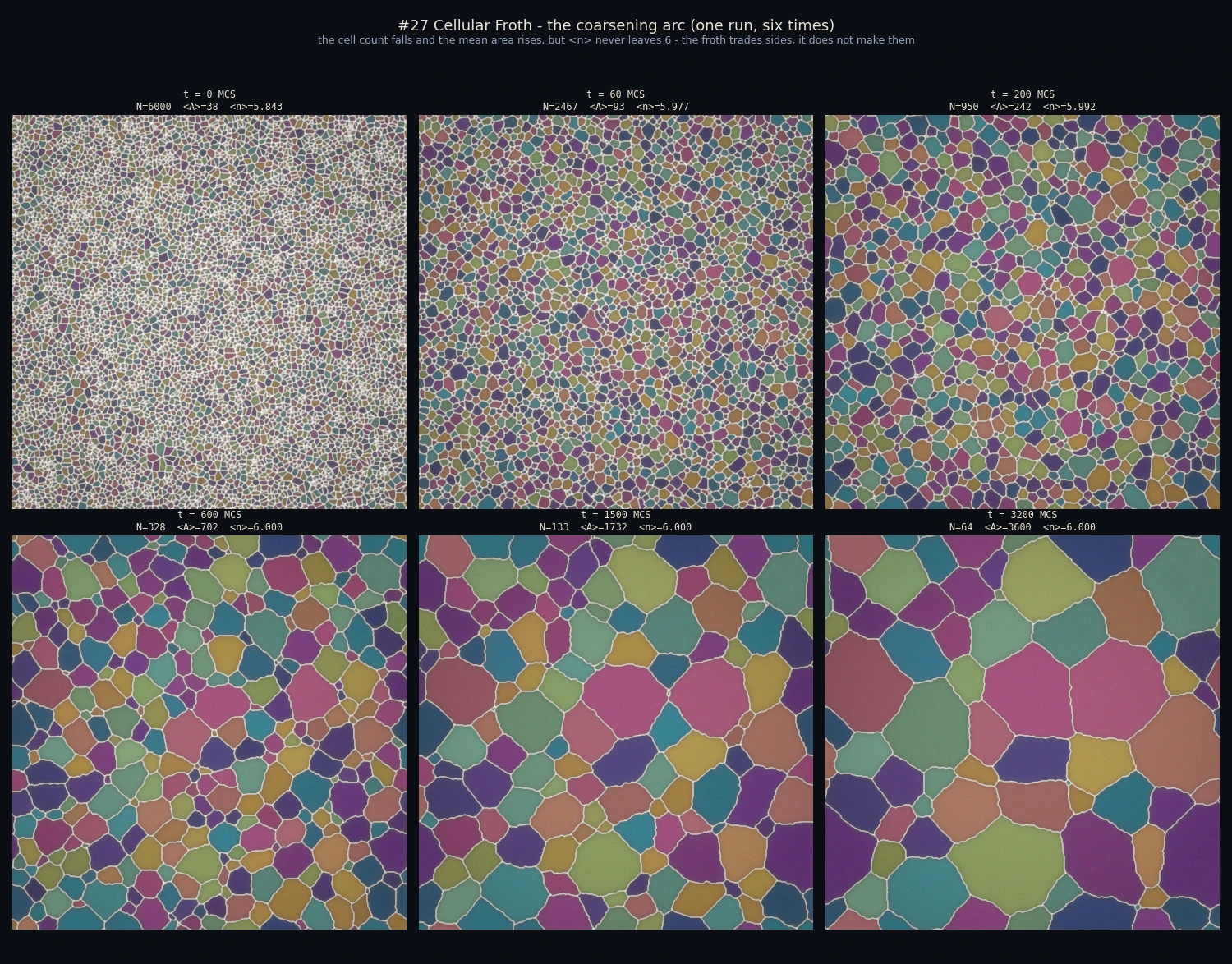
The sweeps behind the stills walked the kT ladder (temperature turned out to move the film, not the rate), the 4- versus 8-neighbour lattice (where the froth can be frozen outright), five imagings of one state, and this sheet — the hero's time axis itself. One run sampled at six times: 6000 cells fall to 64, the mean area climbs 94-fold, and ⟨n⟩ rises 5.843 → 6.000 and then refuses to move.
SIGNATURE — THE VERDICT
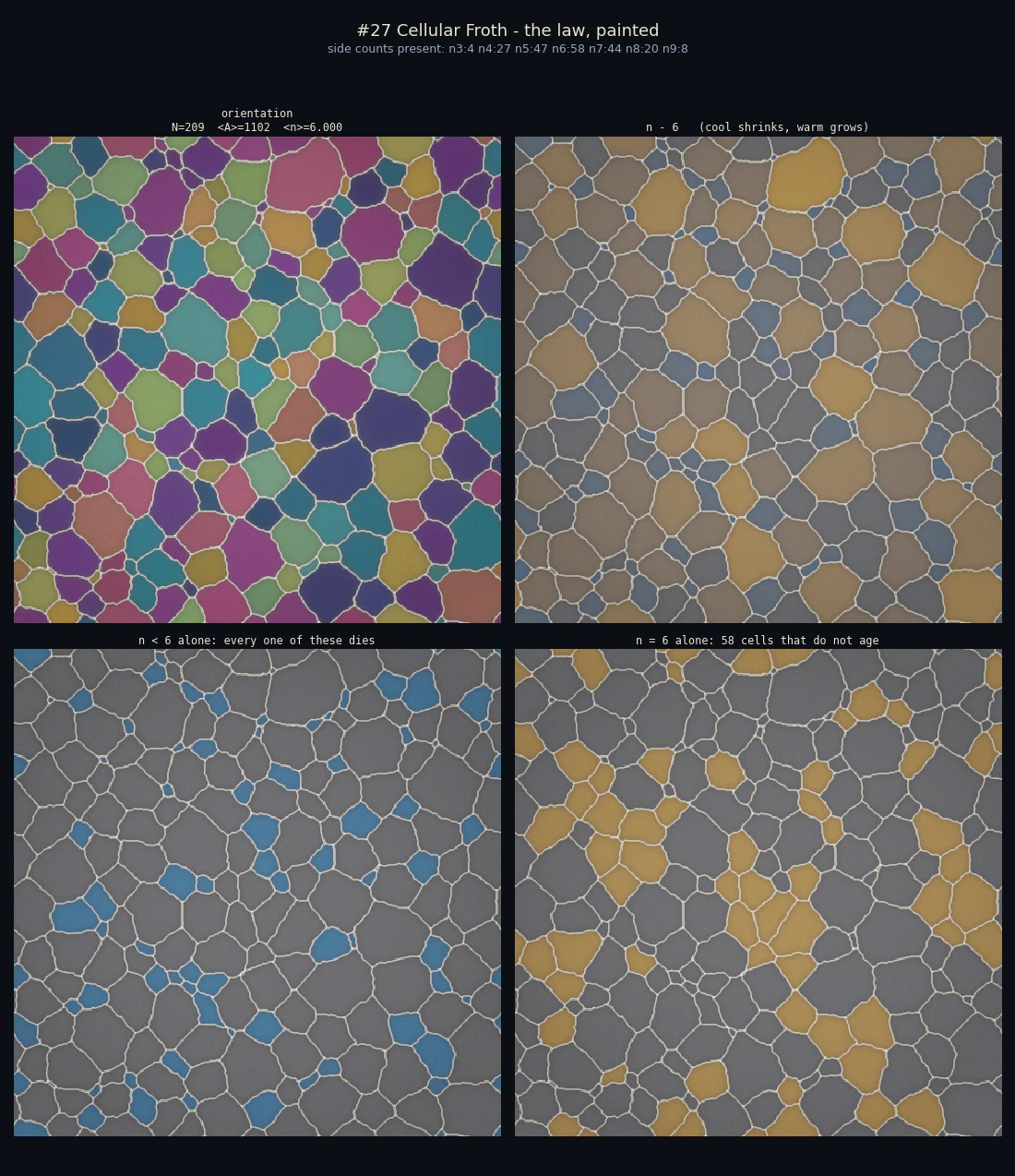
Fewer than six sides and it must shrink. More and it must grow. Six, and it does not age.
von Neumann stated the law in 1952 in a few pages of conference discussion; Mullins derived it properly four years later. It is an absurdly strong statement: the area rate of a cell depends on nothing about the cell — not size, not shape, not position — except the integer number of its sides. This engine was never told. It was told only that disagreeing neighbours cost energy. The measured area change is 1.09·(n−6) px²/MCS with R² = 0.99922, six-sided cells drift at 0.7% of one side's worth, and the same Mγ read from a single shrinking circle predicts that slope to within 10% — the residual carrying the sign that finite triple-junction mobility demands.
And the ledger balances exactly. At the final state the mean side count is six as an integer identity — 2E = 588 = 6F, not a quadruple point left — while the cell count has fallen 94-fold. In the Interactive Study below, tap any cell and it states its own fate from that single integer, then watches the arithmetic come true, while ⟨n⟩ beside it stays pinned at 6.00.
COLOUR = ORIENTATION UNDER CROSSED POLARS
The hue is the grain's crystallographic orientation. Polish and anodise an aluminium section, put it under crossed polars, and each grain lights up in a colour set by which way its lattice happens to point — modern metallography does the same thing digitally with EBSD orientation maps. So mapping each cell to its own hue is not an arbitrary prettification: colour is orientation here, and the colour difference between two neighbouring cells is precisely what makes a boundary exist between them. A boundary is a disagreement about direction; the energy in this model counts exactly those disagreements.
The other imagings are honest alternatives rather than filters: soap is a backlit froth, where the cells are empty and only the films scatter; slag is hot metal, where the network glows. In every one of them the film brightens at the triple points on its own — a vertex has more disagreeing neighbours than a straight wall does, exactly as a Plateau border holds more liquid and scatters more light. One image in the set is not a micrograph and is labelled as such: the n − 6 view, cool for the doomed, warm for the growing, neutral for the timeless — arithmetic made visible.
The model treats every disagreement as costing the same; real grain-boundary energy depends on the misorientation angle. An artistic approximation of published behaviour, not a measurement.
REFERENCES
- John von Neumann. "Discussion: Shape of metal grains." in Metal Interfaces, American Society for Metals, Cleveland, 108-110 (1952).
- W. W. Mullins. "Two-Dimensional Motion of Idealized Grain Boundaries." Journal of Applied Physics, vol.27, no.8, 900-904 (1956).
- Cyril Stanley Smith. "Grain Shapes and Other Metallurgical Applications of Topology." in Metal Interfaces, American Society for Metals, Cleveland, 65-108 (1952).
- M. P. Anderson, D. J. Srolovitz, G. S. Grest, P. S. Sahni. "Computer simulation of grain growth—I. Kinetics." Acta Metallurgica, vol.32, no.5, 783-791 (1984).
- D. J. Srolovitz, M. P. Anderson, P. S. Sahni, G. S. Grest. "Computer simulation of grain growth—II. Grain size distribution, topology, and local dynamics." Acta Metallurgica, vol.32, no.5, 793-802 (1984).
- J. A. Glazier, S. P. Gross, J. Stavans. "Dynamics of two-dimensional soap froths." Physical Review A, vol.36, no.1, 306-312 (1987).
- D. A. Aboav. "The arrangement of grains in a polycrystal." Metallography, vol.3, no.4, 383-390 (1970).
- D. Weaire. "Some remarks on the arrangement of grains in a polycrystal." Metallography, vol.7, no.2, 157-160 (1974).
- F. T. Lewis. "The correlation between cell division and the shapes and sizes of prismatic cells in the epidermis of Cucumis." The Anatomical Record, vol.38, no.3, 341-376 (1928).
- J. E. Burke, D. Turnbull. "Recrystallization and grain growth." Progress in Metal Physics, vol.3, 220-292 (1952).
- J. A. F. Plateau. "Statique expérimentale et théorique des liquides soumis aux seules forces moléculaires." Gauthier-Villars, Paris (1873).
- R. D. MacPherson, D. J. Srolovitz. "The von Neumann relation generalized to coarsening of three-dimensional microstructures." Nature, vol.446, 1053-1055 (2007).
INTERACTIVE STUDY
Soap films, metal grains and dried mud settle into the same polygonal network, and it coarsens: small cells vanish, large ones swell. What decides a cell's fate is not its size — it is the number of sides. Tap any cell to read its verdict — fewer than six and it must shrink, more and it must grow, exactly six and it does not age — then watch the arithmetic come true. Meanwhile the mean side count never leaves 6.00; Euler will not allow it. It is a deliberately simplified instrument, capped at a 192² lattice with a few curated knobs and no export, separate from the full engine used to author the finished works.
This interactive study is not intended as a scientifically validated reproduction. It is a visual interpretation generated from an implemented model and curated parameter exploration — and it is a deliberately simplified instrument, separate from the full engine used to author the finished works.