STUDY #28 · 2026 · IN OBSERVATION
Talbot Carpet
A model-driven visual study of grating self-imaging.
WHAT IS THIS
In 1836 H. F. Talbot noticed that behind an illuminated diffraction grating, the grating's own image reappears at regular distances — with no lens, no mirror, nothing but propagation. Lord Rayleigh derived the revival distance, z_T = 2a²/λ. The full intensity map between revivals — position × height — is the Talbot carpet.
The model is the paraxial diffraction-order sum: each order m carries a phase that grows like m² × height, which is why arithmetic — not optics — decides what the light does. This study evaluates that sum directly on the GPU, in real time, at every pixel.
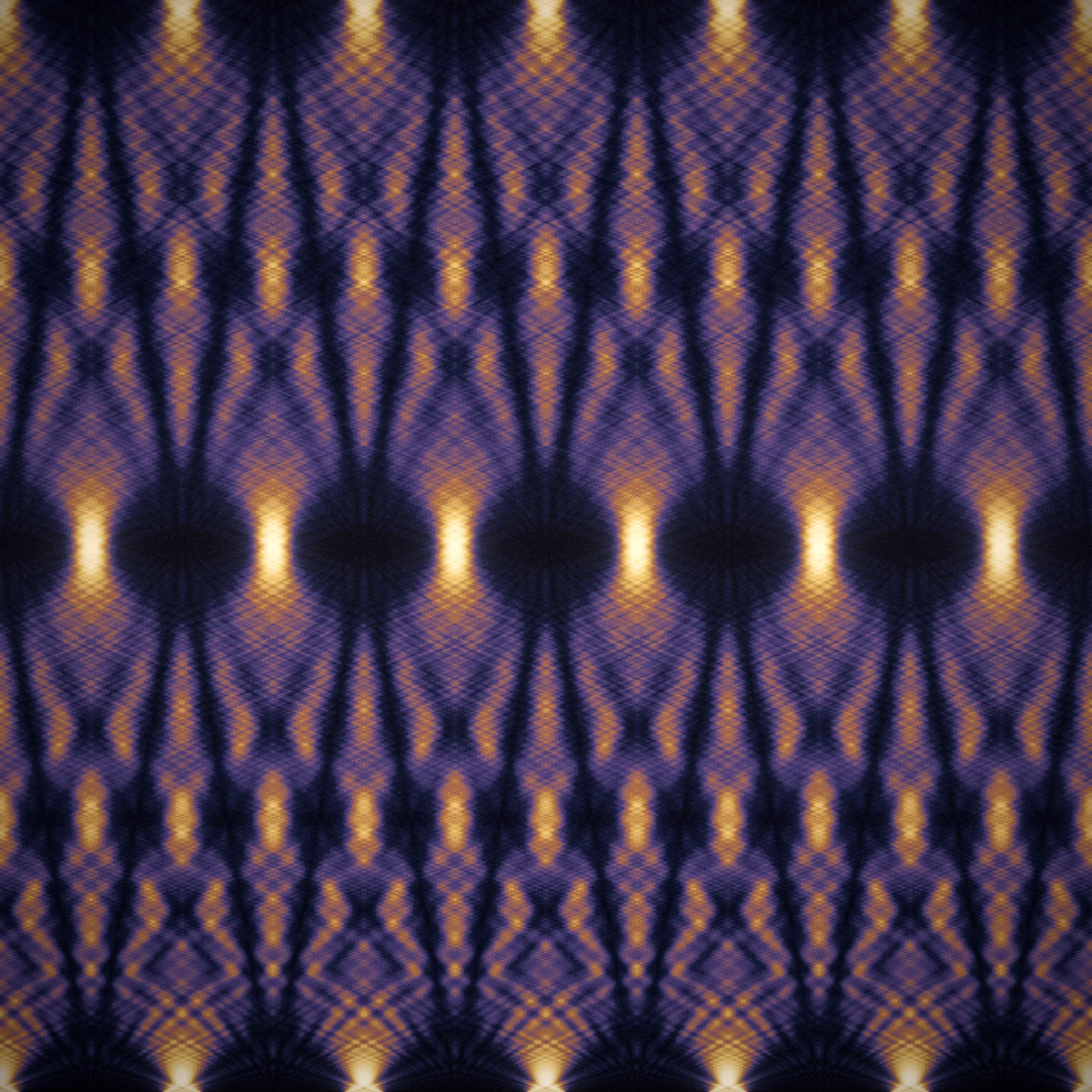
This is not a scientific simulation result, but a visual interpretation of the phenomenon.
SAME FAMILY, THE NEAR FIELD
Interference draws fringes where waves cross. The near field re-draws the grating itself.
PARAMETERS EXPLORED
Each image below records its exact parameter set.
THE MATHEMATICS the model behind the images
One period of a grating written as diffraction orders — the loom's threads — each propagated with a phase quadratic in the order number. Everything in the carpet follows from that exponent.
A visual interpretation of the model, not a claim of scientific precision. The engine is paraxial (a/λ ≳ 50); the non-paraxial walk-off was measured to fall as (λ/a)² — slope 2.000 — and the GPU field matches a float64 reference at six heights to Pearson 1.0000000.
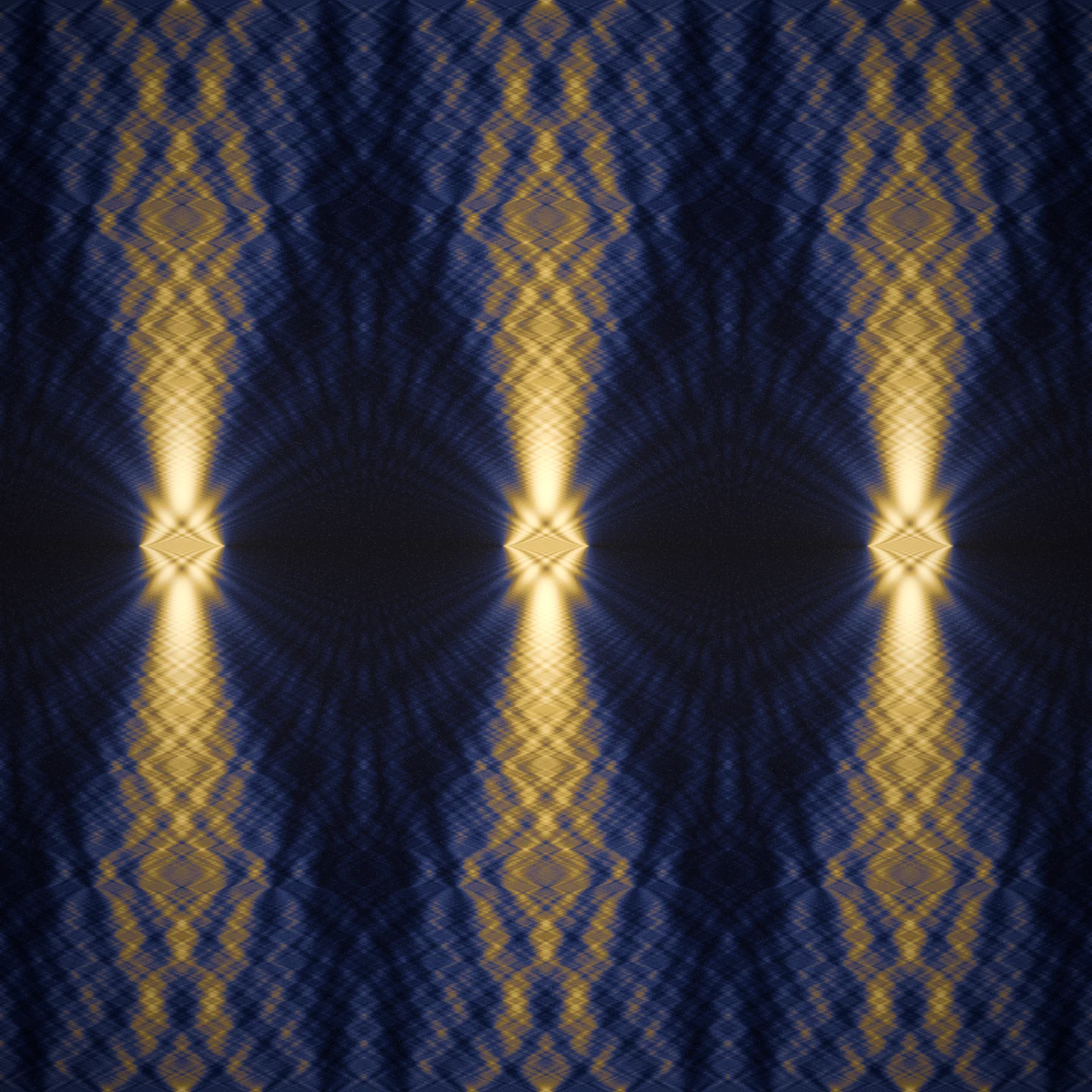
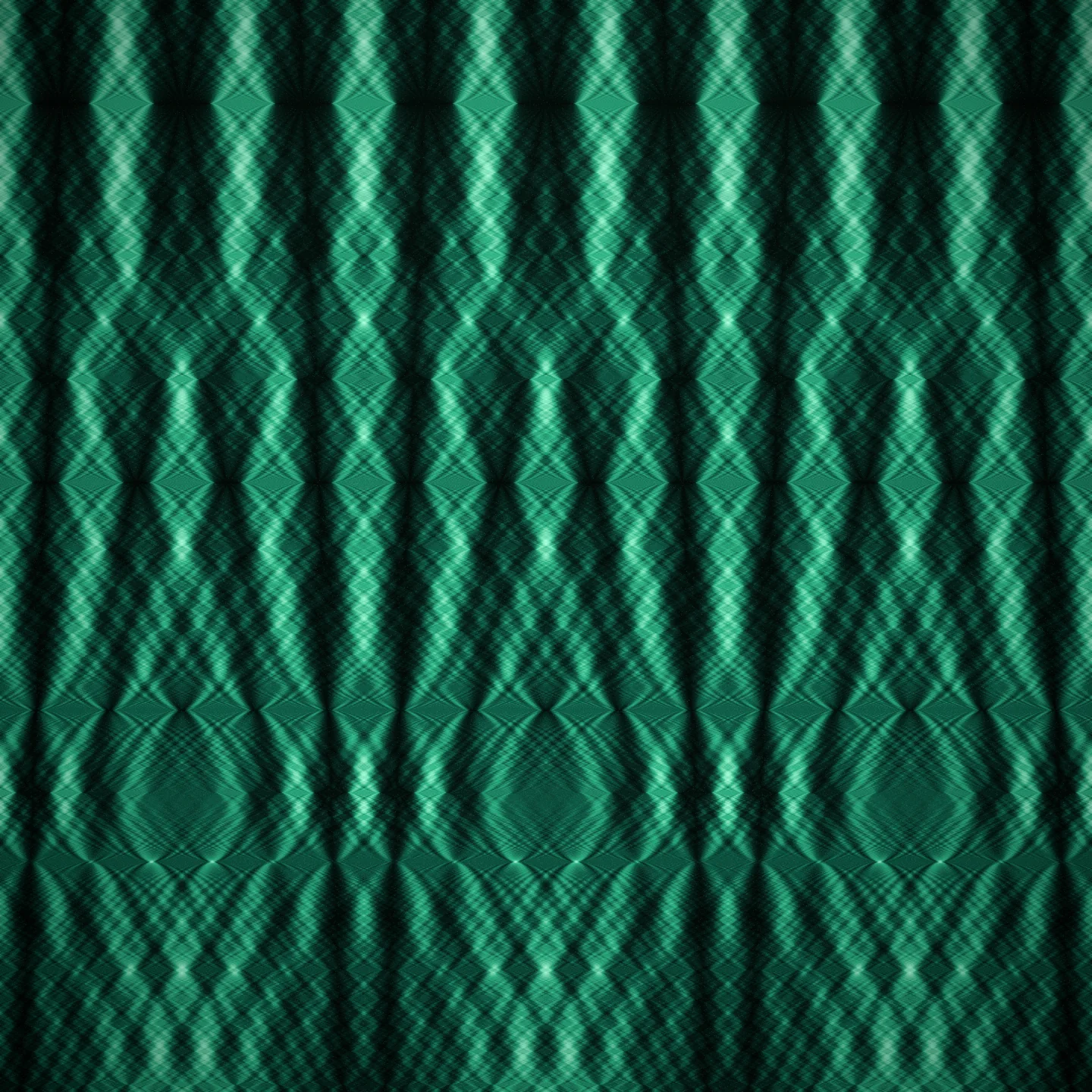
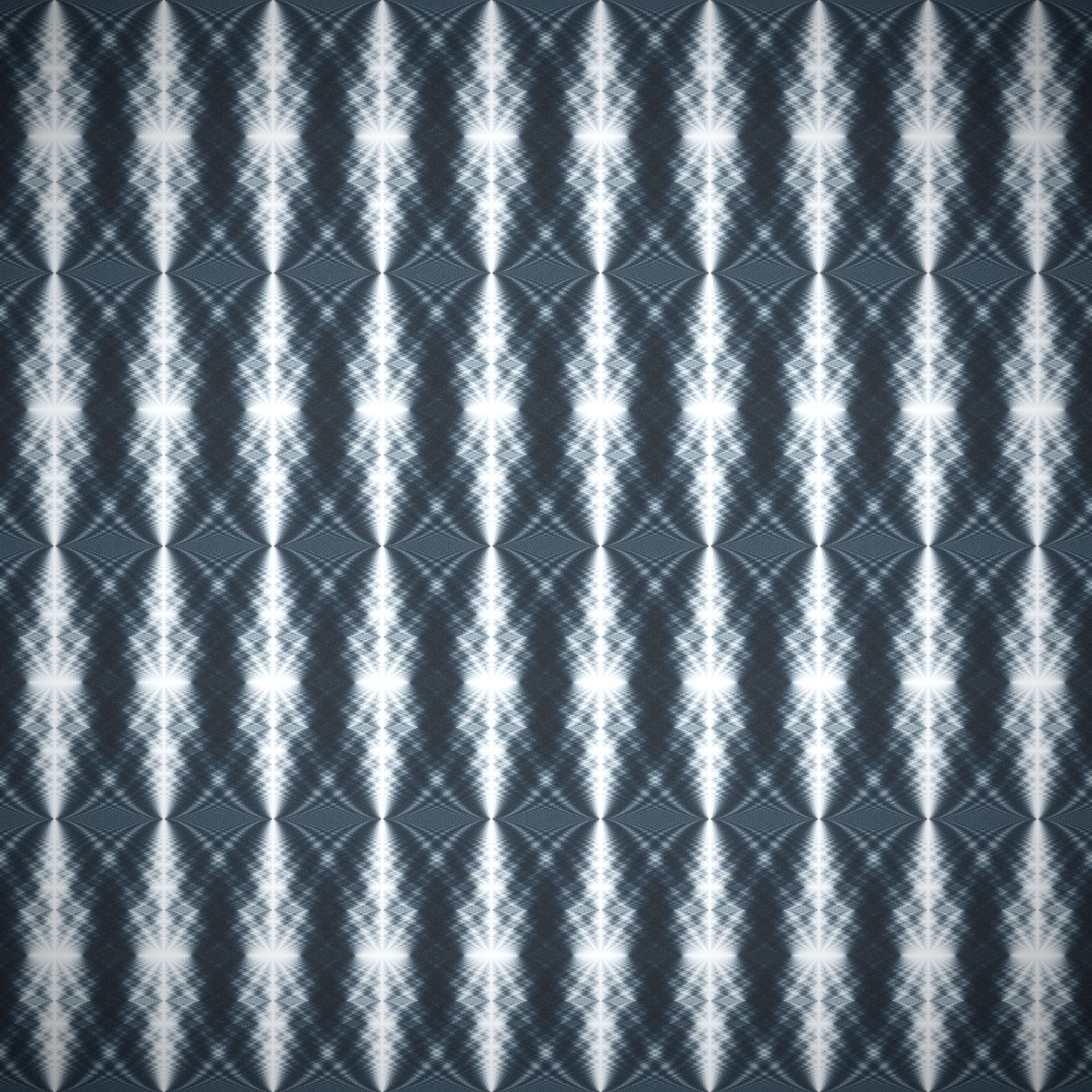
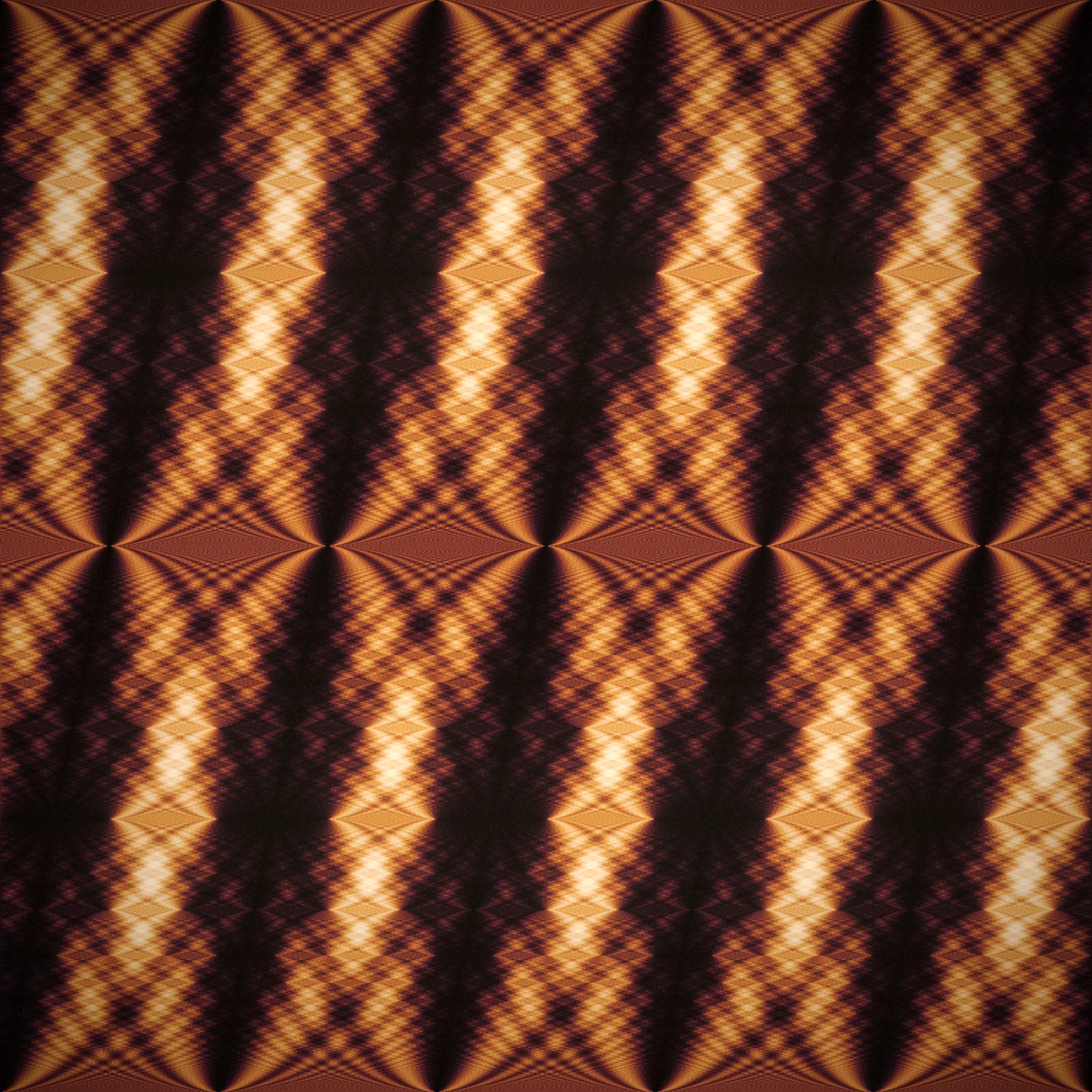
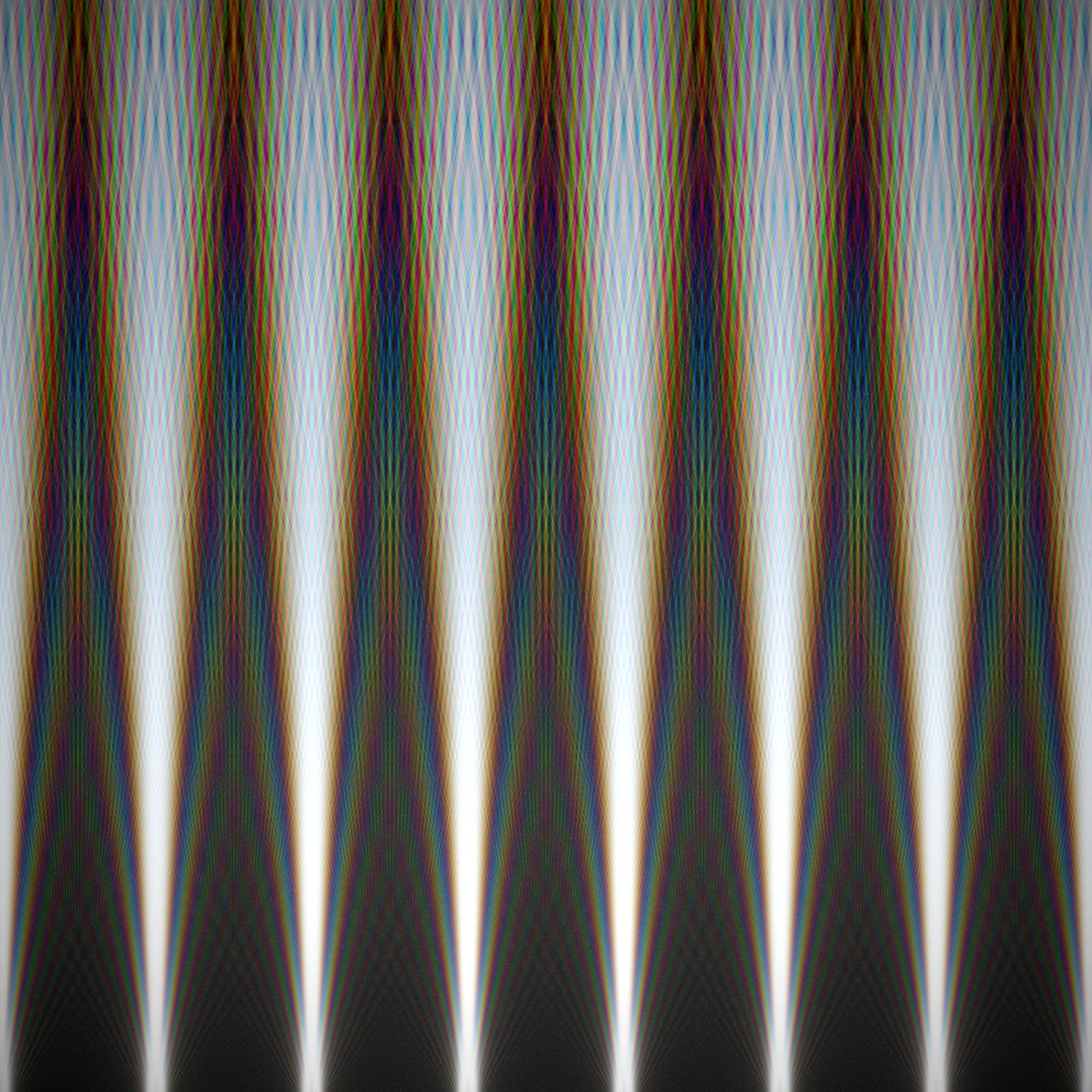
SELECTED STILLS — 6
PROCESS — PARAMETER SWEEPS
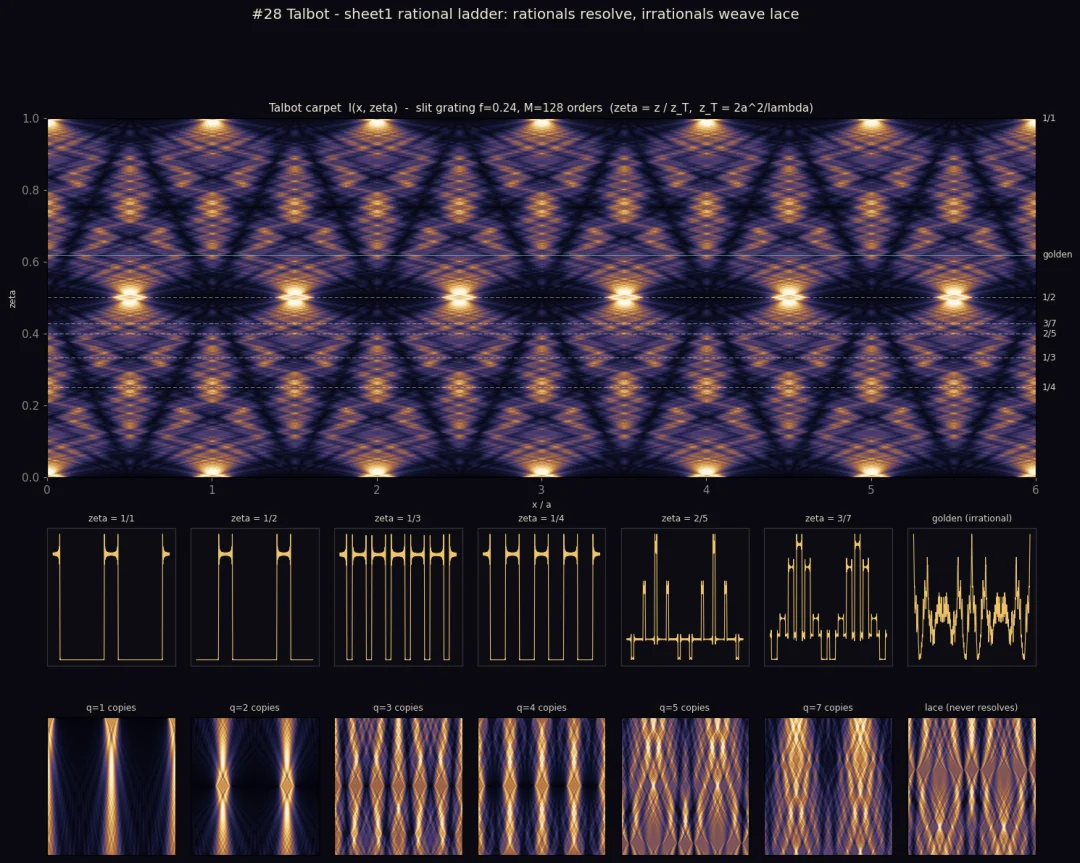
The spine of the exploration — one grating held fixed while the height crosses the rational ladder: ζ = 1, 1/2, 1/3, 1/4, 2/5, 3/7 and the golden ratio, each height read as carpet, profile and zoom strip. At every rational the profile locks into q copies; at the golden ratio it refuses. Four more sheets swept fill factor (the hero band lives at f 0.16–0.28), kept orders (the eye saturates near M ≈ 32), grating types — a blazed 2π grating is a single order and the carpet vanishes: nothing to interfere with, nothing woven — and real RGB dispersion.
SIGNATURE — THE LOOM OF RATIONALS
Rationals resolve, irrationals weave: the light reads the denominator of its height.
At any rational height ζ = p/q the paraxial field is exactly q shifted copies of the grating, weighted by Gauss sums — quadratic exponential sums straight out of number theory. The denominator counts the copies: small q prints bold images, large q splits the light into fine ribbed lace. The engine was checked against that identity before any image was kept — the reconstruction agrees to 1.9 × 10⁻¹³, the weights carry unit energy, and at q = 5 every |B_s| = 1/√5 exactly.
Between the rationals the image never resolves. At the golden ratio — the most irrational height — Berry and Klein proved the intensity profile is a fractal curve; this engine measures its box dimension at 1.426 against their 3/2 (the convergence is logarithmically slow), while the smooth rational cut at ζ = 1/2 measures 1.043. The weave itself is symmetry: the carpet mirrors at half the Talbot distance and glides by half a period across, half a distance up — both identities verified near machine precision.
COLOUR = REAL IMAGE-FORMING MEDIA
The monochrome palettes ground to real image-forming media: a lantern plate — indigo glass, amber lace; X-ray film — Talbot–Lau interferometers really do print these fringes into film, dense where light lands, clear where it cancels; and the green fluorescence of cold-atom matter-wave Talbot experiments. Only the brocade palette — indigo ground, gold thread — is a declared artistic choice: the weave metaphor itself.
The polychrome images are white-light Talbot: the three RGB channels are propagated separately, each with its own Talbot distance (z_T = 2a²/λ at 650 / 550 / 460 nm), so red revives sooner and blue later — the rainbow braiding is the physics of dispersion, not a grade.
All palettes are artistic approximations of these media, not measurements.
REFERENCES
- H. F. Talbot. "Facts relating to optical science. No. IV." The London and Edinburgh Philosophical Magazine and Journal of Science (Third Series), vol.9, no.56, 401-407 (1836).
- Lord Rayleigh. "On copying diffraction-gratings, and on some phenomena connected therewith." Philosophical Magazine (Fifth Series), vol.11, no.67, 196-205 (1881).
- M. V. Berry, S. Klein. "Integer, fractional and fractal Talbot effects." Journal of Modern Optics, vol.43, no.10, 2139-2164 (1996).
- J. Wen, Y. Zhang, M. Xiao. "The Talbot effect: recent advances in classical optics, nonlinear optics, and quantum optics." Advances in Optics and Photonics, vol.5, no.1, 83-130 (2013).
INTERACTIVE STUDY
A grating lit from below weaves a carpet of light with no lens — and the carpet is fully analytic, so the only motion is yours. THE dial is height ζ: at rational heights — 1/2, 1/3, 2/5 — the pattern clicks into q crisp copies and the lock label lights (a Ford-circle rule, window ~1/q²); between them it dissolves into lace, and the golden height never resolves at all. The left strip is the whole carpet — click it to jump; drag the right pane to scrub; the bright midline is what a screen at your height would record. It is a deliberately simplified instrument, a 40-order window with a few curated knobs and no export, separate from the full engine used to author the finished works.
This interactive study is not intended as a scientifically validated reproduction. It is a visual interpretation generated from an implemented model and curated parameter exploration — and it is a deliberately simplified instrument, separate from the full engine used to author the finished works.