STUDY #29 · 2026 · IN OBSERVATION
Faraday Waves
A model-driven visual study of parametric surface waves — the pattern a shaken liquid chooses for itself.
WHAT IS THIS
A layer of liquid is shaken vertically. Nothing is stirred, nothing is poured in: the whole experiment is one number going up and down. Below a threshold acceleration the surface stays flat. Above it, a standing pattern grows — and it repeats only every second drive cycle. Michael Faraday reported this in 1831; the half-frequency response is the signature.
Each Fourier mode of the surface turns out to obey a damped Mathieu equation: the shaking modulates gravity, gravity sets the stiffness, and a mode whose natural frequency is half the drive frequency is pumped once per cycle in phase with itself. That resonance condition, together with the gravity–capillary dispersion relation, is what selects the wavelength — no length scale is written into the simulation. This study runs that model as a second-order-in-time field on the GPU, with the nonlocal dispersion operator reduced to a polynomial in the Laplacian so that a shader can evaluate it.
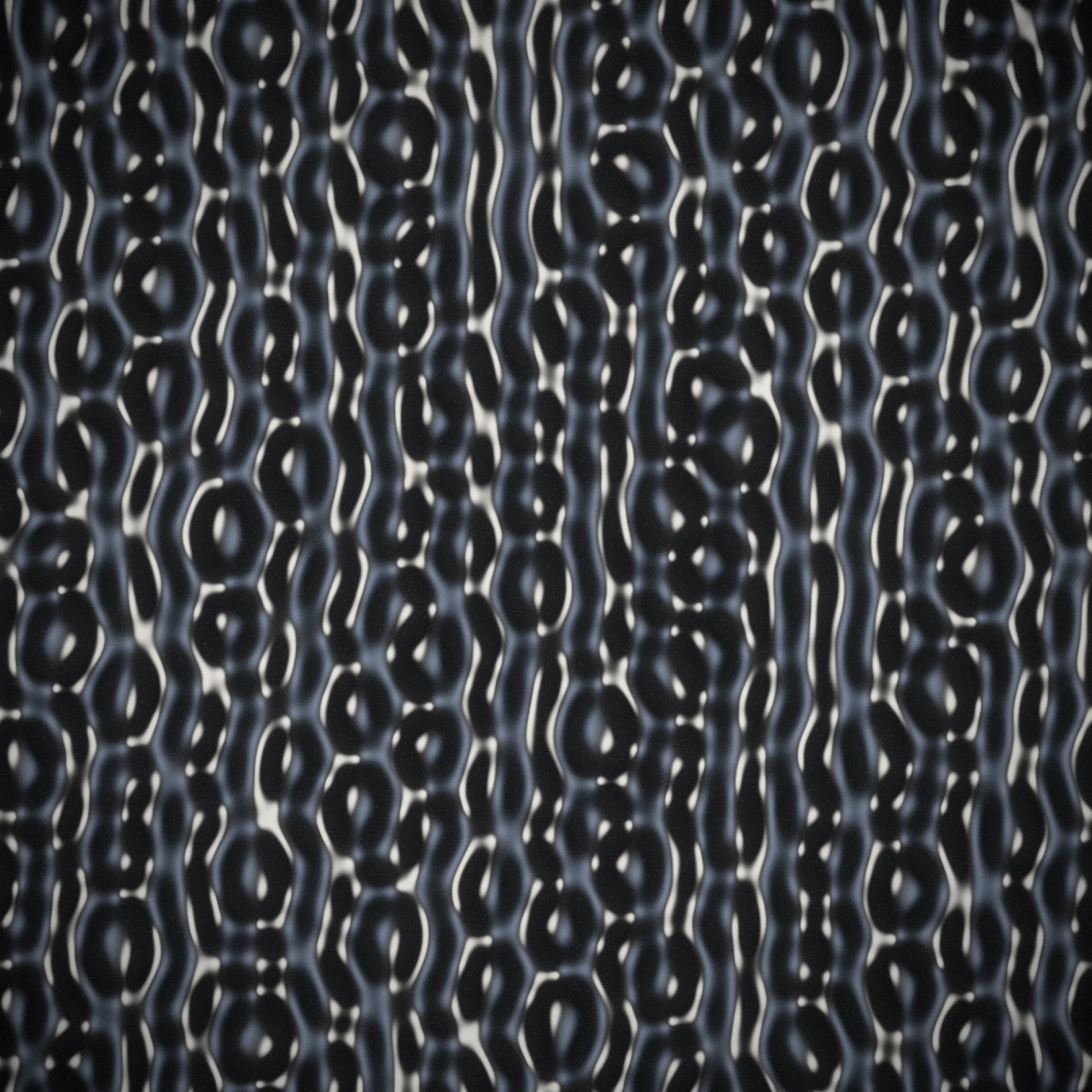
This is not a scientific simulation result, but a visual interpretation of the phenomenon.
SAME FAMILY, NOW DRIVEN
Chladni's plate is told its pattern by its edges. Faraday's liquid picks its own.
PARAMETERS EXPLORED
Each image below records its exact parameter set.
THE MATHEMATICS the model behind the images
One equation, once per surface mode. The shaking modulates gravity; every mode becomes a pumped, damped oscillator; the only waves that survive are the ones whose own frequency is exactly half the driving frequency.
A visual interpretation of the model, not a claim of scientific precision. The linear theory is exact; the saturation term — quadratic plus cubic in the slope u = k_c h — is a model, written in slope units so the saturated steepness stays comparable across drive frequencies. On the GPU the nonlocal dispersion operator is reduced to a polynomial in the Laplacian, exact at k_c, so the shader keeps the resonance in the same place.
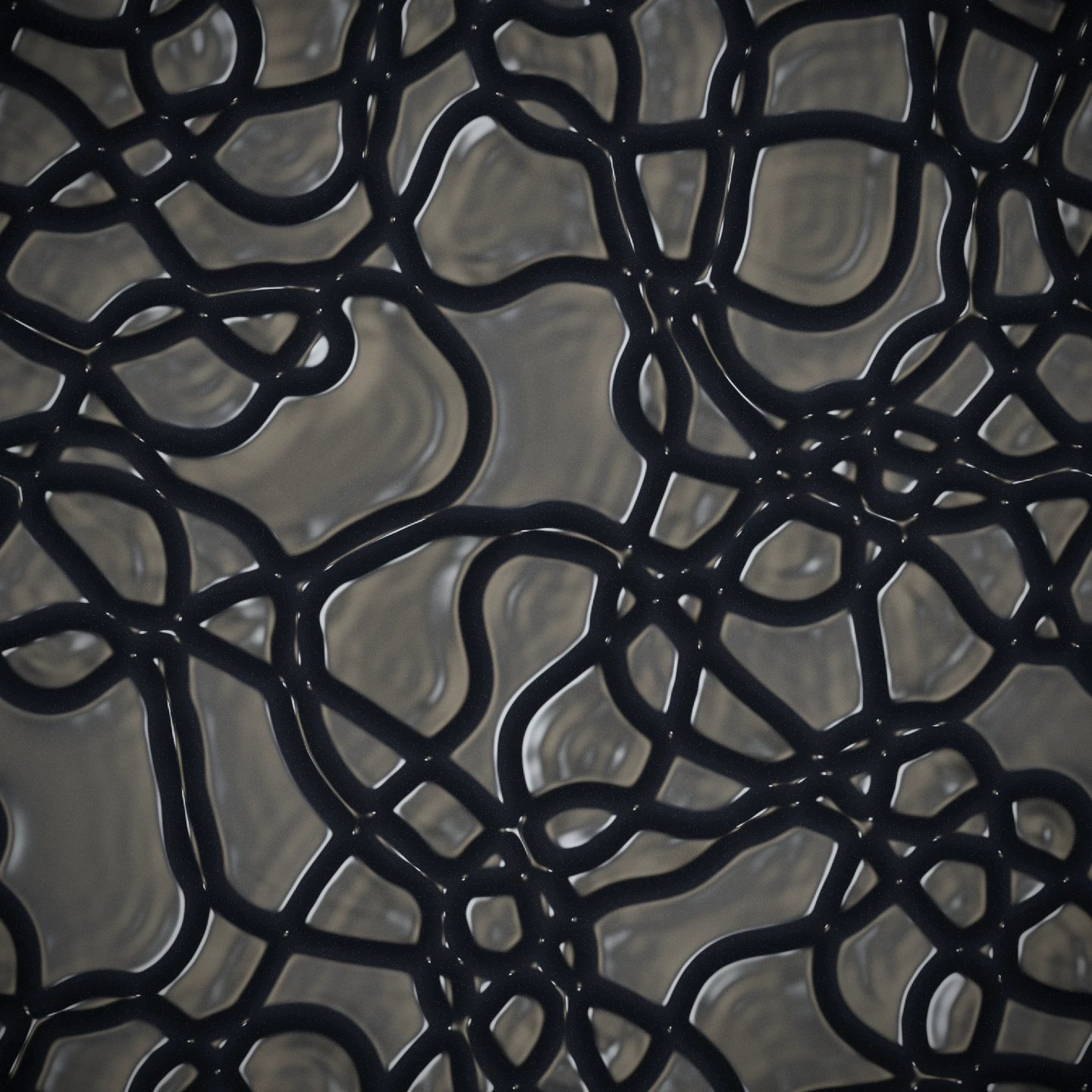
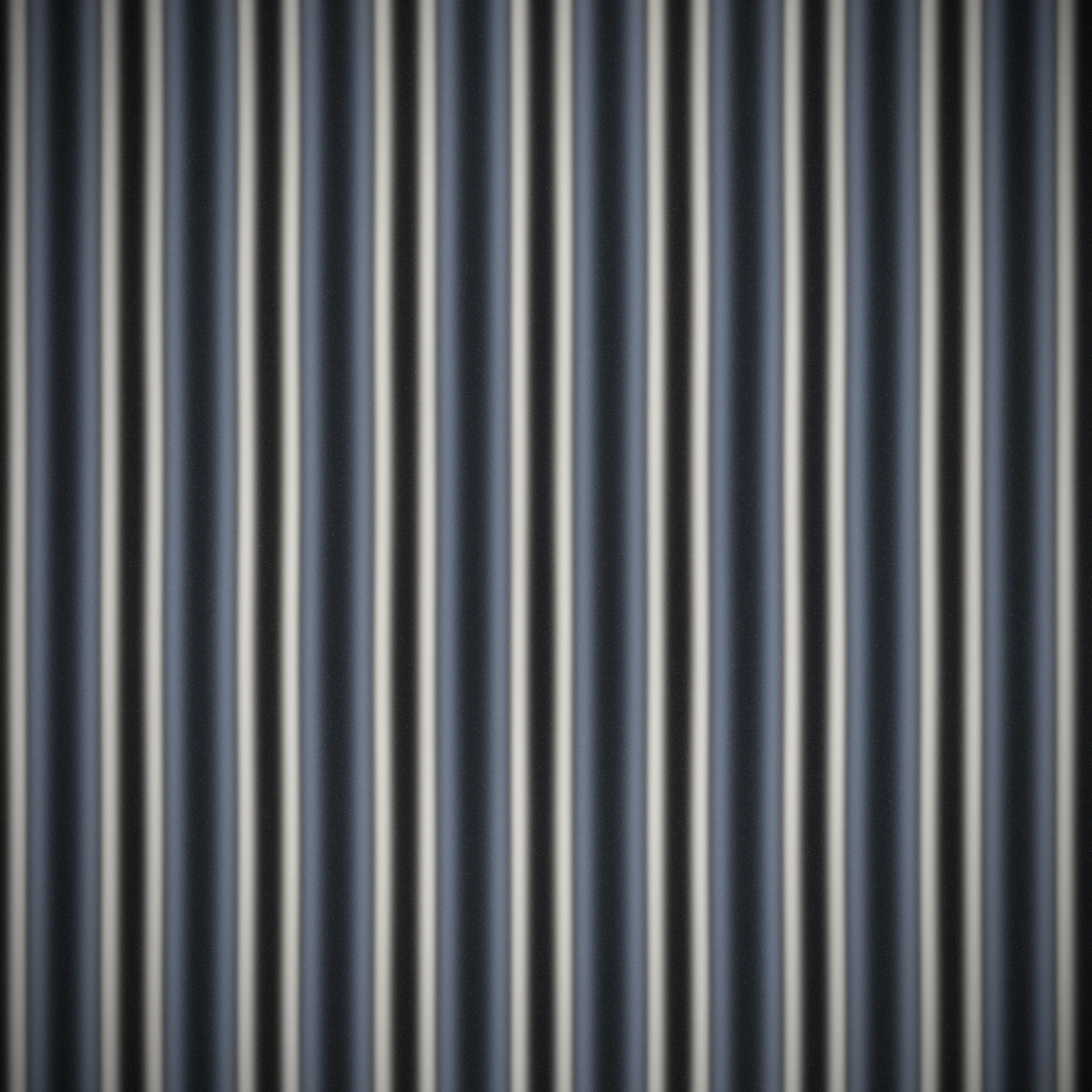
SELECTED STILLS — 4
SIGNATURE — THE HALF BEAT
Nothing in the setup contains a wavelength. The liquid picks it — and answers on every other shake.
The drive is one number going up and down, yet the surface refuses to follow its rhythm: the pattern needs two drive periods to come back to itself. In Floquet terms the dominant multiplier is a negative real number — measured μ = −1.055 here — so one period maps the surface onto minus itself: a period doubling. The saturated field's spectrum peaks exactly at ω/2, with eleven times more power at the half beat than at the drive in the Python engine, fifteen in the shader.
That answer was checked before any image was kept. The exact Floquet neutral curve closes onto the weak-damping analytic threshold monotonically as viscosity drops; the field's monodromy matrix reproduces the Mathieu equation's to 5.3e-6; and the wavelength that grows out of broadband noise lands on the dispersion prediction to about one percent across a 4.4× range of wavenumber. The threshold itself is razor thin: at 0.90 of it the field decays to nothing, at 1.15 it grows without bound — everything worth looking at lives between those two numbers.
COLOUR = A DARK MIRROR
The surface is a mirror, so the picture is not the pattern — it is the slope of the pattern, reflecting a dark room. That is also how the experiment is photographed: a Faraday cell is lit from the side and shot against black, because transmitted light washes the relief away. Every bright filament here is a place where the surface tilts just enough to bounce the lamp into the camera.
The palettes are grounded in real liquids through one number, the normal-incidence reflectance F0: mercury (~0.72) and gallium (~0.62) are metals and come back hard and neutral; ink, oil and milk are dielectrics (~0.03–0.05) and show almost nothing except at grazing angles, where Fresnel takes over and the edges light up. The lengths are real too: in these units 1 = the capillary length of water, 2.73 mm, and the study's home setting is a 27 Hz shake answering at 13.5 Hz with 17 mm cells.
These are artistic approximations of published optical constants, not measurements.
REFERENCES
- Michael Faraday. "On a Peculiar Class of Acoustical Figures; and on Certain Forms Assumed by Groups of Particles upon Vibrating Elastic Surfaces." Philosophical Transactions of the Royal Society of London, vol.121, 299-340 (1831).
- T. Brooke Benjamin, F. Ursell. "The stability of the plane free surface of a liquid in vertical periodic motion." Proceedings of the Royal Society A, vol.225, no.1163, 505-515 (1954).
- Wenbin Zhang, Jorge Viñals. "Pattern formation in weakly damped parametric surface waves." Journal of Fluid Mechanics, vol.336, 301-330 (1997).
- K. Kumar, Laurette S. Tuckerman. "Parametric instability of the interface between two fluids." Journal of Fluid Mechanics, vol.279, 49-68 (1994).
- W. Stuart Edwards, Stéphane Fauve. "Patterns and quasi-patterns in the Faraday experiment." Journal of Fluid Mechanics, vol.278, 123-148 (1994).
INTERACTIVE STUDY
Shake a dish of liquid straight up and down. Below a threshold the surface stays a mirror. Above it, a pattern appears — and it answers on every other shake: the beat readout ticks once per drive period, the surface completes its cycle every two. Nothing here chooses the wavelength — it follows from the liquid's own dispersion and the shake frequency you set, so a faster shake buys a finer wave, and shake strength is dialled in units of the surface's own threshold. It is a deliberately simplified instrument — purely cubic saturation, so it shows rolls, not the finished works' square lattices — capped at a 160² patch with a few curated knobs and no export, separate from the full engine used to author the finished works.
This interactive study is not intended as a scientifically validated reproduction. It is a visual interpretation generated from an implemented model and curated parameter exploration — and it is a deliberately simplified instrument, separate from the full engine used to author the finished works.