STUDY #31 · 2026 · IN OBSERVATION
Chemotaxis — The 8π Gate
A model-driven visual study of self-attracting crowds.
WHAT IS THIS
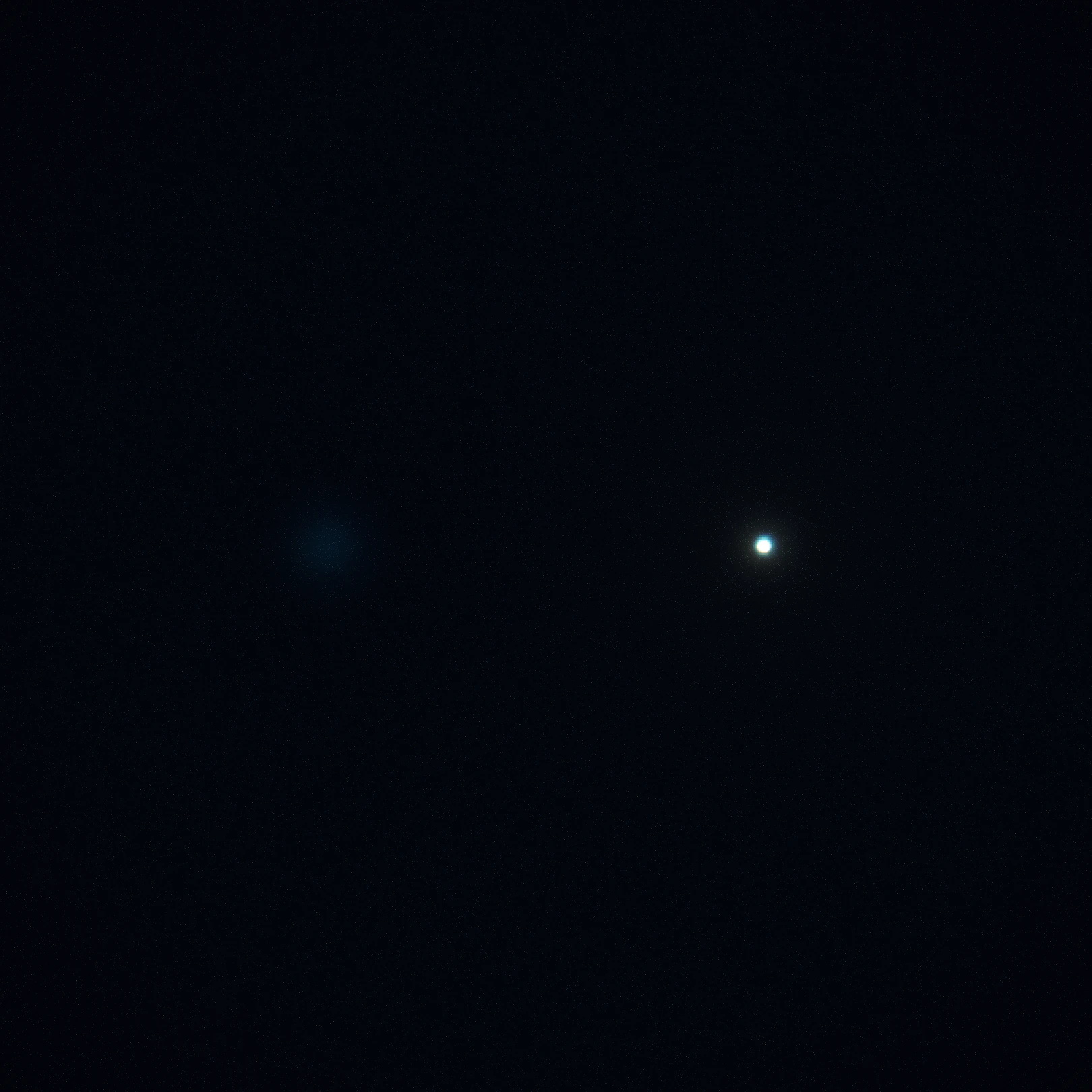
Bacteria and slime-mould cells secrete a chemical that attracts their own kind, then climb the gradient they made together. The crowd becomes a cloud with its own gravity. In two dimensions the outcome is a pure arithmetic of the total mass M: below 8π the cloud disperses, above 8π it collapses into a point in finite time — and exactly at 8π there is a single steady cloud, n(r) = 8/(1+r²)², that neither breathes out nor falls in.
The model is Patlak-Keller-Segel chemotaxis: a density that diffuses and drifts up the gradient of an attractant it secretes. This study runs a conservative lattice version of it in real time on the GPU — the sixth engine of the reaction-diffusion family here, and the first to carry an advection term: these patterns do not appear in place, they gather.
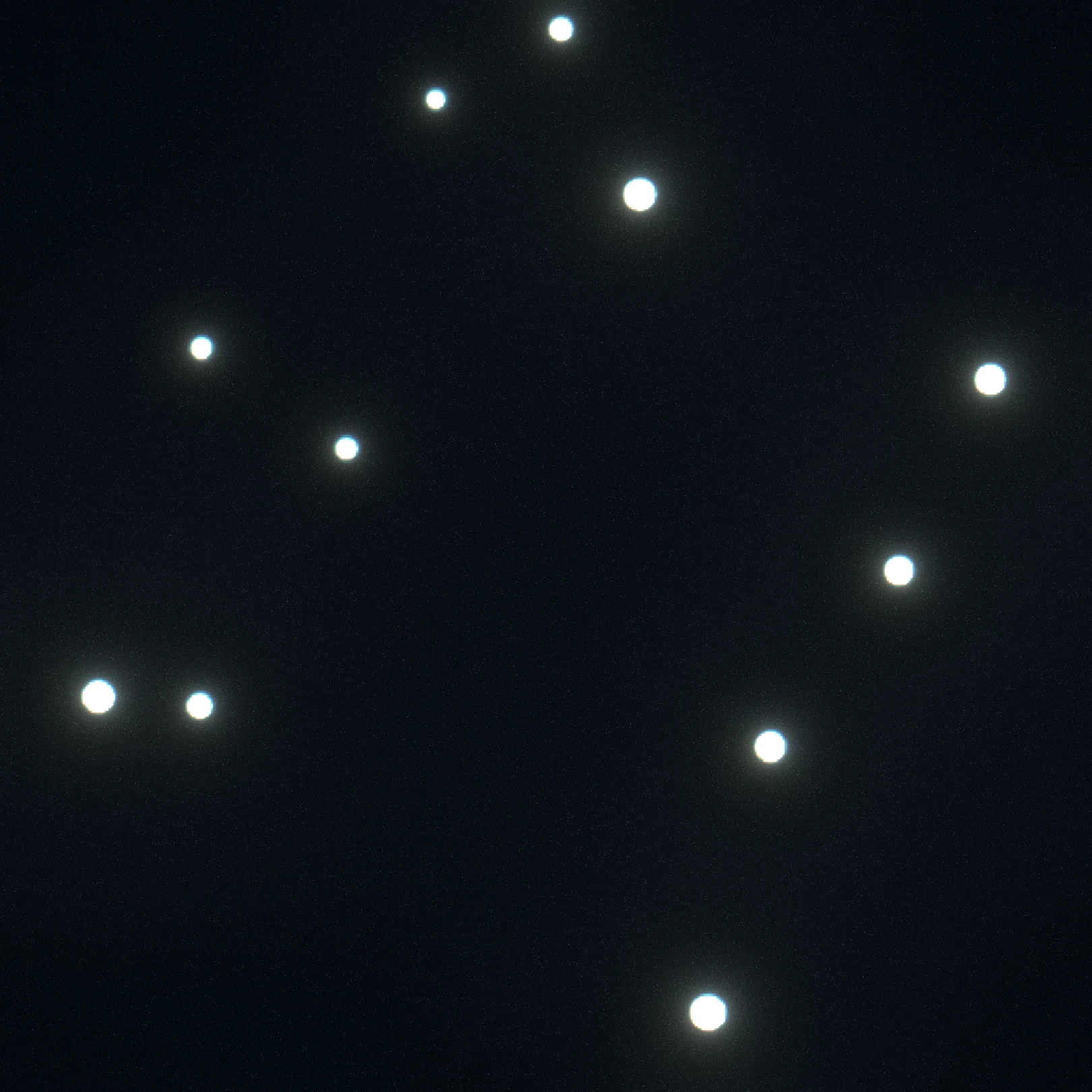
This is not a scientific simulation result, but a visual interpretation of the phenomenon.
SAME FAMILY, TIME REVERSED
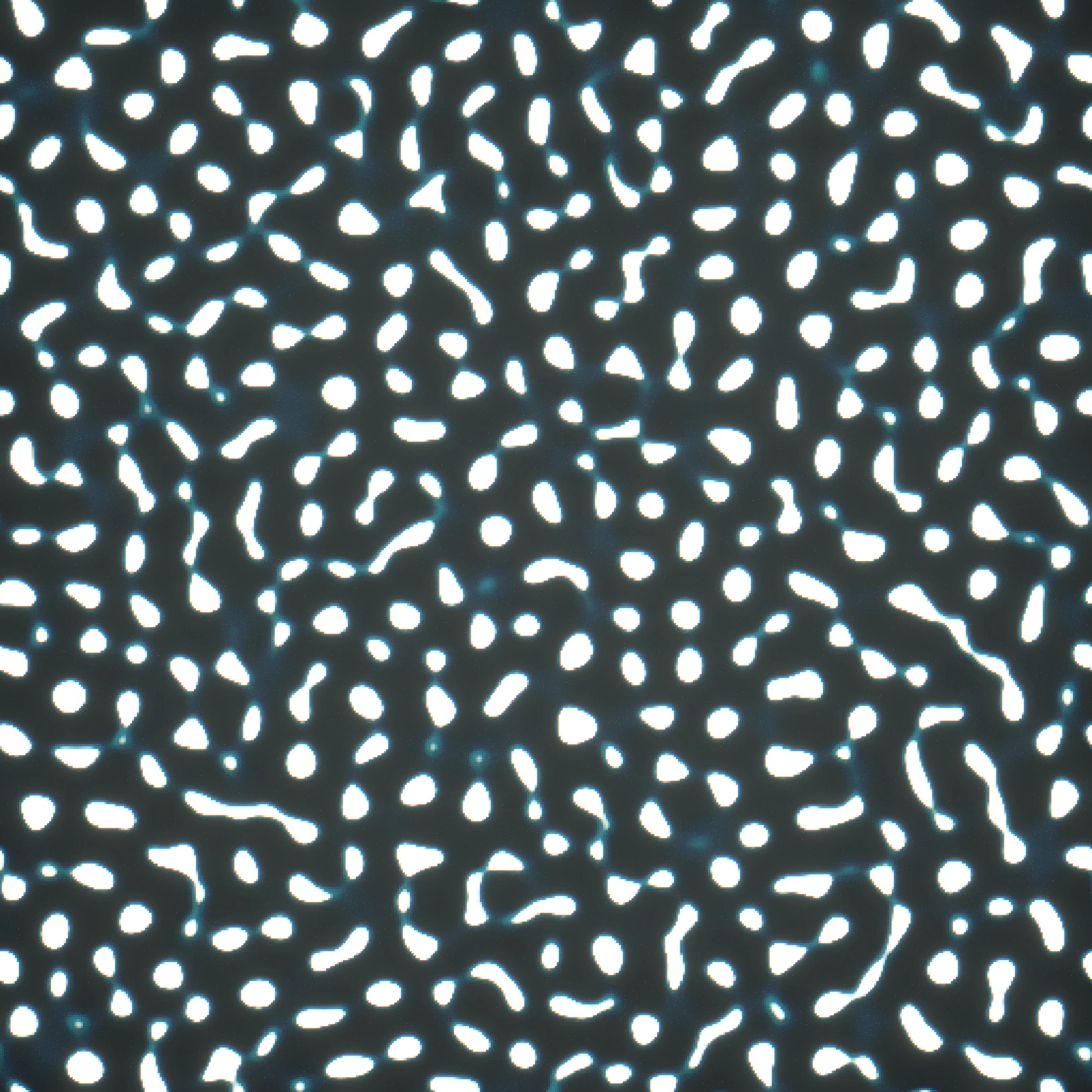
Gray-Scott's spots divide and multiply. These spots devour each other.
PARAMETERS EXPLORED
Each image below records its exact parameter set.
THE MATHEMATICS the model behind the images
Two lines for the theorem, one line for the verdict. The attractant relaxes instantly in the theorem model; the artwork engine lets it diffuse and decay, and caps the crowd so stars saturate instead of diverging.
A visual interpretation of the model, not a claim of scientific precision. The dispersion of the artwork lattice was verified mode by mode against the exact quadratic — using the lattice symbol K² = 2(1 − cos k), which the GPU shader shares term for term with the Python engine (Pearson 1.000000).
SELECTED STILLS — 3
PROCESS — PARAMETER SWEEPS
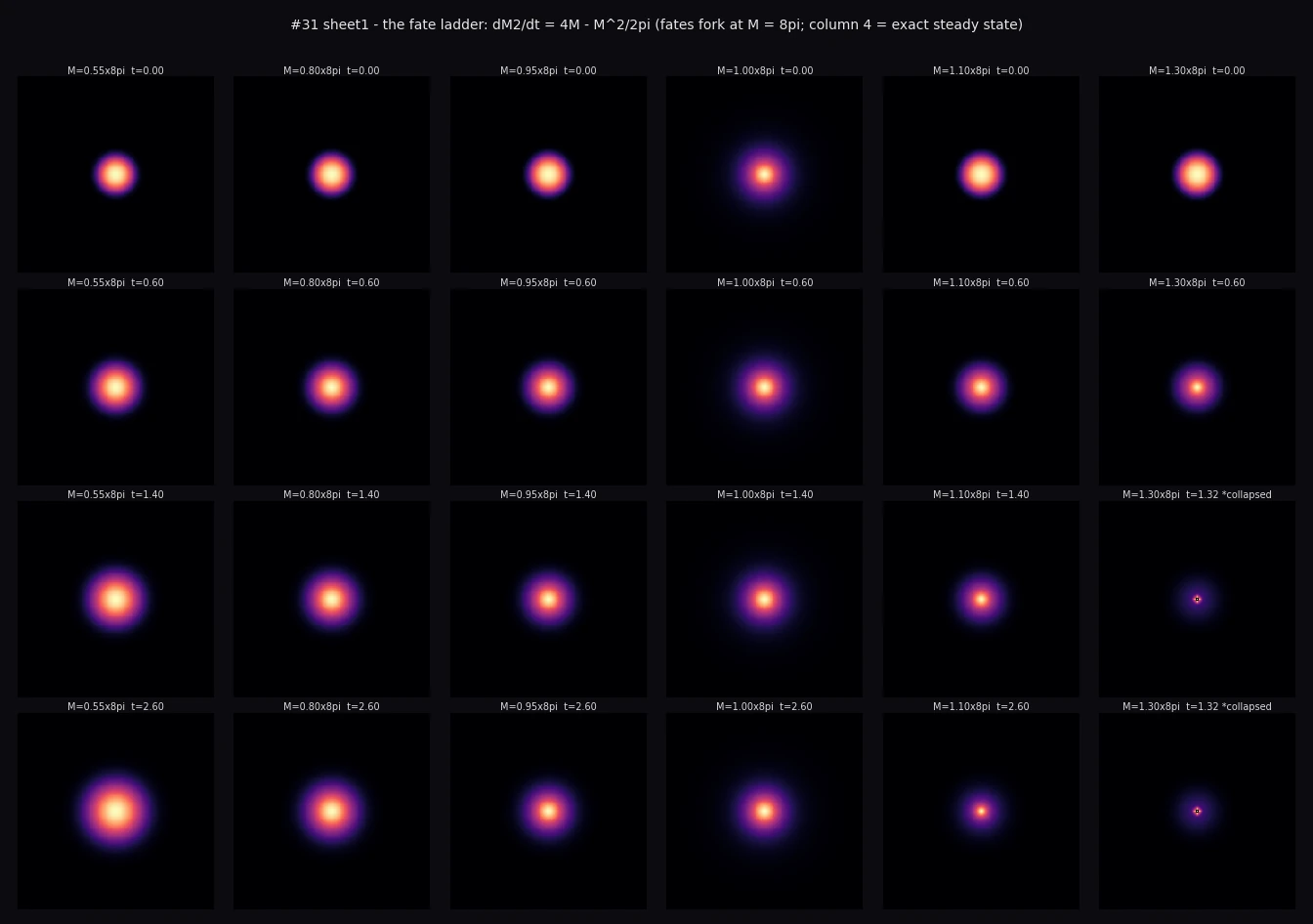
The fate ladder — the same cloud, its mass turned from 0.55 to 1.30 × 8π and nothing else changed. Up to 0.95 it slowly breathes out; the 1.00 column is the exact critical cloud holding its shape; 1.10 pulls inward; 1.30 has already collapsed to a point (marked *collapsed) before the second row. The whole story of this study in one contact sheet.
SIGNATURE — THE SCHEDULED LINE
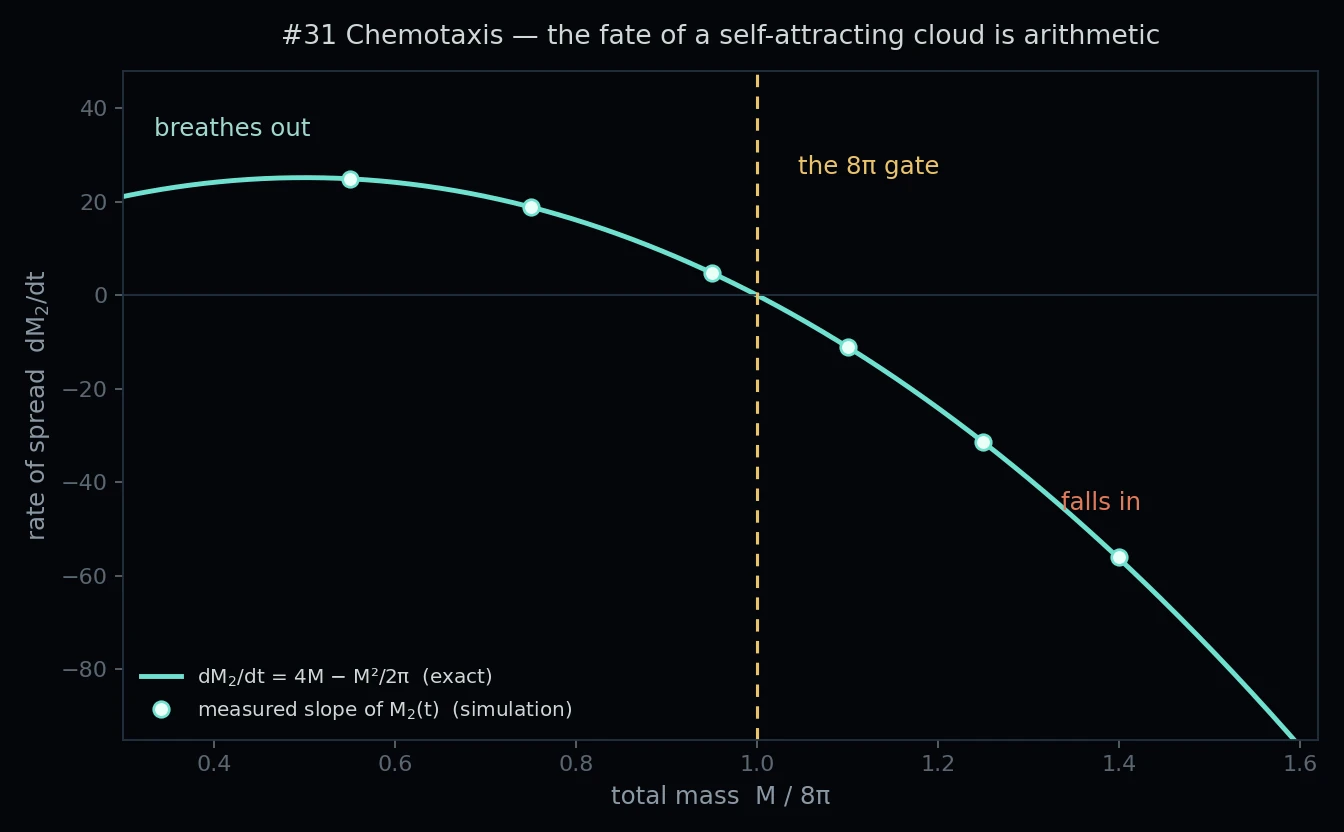
The verdict is arithmetic. A cloud's spread walks a straight line whose slope is written the moment the mass is known.
For the free-space model there is an exact identity: the second moment of the crowd — its spread M₂ — changes at the rate dM₂/dt = 4M − M²/2π, a number that depends on nothing but the total mass. The right-hand side crosses zero exactly at M = 8π: lighter clouds must spread, heavier ones must contract to a point in finite time. π decides the fate of a crowd.
The engine was held to that line before any image was kept: the measured M₂(t) stays straight to 7.3e-6, the fate boundary bisects to 7.94π ± 0.09π, and every collapse arrives before the deadline the line schedules (the virial zero-crossing) — falling in is always ahead of its own arithmetic. In the Interactive Study below, that gold dashed line is drawn ahead of the white measured trace, and the trace walks onto it.
COLOUR = DARK-FIELD BIOLUMINESCENCE
The palette is dark-field microscopy of a night sea: the void is deep indigo, thin crowds glow noctiluca teal — the bioluminescence of dinoflagellate blooms — and saturated cores go white-hot. Each star's halo has a physical radius: the screening length √(Dc/γ) of its own attractant, the edge of its chemical territory.
Variant palettes (luciferase amber, dark-field silver, GFP green, agar) re-image the same field the way different microscopes would. Gold is reserved for one thing only: the 8π gate.
All colours are artistic approximations of these observation contexts, not measurements.
REFERENCES
- Evelyn F. Keller, Lee A. Segel. "Initiation of slime mold aggregation viewed as an instability." Journal of Theoretical Biology, vol.26, 399-415 (1970).
- Clifford S. Patlak. "Random walk with persistence and external bias." Bulletin of Mathematical Biophysics, vol.15, 311-338 (1953).
- Elena O. Budrene, Howard C. Berg. "Complex patterns formed by motile cells of Escherichia coli." Nature, vol.349, 630-633 (1991).
- W. Jäger, S. Luckhaus. "On explosions of solutions to a system of partial differential equations modelling chemotaxis." Transactions of the American Mathematical Society, vol.329, 819-824 (1992).
- M. Mimura, T. Tsujikawa. "Aggregating pattern dynamics in a chemotaxis model including growth." Physica A, vol.230, 499-543 (1996).
INTERACTIVE STUDY
Pour mass into a cloud and read its future on a needle. This panel runs the exact radially symmetric reduction of Keller-Segel — the same equation the study used to verify the 8π dichotomy, so the gate here is arithmetic, not staging: hold the cloud until the needle crosses the gold tick and the same cloud that was breathing out starts falling in, exactly as the gold dashed line schedules. It is a deliberately simplified instrument, capped in resolution with a few curated knobs and no export, separate from the full GPU engine used to author the finished works.
This interactive study is not intended as a scientifically validated reproduction. It is a visual interpretation generated from an implemented model and curated parameter exploration — and it is a deliberately simplified instrument, separate from the full engine used to author the finished works.