PHENOMENA STUDIES WEAVER AXIOM
Studies Archive About
← INDEX

STUDY #32  ·  2026 · IN OBSERVATION

Standard Map

A model-driven visual study of the last invariant curve of a kicked rotor.

MOVING IMAGE — THE FLOOD ARC K 0.35 → 2.2 · dwell at K_c 0.9716 · 262,144 walkers · 18 dye bands · tidal

WHAT IS THIS

A kicked rotor is the simplest system that can be both orderly and chaotic at once: kick the momentum, let the angle drift, repeat. Because the rule preserves area, nothing is ever attracted anywhere — every orbit keeps its fate forever, and the picture is an atlas of all of them at once: invariant curves as coloured threads, resonance islands as closed eyes, chaos as a mixing sea.

The Chirikov standard map p' = p + (K/2π)·sin(2πθ), θ' = θ + p' is that system reduced to two lines. This study runs 262,144 dyed orbits of it in real time on the GPU — every walker coloured by the momentum it was born with, every step deposited into a shared exposure.
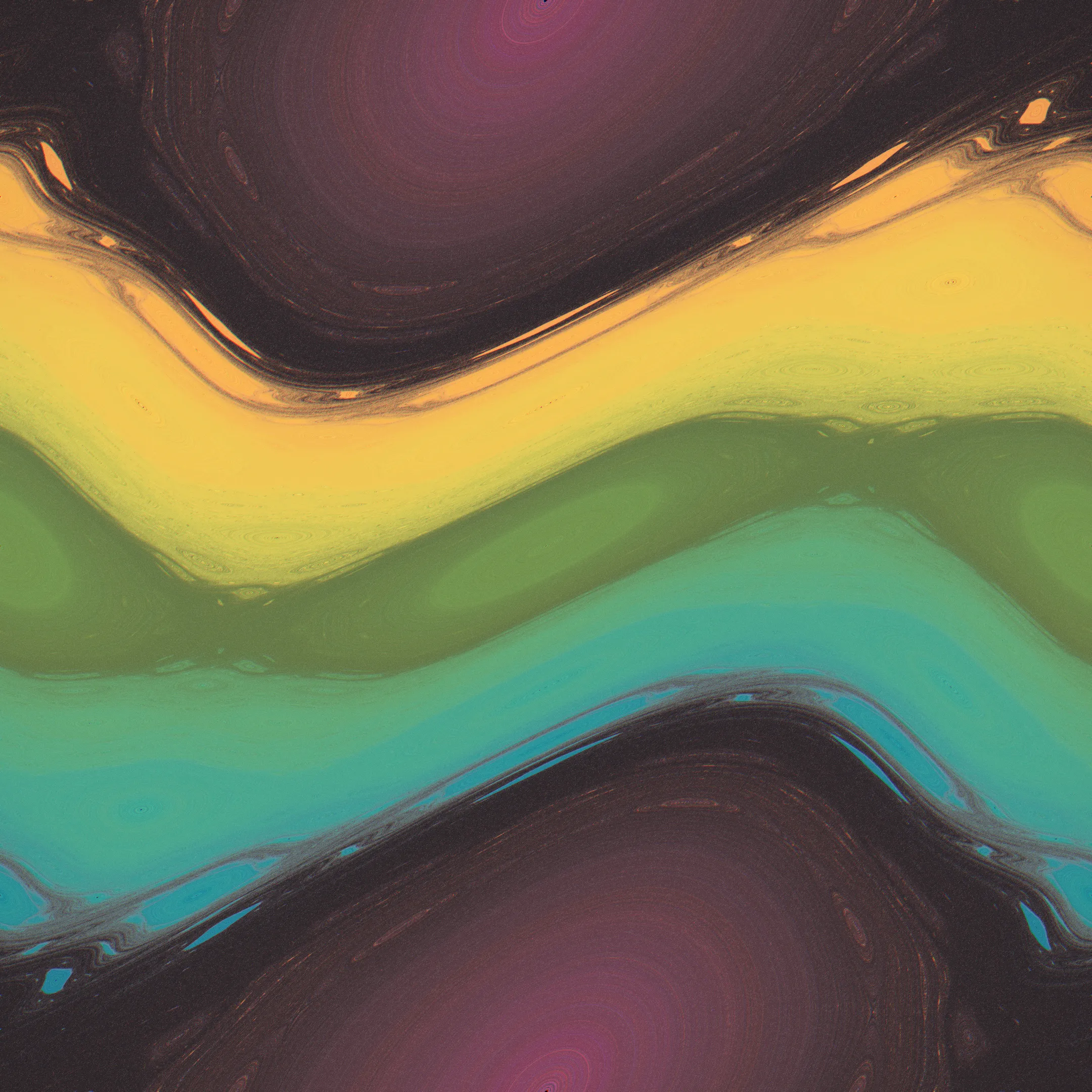
the last dike — K at Greene's constant, the golden curve still holding
the last dike — K at Greene's constant, the golden curve still holding K 0.9716 = K_c · 262,144 walkers · 300 f × 8 sub · 18 bands · tidal
Motif Chirikov standard map / KAM tori / golden-mean cantorus / chaotic transport
Method A small simulator was generated and modified with AI assistance, then ported to a real-time GPU (GLSL) renderer. The visual output was selected through parameter exploration.
Observation Dyed by initial momentum, a quarter-million conservative orbits sort themselves into a stained-glass atlas: the chaotic sea mixes hues into dark water while islands keep theirs forever. Ink poured into the sea climbs exactly to the golden curve (winding 0.382) and stops — until K passes Greene's 0.9716 and the last dike becomes a sieve.
Reference B. V. Chirikov, "A universal instability of many-dimensional oscillator systems," Physics Reports, vol.52, 263-379 (1979); J. M. Greene, "A method for determining a stochastic transition," Journal of Mathematical Physics, vol.20, 1183-1201 (1979).
Tools Python / NumPy / three.js / React / GLSL / ffmpeg / AI coding assistant
Year 2026

This is not a scientific simulation result, but a visual interpretation of the phenomenon.

SAME ENGINE, NOTHING FORGETS

de Jong draws the cloud that forgets its start. The standard map draws an atlas that cannot.

Study #21 — de Jong / Clifford Study #32 — Standard Map
The rule dissipative — every step contracts area conservative — area exactly preserved, det J = 1
Where orbits go every start falls onto the same attractor nowhere — no attractor exists; each orbit keeps its curve, island or sea forever
What colour means arrival — observables of the attractor (density, stretch, jump) origin — the momentum band an orbit was born in; mixing = losing your colour
What chaos leaves one cloud — the measure all memory dissolves into a mosaic of fates — rainbow shelves, island chains and a dark sea, coexisting

PARAMETERS EXPLORED

param meaning effect on the image
K kick strength — the one physics dial (K_c = 0.9716) 0.4 rainbow shelves ripple · 0.7 resonances braid · 0.9716 the last dike breaks · 1.4 flood · 2.2 archipelago · 6.5 accelerator comets
hue the initial-momentum band — dye, not decoration the sea mixes dyes to dark water, islands and curves keep theirs — mixing itself becomes visible
n_iter exposure (iterations per walker) curves develop into solid threads, the sea into an even haze
decay afterglow of the accumulation short = the living weave, long = the whole atlas burns in
jitter added noise — deliberately zero noise would tunnel the KAM dikes; the only perturbation is float32 rounding, measured harmless over 50,000 steps

Each image below records its exact parameter set.

THE MATHEMATICS the model behind the images

Two moves, iterated: kick the momentum, let the angle drift. Everything else — shelves, islands, dikes, floods — is consequence.

pn+1=pn+K2π sin⁡(2πθn),θn+1=θn+pn+1(mod1)p_{n+1} = p_n + \frac{K}{2\pi}\,\sin(2\pi\theta_n), \qquad \theta_{n+1} = \theta_n + p_{n+1} \pmod 1pn+1​=pn​+2πK​sin(2πθn​),θn+1​=θn​+pn+1​(mod1)
The Chirikov standard map on the unit torus — the physical kicked rotor I′ = I + K sin φ, φ′ = φ + I′ rescaled by θ = φ/2π, p = I/2π, so literature values of K carry over unchanged. K is the kick strength, the only physics dial.
det⁡J=1\det J = 1detJ=1
Area preservation, exact at every point (Liouville): no attractor, no forgetting. The map inverts in closed form, and the engine's round trip map∘inverse closes to 4.4 × 10⁻¹⁶ — the mosaic is not an approximation of permanence, it is permanence.
Kc=0.971635…,ωgold=5−12=[0;1,1,1,…]K_c = 0.971635\ldots, \qquad \omega_{\mathrm{gold}} = \tfrac{\sqrt{5}-1}{2} = [0;1,1,1,\ldots]Kc​=0.971635…,ωgold​=25​−1​=[0;1,1,1,…]
Greene's threshold: invariant curves die in order of how well ω is approximated by fractions, and the golden mean — the worst-approximable number — dies last. The engine's crossing-time fit returned K_c = 0.9835 (|d| = 0.012) with critical exponent η = 2.58 vs MacKay's ≈ 3.01.
D(K)=(K/2π)22 [ 1−2J2(K)+2J22(K)+⋯ ]D(K) = \frac{(K/2\pi)^2}{2}\,\bigl[\,1 - 2J_2(K) + 2J_2^2(K) + \cdots\bigr]D(K)=2(K/2π)2​[1−2J2​(K)+2J22​(K)+⋯]
Past the flood the deterministic map generates statistics: global momentum diffusion with Rechester–White's Bessel-function corrections, matched here to 0.3% at K = 9 and 0.1% at K = 15.5. Inside an island the Lyapunov exponent stays 0 while the surrounding sea holds λ ≈ ln(K/2) — two fates at one K.

A visual interpretation of the model, not a claim of scientific precision. What was verified is the eighteen-check battery and the four web parity protocols; K_c comes from finite crossing-time fits, and ergodicity of the sea is assumed only where measured.

SELECTED STILLS — 3
the last dike — silk shelves at criticality, the golden curve still walling the sea
the last dike — silk shelves at criticality, the golden curve still walling the sea K 0.9716 = K_c · 262,144 walkers · 300 f × 8 sub · 18 bands · tidal
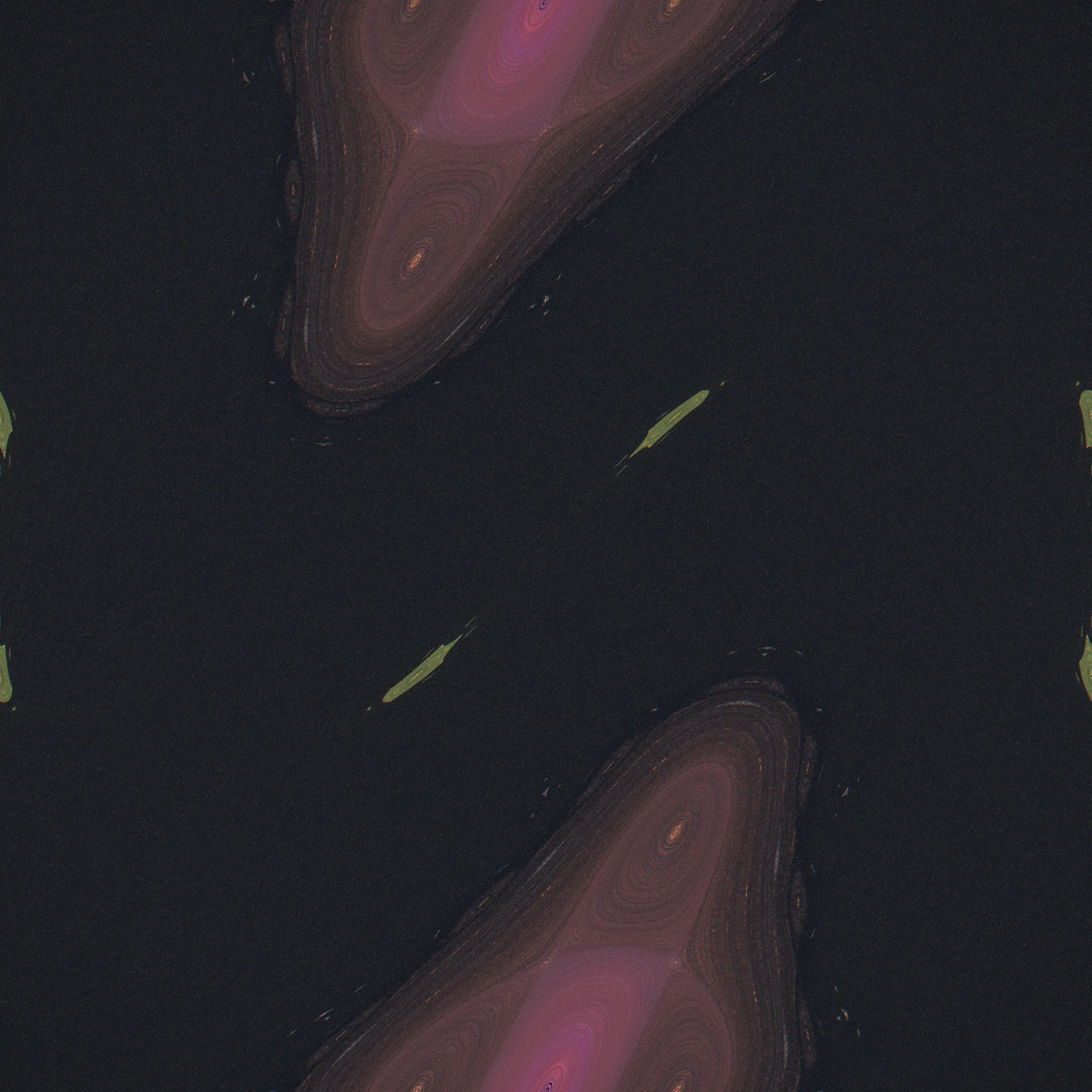
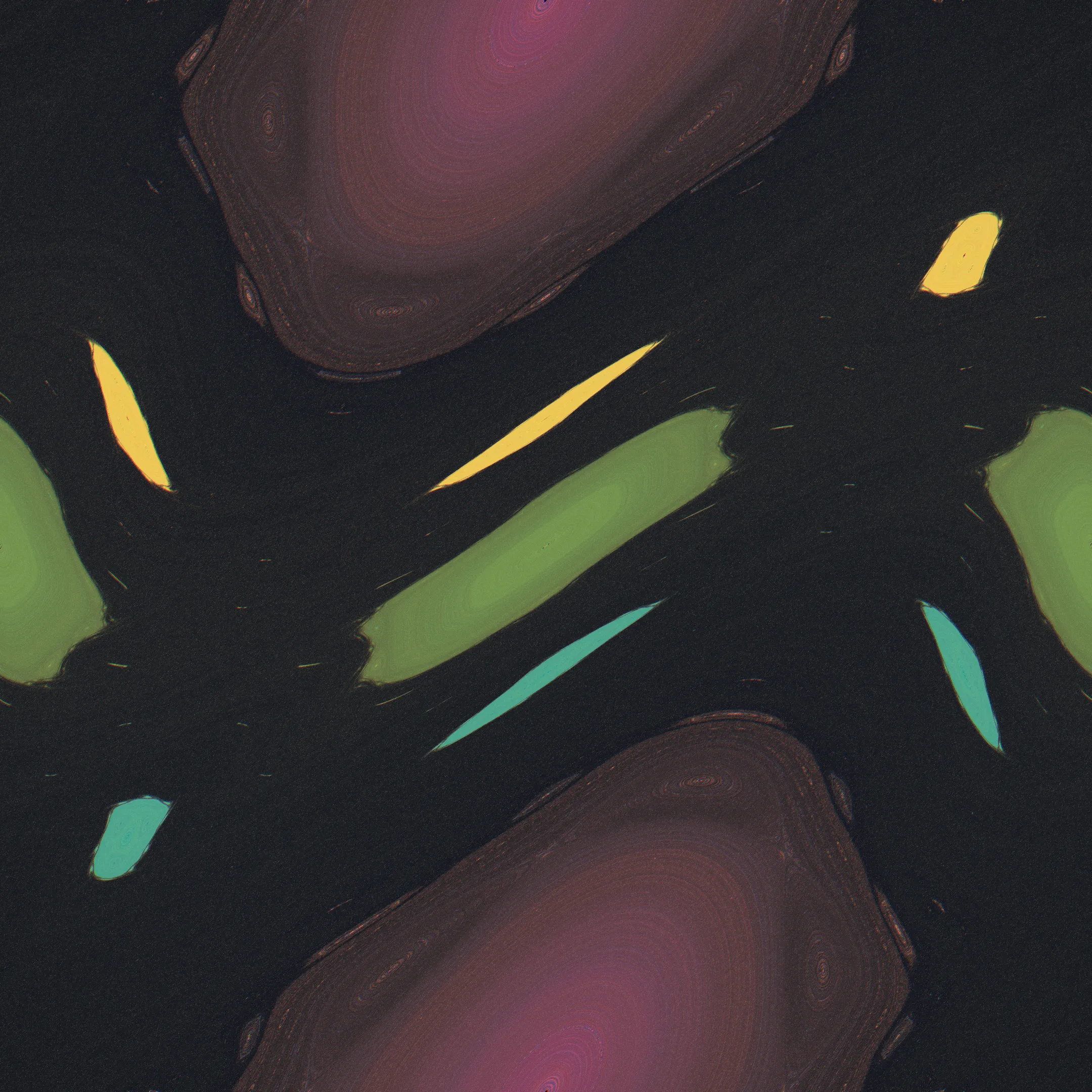
the flood — stained glass in dark water; island chains keep their colour inside the mixing sea
the flood — stained glass in dark water; island chains keep their colour inside the mixing sea K 1.4 · 262,144 walkers · 300 f × 8 sub · 18 bands · tidal
the archipelago — the great flood, and the islands that will not drown
the archipelago — the great flood, and the islands that will not drown K 2.2 · 262,144 walkers · 300 f × 8 sub · 18 bands · tidal

PROCESS — PARAMETER SWEEPS

The exploration ladder — the same dyed square kicked eight times harder, K = 0.4 to 5.0. Rainbow shelves ripple, resonances braid island chains into the stripes, the last dike falls at Greene's constant, the breach becomes a flood, and the flood leaves an archipelago: the sea mixes colours grey while every surviving island keeps its own.
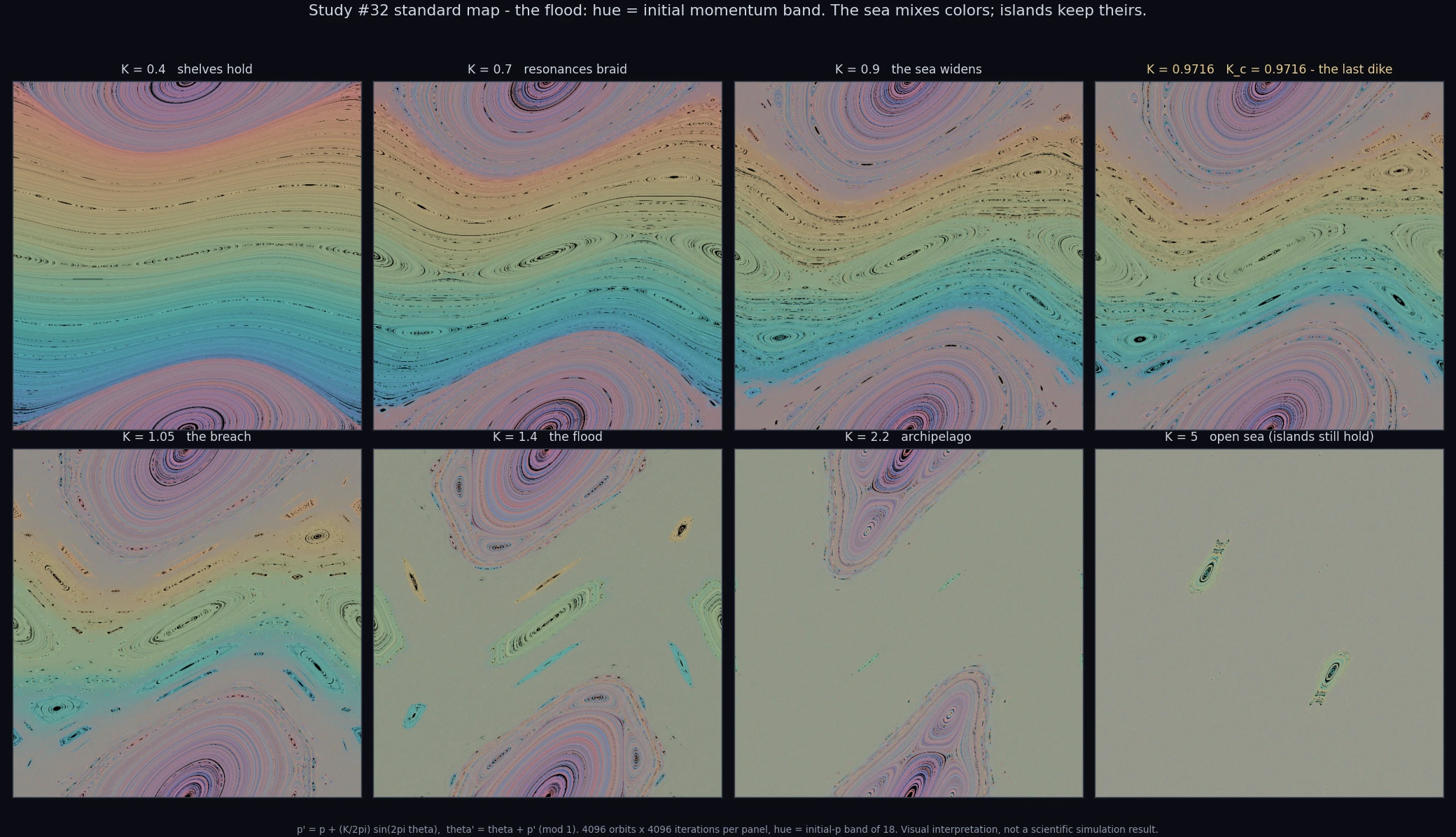
the K ladder — shelves · braid · last dike · breach · flood · archipelago · open sea
the K ladder — shelves · braid · last dike · breach · flood · archipelago · open sea K 0.4 → 5.0 · 4096 orbits × 4096 iter per panel · hue = initial-p band of 18

SIGNATURE — THE TIDE AND THE DIKE

The sea drowns rational shores first; the last dike is woven from the golden mean.

Chaos cannot cross a surviving invariant curve — a topological fact of area-preserving maps. Raising K kills the curves in order of how well their winding number is approximated by fractions: rational shores shatter first into island chains (Poincaré–Birkhoff), better-approximable irrationals follow, and the last survivor winds with the golden mean [0;1,1,1,…] — the number furthest from all fractions. Greene located its death at K_c = 0.971635…

This engine ran that story as an experiment: ink seeded in the central sea climbs the gauge and saturates exactly at the golden line, winding 0.382, for every K < K_c — then breaches and rises without bound. The crossing-time fit recovered K_c = 0.9835 (|d| = 0.012 from Greene) with exponent η = 2.58 against MacKay's renormalisation ≈ 3.01. It is the mirror of Study #28: in optics the rationals build the images; in dynamics the irrationals build the walls.
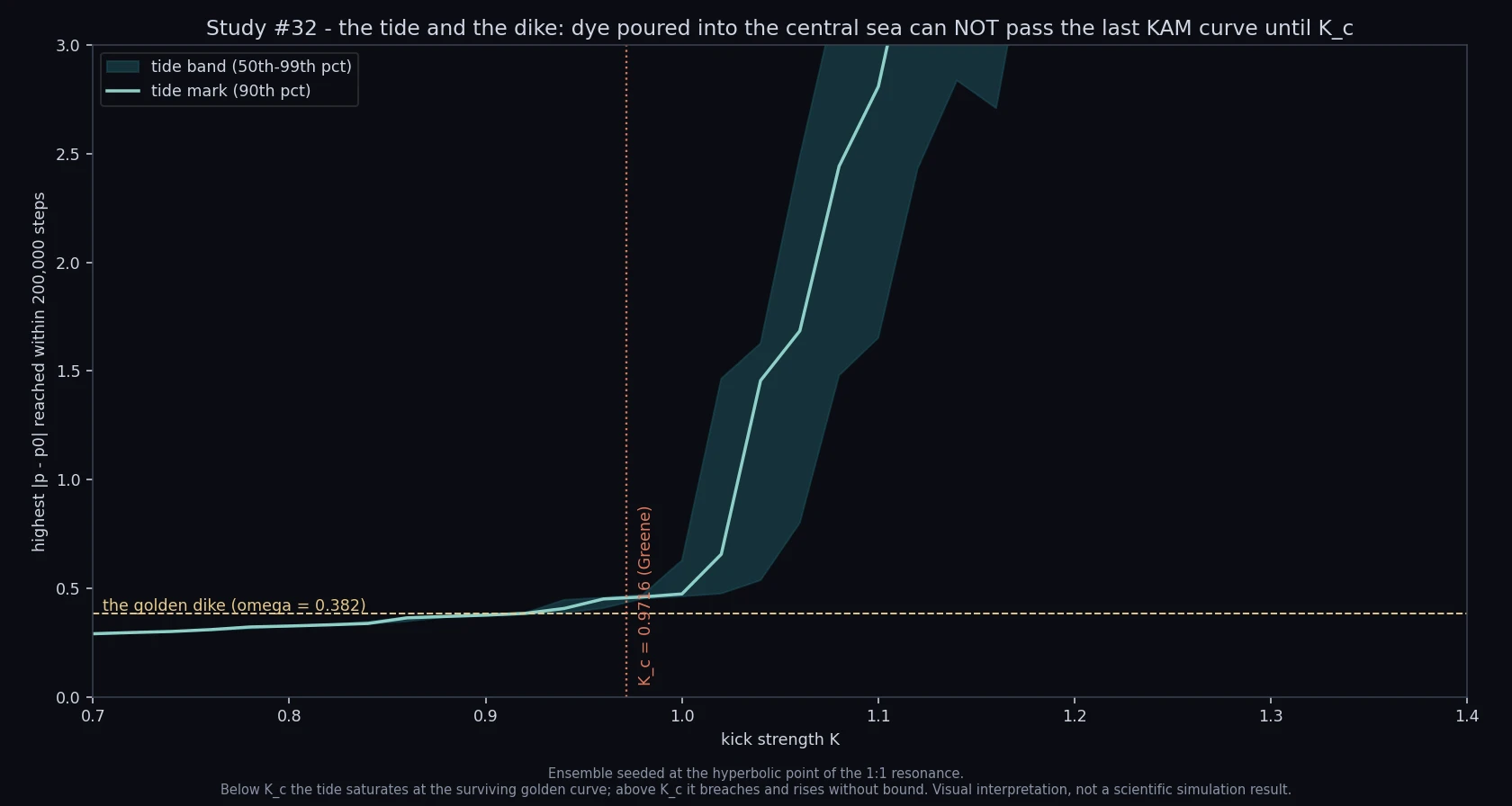
the tide and the dike — ink poured into the sea cannot pass the last KAM curve until K_c
the tide and the dike — ink poured into the sea cannot pass the last KAM curve until K_c 320 dye orbits seeded at the 1:1 hyperbolic point · 200,000 steps · tide saturates at ω = 0.382 · breaches past K_c = 0.9716

COLOUR = INITIAL CONDITION

Hue is not decoration here — it is an initial condition. Every orbit is dyed by the momentum it was born with, so colour survival IS the physics: where hues stay pure, an invariant curve still walls the flow; where they grey out, chaotic mixing has erased the memory. The dark water is literally the average of all dyes — the colour of forgetting.

Island cores burn brightest because area preservation traps their orbits on nested rings forever. The golden dashed line in the instrument below sits at winding number 0.382 = 1 − φ⁻¹: the real, measured position of the last invariant curve of this map.

the dark water is the average of all dyes — only the islands still remember
the dark water is the average of all dyes — only the islands still remember K 1.4 · purity display · 18 bands · tidal

The palette values are artistic approximations, not measurements.

REFERENCES

  1. B. V. Chirikov. "A universal instability of many-dimensional oscillator systems." Physics Reports, vol.52, no.5, 263-379 (1979).
  2. J. M. Greene. "A method for determining a stochastic transition." Journal of Mathematical Physics, vol.20, no.6, 1183-1201 (1979).
  3. R. S. MacKay. "A renormalisation approach to invariant circles in area-preserving maps." Physica D, vol.7, no.1-3, 283-300 (1983).
  4. A. B. Rechester, R. B. White. "Calculation of turbulent diffusion for the Chirikov-Taylor model." Physical Review Letters, vol.44, no.24, 1586-1589 (1980).
  5. J. Moser. "On invariant curves of area-preserving mappings of an annulus." Nachrichten der Akademie der Wissenschaften in Göttingen, II. Mathematisch-Physikalische Klasse, 1-20 (1962).

INTERACTIVE STUDY

A kicked rotor, reduced to two moves: kick the momentum, let the angle drift. Every walker is dyed by where it started, and because this map preserves area nothing ever forgets — coloured shelves are surviving invariant curves, the dark sea is where dyes have mixed. White ink poured into the central sea cannot cross a surviving curve: drag K across the K_c tick and watch the tide stop at the golden line, then thread the broken dike. Click the atlas to launch an orbit and read its rotation-number verdict. It is a deliberately simplified instrument, capped in resolution with a few curated knobs and no export, separate from the full engine used to author the finished works.

SIMPLIFIED INSTRUMENT · FLOAT64 · NO NOISECHIRIKOV STANDARD MAP · 4,096 DYED + 1,024 INK

This interactive study is not intended as a scientifically validated reproduction. It is a visual interpretation generated from an implemented model and curated parameter exploration — and it is a deliberately simplified instrument, separate from the full engine used to author the finished works.

← ALL STUDIES STUDY #33 · FERROFLUID — ROSENSWEIG INSTABILITY · IN OBSERVATION →
PHENOMENA STUDIES — WEAVER AXIOM PERSONAL VISUAL RESEARCH · © 2026