STUDY #33 · 2026 · IN OBSERVATION
Ferrofluid — Rosensweig Instability
A model-driven visual study of a liquid surface sculpted by a magnetic field.
WHAT IS THIS
A ferrofluid is a liquid that magnetizes: nanoparticles of magnetite suspended in oil, black because the particles absorb light across the visible band. Held flat under a growing vertical magnetic field, its surface stays mirror-still until a critical field strength — then it leaps, all at once, into a hexagonal lattice of spikes. This is the Rosensweig (normal-field) instability. The field sculpts the liquid without touching it: a spike gathers magnetic flux, and gathered flux raises the spike, while gravity guards the long waves and surface tension the short ones. The field first breaks through at exactly one wavelength between them — the capillary length sets the spacing of the thorns, about a centimetre in a real dish.
This study runs a volume-conserving gradient flow of the interface energy — gravity, surface tension, and the nonlocal magnetic term, the operator |k|, a half-derivative — in real time on the GPU, with the magnetic dial B as the only protagonist. In these units the critical values are exact numbers: B_c = 2, k_c = 1. And because the leap is subcritical, the spikes persist below the critical field on the way back down. The pattern remembers.
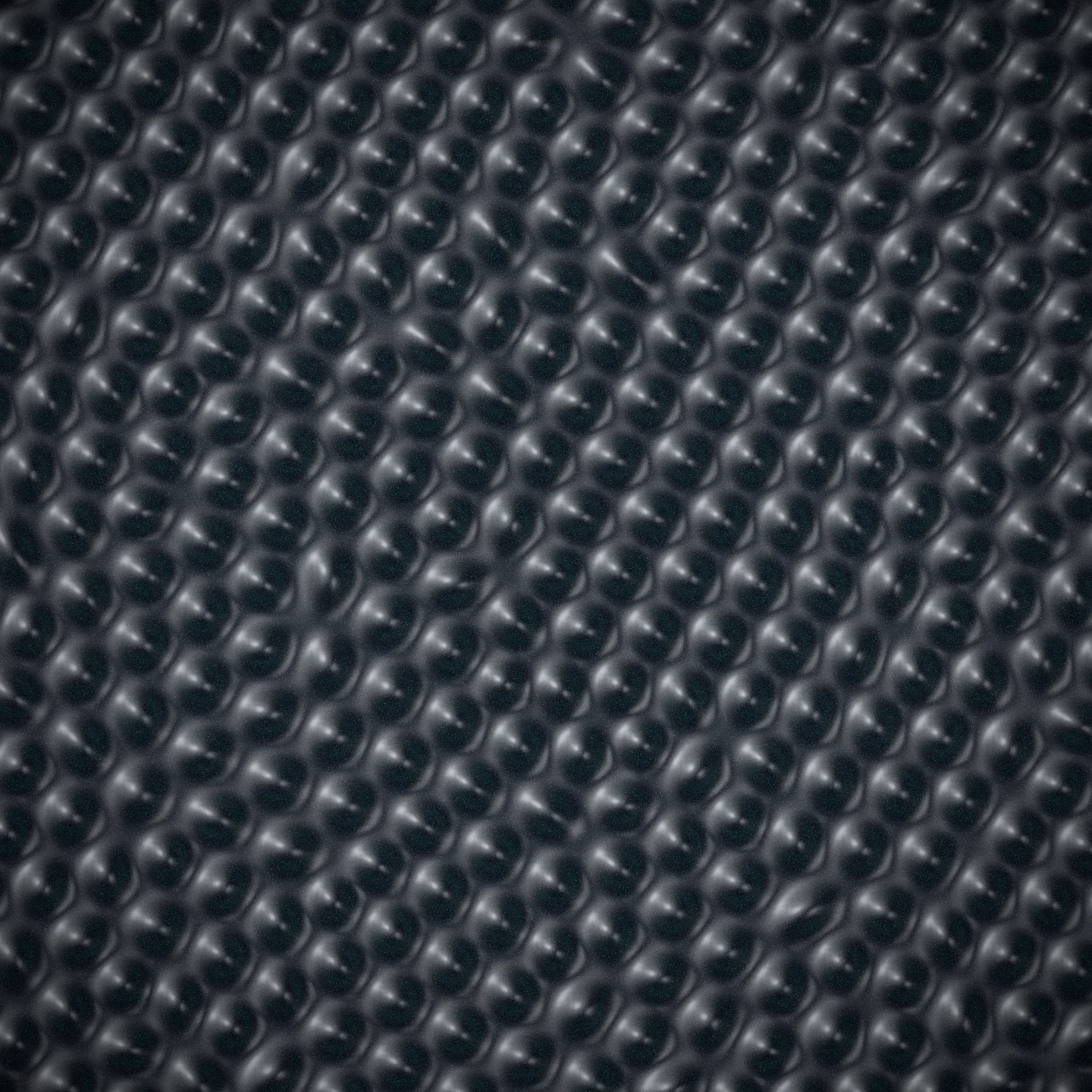
This is not a scientific simulation result, but a visual interpretation of the phenomenon.
TWO LIQUID SURFACES, A DIFFERENT CLOCK
Faraday's waves must keep dancing. Rosensweig's thorns stand still.
PARAMETERS EXPLORED
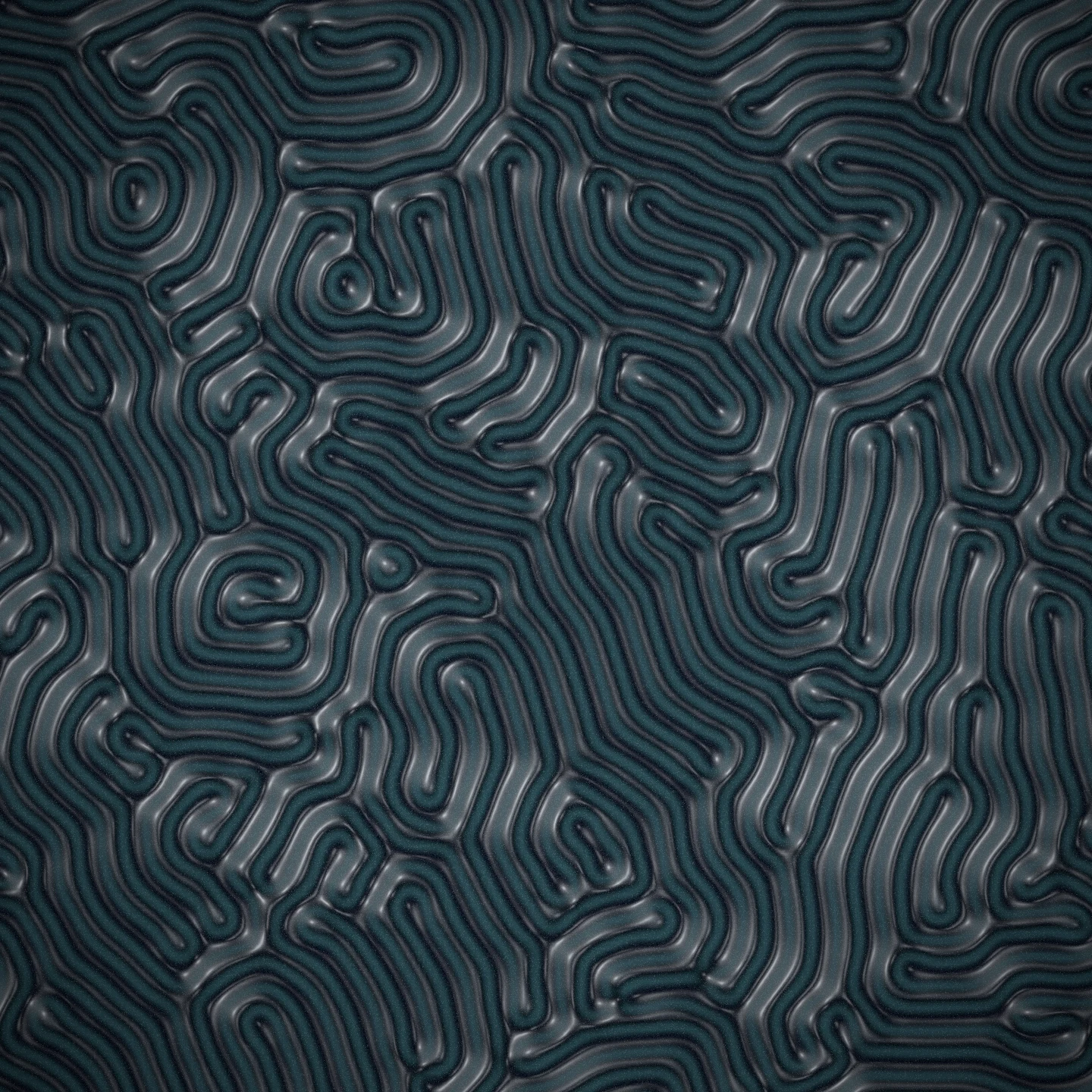
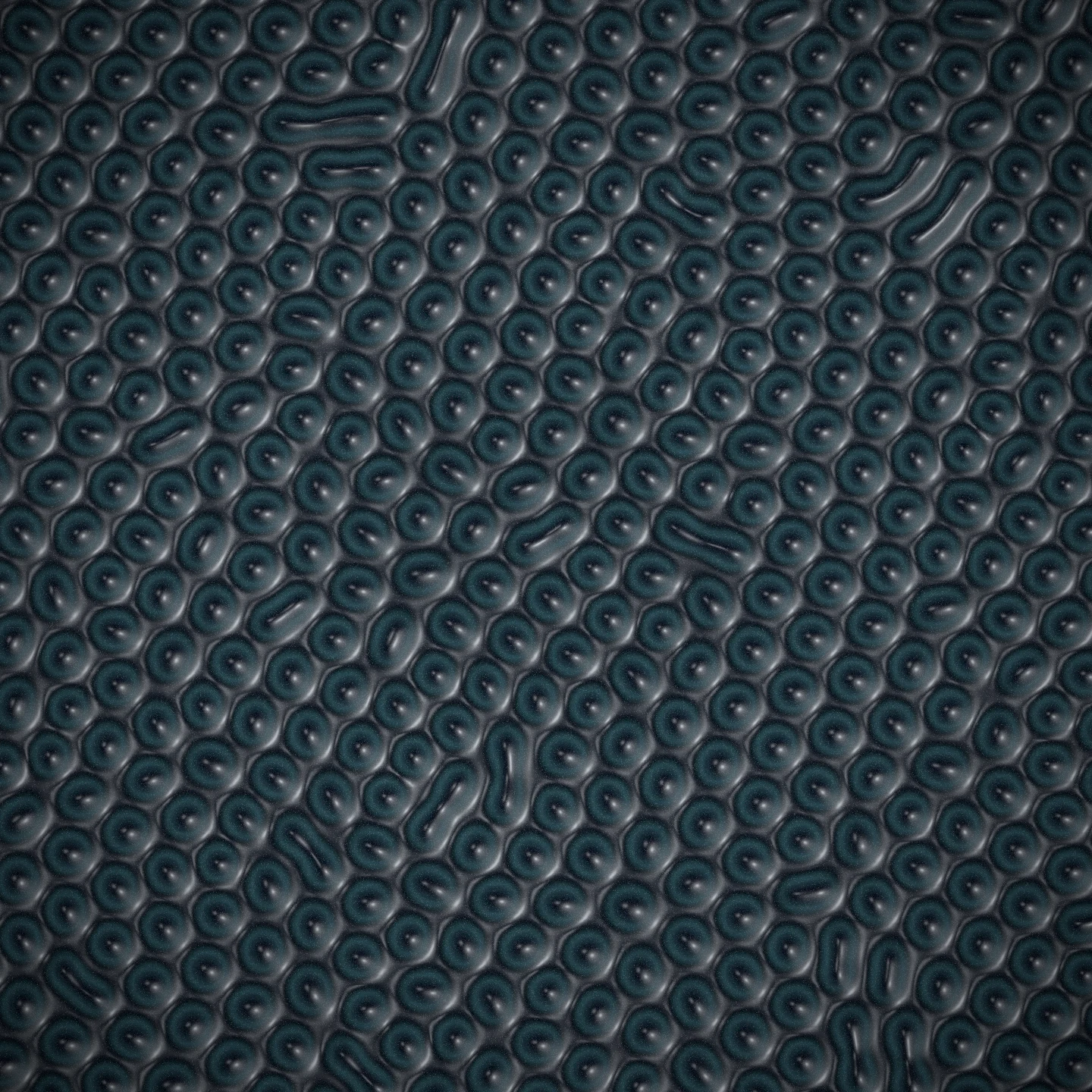
Each image below records its exact parameter set.
THE MATHEMATICS the model behind the images
The whole study is one energy and its steepest descent. The magnetic term carries the operator |k| — neither a derivative nor an integral, the half-derivative that a deep magnetizable liquid presents to its own surface.
The linear physics and the neutral curve are exact statements of the model; the amplitude equation is the standard weakly nonlinear reduction (Gailitis 1977), with the cubic coefficient renormalized by the adiabatically eliminated second-harmonic and difference modes.
SELECTED STILLS — 4
PROCESS — PARAMETER SWEEPS
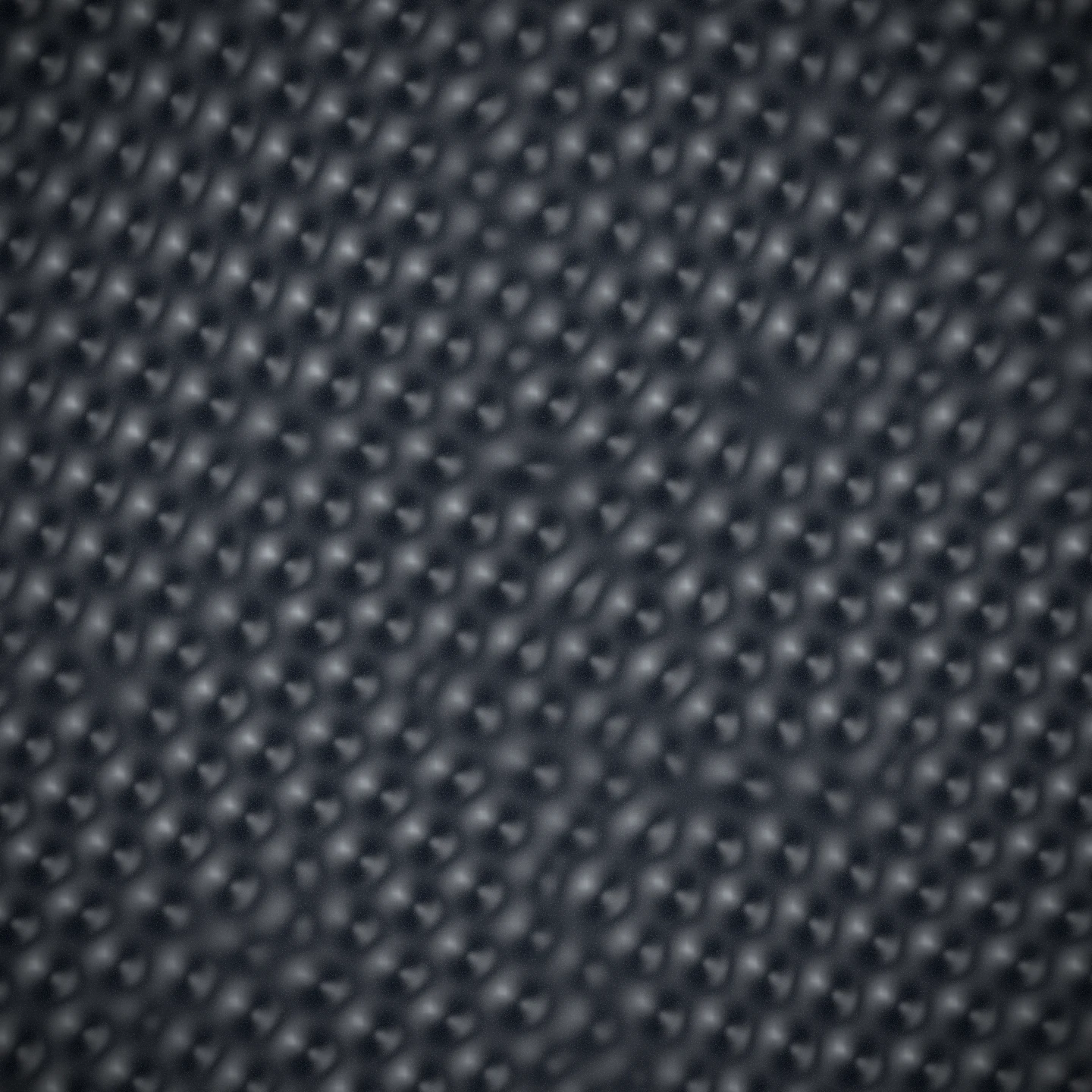
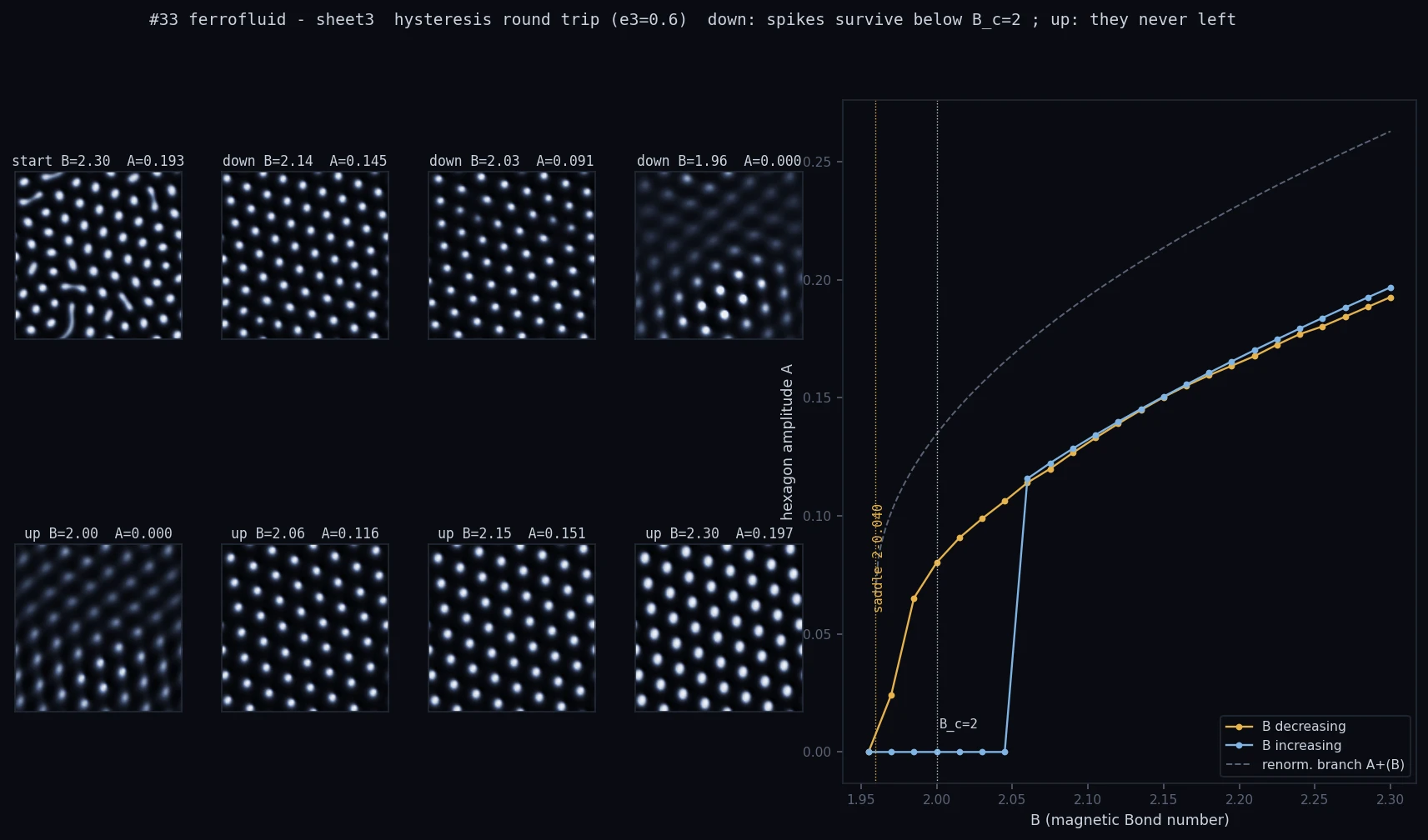
The measured round trip behind the film — hexagon amplitude A against the dial B at e3 = 0.6. The ascending branch hugs the floor and leaps at B_c = 2; the descending branch rides the upper solution past B_c and survives to the saddle at 2 − 0.040, tracking the renormalized branch A₊(B). The thumbnails are the surface's states along the loop: on the way down at B = 1.96 the lattice still stands where, on the way up, the same dial met a mirror.
SIGNATURE — THE MEMORY OF FORM
The way up and the way down are different roads.
The leap is subcritical. Up-down asymmetry — a sharp peak gathers more flux than a round valley loses — feeds the hexagons a quadratic term, and the bifurcation overhangs: below B_c a spiked solution coexists with the flat mirror. Raising the dial, the surface leaps at B_c = 2; lowering it, the thorns ride the upper branch past B_c and let go together only at the saddle B_sn = 2 − e3²/g_eff. Between the two roads lies the memory of form.
The film performs that loop. On the way up, at B = 2.008, the surface is a mirror (rms 0.005); on the way down at B = 1.998 — the same region of the dial — it still carries the full lattice (rms 0.238), and it holds through a long beat at B = 1.966 < B_c before the saddle takes it. The measured hysteresis width matches the amplitude theory only after the slaved harmonics are eliminated: the naive cubic overshoots by tens of percent, the renormalized one lands within 1%.
COLOUR = INTERFACE OPTICS ON A BLACK LIQUID
The liquid is painted black because ferrofluid is black: its magnetite nanoparticles absorb light across the visible band. Everything legible in the frame — the steel highlights, the cold rim, the zenith gleam on each crown — is interface optics on a mirror-dark skin, which is exactly how a real Rosensweig dish presents itself.
The spike spacing follows the capillary length √(σ/ρg) — about 1.6 mm for a typical oil-based ferrofluid, spikes about a centimetre apart — and the hexagonal packing, the stripe and honeycomb variants, and the hysteresis of the lattice are the model's own selections, not staged.
The colours are artistic approximations of the real material, not measurements.
REFERENCES
- M. D. Cowley, R. E. Rosensweig. "The interfacial stability of a ferromagnetic fluid." Journal of Fluid Mechanics, vol.30, 671-688 (1967).
- A. Gailitis. "Formation of the hexagonal pattern on the surface of a ferromagnetic fluid in an applied magnetic field." Journal of Fluid Mechanics, vol.82, 401-413 (1977).
- R. Friedrichs, A. Engel. "Pattern and spike selection in the Rosensweig instability." Physical Review E, vol.64, 021406 (2001).
INTERACTIVE STUDY
A magnetizable liquid surface under a vertical field. Below the critical field B_c = 2 every ripple dies; cross it and the surface leaps into a lattice of spikes. Now bring the dial back down — the thorns outlive the field that made them, all the way to the golden saddle below B_c, where they let go at once. The gauge under the plate draws that round trip live: the way up and the way down are different roads. Click the surface to plant a seed — inside the hysteretic window it grows a lattice from the point you touched. The |k| operator here is exact (a built-in FFT), so the threshold is real, not staged. It is a deliberately simplified instrument, capped at a 128² spectral field with a few curated knobs and no export, separate from the full engine used to author the finished works.
This interactive study is not intended as a scientifically validated reproduction. It is a visual interpretation generated from an implemented model and curated parameter exploration — and it is a deliberately simplified instrument, separate from the full engine used to author the finished works.